
View from Shumaymis Castle towards the plains

Raqqa, Gebäudeseite des Qasr al-Banat

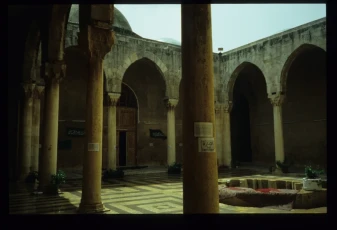
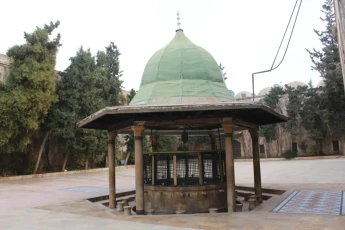
Jamiʿ (mosque) al-Hanabila - courtyard and ablutions basin

Citadel of Aleppo, courtyard of the Palace of al-Malik al-ʿAziz Muhammad

Palmyra, Baal-Tempel - Temenos Wand mit Propyläum und Blick auf die Oase

Gesamtsicht der Ruinen, das Diokletianslager im Vordergrund

Brücke über den inneren, mit Wasser gefüllten Burggraben, Krak des Chevaliers
[Original: Große Orientreise Nr.63 mit Rotel-Tours: Amman-Bagdad-Uruk-Babylon-Arbil-Mosul-Hatra-Samara-Mari-Dura Europos-Aleppo-Dayr Saman-Ugarit-Palmyra-Jarash]

Raqqa, a side of Qasr al-Banat

Afamiya, Südende der Kolonnadenstraße

View from Temple of the Standards
[Original: Blick von der Principia auf die Ausgrabungen (Principia = official places of the army officers)]

Ansicht eines antiken Hauses und eines Grabbaus, al-Bara

Waqf of Ibshir Mustafa Pasha, damage mapping (Arabic)
The waqf (endowment) complex of Ibshir Mustafa Pasha has suffered serious damage in several areas. This includes the khan on the north side and the eastern and western qaysariyya. Without removing the rubble, no final statement can be made about the extent of damage. Most likely, there was a total loss in the areas affected by the April 2015 tunnel bomb explosion. The western portion of the waqf complex, including its front facade, is still standing but is noticeably damaged. Two of the most important buildings of the waqf complex of Ibshir Mustafa Pasha survived: the mosque and the coffeehouse at the south. The uniquely decorated facade of the hall of the coffeehouse, as well as its first row of vaults, were destroyed. The core of the hall was only partially damaged, while the section of the central dome with its high lantern was, for the most part, destroyed.

Ruins of Qalʿat ash-Shugr wa-Bakas on the edge of a mountain slope

A Bedouin woman is weaving with a horizontal loom

Jamiʿ al-Mihmandar, dome of the prayer hall

Al-Bimaristan an-Nuri, Bogenfenster mit ornamental durchbrochener Gitterfüllung aus Stuck
[ Description by author: zum Innenhof. ]

View on the Euphrates river from Dura Europos
Blick von der Zitadelle Euphrat-aufwärts nach ~ Nordwesten.

Bayt Dallal, a part of courtyard and iwan
View at Liwan and the Diwanchane

Raqqa - Remains of the southern arcade of al-Jamiʿ al-ʿAtiq (Great Mosque)

Khan al-Wazir, view of the arcade in the first floor

Im Wohnbereich eines Zeltes, das in Patchwork-Technik bestickt wurde (siehe auch Foto #2850 und #2853)

Euphrates dam and Assad Lake in at-Tabqa

Waqf of Ibshir Mustafa Pasha, Coffeehouse, Ibshir Mustafa Pasha and bathhouse of Bahram Pasha facades
The facades of the coffeehouse of the Waqf Ibshir Mustafa Pasha (left part) and the earlier bathhouse of Bahram Pasha (right side) have an extensively decorated exterior, facing one another on the street that runs east-to-west at the south of the waqf complex, which became the most decorated public street space in Aleppo.

A side of excavated building in Tall Mardikh (Ebla)
shap_import_48438

As-Safira, an old thresher for shearing straw (darrasa)

Yabrud, Wohnhaus mit überdachter Terrasse (riwaq)

Interior view of Basilika A, ar-Rusafa
[Original: 1945 Geschenk Prof. Friedrich Sarre]

Raqqa, die Ruinen des Qasr al-Banat

Raʾs al-ʿAyn, streetview of a late ottoman residential house and a warehouse beside, situated on a slope
Behind the stone building in the front of the photo is situated the garden of the late Ottoman house.

Blick auf den Damm des Assad-Stausees des Euphrats mit Parkanlage
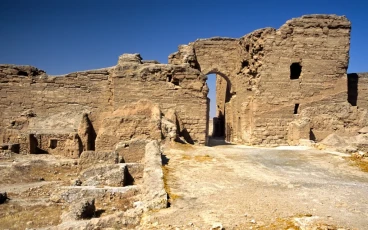
The northern entrance of the historical city of Dura Europos (Qalʿat as-Salihiyya), end of 4th century BC
Innenseite, gesehen von ~ Nordosten. Vgl. Bild 1607 !

Kirkbiza in the Dead Cities: A farmer ploughing his field with a metal plough, pulled by a mule and an ox.

Palmyra, the cella of Bel Temple
View from south west

Bab al-Maqam, ein Teil der Altstadtmauer

Qasr al-ʿAzm, Innenhof im Erdgeschoss

Gesamtansicht der Burg Najm (Qalʿat Najm)

Mnin, general view of Qalamun mountain and the houses scattered on its slopes
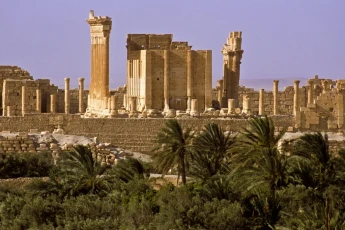
General view from the north, Temple of Bel
[ Description by author: Morgendlicher Fernblick auf die ~ Nordseite. Woher ? Nach der Google-Karte erscheint das Tetrapylon-Hotel als Standort am wahrscheinlichsten: das kenne ich aber von meinen Aufenthalten nicht. In der selben Gegend befinden sich aber das Tower Hotel und auch das Middle East Hotel: in beiden war ich. Vielleicht wurde auch eines der beiden umbenannt ? ['[Tetrapylon Hotel],'] ]

Mushabbak, byzantinische Basilika, Ziegenweide bei der Kirche
[Original: Dreischiffige Säulenbasilika, 2. H. 5. Jh., 18,5 x 13,8 m]

Afamiya, remains of the Great Colonnade (Cardo Maximus)

Jamiʿ Aslan Dada,, Innenansicht der Gebetshalle (qibliyya) mit Gebetsnische (mihrab)

Ruins of Qalʿat ash-Shugr wa-Bakas on the edge of a mountain slope

Remains of Diocletian Baths
[ Description by author: mit dem Becken (Stufen !) und seinem Peristyl. Ganz links die Nordwest-Ecke des Peribolos des Bel-Tempels, weiter rechts der Monumentalbogen von innen, im Bogen die arabische Bastion. Ganz rechts das Propylon der Thermen. Gesehen von ~ Nord-Nord-West. ]

Damascus, Muqarnas above the gate of Khan Asʿad Basha al-ʿAzm

Burj as-Saʿa, general view

Blick auf einen ruinösen Überrest der Burg Shayzar

Tartus, Fenster über dem Portal der Kathedrale Notre Dame de Tortosa (heute Museum Tartus)
[Original: "Kathedrale Nôtre-Dame, zwei Fenster über dem Portal und ein krönendes drittes Fenster werden von eingestellten Säulen und Archivolten gerahmt"]

Izraʿ - Kanisat (church) Mar Jirjis - section of the facade and the dome

Application of the relief paste of a ‘Ajami decoration
Workshop of Abdelraouf and Ziad Baydoun in Malaysia

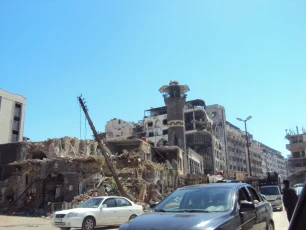
Qunaytra, A general view shows remnants of destroyed buildings

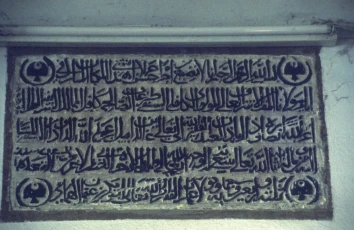
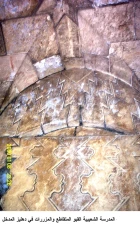
Al-Madrasa al-Muqaddamiyya, an inscription above the entrance gate

Bludan houses overlooking the Zabadani plain

Bayt Wakil, Qaʿa, Aufriss Hoffassade der Empfangshalle
Elevation drawing. No scale

Tall Dahab, Bedding pile in the family's living and storage room
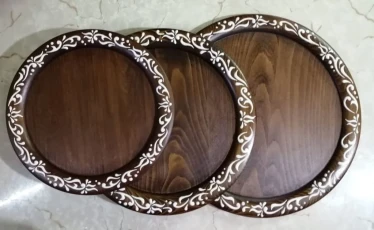
Aliya Alnuami

Raqqa, Qasr al-Banat, clay decorations

Bayt Ghazala, courtyard, southern facade - iwan

Sahat al-Marja, Ansicht des Platzes zu Beginn des 20. Jahrhunderts
[Original:'Damaskus: Telegrafendenkmal']. Die bayerische Luftwaffen-Division 304b war vom 25. Oktober 1917 an in Palästina stationiert. Sie war am Ersten Weltkrieg beteiligt, bis die Division Mitte September 1918 die Region über Aleppo verließ. Während dieser Zeit wurden über 3000 Glasfotos, meist aus der Luft, gemacht. Diese frühen Fotografien waren wichtig für die archäologische Forschung in der Region des Nahen Ostens.

Jamiʿ al-Mihmandar, the entrance half dome

Al-Madrasa ash-Sharafiyya, western facade

Ansicht der Burg von Masayf

Maʿlula St.Tekla Kloster am Tag des Heilig-Kreuz-Festes am 14. September

Mosque, interior view with mihrab and minbar.

A modern residential neighborhood in Aleppo
A view of a modern neighborhood in the city of Aleppo on a cold winter day.

Bimaristan an-Nuri, small iwan
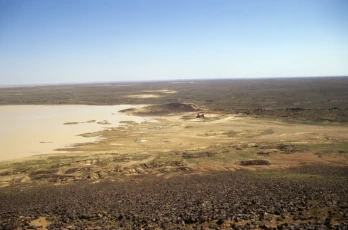
Al-Khubra lake in Jabal Says

Khan as-Sabun, Fenster und Dekoration über dem Eingangsportal

Figurine of a lion on the fountain edge, at-Takiyya as-Sulaymaniyya
[ Description by author: Der Löwe von Bild 0124 von der anderen Seite. ]

Fernblick auf das syrische Küstengebirge

Bayt Ghazala, fountain in the main hall (qaʿa)

View from the north to the middle overbuilt part of the suq (bazaar) of Khan al-Harir (right)

Northwest corner of Mushannaf Temple with the artificial pool in the foreground

Monumentalbogen, ornamentale Details
[ Description by author: - wo genau ? ['Monumentalbogen, ??/??/2002'] ]

Palmyra, Sarcophagus, Camp of Diocletian
[ Description by author: in der Nähe des Fahnenheiligtums. [' 26/03/2002 (?)'] ]

Hammam (Bad) ʿAbd al-Basit, vom Platz al-Jisr al-Abyad aus gesehen

Qasr al-Hayr al-Sharqi, The western enclosure, view from inside

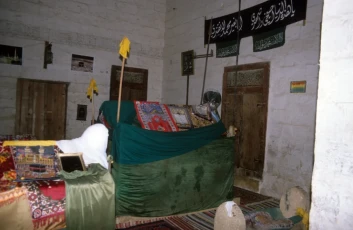
ash-Shaykh Khalid an-Naqishbandi-Mausoleum am Qasiyun Berg
Turbat ash-Shaykh Khalid an-Naqishbandi Beschriftung auf der Rückseite des Photos ['F 80. Wulzinger-Nachlaß WU F80']

ar-Rusafa, view into a conche of the Tetraconch-Church

Baalshamin Temple, view from east

Gräber auf dem Jabal ʿAruda

View from the monastery entrance, northwest of Palmyra, Jazil
[ Description by author: Blick etwa vom Klostereingang. Zu sehen ein Wasserkanal und hinten rechts davon ein Becken, vgl. Bild 0896 ! ]

Al-Jisriyya Norias (Wasserräder) in Hama
Dieses Ensemble von Norias wird al-Jisriyya genannt und gilt als das größte, berühmteste und schönste der Stadt Hama.

Raqqa, Grundriss der abbasidischen Großen Moschee
[original:' Raqqa, Große Moschee']. [84/27/322 a] =[ photo's name as: year/ film no./ photo no,].

Ecological and botanical garden near Damascus citadel

Suq al-Buzuriyya: Läden mit kandierten Früchten, Nüssen mit Zuckerüberzug und anderen Süßigkeiten
Shop
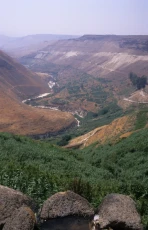
View from the Zayzun waterfalls into Yarmuk river, which there the border between Syria and Jordan
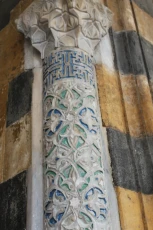
Jamiʿ al-ʿAdiliyya, prayer hall entrance - floral motifs decorating a column

A side from archaeological city of Dura Europos (Qalʿat as-Salihiyya)
Inside view [Original: "Salihiyyah, Burg, Innenseite, S.H. Taf, LXXXII"]

Part of Qalʿat al-Qadmus

Hammam Bahram Basha, Teil der nach Norden ausgerichteten Hauptfassade

Raqqa - "East of Raqqa" site - Tall Aswad, excavation in 1985
[1985/72/995] = [photo's name as: year/ film no./ photo no.]

A woman with her children and a spindle in her left hand
In the background lies a self-woven rug

Jurn Kabir, ein Käuzchen, das dort häufig vorkommt
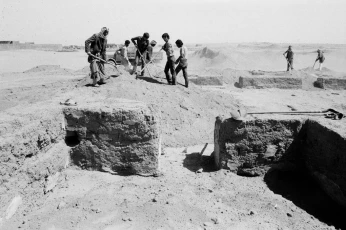
Raqqa - excavations at the site "East Raqqa" - the northern complex
[ 87/ 58/ 1754] =[ photo's name as: year/ film no./ photo no,].. (Naming the area of the photo was done according to the list, although some they are similar but were done in different areas.)

Decoration detail on the Arch of Triumph (Qaws Hadrian)

Die Mittelmeerküste in Baniyas in den 1960er Jahren

Izraʿ - Kanisat (church) Mar Jirjis from the inside

Al-Madrasa al-Ahmadiyya, entrance of the tomb

Bayt Junblat, southern iwan, section east-west
Seize of plan 80 x 38, with ruler (no scale).

Bayt Junblat, Süd-Iwan - Fayencefliesen

Ansicht der Wassermühle von ʿArbin im Rif Dimashq

Raqqa, Qasr al-Banat, Lehmziegeldekorationen

Statue eine Stifters, Säulenstraße - Exedra am Abschnitt A
[ Description by author: und Würdenträgers. Wie Bild 0658, aber frontal. ]

Bimaristan Arghun, Haupteingangsportal, Blick von Westen

Part of the of the city wall of Damascus

Salt flats for salt production west of Jabal Jabisa (Jabisa mountain)

Im frühumaiyadischen Wüstenschloss (westlicher Komplex)

Große Moschee von Raqqa-Rafiqa, 8./12. Jh.
Die Hauptmoschee wurde 772 errichtet und im 12. Jh. erneuert. Monumentale Zeugen dieser Geschichte sind das 25 m hohe Minarett und die Arkadenwand.


Kharab Sayyar, Stuckdekor in situ
[Original: Stucke in Situ an. Jasc.]

Madrasat al-Firdaws, view of the southern arcade and the prayer hall entrance

Al-Madrasa ash-Sharafiyya, Inneres der Mihrab-Kuppel mit Muqarnas und Rippenkalotte

Khan al-Jumruk, Innenhofansicht mit Blick auf die innere Eingangsfassade

Habuba Kabira, Eingangsseite eines halb in den gewachsenen Boden eingetieften Raums (im lokalen Dialekt: debabe)

Suq al-Buzuriyya, Blick nach Süden, Altstadt von Damaskus

Jamiʿ ash-Shuʿaybiyya, the upper part of the entrance - a cornice with floral motifs and a Qur'anic text in Kufic script
{Original: Maulbeerbaum }. on the photo was mentioned: date of creation between 1985-86

Al-Madrasa al-Hallawiyya, wooden prayer niche in the iwan
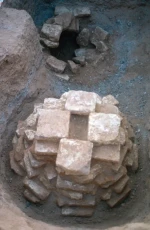
Raqqa, Northeast Complex

Jamiʿ al-Maydani, the minaret

Tall Mardikh (Ebla), Blick auf einen Teil der Befestigungsanlage
shap_import_48482

Excavation works, Dura Europos (Qalʿat as-Salihiyya)
Side of the Excavation

The Euphrates in Raqqa

Orchards in the city of Harim

Licht fällt ins Zentrum des Khan Asʿad Basha al-ʿAzm, da die bedeckende Kuppel fehlt

Raʾs al-ʿAyn, Piles of wheat before its package in bags

Raqqa - "East of Raqqa" site - Tall az-Zujaj - excavations
Raqqa X; Glass-Tall

Vegetationsvielfalt und anstehende Felsen im syrischen Küstengebirge

Porticus post scaenam, Römisches Theater - Busra
[Original: Theater, Bühnengebäude (wahrsch. spätes 2. Jh.)]

Madrasat al-Firdaws, oktogonales Brunnenbecken mit gelapptem Rand im Zentrum des Innenhofes

Bei Tall Tamr, in einem assyrischen Dorf, Innenhof eines Hauses mit zwei später abgeflachten Kuppeln der Ursprungsbebauung
Die assyrischen Dörfer am Khabur mit ihren Kuppelhäusern baute die französische Mandatsregierung für christliche Flüchtlinge aus der Türkei und dem Irak.
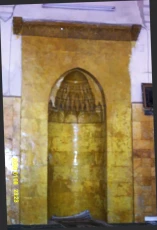
Jamiʿ ash-Shuʿaybiyya, prayer niche (mihrab) in the prayer hall

Fernsicht auf das Stadtzentrum von Damaskus mit der Umayyaden-Moschee

Außenansicht des Turbinengebäude des Assad-Staudamms des Euphrats, dessen Strom weite Teile Nordsyriens mit Strom versorgt
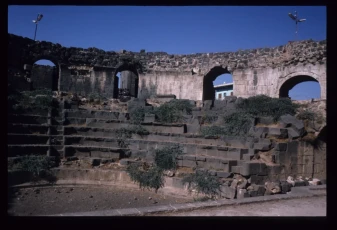
Interior view of Qanawat theater

Raqqa - "East of Raqqa"- Eastern Palace, stucco
Raqqa II; Eastern Eastpalace; relief decoration, bunch of grapes

Takiyyat ash-Shaykh Abu Bakr, the iwan facade

Archäologische Funde aus Raqqa, ausgestellt im Damaszener National Museum

Bayt Wakil, Gästehof mit Springbrunnen (Restaurant)

Jamiʿ al-Khayr, entrance of prayer hall - arch support

Suq Aslan Dada, reconstruction of northern entrance, view towards south

Khan Qurtbak, southern part of Khan - the inner courtyard and the iwan of the Mamluk palace

('Ain) Manîn, Eingang in eines der Heiligtümer
[ Description by author: Die große Halle und ihre Freitreppe, gesehen von ~ Westen. ]

Jamiʿ al-ʿAdiliyya, double arcade front of the prayer hall

Jamiʿ al-Qayqan, Südfassade mit verbauten Spolien
[Original: Moschee um Bab Antakiya}, on the photo was mentioned: creation date between 1985-86]

Al-Bara, pyramid tomb A, 6th c. AD
The Mausoleum A with its pyramid-shaped roof lies in the middle of oil plantations. The wealth of the region was based on the production of olives.

Madrasat al-Firdaws, general view to north - courtyard, eastern arcade and iwan
[Original:'Madrasa al-Firdaus, Halab / Aleppo. Fertiggestellt 1235/36. Hier der Innenhof mit dem großen Iwân.].

Jamiʿ at-Tawashi, minbar (pulpit) - inscription

Blick vom Philippeion zur Stadt

A view of Shayzar Castle from afar

Waqf of Ibshir Mustafa Pasha, siteplan of the building parts (Arabic)
The waqf (endowment) complex of Ibshir Mustafa Pasha has suffered serious damage in several areas. This includes the khan on the north side and the eastern and western qaysariyya. Without removing the rubble, no final statement can be made about the extent of damage. Most likely, there was a total loss in the areas affected by the April 2015 tunnel bomb explosion. The western portion of the waqf complex, including its front facade, is still standing but is noticeably damaged. Two of the most important buildings of the waqf complex of Ibshir Mustafa Pasha survived: the mosque and the coffeehouse at the south. The uniquely decorated facade of the hall of the coffeehouse, as well as its first row of vaults, were destroyed. The core of the hall was only partially damaged, while the section of the central dome with its high lantern was, for the most part, destroyed.

Jurn Kabir, Frau demonstriert die Herstellung einer Stabmatte (arab. zarb) mithilfe von Steingewichten

A view of the Anti-Lebanon Mountains covered with snow

At-Takiyya as-Sulaymaniyya, Innenhof mit Wasserbecken

Afamiya, twisted and fluted columns of the central section of the Great Colonnade

Jamiʿ al-Mihmandar, entrance - inscription band

Archäologische Funde aus Raqqa, ausgestellt im Damaszener National Museum

The damage of the minaret

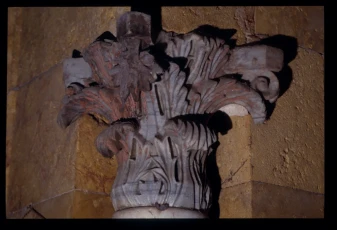
Corinthian capital in the great mosque (al-Jamiʿ al-Kabir), Maʿarrat an-Nuʿman
Spolie am größeren Bau im Hof der Moschee. [Original: Ma'arat an-Nu'mân (Arra)']

A view of the Convent of Our Lady of Saydnaya

Naʿurat al-Muhammadiyya, Hamas größte Noria (Wasserschöpfrad)

Jaʿbar Castle in at-Tabqa, bastion with loopholes.

Straßenseite des Gehöfts: vor Küche und Wohnhaus liegende Terrasse einer kurdischen Familie

ash-Shaykh Khalid an-Naqishbandi mausoleum on the foot Qasyon mountain
Turbat ash-Shaykh Khalid an-Naqishbandi written on the photos back ['F 80. Wulzinger-Nachlaß WU F80']

Waqf of Ibshir Mustafa Pasha, damage mapping (English)
The waqf (endowment) complex of Ibshir Mustafa Pasha has suffered serious damage in several areas. This includes the khan on the north side and the eastern and western qaysariyya. Without removing the rubble, no final statement can be made about the extent of damage. Most likely, there was a total loss in the areas affected by the April 2015 tunnel bomb explosion. The western portion of the waqf complex, including its front facade, is still standing but is noticeably damaged. Two of the most important buildings of the waqf complex of Ibshir Mustafa Pasha survived: the mosque and the coffeehouse at the south. The uniquely decorated facade of the hall of the coffeehouse, as well as its first row of vaults, were destroyed. The core of the hall was only partially damaged, while the section of the central dome with its high lantern was, for the most part, destroyed.

Amrit, Melqart temple (Eshmoun), central shrine

Armanaz, Hanghäuser am Fuß eines Berges

Khan al-Wazir, oberes Fenster der äußeren Eingangsfassade
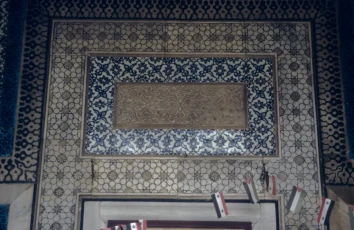
Bayt Junblat, northern iwan - decoration of faience tiles

The main facade of al-Bimaristan an-Nuri in Damascus
Main entrance, muqarnas, wall relief

View of the ablaq-decorated entrance of the Great Mosque of Hama

Raqqa - "East of Raqqa" site - Western Palace
Raqqa VIII; Eastern West Palace, s.SW-Neg.89/638-643

Dar'a, al-Jamiʿ (Moschee) al-ʿUmari, Arkade

The southern-western tower of Damascus Citadel

Tombe carved into the rock, ʿAyn as-Sahib
[ Description by author: Das Grab von Bild 0411 in Untersicht. Im Tympanon war wohl ursprünglich ein Kopf. ]

Al-Madrasa al-Hallawiyya, Apsis - Säulen mit korinthischen Kapitellen
[Original: Medrese Halawiya (gegenüber dem Westeingang der Großen Moschee): quadrat. Kuppelraum mit östlicher apsidialer Säulenstellung; vermutl. urspr. byz. Tetrakonchos Ostapsis mit korinthischen Kapitellen]

Palast (Qasr) al-Hayr ash-Sharqi, Hauptportal

Waqf Ibshir Mustafa Pasha,Kaffeehaus, Innenraum
Das Kaffehaus besitzt einen rechteckigen Grundriss. Das quadratische Zentrum wird von einer Kuppel überspannt, die von vier Pfeilern und vier Säulen mit achteckigem Schaft und Muqarnaskapitellen getragen wird. Muqarnas-Pendentifs leiten vom quadratischen Mittelraum zum rund der Kuppel über. Die Kuppel selbst wird von einer Laterne bekrönt. Der zentrale Raum ist von Pfeilern umgeben. Der durchfensterte Eingangsbereich ist einschiffig, während die drei anderen Seiten zweischiffig gestaltet sind. Die Schiffe werden von Gewölben überdeckt.

Große Moschee von Aleppo (Umayyaden-Moschee), Gebetshalle mit Schrein des Propheten Zacharias

Bayt Junblat, western facade of the women hall (Haramlik)

Abdelraouf Baydoun working with the craft of ‘Ajami: Preparation of a wooden dome

Bab al-Maqam in Aleppo, Gesamtansicht

Hadrian’s Arch, 3rd c. AD
The triumphal arc was constructed in honour of the Roman emperor Hadrian and linked the colonnaded street to the Temple of Baal. In 2015 it was blown up by ISIS.

Im äußeren Hof des ʿAzm-Palastes, der heute das Damaszener Ethnografische Museum beherbergt

A view of the iwan of Dada house
Liwan

General view of Damascus citadel from northwest
The two rectangular towers that protected the citadel from the west appear clearly in the picture. Hidden behind the bushes, is the statue of Salah al-Din riding his horse.

Blick auf den Orontes mit bewaldeten Uferzonen

Application of the relief paste of a ‘Ajami decoration
Workshop of Abdelraouf and Ziad Baydon in Malaysia

25 piastres (silver), 20 mm, 1958 (union with Egypt)

Jamiʿ al-ʿAdiliyya, column details in the double arcade

Hammam an-Nahhasin, the cold section (barrani)
The platforms of the external section (barrani) are divided by wooden barriers with geometric forms, and the walls are also covered with wooden panels. Due to the continuous use of this bathroom, the platforms are upholstered for the convenience of visitors.

Eine Frau zeigt eine gewebte Satteltasche mit Stickereien

Aleppo Great Mosque, courtyard general view towards north west
View of courtyard (Sahn) showing its two-coloured pavements and the two ablution fountains with cupolas, the octogonal is Hamdanid, and the famous minaret in the north western corner, before its destruction in 2013!

An inscription with an decorated frame on the wall of Masyaf Castle

Khan Sulayman Basha al-ʿAzm, Fassade mit Zimmertür und Fenstern im Erdgeschoss
[ Description by author: Türen und Fenster im Erdgeschoss. Vgl. Bild 0314 ! ]

Raqqa, Baghdad Gate, Façade decorations: three-lobed niches and arched frames resting on colonnette

Propylon, Diokletians-Thermen
[ Description by author: der Anlage, diesmal gesehen von ~ Nordosten längs der Säulenstraße Richtung Monumentalbogen. Gut zu erkennen, dass das Propylon höher ist als die Kolonnade (Halbsäule - Pfeiler) und dass es in die Straße vorspringt (Halbsäule / Pfeiler - Säulen). ]

The Great Colonnade

Habuba Kabira, upper part of a cantilever dome construction

as-Suwayda', "Mashnaqa Arch" or remains of a Byzantine basilica
Note: these photos were taken between the year 1924 - 1939. The chosen date is to be average. (photographer unkown)

Preparing dinner in the courtyard of a mud brick house in the outskirts of Raqqa

Gesamtansicht der Burg (Qal'at) von Shumaymis

Raqqa, hypothetic reconstruction of the prayer hall of Grand Abbasid Mosque (al-Jamiʿ al-ʿAtiq)
Isometric view drawing. Scale ruler

Az-Zawiya al-Hilaliyya, wooden cells inside the prayer hall's iwan

Laden im Suq al-Buzuriyya, in dem gerade Kerzen für die Palmsonntagsprozession verkauft werden

Große Moschee von Aleppo, Blick auf Innenhof, von 1907
Blick in östliche Richtung mit der Zitadelle im Hintergrund. Die beiden Reinigungsbrunnen für rituelle Waschung im Innenhof (Sahn) sind gut sichtbar. Aus einer Gruppe von Glasfotografien, einer Schenkung von Prof. Friedrich Sarre im Jahr 1947 an das Museum für Islamische Kunst in Berlin.

Stein- und Betonhäuser in Mnin

Abdelraouf Baydoun working with the craft of ‘Ajami in Qasr al-ʿAzm

Jamiʿ Aslan Dada, entrance of the additional prayer hall (al-Hijaziyya)

South part of the east side, Hammam al-Qaramani
[ Description by author: Südteil der Ostseite. Der obere Teil "modern" mit Beton ausgebaut. ]

A herd of sheep in one of the streets in Raqqa

Bayt Wakil, iwan - decoration above a room's door

Raqqa, Qasr al-Banat, Lehmziegelornamente

Palmyra / Tadmur - Umgebung NW, Jazil, Pfad zum Höhlenkloster
[ Description by author: zum Fels-"Balkon". ]

The prayer hall, Umayyad Mosque
[ Description by author: Blick aus der Nordostecke durch die Osthalle nach ~ Südwesten. Hinter den Säulen der Pavillon mit dem Kopf Johannes' des Täufers. ]

Raqqa -Qasr al-Banat, clay decorations

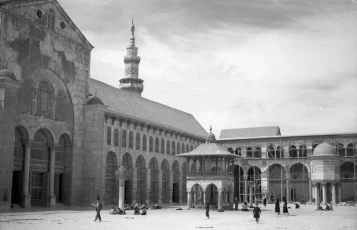
Glockenpavillon, Innenhof der Umaiyaden-Moschee
[Original: Omayyaden-Moschee (705 - 725), Pavillon mit byzant. Kapitellen, im 18./19. Jh. zum „Glockenbaldachin“ zusammengesetzt]

Traditional dish served in a village, at-Tabqa

Kissen mit einem selbstgewebten Bezug

Khan Murad Basha (Museum of Maʿarrat an-Nuʿman), Mosaic
[Original: Khan Murad Pascha, Bodenmosaik (4. - 7. Jh., aus den Toten Städten)]

50 piastres (F.A.O. coin: increasing of world food production), 23,5 mm, 1976

Small river in Baniyas

Excavation at Tall al-Biʿa, Ancient city of Tuttul

Burj Haydar, Ruinen der westlichen Basilika
[Original. Westliche Basilika, Säulenarkaden mit dorischen Kapitellen, 4. Jh.]

Qalʿat Ibn Maʿn, Gesamtsicht der Burg
[Original: Burg oberh. v. Palmyra]

The Euphrates River near Tall Sabi Abyad

Al-Senani Straße: Gesamtansicht
[Original:'Straße in Damaskus']. The Bavarian air force division 304b was based in Palestine from 25. October 1917 and was involved in the First World War until the division left the region, over Aleppo, in mid September 1918. During that period, over 3000 glas photographs, mostly aerial, have been made. Those early photographs were important for the archaeological research in the Middle East region.

Al-Madrasa ash-Sharafiyya, the entrance from the interior

A side of Qalʿat Ibn Maʿn

View from the west, courtyard of Umayyad Mosque

Damascus, Propylaea of Jupiter Temple, 1st CE. AD
The west gate of the Jupiter Temple lies in the middle of the historic old town. Today it marks the transition between the bazaar area and the Umayyad Mosque.

Bimaristan Arghun, Achteckhof - Springbrunnen

Zitadelle von Aleppo - Torturm und Eingangstorbau, Gesamtansicht der Eingangsanlage
[Original: Zitadelle, Haupttor, Vortor und Brücke]

Temporary title for Image 44445
Aside of the Ruins

Afamiya, the Ottoman Khan below Qalʿat al-Mudiq (al-Madiq castle)

Maʿlula, Gesamtsicht von oben
[ Description by author: Gesehen vom linken Berg - GPS-Tag approximativ - nach ~ Nordosten auf den Ortskern. Unten links die Masjid Ma'lûlâ, oben links das Kloster Mâr Takla und links davon der Eingang zum Fajj Mâr Takla. Hinter dem Ganzen der "rechte" Berg und das Plateau. ]

Busra, Jamiʿ (Moschee) al-Mabrak von außen

Blick über die Ruinenlandschaft von Palmyra in Richtung der südostlich gelegenen Palmhaine

Courtyard of the monastery of Mar Musa al-Habashi
[ Description by author: Innenhof, rechts die Kirche.- Das Kloster geht auf Mönchsgrotten in der Umgebung aus dem 6. Jh. zurück, die ältesten Gebäudeteile stammen aus dem 10. Jh., die Fresken (vgl. Bild 0480 - 0490 !) - in drei Lagen übereinander ! - aus der Zeit bis zum 15. Jh.. Gegen Ende des 17. Jh. wurde das Kloster verlassen. Sein Patron soll der Sohn eines äthiopischen Königs sein und das Kloster gegründet haben. ]


The Baths of Diocletian
[ Description by author: - aber was sollen dann die Säulen vorn ? Im Hintergrund der mittlere Abschnitt der Säulenstraße, die Bögen markieren den südlichen Eingang in die Rundstraße ums Theater. Die Außenseite von dessen Scaenae Frons erkennt man rechts hinter den Säulen. Gesehen von ~ Nordosten. ]

Südost-Nekropole, Hypogäum des Artaban, Inneres
[ Description by author: Die Exedra mit dem Grabinhaber auf seiner Totenkline, umgeben von seiner Familie. Außerdem sind in diesem Grab einige der Platten mit den Reliefbüsten der Verstorbenen erhalten, die die Loculi nach vorn abschlossen. ]

Al-Asad artificial lake, view to the Tabqa dam

Jamrin - The ancient bridge over Wadi az-Zaydi
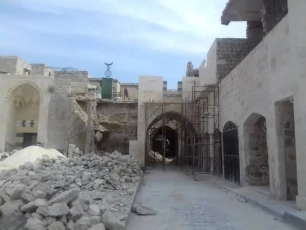
Suq Aslan Dada, rebuilding of northern entrance, view towards south

Telegrafensäule auf dem Marja-Platz

Jamiʿ Aslan Dada, Kuppel der Halle - Ecktrompe mit Muqarnas als Überleitung zum achteckigen Tambour

Ghab plain: thatched mud houses, 1963

Jamiʿ al-ʿAdiliyya, prayer hall's entrance - muqarnas and inscription documenting the date of building accomplishment

Simeonskloster - Pilgerkirche des hl. Simeon Stylites, Überreste der Säule des Säulenheiligen Simeon
In der Mitte des achteckigen Zentralbaus steht der Rest einer Säule. Auf ihr der soll Heilige Simeon Stylites Jahre seines Lebens verbracht haben.

A side from Tartus Cathedral - Tartus Museum

Jamiʿ Aslan Dada, facade of the hall entrance
[Original: B63 Film-VI]

Teil des Bades in der Burg von Harim

Women and children (of a family of former nomads) in one of the Upper Euphrates Valley villages

Ökologisch-botanischer Garten neben der Zitadelle von Damaskus
Jabla, Mosque of Sultan Ibrahim, Arabic calligraphy,

A side of the architectural remains, Mari (Tall al-Hariri)

Citadel of Aleppo, minaret of the Great Mosque

Raqqa, Westpalast, Luftaufnahme des Ausgrabungsgeländes
Das Luftbild zeigt den Zustand während der Grabungsarbeiten. Am Rand des Grabungsgeländes sind Lehmziegel zum Trocknen ausgelegt. [Original auf der Rückseite: '86']

Der Eingang in die Bug Marqab wir von einem Stufenportal umrahmt

Roman grave behind the Convent of Our Lady of Saydnaya

Ornament over a window, Khan Sulayman Basha al-ʿAzm
[ Description by author: Dekor über dem linken Fenster von Bild 0313. ]

Herd of sheep in a grove of trees in the Ghouta
People of Damascus used to praise the delicious taste of sheep’s meat coming from the Ghouta. But the number of sheep has decreased due to the shrinking of the Ghouta area itself and the export of sheep to the Gulf countries.

Al-Madrasa al-Hallawiyya, entrance - a stone base (spolia) which is the cathedral baptismal font

Blick durch die Ruinen der Burg von Harim

Bayt Wakil, facade of the reception hall

Bayt Wakil, Empfangshalle - westlicher Sitzraum

Busra, Hammam Manjak, interior view

Suq Aslan Dada, general view after completion of the reconstruction, view towards south

Qasr (palace) al-Hayr al-Gharbi, view of the ruins

Dura Europos (Qalʿat as-Salihiyya), Ruinen eines Gebäudes
Inside view [Original: "Salihiyyah, Burg, Innenseite, S.H. Taf, LXXXII"]

Habuba Kabira, Bau des Gurtbogens, auf dem 2 Kragkuppelseiten aufliegen sollen

Qasr al-Hayr al-Sharqi, oberer Bereich des Eingangsturmes

Khan al-Jumruk, innere Eingangsfassade

Ruinen der Burg Ja'bar
Hinweis: Dieses Foto wurde zwischen den Jahren 1924 - 1939 aufgenommen. Das gewählte Datum soll ein Durchschnittswert sein. (Fotograf unbekannt)

Busra, Masjid Yaqut (Moschee), Außenfassade und Eingang

Khan Dannun, Arkade

Takiyyat ash-Shaykh Abu Bakr, Hoffassade des Iwans

Wall of the colonnaded enclosure, Temple of Bel
[ Description by author: Die Propyläen - die arabische Bastion - von der Hofseite, also von ~ Osten. ]

The right part of the sacred complex gate, Mnin
[ Description by author: Der Zugang: rechter Teil eines Tores zum heiligen Bezirk.- Wenn hier und bei den folgenden Bilder "Römisch" angegeben ist, soll damit nur gesagt werden, dass die Anlage in heutiger Form zu dieser Zeit entstand und die Formensprache der "Reichskunst" benutzt wird. (The date of this photo was not sure as Peter Heiske did [(wohl) 08/05/1999)] ]

A side of Ibn Maʿn Castle


Jamiʿ ar-Rumi, general view from the minaret

Busra - Jamiʿ (Moschee) Fatima von außen

Part of the main façade of Roman South Temple in ʿAtil
Roman temple

Al-Jamiʿ an-Nuri, Hofarkaden - Zwillingsbogen
Antike Säule im Innenhof. ['Original: Hamâ (Epiphania),']

Small cistern in the Castle of Harim

Valley of the Tombs, Tomb of Jambliku - facade decoration
[ Description by author: Linke Seite des Fassadendekors: der bärtige Kopf als Träger der unteren und die Nike (Sirene / Harpye) als Träger der oberen Konsole. Gesehen von ~ Osten. ]

General view from outside, Jamiʿ Manjak

Grab der drei Brüder, 2. Jh.
Die farbigen Wandmalereien der Grabkammer stellen mythologische Gestalten dar. Lokale und römische Kunstformen gingen hier eine Symbiose ein.

An Arabic inscription on the wall of Qal‘at Shayzar

Einer der Türme der Burg Shayzar

Inneres der seljukischen Wassermühle vom Bab as-Salam, Damaskus

Rich decorations in Bayt Shaykh Qatana before demolition
Innenraum

A view in the Limestone Massif, near al-Bara
Madrasat al-Firdaws, a grave on the west of prayer hall

The Pigeons, old city of Damascus
A flock of pigeons flies over the old City

al-Utrush Mosque, general view of western facade and entrance

Busra, Hammam Manjak, Frigidarium oder Kaltbaderaum (Barrani)
Umayyad Mosque, the facade of the prayer hall and the Qaytbay minaret

View from south-west, Basilica of Kharab Shams
[Original. Säulenbasilika, 4. Jh. von weitem, von SW. Nach dem Einsturz der Seitenschiffe bei einem Erdbeben ist nur noch das Mittelschiff erhalten. Fensterhochwand mit Rechteckfenstern stammt aus dem 4. Jh., die mit Rundbogenfenstern aus dem 6. Jh.]

Ökologisch-botanischer Garten neben der Zitadelle von Damaskus

Qasr al-Hayr ash-Sharqi, Bogen
[Original: Arch-k.K6/=HQ k.K 60,]

Public street life in Raqqa

Qanawat, Ruins of the Temple of Rabbos

Remains of the Great Colonnade

Römisches Felsgrab hinter dem Kloster Unserer Lieben Frau von Saydnaya
[ Description by author: aus byzantinischer Zeit im Felssockel der Klosteranlage. Die Figuren erinnern an die der sog. "Hochzeit von Kana" in Qânâ / Libanon. ]

Hammam Bahram Basha, the entrance facade

Jamiʿ al-Khayr, Inneres der Gebetshalle - Konsolkapitell der Eingangs-Empore

Fischer auf ihren Booten im Hafen von Tartus
[Original: Fischer in Tartus]

Corinthian capital of a pillar, Agora
[ Description by author: Kapitell des Pfeilers mit vorgelegter Halbsäule von Bild 0711. ]

Vorbereitung von Lehm zum Bauen in einem Dorf im Gouvernement ar-Raqqa

Sarkophagrelief mit Kamelführern in parthischen Hosen
[ Description by author: aus Palmyra in parthischer (Hosen !) Tracht. ]

At-Taynabiyya-Moschee, Gebetsnische
[ Description by author: Der Mihrâb oder ein Mihrâb der Moschee. Vermutlich konnte ich ihn nur sehen, weil sich die Moschee in Restauration befand. ]

A view at the town of Maʿlula
[Original: Große Orientreise Nr.63 mit Rotel-Tours: Amman-Bagdad-Uruk-Babylon-Arbil-Mosul-Hatra-Samara-Mari-Dura Europos-Aleppo-Dayr Saman-Ugarit-Palmyra-Jarash]

Bimaristan Arghun, view of main courtyard
shap_import_60891

Near Habuba Kabira, a family trip by boat to their former village, that was flooded in 1973 by the Tabqa-Dam

Hain in der Ghouta von Damaskus

Bimaristan Arghun, muqarnas vault behind entrance portal

Qalʿat Ibn Maʿn, Gesamtsicht der Burg, Blick nach Nordosten
[ Description by author: Blick nach ~ Nordosten. ]

Habuba Kabira, Berührungsstelle von 3 Kragkuppeln (zwei liegen auf einem Entlastungsbogen auf)

Raqqa - the excavations of the site "East of Raqqa" - Eastern Palace
The so-called Eastern Palace is part of the Palace City of Caliph Harun al-Rashid. After the excavations it was preserved and made publicly accessible.

Al-Bara, oil mill, 5th-6th c.

The suspension bridge over the Euphrates, Dayr az-Zawr
Note: these photos were taken between the year 1924 - 1939. The chosen date is to be average. (photographer unkown)
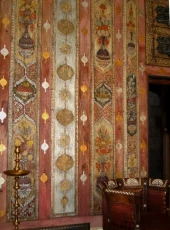
Bouquet of flowers and fruits in bowls on the wooden panels of Bayt ad-Dahhan (Funduq Qasr al-Mansuriyya), 18th century

A side of Hiraqla victory monument, built by Harun ar-Rashid, near Raqqa

Blick über die Hausdächer in der Altstadt von Aleppo
Eines der Armenviertel in der Altstadt von Aleppo, das bescheidene, informell errichtete Dächer mit Satellitenempfängern zeigt.

Al-Madrasa as-Sharafiyya, Innenfassade des Hauptportals
Madrasat al-Firdaws, view to south - courtyard and arcades
Courtyard, Fountain

Mnin, traditionelle Dorfhäuser am Fuss der Qalamun-Berge

Part of golden and colored mosaic, Umayyad Mosque
[ Description by author: Mittelgang, Südwand, Mittelteil.- Die Bilder 0179 - 0192 wurden mit einem High-Speed-Film gemacht, daher die mäßige Qualität ! ]

Jamiʿ Aslan Dada, hall dome - squinch

Hauptfassade des Klosters Unserer Lieben Frau von Saydnaya
Jamiʿ Aslan Dada, Corinthian marble capital decorating the prayer niche

Remains of the western basilica, Burj Haydar
[Original. Westliche Basilika, Säulenarkaden mit dorischen Kapitellen, 4. Jh.]

Khan as-Sabun, window and decoration above the entrance

Busra, al-Jami‘ al-ʿUmari und Hammam Manjak, Außenfassaden
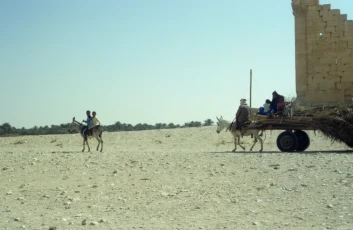
Peasants returning home from work in their palm grove passing by Bel temple
View along north western corner towards the oasis

Al-Madrasa al-Hallawiyya, korinthisches Säulenkapitell

Bayt Ajiqbash, view of the courtyard interior
shap_import_63540

Balcony above main portal of Khan al-Harir

At-Takiyya al-Mawlawiyya, Kanzel im Samah Khana

Busra, Jamiʿ (Moschee) al-Mabrak, Innenhof

Raqqa. Reste der Südarkade, der Großen Moschee (al-Jamiʿ al-ʿAtiq)

Jurn Kabir, Kinder an der öffentlich zugänglichen Wasserstelle (sabil), die zu einem Privathaus gehört

Khan al-Wazir, interior facade of the khan's entrance
The Bavarian air force division 304b was based in Palestine from 25. October 1917 and was involved in the First World War until the division left the region, over Aleppo, in mid September 1918. During that period, over 3000 glas photographs, mostly aerial, have been made. Those early photographs were important for the archaeological research in the Middle East region.

Bimaristan Arghun, Innenhof, Blick auf die seitlichen Arkaden
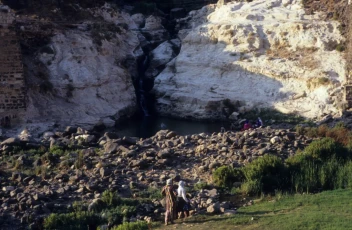
Lower basin of the waterfalls of Tall Shihab

Raqqa, Tall Aswad, stucco

Remains of a façade of the Roman temple, Qalʿat Burqush
[ Description by author: Fassade, gesehen von ~ Südwesten. ]
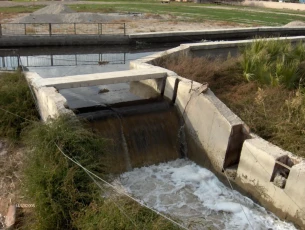
A concrete irrigation canal in the Ghouta of Damascus

shap_import_64479

Nahiyat Tall Tamir, Very well preserved domed rooms of a farmstead in an Assyrian village
The Assyrian villages on the Khabur with their domed houses were built by the French Mandate Government for Christian refugees from Turkey and Iraq.

Landwirtschaft in der ar-Ruj-Ebene

During a sandstorm this photo was taken from the museum to the backside of the suq in Dayr az-Zawr
View during sandstorm, photo taken from the museum to the backside of the suq
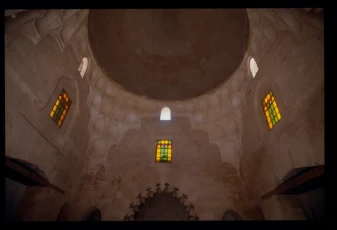
Al-Matbakh al-ʿAjami, muqarnas squinches of the iwan dome
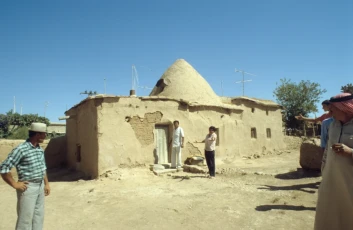
Nahiyat Tall Tamir, Street facade of a house in an Assyrian village, that still kept one domed room.

The suspension bridge over the Euphrates in Dayr az-Zawr

Citadel of Aleppo, a view from the main entrance showing the Gate Tower

Qasr al-Hayr al-Sharqi, Part of the western enclosure

Husn Sulayman, Tempel des Zeus Baetocaece, Innenansicht des Nordtores
Symetrische Torkomposition: höheres Mitteltor, gekrönt von einem Rundbogen. Ansicht von Süden.

ar-Rusafa, remains of the arches of the so called building with two apses
[Original: k.K6/=HQ k.K6]

Traditional house in neighborhood "al-Almaji"
Photograph of house's main, southern, fassade during beginning works of refurbishment and after the loss of woodden oriel "Kishk". The image is a panorama composed of several images

Jamiʿ al-ʿAdiliyya, capital with muqarnas of a column in the double arcade

Fishermen in the Tartus' harbour
[Original: Fischer in Tartus]

Eine Gasse in der Innenstadt von Halbun

An artificial canal, al-Furat al-Aʿla (the Upper Euphrates Valley)

Jurn Kabir, the fertile plain of the Euphrates with floodplain forest in the background before the flooding of the Tishrin Dam

Nature in spring, Raʾs al-ʿAyn

The remains of the temple of 'Ayn Dara-1

Grabrelief - Büste einer Frau in reicher Gewandung

Inscriptions on a volcanic stone in Jabal Says

Raqqa-Ost, Westpalast, Grabungsfund

Turbat Khaʾirbak (mausoleum), western facade and dome

Raqqa, Baghdad-Tor, Fassadengestaltung mit Nischen und Halbsäulchen
![Arial view at the citadel. [S.151, Abb.168]](https://syrian-heritage.org/wp-content/plugins/justified-image-grid/timthumb.php?src=https%3A%2F%2Fsyrian-heritage.org%2Fwp-content%2Fuploads%2F2020%2F04%2Fshap_import_50305-1024x697.png&h=230&q=90&f=.png)
Arial view at the citadel. [S.151, Abb.168]

Exterior view of Seljuk watermill ''Bab as-Salam watermill'', Damascus

Bimaristan Arghun, Achteckhof - Springbrunnen

Tall Bdiri, Gehöfte, die keine Hofmauern aufweisen

Waqf Ibshir Mustafa Pasha, Kaffeehaus, Dachansicht
Die hohe zentrale Kuppel im Zentrum des Gebäudes wird umgeben von kleineren Klostergewölben und Kuppeln.
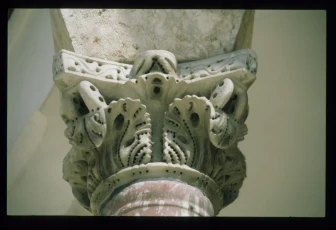
Capital, Umayyad Mosque
[Original: Omayyaden-Moschee (705 - 725), Aktanthuskapitell]

At-Takiyya al-Ikhlasiyya (az-Zawiya ar-Rifaʿiyya), Innenhofansicht

Raqqa-Ost, Palast D, Stuckdekorationen

View from a far to the basilica in Kharab Shams
Säulenbasilika, 4. Jh. von weitem

Qanawat, Nymphäum

The altar of Nabu Temple, Palmyra
[ Description by author: in Form eines Naiskos und Propyläen von der Hofseite, gesehen von ~ Norden. ]

Traditionelle Häuser im Sajur-Raum
Double room floor plan

Khan al-Wazir, Fenster und Dekoration im oberen Bereich der inneren Eingangsfassade
[Original:'Khân al-Wazîr, Halab / Aleppo.Ausschnitt auf die Fenster der Innenfassade von Bild 1250.'].

Remains of the temple, Harran al-ʿAwamid
[ Description by author: die noch verblieben sind. Der Tempel soll aus der Zeit des Kaisers Philippus Arab, also kurz vor 250 n. Chr. stammen. Wikipedia spricht von "Hauranischem Einfluss": dazu würde der Basaltkern der Säulen gut passen - was römisch in Damaskus erhalten ist, ist Kalkstein. Vgl. Bild 0374 und 0375 ! ]

Palmyra, Nabu-Tempel, Altar
[ Description by author: ~ Süd- und ~ Ostseite, dahinter die Stufen vom Aufgang des Podiums des Tempels. Die Reliefs sollen Gottheiten darstellen. ]

Blick von Halbun aus auf das Qalamun-Gebirge

Jamiʿ al-Utrush, view of the western facade and dome of the mausoleum

Al-Jamiʿ an-Nuri, Innenhof mit Brunnenbecken, Blick auf das Eckminarett

Große Moschee von Hama, Blick in den Innenhof

Maronite Cathedral, lower part of one of the cathedral towers

Hammam Bahram Basha, the main northern facade

Südtempel in 'Atil, vor einiger zeit wurde der Tempel in ein Wohnhaus umgewandelt

Qanawat, Ruins of the Temple of Rabbos

Mushabbak, byzantinische Basilika, Ansicht von Südwesten

Excavation work, Madinat al-Far

Jamiʿ al-Utrush, tomb - interior view of the dome damages
An upward view of the overall roof structure, a stone dome, elevated on a dodecagonal drum, and below, bent squinches made of muqarnas (stalactite forms) in transition to the quadrilateral form on pointed arches. Missing elements on north part of the drum; a hole of 2m dia., and loose elements/ cracks in the dome stonework construction

Remains of the Byzantine Cathedral, Qalʿat Burqush
[ Description by author: Die Substrukturen von oben. Man steht am Rand des letzten erhaltenen Gewölbes, Blick nach ~ Südosten. Links sind vier Ansätze der Gewölbe-Gurte zu erkennen. Die Kathedrale liegt links außerhalb des Bildes. ]

Jurn Kabir, wall shelf on which metal plates, cups and spoons are presented

Raqqa, "East of Raqqa" site - Western Palace, vegetable stucco ornaments

Madrasat al-Firdaws, the main entrance
shap_import_62841

Stonework in the Citadel of Damascus

Warp threads in a mechanical loom, textile factory of the Mezannar family in Damasus

Tartus, Blick auf ein Wohnviertel

Busra, Theater, eine der Hauptattraktionen der Stadt

General view of the Monastery of Mar Musa al-Habashi
[ Description by author: und rechts die Unterkünfte für "Suchende". Gesehen von der Anhöhe ~ nördlich des Klosters. Im Vordergrund der "Aufweg" vom Parkplatz am Austritt des Wadi in die Ebene. ]

Restaurant mit Terrasse und Fontaine in Mnin

Al-Madrasa ash-Sharafiyya, prayer niche decorated with geometric patterns

Das Kloster Mar Taqla

General view of Baalshamin Temple, 2nd century AD
[Original: Tempel des Baal Schamin (beim Hotel Zenobia)]

Raqqa, Nordostkomplex

Bayt Shaykh Qatana, Ansicht des reichen Wanddekors vor dem Abriss
Innenraum

Stucco decorations in situ, Kharab Sayyar
[Original: Stucke in Situ an. Jasc.]

Blick auf die Burg (Qal'at) Marqab vom Fuß des Bergs aus gesehen

Khan al-Jumruk, äußere Eingangsfassade

Temporary title for Image 44445
Aside of the Ruins

A view of traditional houses in Jabʿadin village

Jamiʿ al-Utrush, Westfassade - gerahmte Fensternische, oberer Abschluss

Al-Bimaristan an-Nuri, Innenhofansicht

A façade of the Shahba baths
The Shahba baths are one of the largest known baths in of the third 3rd century AD, built by Emperor Philip al-the Arabi. The picture shows a façade of one of the bath’s sections. It has a central entrance with a semi-circular arch, with two rectangular niches and on the sides two rectangular niches ending with a semi-circular arch.

Monumentalbogen, Deatailansicht Innenseite und Pilaster
[ Description by author: Linker Ansatz des großen Bogens der 2. "Scheibe". ]

Raqqa, Qasr al-Banat, clay decorations

General view of Jamiʿ (mosque) al-Imam Ismaʿil

Blick auf den Euphrat in Dayr az-Zor
Jisr Dayr az-Zawr, al-Furat

Dome under maintenance in the village of Shaykh Hilal
Picture of a worker standing on the stone protrusions projecting from the dome to carry out maintenance and restoration works.
One of the inner parts of the Madrasa al-ʿUmariyya al-Kubra

A side from Shumaymis Castle, as-Salamiyya

Treppe ins Obergeschoss der Burg Najm (Qalʿat Najm)

Monastery of St Simeon, baptismal font

Ruine eines Doppelraumhauses im Dorf Qalʿat Najm

Al-Madrasa al-ʿUmariyya al-Kubra, Ansicht von Süden
Beschriftung auf der Rückseite des Photos: ['567. ''Photographie, Francois MARTIN, 19, Bd du Pont d'Aive, 1205 GENEVE'. Foto M. von Oppenheim, reproduziert nach Phototheque M. von Berchem Nr. 567 (1035). (----> Gent, Foundation Max van Berchiem). Org, Catalogue (1975) 50: Madrasa'Umariya. Conv interieure. =Nr. 38.']

Temple of Bel, ceiling decorations
[ Description by author: des Peristyls oder des Naos. Die alte Karteikarte sagt Naos, ich denke jetzt aber eher Peristyl: am "Bacchus"-Tempel in Ba'labak gibt es ganz ähnliche Peristyl-Platten.- Es gibt hier zwei Typen von Rosetten: eine "normale" und eine "rotierende". Letztere lässt an die "windzerzausten" Kapitelle ind Qal'at Sem'ân und in Halab denken. ]

Khan al-Wazir, Haupteingangsportal
On the photo was mentioned: date of creation between 1985-86

ar-Rusafa, Ansicht des Nordtors von Süden.

Habuba Kabira, Blick vom entstehenden Innenraum in die Kuppelkonstruktion

A field in a village nearSafira in Aleppo province

Umayyaden-Moschee, das reich dekorierte Qaytbay-Minarett

Khan Murad Basha (Museum von Maʿarrat an-Nuʿman), Innenhof
[Original: Khan Murad Pascha, osman. (heute Mosaiken-Museum)]

Trinkende Herde am Euphrat

Baghdad Gate of Raqqa-Rafiqa, 10th c. onwards
The gate built from fired brick was located in front of the southeast corner of the city wall of Raqqa-Rafiqa.
Archs: Remains of al-Ashnan watermill on the foot of Qasyun mountain
shap_import_77200

Raqqa, Qasr al-Banat, Hof mit Südiwan

Az-Zawiya al-Hilaliyya, the upper part of the entrance

Turm der Befestigung der Burg (Qalʿat) Salah ad-Din

Rumi motifs forming the border of the frame, Aleppo Room wall frame, early 17th century

Bimaristan Arghun, octagonal courtyard - fountain

Blick von einem hohen Gipfel des Anti-Libanon

Homs, Khalid ibn al-Walid-Moschee, historische Fotografie aus den 1920/30er Jahren
Hinweis: Dieses Foto wurde zwischen den Jahren 1924 - 1939 aufgenommen. Das gewählte Datum soll ein Durchschnittswert sein. (Fotograf unbekannt)

Propylon im Westen des Jupiter-Tempels von Damaskus
[ Description by author: des Períbolos des ehemaligen Tempels des Jupiter Damascenus, gesehen von ~ Osten (= Innenseite). Am Tympanon ist rechts zu erkennen, dass es sich um einen "Syrischen Bogen" handelte. Vgl. Bild 0151 und 0152 ! ]

Madrasa al-Hallawiyya: interior view at the former Byzantine apse
Parts of the Byzantine cathedral (5th c.) were integrated into a religious college (Medrese) in the 12th century. During the war, the monument was damaged and plundered.

Damaskus, Hammam al-Qaramani
[ Description by author: Detail aus Bild 0138. Ist das der Bogen mit Tympanon eines Tores ? Wenn diese Vermutung stimmt, würde das Gebäude ca. zwei bis zweieinhalb Meter tief in der Erde stecken ! ]
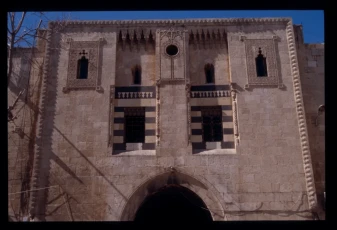
Khan al-Wazir, decorations and windows on top of the entrance's internal facade

Ar-Rusafa, Basilica A

Khan Dannun, Innenhof

Khan al-Jumruk, innere Eingangsfassade

Busra - Jamiʿ (Moschee) Fatima, oberer Bereich des Minaretts

Hammam Bahram Basha, the main facade after the destruction
1

Al-Madrasa as-Sharafiyya, Außenfassade des Hauptportals mit Inschriftenband
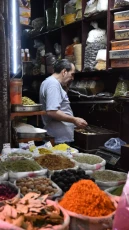
The interior of a shop in Suq al-Buzuriyya

Making falafel sandwiches

Raʾs al-ʿAyn, Getreideberge vor ihrer Verpackung in Säcke

Raqqa, "East of Raqqa" site - Western Palace, vegetable stucco ornaments
Raqqa IV; Eastern West-Palace, s.SW-Neg.85/412

Al-Madrasa az-Zahiriyya, Ansicht des Innenhofs nach Süden mit Arkadenportikus der Gebetshalle

Monumentalbogen hinter Palmen
[ Description by author: am Knick der Säulenstraße, und ein Stück der Kolonnade Richtung Tetrapylon. Morgendlicher Fernblick von einem der beiden Hotels, also von ~ Nordosten. ['Hotel Villa Palmyra (Heliopolis ?)'] ]

Bel-Tempel, Eckstützen-Kapitell der Portikus
[ Description by author: Tele-Ausschnitt aus Bild 0609: das Kapitell der Eck"säule". Diese Eck"säule" ist von außen gesehen ein Pfeiler, von innen sind es zwei Halbsäulen in die beiden Richtungen (vgl. Bild 0611 !). Das Ganze hat einen herzförmigen Querschnitt, s. entsprechende Fotos bei den Beirut- und Ba'labak-Bildern ! ]

Qalʿat (castle) al-Qadmus, inscription

The back arch belongs to the Great Colonnade
[ Description by author: in der Säulenstraße beim südöstlichen Abgang der Rundstraße ums Theater. Der hintere Bogen gehört zur Kolonnade, der vordere entspricht der Linie der Häuserfronten. Gesehen von ~ Südwesten. ]

Salah ad-Din statue at the western facade of Damascus citadel

Monolith ceiling of the south Thalamos in the cella, Temple of Bel

Busra - Jamiʿ (mosque) al-Mabrak

Maronitische Kathedrale St. Elias, Hauptfassadenansicht (West)

Jamiʿ Aslan Dada, interior view of the prayer hall (qibliyya)

General view of Tall Mardikh (Ebla)
shap_import_48497

Women wearing screen-printed headscarfs (Habari)

View from the courtyard towards the northeastern side of the valley, Dayr Mar Musa al-Habashi
[ Description by author: Blick vom Innenhof auf die ~ nordöstliche Talseite mit modernen Bauten für Leute "auf der Suche". Die teil-vermauerten Höhlen könnten die der ursprünglichen Mönche sein. ]

Kharijat ad-Drisiyat, Gästehaus

Zitadelle von Damaskus, der Gefängnishof im nordöstlichen Teil

Bayt Ghazala, ʿajami panels decorating the northern wing ceiling in the main reception hall (qaʿa)

The entrance of Tartus museum, Cathedral of Our Lady of Tortosa

Architectural remains of Dayr (Monastery) Subat, al-Bara

Theater, Proszenium und Scaenae Frons, 2. Jh. n. Chr.

Tartus, ash-Shaykh Badr, Inschrift auf der Burg al-Kahf

Innenansicht der Burg Najm (Qalʿat Najm)

A general view of the remains of Shayzar Castle
View at Qalʿat Shayzar with Qalʿat al-Madiq

Blick über Harim (Muhafazat Idlib)

Shahba, Frauen in traditioneller Kleidung beim Wäschewaschen

Jamiʿ ar-Rumi, general view of the minaret

Eingangstor der Burg Najm (Qalʿat Najm)

Tetrapylon und Kolonnadenstraße, 3. Jh. n. Chr.
Im Verlauf der Säulenstraße gelegen, markiert das Tetrapylon eine Wegekreuzung und eine leichte Richtungsveränderung. Der ISIS hinterließ eine Ruinenlandschaft.

Al-Khusrawiyya, Friday Mosque, entrance portal
Close-up of the niche of the entrance portal with its Muqarnas decoration and a panel with its founding inscription. This element is lost today (destroyed since 2015)!

Ar-Rusafa, Stadtmauer, mittlerer Durchgang des Nordtors von innen
[Original: 7-Syr98/17-14]

Arch of Triumph (Qaws Hadrian) from the outside
[ Description by author: Unter "Außenseite" ist hier und im Folgenden immer die Südostseite zum 1. Abschnitt der Säulenstraße zu verstehen, unter "Innenseite" die Nordwestseite zum 2. Abschnitt (= Bogen > Tetrapylon) der Säulenstraße.- Der Bogen stammt aus der Zeit des Septimius Severus, also um ca. 200 n. Chr. ]

Instandsetzung einer Kuppel im Dorf Shaykh Hilal
Bild eines Arbeiters, der auf den aus der Kuppel herausragenden Steinvorsprüngen steht, um Wartungs- und Restaurierungsarbeiten durchzuführen.

Three burial tombs in the rocks, northwest of Palmyra, Jazil
[ Description by author: Ganz "klassiche" Anlage mit Anordnung der drei "Särge" als Triclinium. Die sorgfältige Ausführung spricht für "bessere Leute": für den Abt (die Äbte) oder gar den Gründer des Klosters ? Vgl. Bild 0907 ! ]

Yabrud: Geschäfte mit Wohnhäusern im 1.OG, die Häuser stammen wahrscheinlich vom Anfang des 20.Jahrhunderts

Shaykh Anas Schrein, Berg al-Tar, süd-östlich von al-Mayadeen

Raqqa - Qasr al-Banat - stone decorations
Neg. Nr. 83/54

Kuppelhäuser im Dorf Shaykh Hilal
In dieser Szene überziehen die Arbeiter die Kuppeln im Rahmen der Restaurierungs- und Wartungsarbeiten mit einem Lehmputz. Die drei Kuppeln scheinen zu einem Haus zu gehören.

View to the south from the battlements of the citadel to the city in 1916
In the foreground the Khusrawiyya complex is partly visible, as is the mosque as-Saffahiyya and parts of the districts al-Jallum and Sahat Bizza.

Al-Madrasa al-Ahmadiyya, Hof und südliche Portikus

Raqqa - "East of Raqqa" site - Tall Aswad, excavation in 1985
Tall Aswad, s.SW-Neg.85/735-6;738

Qalʿat Ibn Maʿn, Gesamtsicht der Burg
[ Description by author: Tele + Ausschnitt. Blick von ~ Südosten. Der Standort muss nicht der angegebene sein: jeder Punkt auf dieser Linie zwischen Hauptstraße und Stadtmauer ist möglich ....... ['Zenobia Hotel (?),'] ]

House Wakil, 1976, daily life scene in courtyard
Everyday life in a courtyard of the House Wakil, from which the so-called Aleppo Room of the Museum of Islamic Art in Berlin originates. At times the house served as an orphanage for the Greek Orthodox Church.

Yabrud: Outer wall of the Greek Orthodox church "Konstantin and Helena", which once belonged to a temple
![Frauen und Kinder in einem Dorf der Oberen Euphratregion [Neusiedler am Euphrat]](https://syrian-heritage.org/wp-content/plugins/justified-image-grid/timthumb.php?src=https%3A%2F%2Fsyrian-heritage.org%2Fwp-content%2Fuploads%2F2020%2F04%2Fshap_import_6703-1024x667.png&h=230&q=90&f=.png)
Frauen und Kinder in einem Dorf der Oberen Euphratregion [Neusiedler am Euphrat]

Modernes Wohnviertel in Aleppo
Ein Blick auf ein modernes Viertel in der Stadt Aleppo an einem kalten Wintertag.

The enjoyment of sulfur water in Afqa Spring
[Original: Efqa-Quelle in Palmyra, 2002 od. früher versiegt]

Aliya Alnuami is applying the relief paste on her ‘Ajami-work
Jamiʿ al-ʿAdiliyya, view of the ablutions fountain

Im Orontes-Tal gelegener Khan (16.Jh) unterhalb des Ortes Qal'at al-Mudiq, der als Museum dient

A view of the courtyard of al-Jamiʿ al-Kabir, Maʿarrat an-Nuʿman

Khan Qurdbak, southern portico - Mamluk rank

Raqqa, Reste der Südarkade der Großen Moschee (al-Jamiʿ al-ʿAtiq)

Bezirk des Bel-Tempels
[ Description by author: Morgendlicher Fernblick aus einem der beiden Hotels, also von ~ Nordosten.. ['Hotel Villa Palmyra (Heliopolis ?)'] ]

Bayt Ghazala, Inneres der Kuppel in der Hauptempfangshalle (Qaʿa)

Tall Halaf with the Khabur-valley, seen from the northeast during the rainy season

Burj al-Ghanam, tower's southern facade with its machicolation
shap_import_63418

Vegetation im syrischen Küstengebirge
[Original: Ansariyengebirge]

Afqa-Quelle - historisches Bad
[ Description by author: Wieder die Quelle, aber diesmal von ~ Nordosten. Links und hinten rechts sind zwei Altäre zu erkennen. Wenn das Gestufte hinter der Säule die alte Zugangstreppe zur Quelle ist, war sie verdammt steil ....... ]

Busra - Southern Roman Bath (al-Hammam ar-Rumani al-Janubi)
South-Thermae, Forecourt before Renewal

Qalb Lawza, Basilica of 5th c., decorative door of reliquary room in southern facade (east)
The relics of Symeon were located in the southern apse side room. This martyrion can be recognized from the outside by the third door in the south wall and by a tiny window next to the door through which the pilgrims could be supplied with holy oil. A direct door into the sanctuary suggests that the Symeon relic was also used during the service. The windows are bordered by a particularly elaborately designed cornice band. The façade also has oblique grooves and square depressions, probably from the base of a sloping roof and its purlins.

Relief mit Weinranken
[Original: Bauornamentik]

Lion of goddess Al-Lat, 1st c. AD
[ Description by author: Detail, vom Eingang des Temenos der Allât. Sie symbolisiert den beschützenden Aspekt - siehe die "glückliche" Antilope - der Herrin der Tiere. Die Statue soll um die Zeitenwende entstanden sein. Eine Kopie - oder doch das Original ? - steht im Garten des Nationalmuseums in Damaskus. Vgl. Bild 0752 und 0754 ! ]
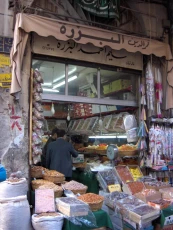
A shop in Suq al-Buzuriyya, Old City of Damascus
Jamiʿ ash-Shuʿaybiyya, entrance portal, building ornaments made of carved stones

At-Takiyya al-Mawlawiyya, Haupteingangsportal mit Minarett

Die Apsis der Ananias-Kapelle im Viertel Bab-Tuma
An der Wand der überwölbten Apsis befinden sich drei Bilder, die aus der Geschichte des Apostels Paulus erzählen.

An apse in Hananiya church in Bab Tuma quarter
The stone vaulted niche contains three paintings that tell part of the stories of Paul the Apostle

Der äußere Bereich (barrani) des al-Bayyada Bades

Agora-Annex, Südwest-Mauer mit Portal
[ Description by author: Südwestwand der Anlage, gesehen von ~ Südosten, von der Außenseite. Im Hintergrund die Säulenstraße. Vgl. Bild 0709 ! ]

Ansicht des Sajur mit Uferbewuchs

Al-Bab, the upper part of al-Jamiʿ al-Kabir (the Great Mosque) minaret

The avenue "Between the Schools"

General view in Suq al-Hamidiyya, Old Damascus

Offener Gang in der Burg von Harim

View of Orontes valley
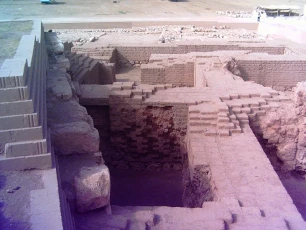
Tall Mardikh (Ebla), Blick in ein ausgegrabenes und teilweise rekonstruiertes Gebäude
shap_import_48438

Maronitische Kathedrale St. Elias, Kirchenschiff nach Westen

Jamiʿ al-ʿAdiliyya, corbel with muqarnas supporting an arch in the inner portico

Khan Qurdbak, Haupteingangsportal - Steinbank

Shaykh Shibli shrine - al-Tar mountain, south east of al-Mayadeen - plan
Sketch (Skizze), scale approx. 1:50

al-Malikiyya - ʿAyn al-Khadra, Basaltgrab mit arabischer Inschrift

Kuppelgehöft in Shaykh Hilal
Der Innenhof der Häuser wird für alltägliche Aktivitäten wie zum Wäscheaufhängen genutzt.

Habuba Kabira, building a cantilever dome house - in the foreground clay bricks, which are to be used soon

Naturvielfalt im Jabal Haramun (Hermon-Gebirge)

View from a far to the basilica in Kharab Shams
[Original: Säulenbasilika, 4. Jh. von weitem]
The damage of the west-southern corner of the mosque.
View, from south, at northern overbuilt part of Suq (bazaar) of Khan al-Harir (Picciotto house)

A general view of the Krak de Chevaliers at the sunset

Street vegetable hawker, ar-Raqqa

Al-Madrasa al-Hallawiyya, wooden prayer niche in the iwan

Bayt Junblat, Süd-Iwan - Fayencefliesen-Dekoration
[Original:'Qasr Jumblât, Halab / Aleppo. Dekor in der Wand oberhalb der Tür von Bild 1303.].

Raqqa - "East of Raqqa" site - Western Palace
Raqqa V; West Palace, s.SW-Neg.86/1252

Temple of Bel behind palm trees

al-Malikiyya - ʿAyn al-Khadra, Basaltgräber

Afamiya, a side of ruins

A seller of diesel fuel, Raqqa

Lehmziegel, vorbereitet für die Restaurierung der Stadtmauer von ar-Raqqa

Waqf of Ibshir Mustafa Pasha, Mosque, main entrance

Detail of decorations, Agora
[ Description by author: Ausschnitt aus dem Mäander-Dekor. ]

Jisr ash-Shughur, Qalʿat ash-Shugr wa-Bakas, Kreuzritterburg, Arabische Inschrift

Jisr ash-Shughur, Qalʿat ash-Shugr wa-Bakas, twin crusader castles, stone arch

Part of the noria wheel
['Original: Hamâ (Epiphania),']
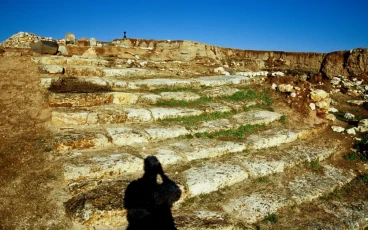
Stairs lead to the Ishtar Temple D? Ebla (Tall Mardikh)
Im Vordergrund die Treppe von Bild 1185 hinten. Nach dem Gesamtplan Bild 1162 müsste sie zum Roten Tempel / Ishtar-Tempel D führen. Gesehen nach ~ Nordosten. [Original:Tall Mardîkh (Ebla)']

A view of the inner courtyard, al-Bimaristan an-Nuri

Ananias-Kapelle im Viertel Bab Tuma, Bilderreihe mit Motiven aus dem Leben des Paulus in der
Die Bilder an den Wänden der Kapelle erzählen von Paulus' Missionsreisen zwischen 46 und 62 n. Chr.

Picknick am Euphratufer, Obere Euphratregion

Blick auf die Landschaft zwischen Grabtürmen, Neustadt und Oase

ʿAyn al-Khadra, Baby in einer traditionellen hölzernen Wiege
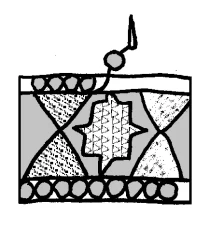
Patchwork for textile designs
Drawings by Estibaliz Sienra Iracheta to illustrate processes of traditional textile manufacturing

Tetrapylon and Colonnaded Street, 3rd century AD
The Tetrapylon marks a slight change of direction and an intersection in the course of the colonnaded street. It completely lies in ruins after the explosion.

Preparation of the design of a felt carpet in Al-Bab
Photographs of a manufacturing facility for felt carpets in Al Bab as part of the "Aleppo Stadtarchivprojekt" of GIZ (German Corporation for International Cooperation) in 2008

Ausgrabungen in Tall Afis

Wakil house, courtyard

Khan Qurtbak, eastern arcade

ʿAyn al-ʿArus, Ausgrabung eines Bodenmosaiks

The foothills of Antilibanon- Mountains overlooking the Zabadani plain

Busra - al-Jami‘ (mosque) al-ʿUmari - courtyard surrounded by arcades
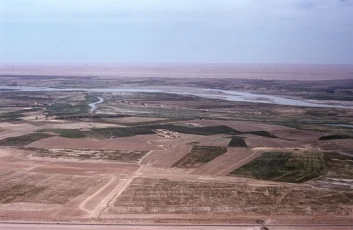
General view of Euphrates valley at Dayr az-Zawr countryside

Preparation of spools in the textile factory of the Mezannar family

Fassade der Kirche, Qasr Ibn Wardan
[Original: Kirche (Kuppelbasilika mit Emporen)]

Palmyra / Tadmur - Umgebung NW, Jazil, Fensteröffnungen des Höhenklosters
[ Description by author: in der "Fassade" - ein gewisses ästhetisches Bemühen ist unverkennbar, leider haben Felsabbrüche viel vernichtet. ]

as-Suwayda', "Mashnaqa Arch" oder Ruinen einer byzantinischen Basilika
Hinweis: Dieses Foto wurde zwischen den Jahren 1924 - 1939 aufgenommen. Das gewählte Datum soll ein Durchschnittswert sein. (Fotograf unbekannt)

Jamiʿ Aslan Dada, Halle - Inneres der steinernen Kuppel

Jamiʿ at-Tawashi, prayer niche

At-Takiyya al-Ikhlasiyya (az-Zawiya ar-Rifaʿiyya), general view of the facade and the entrance

View, from south, at northern overbuilt part of Suq (bazaar) of Khan al-Harir (Picciotto house)

Part of the Mihrab decorations, Umayyad Mosque
[ Description by author: Mihrâb: "Borte" über dem unteren Teil der Nische. ]

Khan al-Wazir, decoration and windows on top of the internal facade of the khan's entrance
Exterior view, front

A side from the courtyard of Bayt Jubran Afandi Shamiyya, Bab Tuma
Hof mit Liwan und Seitenliwan

Palmyra / Tadmur - Umgebung NW, Jazil, Grabkammern ?
[ Description by author: Jeweils für mehrere Personen ? ]

Jamiʿ Sharaf, Mamluk rank

Qasr al-Hayr al-Sharqi, upper part of one of the towers, flanking the gate
[Original: Turm links]

Busra, View into the Cathedral, 6th C.
[Original: Kathedrale (den Märtyrern Sergios und Bacchios und dem Leontios geweiht), 512/13]
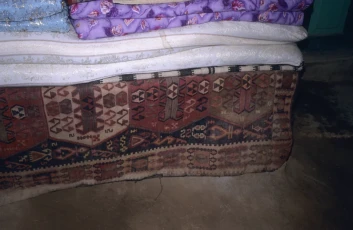
A traditionally crafted tapestry cover (Kilim)

Salkhad, aiyubidisches Minarett

Archaeological finds from Raqqa, exhibited in the Damascus National Museum
coins from ar-Raqqa, National Museum Damascus; A.16046

Blick über die Berglandschaft um Palmyra / Tadmur (Teil der Palmyraketten)

Columns with Corinthian capitals- The Great Colonnade at Afamiya

Basrelief mit geometrischen und floralen Motiven
[Original: Große Orientreise Nr.63 mit Rotel-Tours: Amman-Bagdad-Uruk-Babylon-Arbil-Mosul-Hatra-Samara-Mari-Dura Europos-Aleppo-Dayr Saman-Ugarit-Palmyra-Jarash]
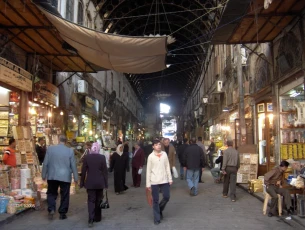
A view in Suq al-Buzuriyya, Old City of Damascus

A basin belonging to the Ummayad Palace ''Qasr Says'' in Jabal Says

Masbanat al-Jubayli, the soap cubes after cutting
The arranged and cut-out Aleppo soap in the upper floor of the soap manufactory which is located in a historic building.

Ar-Raqqa, part of city wall

Qunaya: im Museum des Simeonsklosters (Qalʿat Samʿan)
Ausgestellt werden Alltagsgegenstände, wie sie bis heute häufig in der Erde gefunden werden: Perlen, Armreifen, Spinnwirteln, etc.

A part of architectural remains in Tall Mardikh (Ebla)
shap_import_48472

Door and windows of a room in the ground floor, Khan Sulayman Basha al-ʿAzm
[ Description by author: Türen und Fenster im Erdgeschoss. Vgl. Bild 0314 ! ]

Säulenstraße (Decumanus) in Palmyra mit Blick nach Südosten

Tall Abyad, House decoration to welcome the house owner after the pilgrimage to Mekka

Raqqa - "East of Raqqa" site - Tall Aswad, excavation in 1985
Tall Aswad

Blick nach Nordosten über das Kloster Sankt Moses der Äthiopier
[ Description by author: in seiner Landschaft. Etwas anderer Standort als Bild 0493, Blick nach ~ Nordosten. ]

Al-Madrasa al-Hallawiyya, detail of Corinthian capital
[Original:'Al-Madrasa al-Halâwiya, Halab / Aleppo. Kapitell einer Säule des Konchos.'].

Mushabbak, Byzantine basilica, nave looking west

Jamiʿ at-Tawashi, entrance

An old photo in ʿAyn al-Fija, Wadi Barada
[Original:'Militär-Transport im Taurus'].. The Bavarian air force division 304b was based in Palestine from 25. October 1917 and was involved in the First World War until the division left the region, over Aleppo, in mid September 1918. During that period, over 3000 glas photographs, mostly aerial, have been made. Those early photographs were important for the archaeological research in the Middle East.

Citadel of Aleppo, minaret of the Great Mosque
Note: these photos were taken between the year 1924 - 1939. The chosen date is to be average. (photographer unkown)

Wedding party in a street in Mukhayyam al-Yarmuk in Damascus

Afamiya, The Great colonnade (Cardo Maximus)
shap_import_70670

at-Tabqa , a view to the Euphrates from Jaʿbar Castle

Al-Madrasa al-Ahmadiyya, general view of the entrance

Archäologische Funde aus Raqqa, ausgestellt im Damaszener National Museum

Application of the relief paste of a contemporary ‘Ajami decoration
Abdelraouf Baydoun in his workshop on Malaysia

Decorations on an arch in the Church of Qalb Lawza

The cathedral of Busra from the inside
HQ-k.9 Interior view, Arch,

One of the square towers of Masyaf Castle

Jamiʿ Aslan Dada, Gebetshalle (qibliyya) mit Gebetsnische (mihrab)

Plan of (dome) Qubbat as-Sayyar on Qasyun mountain

Interior view of the monastery, northwest of Palmyra, Jazil
[ Description by author: Blick durch die Flucht der Räume. ]
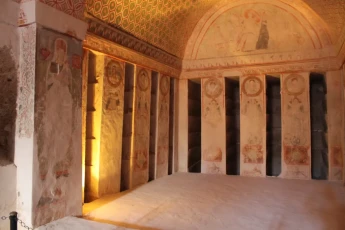
Tomb of the three Brothers, 2nd c.
The colourful fresco of the subterranean burial chamber present mythological creatures. Local and Roman artistic traditions were joined together.

Palmyra, Tetrapylon, rose granite columns from Aswan, 3rd century
[Original: Tetrapylon mit Rosengranitsäulen aus Assuan (nur noch eine original)]

At-Takiyya al-Mawlawiyya, prayer hall (old Midan)

Funerary temple, Palmyra

Nordostsyrien, kurdisches Hochzeitsfest
[Original: Musikanten bei kurdischer Hochzeit]

Monumentalbogen ("Hadriansbogen"), 3. Jh. n. Chr.
Der Triumphbogen zu Ehren des römischen Kaisers Hadrian verband die Säulenstraße mit dem Baaltempel. Er wurde 2015 vom ISIS gesprengt.

Raqqa - excavations at the site "East Raqqa" - the northern complex
[ 87/ 59/ 1789] =[ photo's name as: year/ film no./ photo no,]. On the back of the photo: [87/59].. (Naming the area of the photo was done according to the list, although some they are similar but were done in different areas.)

Jamiʿ ash-Shuʿaybiyya, upper part of the entrance - a cornice with floral motifs and a Qur'anic text in Kufic script

Ausschnitt der östlichen Stadtmauer von Damaskus

Al-Madrasa al-Muqaddamiyya, entrance to the prayer hall

Takiyyat ash-Shaykh Abu Bakr, the outer entrance and the minaret

Raqqa-Ost, Tall Aswad, Ausgrabung im 1985
[1985/72/988] = [photo's name as: year/ film no./ photo no.]

View to the east.

Bayt Ghazala, ʿajami panels decorating the southern wing ceiling in the main reception hall (qaʿa)

Busra - Southern Roman Bath (al-Hammam ar-Rumani al-Janubi)
Forecourt before Renewal, view to south

Burj as-Saʿa, Außenansicht

Busra - Jamiʿ (Moschee) al-Mabrak
Fishing in the Euphrates, Jabal ʿAruda

Busra, Hammam Manjak, exterior view

Manbij, gut sortierter Obst- und Gemüsehändler im Zentrum

Husn Sulayman, Temple of Zeus Baetocaece, inner face of the North Gate
Symetrical gate composition: higher middle gate, topped with semi circular arch. View from south.

Jisr ash-Shughur, Qalʿat ash-Shugr wa-Bakas, Kreuzritterburgen, Gesamtansicht des Standorts

Busra, Kirche im Kloster des Mönchs Buhayra, Schiff und Apsis
[Original: Bahira-Basilika, paganer Profanbau des 3. Jhs. n.Chr., Innenansicht: Triumphbogen und Apsis]

Qasr al-ʿAzm, Qaʿa im Obergeschoss, Muqarnas-Pendentif der Kuppel
Kuppelsaal: eine Trompe der Kuppel mit einer Art Muqarnas. ['Original: Hamâ (Epiphania),']

Al-Madrasa al-Ahmadiyya, dome of the prayer hall

Al-Madrasa al-Ahmadiyya, general view into the turba

Außenansicht der seljukischen Wassermühle vom Bab as-Salam, Damaskus

Garbage on the edge of an orchard in the Ghouta of Damascus

Propylon im Westen des Jupiter-Tempels, Teilansicht
[ Description by author: am Tympanon des Westportals des Períbolos. Vgl. Bild 0150 und 0151 ! ]

Blick über Safita mit dem kreuzfahrerzeitlichen Donjon

Habuba Kabira, Vorbereiten der Lehmmasse zur Herstellung von Lehmziegeln

General view of Qalʿat Salah ad-Din

Ebla (Tall Mardikh), Ruinen des Resheph Tempels
So nach dem unteren Bild der Schautafel. Hier nach ~ Südosten / Süd-Süd-Ost gesehen. [Original:Tall Mardîkh (Ebla)']

Windows above the western entrance of the Cathedral, today Tartus Museum
[Original: "Kathedrale Nôtre-Dame, zwei Fenster über dem Portal und ein krönendes drittes Fenster werden von eingestellten Säulen und Archivolten gerahmt"]

Aleppo: Grundstücksplan der nördlichen Altstadtquartiere
Entwurf eines Plans für die Katasterflächen der nördlichen Viertel der Altstadt: Hayy al-Judayda, Hayy Qastal al-Musht, Hayy al-Almaji und Hayy al-Hazzaza.

Aliya Alnuami
Tall al-Mishrifa (Qatna) within its geographic area

Minaret of al-Imam Ismaʿil Mosque, as-Salamiyya
Gesehen von der Sâhat al-Hurriya nach ~ Südosten. Im Vordergrund zwei byzantinische Säulen mit Kapitellen, vermutlich aus einer Kirche. [Original: 'Salamiya (Salamias)']

View to the village north of Jabal ʿAruda, graves in the foreground

Entrance towers on the west side, Harim Castle

Habuba Kabira, the stacked bricks under the relieving arch are removed by the master bilder

A view of the main facade, the Convent of Our Lady of Saydnaya

Zwei Türme der Burg Jaʿbar

View of the courtyard, Umayyad Mosque
[ Description by author: Blick aus der Nordost-Ecke nach Südwesten. Vorn links der Uhren-Pavillon, dahinter die Fassade des Transepts und seine Kuppel, rechts daneben das Minarett von Qait Bay. Weiter rechts im Hof der Bau mit dem Becken für die Waschungen, ganz rechts das Schatzhaus. ]

Bimaristan Arghun, view of main courtyard

In the chruch Saint Simeon Stylites, 5th century AD

Woman in the outskirts of Raqqa presenting an embroidered cushion sitting on the houses terrace

Bayt Wakil, dome of the reception hall

Shaykh Anas shrine - al-Tar mountain south-east of al-Mayadeen

al-Malikiyya - ʿAyn al-Khadra, Basalt Tomb with arabic inscription

Am 14.September feiert Maʿlula das Heiligkreuzfest, hier mit der Standarte der Heiligkreuz-Jugend

Damascus Gate, City Wall of Palmyra
[ Description by author: Gesehen von ~ Südosten. ]

Bayt Ghazala, ʿAjami-Wandvertäfelung in der roten Halle (Qaʿa)

Muqarnas inside the Kahf Castle, ash-Shaykh Badr, Tartus Region

Raqqa, Qasr al-Banat, Säulenkapitell mit vegetabilen Motiven
al-Husn Church, remains of basilica's façade, which, after its demolition, was transformed into an agricultural field

Dar'a, al-Jamiʿ (Moschee) al-ʿUmari, Inschrift an der Ostarkade

Al-Madrasa al-Hallawiyya, entrance - Zengid inscription in Naskhi script

Bimaristan Arghun, entry portal detail

Bel-Tempel, Kapitell im Temenos
[ Description by author: Kapitell. Auch von der Höhe her der ideale Gartentisch ....... ]

Hammam Bahram Basha, plant motifs above the main entrance

A photo of two towers, Jaʿbar castle

Al-Madrasa ash-Sharafiyya, details of the entrance muqarnas

Bimaristan Arghun, octagonal courtyard - fountain

Blick auf Stromschnellen des Orontes

Bayt Wakil, iwan

Waqf Ibshir Mustafa Pasha, Kaffeehaus, Halle
Das Innere der Halle wurde nur teilweise beschädigt, während die Kuppel mit ihrer hohen Laterne zum Größtenteil zerstört wurde.

View, from south, at northern overbuilt part of Suq (bazaar) of Khan al-Harir (Picciotto house)

Hama, general overview at the Jisriyya/Bridge Noria (waterwheel)
Here, in the picture from the thirties of the twentieth century, you can see the waterwheel, together with the name giving bridge, a separate building, as well as the terraces of two excursion locales or cafes. [Original description: Oronte eclairci NB] Note: these photos were taken between the year 1924 - 1939. The chosen date is to be average. (photographer unkown)

Interior view to the west showing the courtyard and the entrance of al-Bimaristan an-Nuri
[ Description by author: Innenseite, gesehen über den Innenhof nach ~ Westen. ]

Obergeschoss eines Wohnhauses in der Altstadt von Damaskus
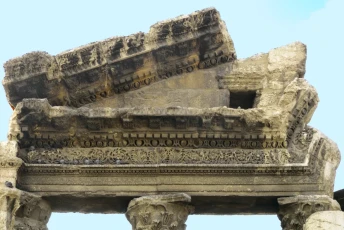
Part the western gate, Jupiter Temple
[ Description by author: vom Westportal des Períbolos, Detail aus Bild 0150. ]

Terrasses cultivation in the Coastal Mountains (al-Jibal as-Sahiliyya)

Spulen in der Textilfabrik der Familie Mezannar

Raqqa - "East of Raqqa" site - Western Palace
Raqqa X; West Palace, aerial photo prob. taken by a crane

Husn Sulayman, Temple of Zeus Baetocaece, inner face of the east gate of the temenos

Raqqa - Überrest der südlichen Arkade der Jamiʿ al-ʿAtiq

Jamiʿ Aslan Dada, Eingang der zusätzlichen Gebetshalle (al-Hijaziyya)

Afqa-Quelle - historisches Bad
[ Description by author: Beim Austritt des Kanals, Blick nach ~ Nordosten. Vorn rechts die "Treppe", links ein Altar, hinten die Säule und links von ihr noch ein Altar. ]

Zabadani Plains with trees and agriculture

Madrasat al-Firdaws, exterior view - northern facade

Jamiʿ Aslan Dada, view of the prayer niche

Die Norias ar-Rawaniyya und as-Sahuniyya/al-Gharbiyya (gegenüber von al-Kilaniyya)
Tele-Ausschnitt aus Bild 1007. (original date 03/03/2001 (?)) .['Original: Hamâ (Epiphania),']

Jamiʿ al-ʿAdiliyya, prayer hall's entrance - muqarnas details

View at an-Nuri Mosque and the Kilaniyya Norias on the Orontes River, Hama
Gesehen nach ~ Südwesten vom Dach des "Afamia Cham Palace", rechts etwa anschließend an Bild 0978. Vor der Moschee zwei Nawâ'îr, eine weitere links unten. . ['Original: Hamâ (Epiphania),']

Afamiya, remains of the colonnaded street (Cardo Maximus)

Remains of Busra cathedral

Jamiʿ al-Maydani, Gesamtansicht

Restoration of a part of a decorated wooden panel with ‘Ajami decoration of the Damascus Room in the Dresden Museum for Ethnology

Plan of Krak des Chevaliers
[Krak, Plan]

Al-Madrasa ar-Rukniyya al-Barraniyya, Blick in die Kuppel

Hammam Yalbugha an-Nasiri, the cold section (barrani)
The cold section (barani) is big and composed of four vaulted iwans, each of which has a platform and arched niche to put garments in. The center of this section is an octagonal water basin with a fountain.

Al-Senaniya Street: General View
[Original:'Straße in Damaskus']. The Bavarian air force division 304b was based in Palestine from 25. October 1917 and was involved in the First World War until the division left the region, over Aleppo, in mid September 1918. During that period, over 3000 glas photographs, mostly aerial, have been made. Those early photographs were important for the archaeological research in the Middle East region.

Museum of Palmyra / Tadmur, Stone-relief with figural decoration

Qanawat, General view the nymphaeum

Bayt Junblat, Grundriss
Beschriftung auf deutsch. Plangröße 42 x 30, kein Maßstab.

Raqqa-Ost, Nordkomplex, Ausgrabung
Eastern North Complex; Middle Trench

General View of al-Bahramiyya Mosque

Qal‘at Shayzar ( Zitadelle), Eine arabische Inschrift

Al-Madrasa al-Muqaddamiyya, an inscription above the entrance gate
shap_import_65984

Staircase and old wooden door in a traditional House in Maʿlula

View into an excavation trench of Tall Bdiri: to stabilize the walls, pilasters were added
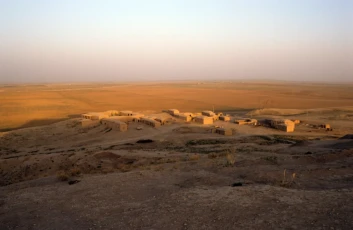
Village of Tall Hamidiyya with excavation house (left)

Qasr al-ʿAzm, Innenhof des Salamlik
(Offizieller Bereich): Innenhof. ['Original: Hamâ (Epiphania),']

Al-Madrasa al-Kamiliyya, niche (mihrab) in the prayer hall

Hiraqla victory monument, Western gate - decorative stone panel

A side from the castle showing an entrance, Qalʿat Najm

Jamiʿ Sharaf, Qastal facade

Al-Madrasa az-Zahiriyya, prayer niche
shap_import_66087

Qal‘at Shayzar (Zitadelle), der obere Bereich des Eingangs.

Palmyra, Blick von der Burg auf die Wüstenlandschaft
[Original: Blick von der Burg auf die Wüstenlandschaft]

Busra, Hammam Manjak, iwan in the cold section (barrani)

Near Tall Abyad, ʿAyn al-ʿArus-Karstteich

Shaykh Shibli shrine - al-Tar mountain, south -east of al-Mayadeen
Near Qa'alat ar-Rahaba, Shrin Shaykh Shibliy. [Original:'Bei QAL'AT ar-RAHABA, Grabbau = SAIH SIBLI']

The altar of Nabu Temple, Palmyra
[ Description by author: ~ Süd- und ~ Ostseite, dahinter die Stufen vom Aufgang des Podiums des Tempels. Die Reliefs sollen Gottheiten darstellen. ]

Turbat ash-Shaykh Hasan / Turbat Mukhtar / Turbat Ahmad Basha, Fassadenansicht Jaddat Suq al-Ghanam
[ Description by author: Erbaut 1316. Zwei Kuppeln auf achteckigem Tambour, Eingangs-"Iwân". Die Nische rechts neben dem "Iwân" ist möglicherweise ein Brunnen. Gesehen wohl von ~ Nordwesten. ]

Dar'a, al-Jamiʿ (Moschee) al-ʿUmari, Haupteingang von innen gesehen

Sample catalogue for silk fabrics, textile factory of the Mezannar family in Damascus

A Jacquard-loom in the textile factory of the Mezannar family in Damascus

Jamrin, Brücke über das Wadi az-Zaydi

Qalʿat Burqush, Reste einer Byzantinischen Kathedrale
[ Description by author: Es soll bei der Kathedrale fünf Kapitell-Typen geben, hier einer davon, auf Bild 0086 ein anderer. Ich vermute, dass das Kapitell nicht wiederverwendet römisch, sondern original byzantinisch ist. Ist der Stein im Hintergrund Teil einer Türschwelle (Tür zum Betrachter hin öffnend) ? ]

Kharbaqa Dam: One of the dams that were built to limit seasonal flood waters in the Badiyya

The façade of al-Hayr al-Gharbi Palace, National Museum of Damascus

Door with ornaments on the lintel, Qarqbiza
[Original: Haus, Tür mit Ornamenten auf dem Türsturz]

Jabal ʿAruda, Maqam (shrine) ash-Shaykh 'Aruda

Mary's girdle in the Saint Mary Church of the Holy Belt, Homs

Imam Ismaʿil-Moschee, Seitenansicht mit Mausoleums-Kuppel

Al-Madrasa al-Hallawiyya, Haupteingang

Madinat al-Far, Grabung

Minaret and exterior wall of the Great Mosque of ar-Raqqa/ar-Rafiqa, 8th/12th c.

Busra, Hammam Manjak, Nordflügel mit Heißwasser-Reservoir während der Restaurierung
North wing with hot water reservoir

Al-Khubra See in Jabal Says

Ithriya Temple - Some archaeological finds

Modernes, dreigeschossiges Gebäude in Raqqa

Jaʿbar-Burg in At-Tabqa, eine Bastion mit Schießscharten.

Ländliches Leben im Qalamun-Gebirge (Antilibanon): Bauern kommen von Weinlese zurück

A view of fields in 'Afrin area

Traditional patchwork wall hangings, in which small things might be stored

Bimaristan Arghun, Achteckhof, Blick auf die Zellentüren

Qanawat, Relief on a rectangular basalt stone

Engraving of Aglibol (god of the moon), Temple of Bel
[ Description by author: Detail aus Bild 0637: Aglibol an seinem Altar, hinter ihm ein Adler mit einem Palmzweig. ]

Waqf Ibshir Mustafa Pasha, Kaffehaus, Innenraum nit Kuppel und Muqarnas-Pendentifs

Al-Matbakh al-ʿAjami, muqarnas squinches of the iwan dome

Bayt Wakil, the iwan's canopy

Izraʿ, al-Jamiʿ (Mosque) al-ʿUmari - the courtyard

Khan Qurdbak, detail of a window in the iwan

Raqqa, Qasr al-Banat, courtyard with southern Iwan

Tall Bdiri, Farmsteads, that have no enclosure walls

Blick auf den großen Platz vor dem Eingang in die Zitadelle von Aleppo
Das Foto, das vor dem Krieg vom großen Saray (as-Saray al-Kabir) aus aufgenommen wurde, zeigt den Platz gegenüber dem Eingang der Zitadelle Aleppo. Der Platz ist mit Basalt- und Kalksteinfliesen belegt und mit Palmen begrünt.

Bel-Tempel, Cella von Südosten
[ Description by author: West- und Südseite, gesehen von ~ Südosten. Über dem Gebälk der Peristase "Assyrische Treppenzinnen" - typisch für derartige Gebäude im Nahen Osten in dieser Zeit, s. z.B. Petra ! ]

Mushabbak, Byzantine basilica, general view from south-west

Ghuta of Damascus, aerial photograph of some orchards
Farmers in the Ghouta of Damascus have adopted a dense and mixed farming pattern of diverse vegetables, fruits, trees and aromatic plants. The residences are placed in the orchards.

Nahiyat Tall Tamir, Frau baut die Wandung eines kleinen Vorratssilos
Die assyrischen Dörfer am Khabur mit ihren Kuppelhäusern baute die französische Mandatsregierung für christliche Flüchtlinge aus der Türkei und dem Irak.

Palmyra / Tadmur, General view of Baalshamin Temple
[Original: Baal-Schamin-Tempel, 130 - 150 n. Chr.]

A photo of the courtyard of Bayt Shaykh Qatana before demolition
Bl.aus dem Liwan ü.d. Bahra

Palmyra / Tadmur, Umgebung S, Südwest-Turm, Khan al-Hallâbât / Veriaraca
[ Description by author: (der linke von Bild 0944), gesehen von Südosten. ]
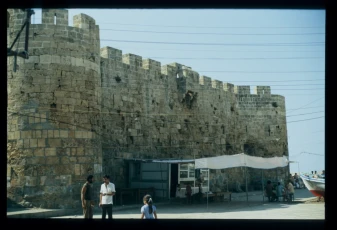
Arwad, Ayyubid fort

Jamiʿ ad-Darwishiyya, Eingang und Minarett
[ Description by author: Erbaut 1574. Eingang und Minarett, gesehen vermutlich von ~ Osten. ]

Bayt Dallal, ornamentierter Steinfries über einer Tür

Bayt Junblat, courtyard and northern iwan

Moschee, Innenansicht mit Mihrab (Gebetsnische) und Minbar (Kanzel).

Yabrud: residential houses with central hall floor plans
Street view with central hall house. This building along the street shows a local variation (of the Qalamun Mountains) of the house form known from Lebanon since the middle of the 19th century: shaded entrance hall with an entrance arcade of three arches on round columns on the ground floor, above it on the upper floor the repetition as open seating area with balcony in front. A symmetrical stone façade made of cleanly carved limestone and slender arched windows. These houses were probably built in the first quarter of the twentieth century.

Reuse of a Byzantine building as a residence, Sirjilla
[Original: Haus Nr. 17/18. Das höher gelegene Haus Nr. 18 mit einer teilweise noch stehenden doppelgeschossigen Säulenvorhalle ging zeitlich dem Haus Nr. 17 (6. Jh.) voraus.]

Luftbild des Anti-Libanon mit Barada-Tal

In der "Geraden Straße" mit römischem Torbogen und Al-'Umari-Minaret

Maqam Ughulbak, Gesamtansicht von außen

Raqqa, Remains of Qasr al-Banat

Fresko an der Westwand der Kirche, Kloster Sankt Moses der Äthiopier
[ Description by author: Jüngstes Gericht an der Westwand, Details. Drei Register der linken Seite, in der Mitte vier Mal "Abrahams Schoß". Interessant ist die Figur unten rechts, die etwas "von oben" empfängt: ihre Harartracht erinnert sehr an die von Bild 0483 ! Dort vermutete ich eine Dornenkrone, das trifft hier aber gewiss nicht zu ! ]
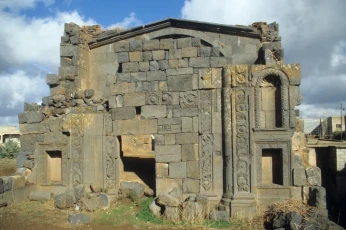
South Temple in ʿAtil, remains of the main façade (partially distorted at present by the transformation of the building into a residence)

As-Sabuniyya-Moschee, Eingang, oberer Bereich der Portalnische mit reichem Dekor und Muqarnas-Halbkuppel
[ Description by author: Dekor des oberen Teiles, wohl von ~ Osten gesehen. ]

Blick über das Kalksteinmassiv, hier liegt das Kloster St. Simeon (Qal'at Sam'an)

Suq Istanbul al-Jadid, Blick nach Norden in die zerstörte Marktgasse

Khan al-Jumruk, internal facade of the Khan's entrance

Raqqa - "East of Raqqa" site - Tall Aswad, excavation in 1985
[1985/72/977] = [photo's name as: year/ film no./ photo no.]

A general view of the remains of Shayzar Castle located on a rocky cliff

Khan al-Jumruk, Ansicht der Moschee im Zentrum des Innenhofes

Baalshamin-Tempel, Ansicht von Osten

Bimaristan an-Nuri, view of the western Iwan

Citadel of Aleppo, Maqam Ibrahim - foundation inscription on the right side of the prayer hall's entrance

Kaffeehaus Aslan Dada (nicht erhalten)

Khan al-Wazir, Innenhofansicht

Inschrift mit ornamentiertem Rahmen in der Burg von Masyaf

Tartus, Qalʿat al-Marqab , Kreuzritterburg, ein Innenhof in der Burg.

Al-Madrasa al-Muqaddamiyya, a groin vault in the entrance
shap_import_65983
Bimaristan Arghun, passageway
shap_import_60902

The dome of Maqam Salah ad-Din al-Ayyubi
[ Description by author: Der Bogen rechts und das anschließende Grab sind die einzigen Reste der Madrasa 'Azaziya, gegründet von einem Sohn Salâhu d-Dîns, wo dieser 1195, zwei Jahre nach seinem Tode, beigesetzt wurde.- Gesehen nach ~ Nordwesten. ]

Qalʿat Salah ad-Din

Al-Madrasa as-Sultaniyya, Marmor-Gebetsnische
The mihrab is another fine example of marble marquetry, with recessed panels bordered by a relief molding in the central half-cylinder, horizontal coursing in the niche head, and a well developed interlace occupying the spandrels. Columns, capitals, and bases are again contemporary. (Allen, Terry. "Madrasah al-Sultaniyah". In Ayyubid Architecture. Occidental, CA: Solipsist Press, 2003. http://www.sonic.net/~tallen/palmtree/ayyarch/ch8.htm#alep.msul)

At-Takiyya al-Ikhlasiyya (az-Zawiya ar-Rifaʿiyya), inscription and decoration above the entrance
shap_import_65802
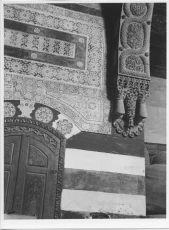
Decoration of the qaʿa (guest room) in the Quwatli House
Kämpferkonsole in der Qa'a

Al-Madrasa ash-Sharafiyya, Gebetsnische mit geometrischen Flechtbandmustern

View of the old town from Maʿlula with its traditionally light blue painted facades

Bayt Junblat, southern iwan (the great iwan)

Burj as-Saʿa, Eingangsportal

Side of the Ruins, Sirjilla

Yabrud: Streetlife with shops and residential houses, townspeople and peasants
Street view with houses and a village scene of a farmer with cart and draught animal. The buildings along the road show a local architecture (of the Qalamun Mountains): one to two-storey stone facades with triple openings in the upper floors. Middle door and side windows, all with round arches and a balcony in front. A symmetrical stone façade made of cleanly carved limestone and slender arched windows. These houses will probably be built in the first quarter of the twentieth century.

Hama, Zum Qasr al-ʿAzm führende historische Gasse

Kharbaqa Dam: One of the dams that were built to limit seasonal flood waters in the Badia
[ Description by author: Steiler Blick nach oben aus dem Flussbett. ]

Maronite Cathedral, the nave

Az-Zawiya al-Hilaliyya, the entrance
shap_import_63346

Turmgrab des Elahbel, Innenansicht

Säulenstraße - Abschnitt C, Blick auf Totentempel
[ Description by author: 3. Abschnitt mit dem Tempelgrab als Abschluss. Rechts die Burg des Fakhru d-Dîn al-Ma'ni. Gesehen von ~ Südosten. ]

Jamiʿ ash-Shuʿaybiyya, west facade - entrance and Qastal
Other names are Mosque of Shields or Mosque of Bab-Antakya,

Conservation of the Grape Room made in 1835, house Nizam, Damascus

As-Safira area in Aleppo province - clay dome houses

Painting of a calligraphy work of a contemporary ‘Ajami decoration
Mohammad Haj Qab in the age of 17 working with the craft of ‘Ajami

Waqf Ibshir Mustafa Pasha, Kartierung der Schäden (Arabisch)
Der waqf (Stiftungs-Komplex) von Ibshir Mustafa Pasha hat in mehreren Bereichen schwere Schäden erlitten. Dazu gehören der Khan auf der Nordseite und die östliche und westliche Qaysariyya. Ohne vorherige Trümmerbeseitigung kann keine abschließende Aussage über das Ausmaß des Schadens getroffen werden. Höchstwahrscheinlich kam es in den von der Tunnelbombenexplosion vom April 2015 betroffenen Gebieten zu einem Totalschaden. Der westliche Teil des waqf-Komplexes, einschließlich seiner Vorderfront, steht noch, ist aber deutlich beschädigt. Zwei der wichtigsten Gebäude des Waqf-Komplexes von Ibshir Mustafa Pasha sind in Teilen erhalten geblieben: die Moschee und das Kaffeehaus im Süden. Die einzigartig dekorierte Fassade der Halle des Kaffeehauses sowie die erste Gewölbezeile wurden zerstört. Der Kern der Halle wurde nur teilweise beschädigt, während der Abschnitt der zentralen Kuppel mit ihrer hohen Laterne größtenteils zerstört wurde.

A photo of villagers in front of traditional building under construction, Raqqa

Qarqbiza, ornamentierter Türsturz
[Original: Haus, Tür mit Ornamenten auf dem Türsturz]


Damascus, the eastern part of the city wall near to Bab Kisan
Parts of the historic city wall, some with integrated residential buildings, have been preserved to this day. Legend has it that the apostle Paul fled from here, the Bab Kisan gate in the background on the right, to spread the Christian doctrine.

West Syria, access to the Salah ad-Din Castle carved through two artificial crevices, 12th c.

Khan Qurdbak, Haupteingangsportal

General view of the ruins of Palmyra
[ Description by author: vom Bel-Tempel, also von ~ Südosten, her. Rechts der Monumentalbogen, von ihm ausgehend nach hinten links der 2. Abschnitt der Säulenstraße bis zum Tetrapylon. Von dort zweigt eine weitere Säulenstraße nach links ab. Im Hintergrund die Burg des Fakhru d-Dîn al-Ma'ni. Die hohen Säulen vorn gehören zur Exedra des 1. Abschnitts der Säulenstraße (vgl. Bild 0657 - 0660 !). ]

Busra, Hammam Manjak, Restaurierungsarbeiten

Khan al-Wazir, internal facade of the khan's entrance
[Original:'Khân al-Wazîr,Halab / Aleppo. Innenseite des Tores von Bild 1248.'].

Relief with vine tendrils
[Original: Bauornamentik]

Turbat Khaʾirbak (mausoleum), western facade - niche with trefoil arches

Raqqa, Qasr al-Banat, Lehmziegeldekorationen

Az-Zawiya al-Hilaliyya, the upper part of the wooden prayer niche

Al-Madrasa al-Hallawiyya, Gesamtüberblick vom Minarett der Großen Moschee

Mari (Tall al-Hariri), the palace's cistern made of baked brick (beginning of 2nd millennium BC)
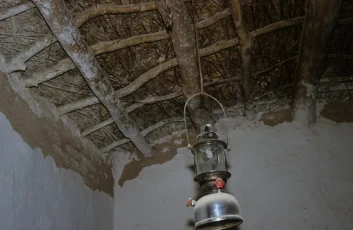
ʿAyn al-ʿArus, view into the ceiling of a village mud bricks house, armenian owners

Blick vom Zayzun-Wasserfall ins Yarmuk-Tal, das hier die Grenze zwischen Syrien und Jordanien bildet

Capital of a column- Temple, Harran al-ʿAwamid
[ Description by author: einer der drei Säulen. Zumindest auf zwei Seiten ist es sehr gut erhalten. Vgl. Bild 0373 ! ]

Aleppo-Seife: frische Seife zum Trocknen
Die Seife wird zum Trocknen gestapelt. Der Vorgang dauert mehrer Monate. Schmale Spalten zwischen den Stücken dienen der Belüftung.

Raqqa - remains of the southern arcade of al-Jamiʿ al-ʿAtiq (Great Mosque)

Bab Qinnasrin (city gate), exterior view of the gate from south-west
The gate is topped by a pointed vault. It was built in the style of Ablaq, in which stone rows alternates between black and white colors.

Great Mosque of Aleppo, view at courtyard, from 1907
View in eastern direction with the citadel in the background and the pavilions for ritual washing (Abolutionary) visible in the inner courtyard (Sahn). Out of a group of glass-plate photographs from a donation by Prof. Friedrich Sarre to the Museum für Islamische Kunst in Berlin in 1947!

Bab al-Hadid, general view of the gate's tower from the outside

Inside of Krak des Chevaliers

Turbat Khaʾirbak (mausoleum), Mamluk Rank

Hammam Yalbugha an-Nasiri, general view from the Citadel


Obstplantage in der östlichen Ghouta

Çintamani motifs, Aleppo Room wall frame, early 17th century

General view of Masyaf Castle

Busra, Hammam Manjak von außen

Roman grave behind the monastery of Notre Dame de Saydnaya
[ Description by author: aus byzantinischer Zeit im Felssockel der Klosteranlage. Die Figuren erinnern an die der sog. "Hochzeit von Kana" in Qânâ / Libanon. ]

Al-Madrasa as-Salimiyya, Arkadenhof mit Brunnenbecken
[ Description by author: mit ähnlicher Grundstruktur, errichtet um 1570 unmittelbar östlich an der Takiya. Blick von ~ Norden über den Innenhof mit Becken auf die Moschee. Die Anlage dient heute für Werkstätten des klassischen Kunsthandwerks: man kauft hier teils Besseres und auf alle Fälle presigünstiger als im Sûq al-Hamadiya. ]

Jamiʿ al-Mihmandar, prayer hall - minbar (pulpit)

Südwestsyrien: Qalamun-Gebirge, das Dorf Maʿlula mit seinen hellblauen oder weißen Hausanstrichen

ʿAyn al-ʿArus, in der Küche eines Lehmziegelhauses armenischer Besitzer mit eingebautem Spülstein
Fensternische mit integriertem Spülbecken aus Beton

A room cladded with ‘Ajami decoration in a Damascene house
shap_import_97591

At-Takkiyya al-Mawlawiyya, Sabil (Brunnen)

Bayt Junblat, southern iwan - marble decoration
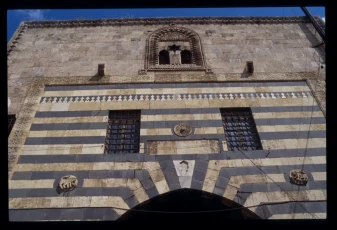

Busra, Hammam Manjak, Seitenansicht

Takiyyat ash-Shaykh Abu Bakr, Innenhofansicht mit Portikusarkaden, Zimmern und innerem Eingang

Säulenstraße, Überreste von Säulenreihen

The ceiling of the guest room (qaʿa), al-Quwatli House
Decke der Ataba in der Qa'a

Aleppo-Seife
Das Bild zeigt ein angeschnittenes Lorbeerseifenstück nach dem Trocknen. Es ist innen grün.

Bab as-Salam, das "Friedenstor", im Norden der Altstadt von Damaskus

Tower north of Bab Antakiya. The inscription indicates a restoration by the Mamluk ruler al-Malik al-Muʾayyad Shaykh between 820/1417 and 823/1420

Jamiʿ at-Tawashi, Ostfassade - rahmende Ecksäule einer Fensternische
[Original:'Jâmi' at-Tawâshi, Halab / Aleppo. Detail aus Bild 1284: die rechte Säule des Fensters.'].

Interior view with fresco paintings, Tomb of the Three Brothers

Große Moschee, Blick auf den Innenhof, 2018.
Blick auf den Innenhof während der Wiederaufbauarbeiten und der Trümmersortierung, im Innenhof werden insbesondere die Trümmer des zerstören Minaretts inventraisiert und sortiert gelagert.

Raqqa/Rafiqa, An old photo of the remains of al-Banat palace before restoration
[Original: Palast. Aufnahme von Westen/ 1945 Geschenk Prof. Friedrich Sarre]

Khan al-Jumruk, interior facade of the khan's entrance

Raqqa - "East of Raqqa" site - Western Palace
[86/190/1240a] = [photo's name as: year/ film no./ photo no.]. [Original on the back: 'ar-Raqqa, Grabüng Ost (1986), Westpalst'. 'Alt:10/86/39']

al-Malikiyya - ʿAyn al-Khadra, Basaltgrab mit arabischer Inschrift

Bayt Junblat, southern iwan - decoration of marble and faience tiles

Baalshamin Temple, general view from southeast, Qalat Ibn Maan in background

Nordostsyrien: Webarbeiten im Zelt

Sirjilla, Gesamtansicht der Gebäudereste

The eastern altar, al-Karasi
[ Description by author: Zwei Seiten ohne Inschrift / Relief. ]

Die Wasserkammern im Radkranz eines Schöpfrades (Noria)
['Original: Hamâ (Epiphania),']

Citadel of Aleppo, the Great Mosque - inscription

Qalb Lawza, Basilica of 5th c., Apse and south façade
[Original: Basilika, vor 469, SO-Seite]

Details of lintel decorations, Theater of Palmyra
[ Description by author: Rückseite des Tores von Bild 0721, Detail der rechten Seite. Man erkennt links eine Büste ohne Kopf, daneben ein sitzendes Huftier oder vielleicht einen Faun. Dieses/r entspricht genau der Figur ganz links auf der linken Spolie in der arabischen Bastion Bild 0598 ! Vgl. auch Bild 0754 ! ]

Raqqa, Seitenansicht des Qasr al-Banat

Noria (water wheel) with aqueduct in ar-Rastan in 1930
An old vintage print (postal card? Labeled Photo ARCHO) of one of the norias of Orontes River near the city of ar-Rastan. The aqueduct, made of stone vaults, receives water from the noria’s buckets.
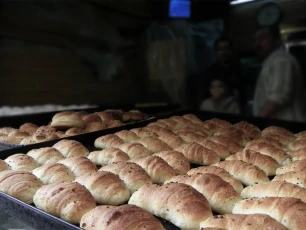
Eine Bäckerei in der Altstadt von Aleppo
Backwaren in einer Bäckerei Im historischen Stadtviertel al-Jallum.


Palmyra, Diokletianslager, Grab
[ Description by author: Inneres des Grabes von Bild 0759. ]

Qasr al-ʿAzm, view of the ground floor courtyard

Courtyard of the Great Mosque, Hama

Eingangsseite mit Minarett der Sibaʿiyya-Moschee in Damaskus

Khan Qurdbak, südlicher Teil des Innenhofes mit Iwan des mamlukischen Palastes

ʿAyn Diwar, ehemalige Brücke über den Tigris

Bayt Junblat, Süd-Iwan, Wanddekoration mit Marmorplatten und Fayencefliesen

Kharab Shams, Blick von Südwesten auf die Basilika
[Original. Säulenbasilika, 4. Jh. von weitem, von SW. Nach dem Einsturz der Seitenschiffe bei einem Erdbeben ist nur noch das Mittelschiff erhalten. Fensterhochwand mit Rechteckfenstern stammt aus dem 4. Jh., die mit Rundbogenfenstern aus dem 6. Jh.]

Bayt Wakil, iwan - decoration above a room's door

A small river in the Syrian coastal mountains (al-Jibal as-Sahiliyya)

Alltägliche Straßenszene in ar-Raqqa
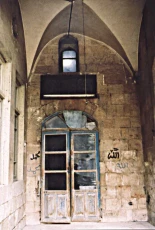
At-Takiyya al-Ikhlasiyya (az-Zawiya ar-Rifaʿiyya), Eingang der Gebetshalle
shap_import_65805

ʿAyn al-Khadra, Wohnhaus einer kurdischen Familie mit Mittelhallengrundriss in der Malkiyya-Region

Raqqa - the excavations of the site "East of Raqqa" - Eastern Palace - stucco decorations
Floral frieze decoration, Raqqa II; Eastern East-Palace

Hiraqla victory monument: isometric reconstruction

A boat trip in the Euphrates, near Jabal ʿAruda

A view towards the Euphrates, Jabal ʿAruda

Burj as-Saʿa, upper part of the entrance

A mechanical loom in the textile factory of the Mezannar family

The entrance of the Tomb (Hypogeum) of the Three Brothers

Raqqa - "East of Raqqa" site - Tall Aswad, excavation in 1985
[1985/24/405] = [photo's name as: year/ film no./ photo no.]. ["s.a. Dias"]

Khan al-Wazir, general view

Great Mosque, damage mapping
The Great Mosque of Aleppo has moderate damage, except for the complete destruction of the minaret in April 2013. The degree of damage is around 30%. The western wing shows two large circular holes in the roof. There are currently no photographs available which clarify the extent of the interior damage. Several fires have affected parts of the main prayer hall causing damage especially to the southern gate and the wooden doors of the northern facade. The northern arcade was burned and its main gate partially damaged. The eastern part of the courtyard floor is torn out.

Suq Aslan Dada, rebuilding of northern entrance, view towards south

Al-Madrasa al-Kamiliyya, Eingangsportal

Tartus, Qalʿat al-Marqab , Kreuzritterburg, ein Blick von der Zitadelle

at-Tabqa, Jaʿbar Castle, Towers of western walls

Excavations at Tall Sabi Abyad

al-Matbakh al-ʿAjami, ground plan drawing before the partial demolition
Reconstruction drawing of the intact palace before the partial demolition in the southern part (plot VII-3-1 2057 in today's borders), with additionally drawn in cadastral level, for its extension on different plots. Based on a partial survey of the Antiquities Administration (DGAM).

Two large reservoirs in the ruins of Kharab Sayyar

Zitadelle von Aleppo - Tempel des Wettergottes Hadad, Orthostatenwand (Ausschnitt)
[Original: Grabung Kohlmeyer]

Busra, Hammam Manjak, Islamic Museum

Wakil House, dome of qaʿa (reception hall)
view at the dome on top of the representative reception hall (Qaʿa). It is standing on a polygonal drum (tambour) with windows for lighting.

The western vaulted arcade of al-Jamiʿ al-Umawi (Umayyad Mosque)

A shepherd with his herd on the arch bridge which leads to Shayzar Castle

Qalb Lawza, Basilica 5th c., view of main facade from south-west

Al-Madrasa as-Sharafiyya, main entrance facade, Inscription

Archaeological excavation at Balis

Busra - Hammam Manjak - bathing niches in the hot section (Juwwani)

Excavation of mosaic floor, ʿAyn al-ʿArus
![The South-western part of Bayt al-Husainin with the minrat of its mosque. [Original photo name: as-i-مجمع قصر الحسيني 1_SYRHER]](https://syrian-heritage.org/wp-content/plugins/justified-image-grid/timthumb.php?src=https%3A%2F%2Fsyrian-heritage.org%2Fwp-content%2Fuploads%2F2020%2F04%2Fshap_import_75454-1024x768.png&h=230&q=90&f=.png)
The South-western part of Bayt al-Husainin with the minrat of its mosque. [Original photo name: as-i-مجمع قصر الحسيني 1_SYRHER]

Palmyra / Tadmur, Museum, Löwe der Göttin Al-Lat
[Original: Museum: Löwe als Beschützer einer Gazelle aus dem Heiligtum der Allat, ca. 50 v. Chr.]

The northern entrance of the historical city of Dura Europos (Qalʿat as-Salihiyya), end of 4th century BC
in der Westmauer, gesehen von ~ Nordwesten.

Jamiʿ (Moschee) al-Hanabila, Grundriss

reiterstandbild von Salah ad-Din, vor der Westfassade der Zitadelel von Damaskus

Salah al-Din Castle, castle walls resting on the grown rock

Suq Aslan Dada, general view of the reconstruciton of the suq and the eastern facade of Khan as-Sabun
Bögen der einstigen Wassermühle von al-Ashnan am Fuß des Qasyun-Bergs in Damaskus
shap_import_77200

Jamiʿ al-Utrush, western facade - decorated window
The window has rectangular shape and decorated by ablaq style (black and yellow masonry) on the sides and joggled voussoir. All combined inside a large flat niche with two spiral columns on the lower section and topped by a cornice of muqarnas. The niche top part framed by double muqarnas plates and carved serrated border. Also, there is upper small niche above the big windows.

Qalʿat ash-Shugr wa-Bakas, die verbindende Brücke zwischen den beiden Burgen

Jamiʿ Aslan Dada, Gebetshalle (Qibliyya), Fenster oberhalb der Gebetsnische
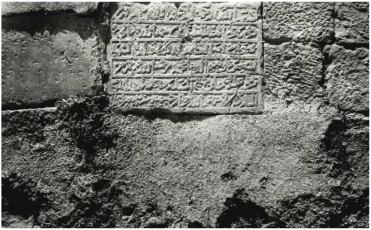
Jamiʿ (mosque) al-Hanabila, inscription

Wadi az-Zaydi, historische Brücke
bei Busra, Brücke

ceiling of Bayt Ḫazīna-Kātibī / Niẓām with ‘Ajami decoration
detail of the šīša-ceiling with panels (ṭabaq) painted alternately on green and red ground

Busra, Hammam Manjak

Arch of the remains of Qasr al-Hayr al-Gharbi (Palace)
[ Description by author: Blick nach Osten - vielleicht durch das Westtor ? Oder geht der Blick durch die Ostmauer auf andere Gebäude (z.B. den Khân) ? ]

View from Qalʿat Ibn Maʿn towards the Valley of the Tombs
[ Description by author: Blick nach ~ Südwesten. Der hohe Turm rechts der Bildmitte ist der des Elahbel. ]

Jamiʿ Aslan Dada, inscription above the hall entrance

General view showing the remains of city wall on the right
[ Description by author: In der Mitte das Tempelgrab, ganz rechts ein Turm der Mauer, dahinter Säulen vom 3. Abschnitt der Säulenstraße, links oben die Burg. Blick nach ~ Norden. ]

Hauptfassade des Klosters Unserer Lieben Frau von Saydnaya

Al-Madrasa az-Zahiriyya, prayer hall - historic photo of the collapsed central dome
Muqarnas-Zwickel der Grabkuppel

Jamiʿ Aslan Dada, Iwan mit Eingang zur Halle

Nahiyat at-Tabqa, Euphrates Dam

Al-Madrasa as-Sultaniyya, östliches Fenster des Mausoleums von al-Malik az-Zahir Ghazi

One of the entrances in Qalʿat Salah ad-Din (castle)

Die Straße "Zwischen den Schulen"

Busra, Masjid Yaqut (Moschee), Steinblock mit Gründungsinschrift

Raʾs al-ʿAyn, Straßenseite eines spätosmanischen Wohnhauses und eines Lagers oder Geschäftes, die am Hang gelegen sind
Hinter dem Steingebäude im Vordergrund liegt der große Garten des spätosmanischen Hauses.

Bayt Jubran Afandi Shamiyya, now the Riʿaya private school, Bab Tuma
Tarma. Innen

Damascus, Glass Blowing Workshop near Bab Sharqi
[Original: LEAD Technologies Inc. V1.01]
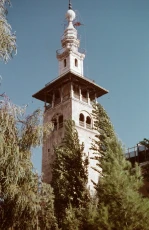
Umayyad Mosque in Damascus - al-ʿArus minaret

Raqqa - "East of Raqqa" site - Tall Aswad, excavation in 1985
Tall Aswad

Ruinen der islamischen Burg Ja'bar
Hinweis: Dieses Foto wurde zwischen den Jahren 1924 - 1939 aufgenommen. Das gewählte Datum soll ein Durchschnittswert sein. (Fotograf unbekannt)

Eine kleine Noria (Wasserschöpfrad) am Orontes-Fluss
Eine der kleinen Norias in Hama, die den großen Norias mit ihrem Holzrad und Steinsockel sehr ähnlich ist.

Mushabbak, byzantinische Basilika, Kirchenschiff nach Westen

General view of the Barada spring close to the eastern Mountains of Lebanon

Imam Ismaʿil-Moschee, Innenhof - Eingang zur Gebetshalle

Busra - Madrasat Abu al-Fidaʾ and (pond) Birkat al-Hajj, filled with rain water

Seitenansicht einer byzantinischen Kirche, al-Bara

Exterior view of the wall of Najm Castle (Qalʿat Najm)

Haus Dada, Innenhof mit Brunnen, vom Iwan aus gesehen,
Hof vom Liwan aus gesehen

Gästehaus einer wohlhabenden Familie in Maskana, an den ein Iwan angebaut wurde
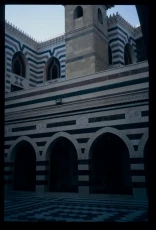
Alternate ablaq rows in the courtyard of Jamiʿ Manjak

Fort V, Ebla (Tall Mardikh)
Gesehen nach ~ Süden. [Original:Tall Mardîkh (Ebla)']

Nordostsyrien, Obere Euphratregion

A robust 4 cm thick felt carpet made of wool in the manufacturing facility for felt carpets in Al-Bab
Photographs of a manufacturing facility for felt carpets in Al Bab as part of the "Aleppo Stadtarchivprojekt" of GIZ (German Corporation for International Cooperation) in 2008

Tomb tower of Elahbel, the Valley of Tombs
[Original: Große Orientreise Nr.63 mit Rotel-Tours: Amman-Bagdad-Uruk-Babylon-Arbil-Mosul-Hatra-Samara-Mari-Dura Europos-Aleppo-Dayr Saman-Ugarit-Palmyra-Jarash]

Mushabbak, byzantine basilica

Irrigation fields of ʿAyn at-Tina in Qalamun (mountainous region in southwest Syria)
The village itself lies in the middle ground above the level of the irrigated field terraces: In the background, the Eocene limestone layer of the Jebel Maaloula with up to 1913 m above sea level.

View to the south-east of ʿAyn al-ʿArus lake

Monumentalbogen, Fernsicht mit Säulen der Exedra am Abschnitt A der Großen Kolonnade
[ Description by author: Exedra des 1. Abschnitts der Säulenstraße, Monumentalbogen und 2. Abschnitt, Burg, gesehen von ~ Südosten. Die sehr hohen Säulen der Exedra sind aus - vermutlich ägyptischem - Granit, nicht aus dem lokalen Kalkstein. Der Abstand der beiden Mittelsäulen ist etwas größer als der zwischen Mittel- und Außensäulen.- Im Plan in G. Degeorge "Palmyra" steht an etwa dieser Stelle "Nymphäum" - ? ]

Al-Matbakh al-ʿAjami: Annex, Grundriss Erdgeschoss

Grabungsfund aus dem Ostpalast in ar-Raqqa

Blick über Harim in der Provinz Idlib
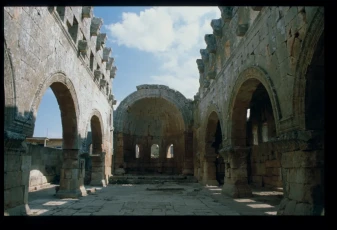
Qalb Lawza, Basilica of 5th c., central view at nave and apse

The northern entrance of the historical city of Dura Europos (Qalʿat as-Salihiyya), end of 4th century BC
Gate of south-western side/ view from outside [Original: "Salihiyyah, Tor der Südwestseite / von Außen"]

Modell des Bel-Tempels
[ Description by author: Modell, gesehen von ~ Nordwesten. Zu sehen der Tempel in seinem Hof und die Peribolos-Mauer mit den Propyläen. Der Tempel wurde um 30 n. Chr. geweiht, die Propyläen im 12. Jh. in eine arabische Bastion umgewandelt (Bauinschrift s. Bild 0599 !). Im linken Teil sieht man den Eingang zum Tunnel der Rampe unter den Peribolos (s. Bild 0606 !): hier wurden die Opfertiere in einer Prozession zum Altar im Hof geführt. Zu erkennen ist auch, dass der Tempel quer orientiert ist - interessanterweise wie die islamische Moschee ! ]

Raqqa, "East of Raqqa" site - Western Palace, vegetable stucco ornaments
1985/49/743 = [photo's name as: year/ film no./ photo no.] Frieze P ["s.a. Farbdias"]

Palmyra, Nabu-Tempel, Altar

Nahiyat Tall Tamir, Die Kuppeln der in den 1930ern gebauten Häuser wurden häufig später abgeflacht.
Die assyrischen Dörfer am Khabur mit ihren Kuppelhäusern baute die französische Mandatsregierung für christliche Flüchtlinge aus der Türkei und dem Irak.

Al-Madrasa al-Hallawiyya, columns and pillars

Busra, View into the Cathedral, 6th C.
[Original: Kathedrale (den Märtyrern Sergios und Bacchios und dem Leontios geweiht), Chor]

In a small village on the Khabur: foreign visitors are welcomed

Bayt Ghazala, courtyard - eastern facade
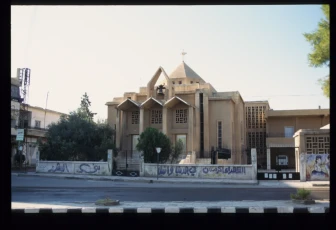
Church of the Armenians in ar-Raqqa

Hammam Bahram Pasha, exterior facade
The street facade of the bathhouse with striped masonry (ablaq).

View of the Madrasa al-ʿUmariyya al-Kubra from the inside

Bayt Wakil, Kuppel der Empfangshalle von Innen

A private Aleppine house
A view of a courtyard corner in a private Aleppian house, where we can see two façades that contain several arched windows.

Raqqa, Baghdad Gate (Bab) as seen from outside the fence
Raq19820005.tif

Fassadennische am Turmgrab des Elahbel, Tal der Gräber (Westnekropole)
[ Description by author: Oberer Teil der Fassade. Im Bogen eine Kline für den Toten, dessen Hochrelief allerdings fehlt. Unten in einer Tabula ansata eine zweisprachige Inschrift. Gesehen von ~ Süden. ]
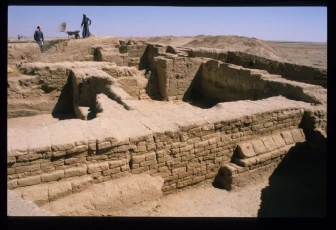
Tall Shaykh Hamad (Dur Katlimmu) - Excavations
[Original:'TALL SAIH HAMAD']
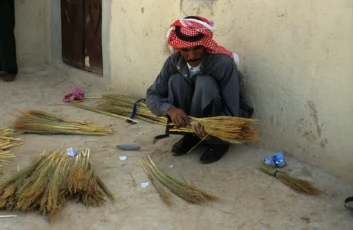
Jurn Kabir: in 1998 brooms were still made by hand in some villages

The tower tombs, Valley of the Tombs
[ Description by author: Blick nach Süden auf Grabtürme: links hinten der des Maliku, rechts der des Jambliqu. ]

Bab al-Hadid, general view of the gate's tower with its machicolations and parapets

Afamiya, Apsis der Ost-Kathedrale
[Original: Ostkathedrale in Vierpaßform, Chor mit abschließender Apsis, 5. Jh. Synthronon aus dem 6. Jh.]

Bimaristan an-Nuri, door puller of main wooden entrance door

Raqqa - "East of Raqqa" site - Tall Aswad, excavation in 1985
Tall Aswad

Laden mit Plastikwaren in ar-Raqqa

At-Takiyya al-Ikhlasiyya (az-Zawiya ar-Rifaʿiyya), Inschrift oberhalb des Haupteingangs

2 pounds, 23 mm, 1996

Palmyra, Diokletianslager, Das Lager
[ Description by author: Blick vom Hang des Jabal al-Husainiya oberhalb des Fahnenheiligtums nach ~ Südosten. Ganz unten das Fahnenheiligtum, davor der Platz des Präteriums, davor ein Vestibül mit vier (nur eine steht) monolithischen Säulen, dann nach hinten die Via Praetoria, die hinter den Säulen in der Mitte von der Via Principalis geschnitten wird. Daran, links davon, der Allât-Tempel. Außerdem erkennt man ganz hinten gleich rechts der Mitte den Tetrapylon, weiter rechts den Bel-Tempel. ]

Römische Straße in der Lejat

Bayt Wakil, entrance

Raqqa, Map draft of ar- Rafiqa and its walls
Overlay drawing with remaining street structure and modern city areas. 84-87% > approx. scale 1:10.000

ʿAyn al-ʿArus, Ausgrabung eines Bodenmosaiks
Mosaic floor panel in hexagonal shape

Al-Madrasa al-Kamiliyya, Gebetsnische (Mihrab) in der Gebetshalle

Izraʿ, Kanisat (Kirche) Mar Jirjis, Außenansicht
Kirche St. Georg

al-Bab ash-Sharqi, a small arched side entrance

Raqqa-Ost, Luftaufnahme des Westpalastes
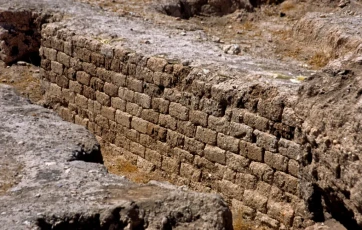
Inside the city wall, excavation work, Qatna
. [Original: Al-Mishrifa / Qatnâ']

Ein Teil der Ruinen von Qalʿat Harim

Manufacturing of spools in the textile factory of the Mezannar family in Damascus

Al-Bimaristan an-Nuri, Innenhofansicht nach Westen mit Eingangsfassade
[ Description by author: Innenseite, gesehen über den Innenhof nach ~ Westen. ]

Bayt Junblat, Süd-Iwan (großer Iwan)
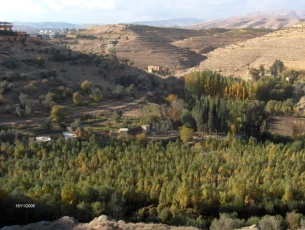
A view in Wadi Barada

Raqqa, Tall Aswad, section drawing of a pottery kiln
Ceramic stove, section drawing with scale ruler

Entrance of Hammam ʿAbd al-Basit
The entrance, leading to the external section (barrani), is one of the most beautiful entrances of Islamic baths. It was built according to the Ablaq masonry system, with stone rows alternating between white, gray and blue colors. This entrance is a retreat in the façade, topped by an ornate arch from the outside. The lower part of the dome of the barrani section is composed of many windows. This building is vanished nowdays!

Gesamtansicht der Burg al-Mudiq, die über der Ebene al-Ghab thront

Palmyra, general view of the Tetrapylon
[ Description by author: Gesehen von ~ Süden aus dem Gelände zwischen Agora und Tetrapylon. ]

Al-Matbakh al-ʿAjami, östliche Stirnwand der großen Halle

Ein traditionell hergestellter Webteppich

Valley of the Tombs, Tomb of Jambliku - decoration of the door lintel
[ Description by author: Linke Volute vom Türsturz, gesehen von ~ Osten. ]

Raqqa - "East of Raqqa" site - Western Palace - finds
Raqqa VIII; Eastern West Palace, SW-Neg.89/923-924

Blick über das Tal der Gräber (Westnekropole)

General view of ancient house and grave building, al-Bara

The tower tombs, Valley of the Tombs
[ Description by author: Links der Turm des Maliku (vvgl. Bild 0576, 0815, 0822 !), rechts der des Jambliqu. Davor in der Mitte das Tempelgrab, links davon der untere Teil eines Turmes der Justinianischen Stadtmauer (Nordseite). Gesehen von ~ Nordosten. ]

Maisfeld, das an die Häuser von Mishrifa auf der Stadtmauer von Qatna angrenzt

Busra, Reste der byzantinischen Kathedrale

Hama, general view of the "Four Norias", the two Bischriyyat and two Uthmaniyyat
Blick von Südosten auf die vier Wasserräder. . ['Original: Hamâ (Epiphania),']

Hama, Al-Jamiʿ an-Nuri, Minarett

Kapitell, Umaiyaden-Moschee
[Original: Omayyaden-Moschee (705 - 725), Aktanthuskapitell]

Abdelraouf Baydoun working with the craft of ‘Ajami: Preparation of a wooden dome

Bauinschrift an der Ziatdelle von Damaskus
[ Description by author: auf der Ostseite des Nordost-Turms (vgl. Bild 0143 !). Mit der Inschrift habe ich Probleme: nach dem Rahmen scheint sie mir aus späterer türkischer Zeit, ca. 19.Jh., zu stammen - aber der Text scheint mir Arabisch und nicht Osmanli zu sein. Auf jeden Fall steht sie unter einem älteren - mamlukischen ? - Relief(band). Zu erkennen sind zwei - gegenständige ? - Löwen, unter dem rechten ein junger Löwe. Darunter eine Art Muqarnas. ]

Pavilion, vor dem Eingang, Qasr al-Hayr al-Sharqi
[Original: Pavillon vorm linken Tor]

Afamiya, a side of ruins

Raqqa-Ost, Tall Aswad, Ausgrabung im 1985
Raqqa IV; Tall Aswad

Qalʿat Ibn Maʿn, Eingang zur Burg
[ Description by author: Der typische abgeknickte Zugang ins Innere der Burg. ['Qal'a, 25/03/2002 (?)'] ]

Courtyard of guest wing (so called selamlik oder barrani), Asʿad Basha al-ʿAzm Palace

Blick auf die tieferen Teile des Jabal Haramun (Hermon-Gebirge)

Bayt Wakil (Aleppo-Zimmer), Painted wooden panel, Mary and Jesus
One of the most famous Christian themes in the hall of Wakil house is a painting of the Virgin Mary carrying her child, surrounded by plant and blossom drawings.

Damascus, Khan Asʿad Basha al-ʿAzm, dome on pendentives
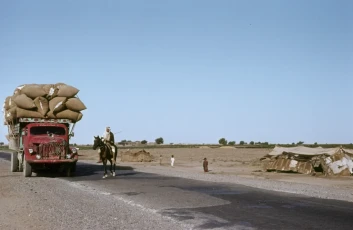
Ein LKW mit Baumwollsäcken stoppt bei einigen Beduinenzelten im Umland von Raqqa
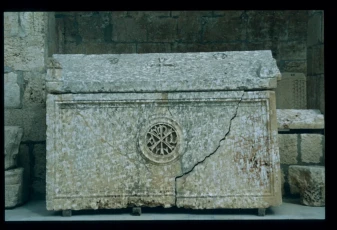
Sarcophagus at Maʿarrat an-Nuʿman Museum
[Original: Khan Murad Pascha, Weinspende-Grabreliquar, 6. Jh. (?)]

ʿAyn al-Khadra, in the farm yard behind the house with stables made of basalt stones

Manufacture of local handmade carpets, Qanawat

A Kurdish woman spinning with a suspended spindle. She is wearing a traditional overgarment

Remains of the Praetorium from east, Balis (Barbalassos)

Sphinx in the Temple of 'Ayn Dara

Habuba Kabira, construction of the corner of a mud brick house

The remaining upper part of Shumaymis Castle
Nach dem Licht und dem, was auf dem Satellitenfoto zu erkennen ist, muss dies die Südmauer sein. Man sieht gut, wie ein Stein-Mörtel-Kern mit Basaltquadern verblendet wurde. . [Original: Qal'at ash-Shamîmîs']

Jamiʿ al-ʿAdiliyya, prayer hall's entrance - muqarnas details
[Original:'Jâmi' al-'Âdiliya,Halab / Aleppo. "Muqarnas" über dem Eingang. Vgl. Bild 1221.'] !

Ansicht des Krak de Chevaliers (Qal'at al-Husn)

Nahiyat Tall Tamir, Straßenseite eines Hauses, das noch einen Kuppelraum bewahrt hat - in einem assyrischen Dorf gelegen

Busra, Hammam Manjak, Nischen im Inneren des Heißbadetrakts

Raqqa - "East of Raqqa" site - Tall Aswad – sherds
Raqqa IV; Tall Aswad; Pottery garden probl. near excavation house in Tall Bi'a

Ackerbaulandschaft in der Hauran-Ebene
[Original: Südsyr. Ackerebene im Hauran mit Hermon]

Bayt Wakil, Springbrunnen der Empfangshalle (Qaʿa)

Restaurant with terrasse and fountain in Mnin

Frau zeigt besticktes Kissen - während die Familie auf der Terrasse des Hauses am Stadtrand sitzt

Khan Qurdbak, eastern portico

An alley in Halbun town

ʿAyn al-Khadra, im Wohnraum des Mittelhallenhauses einer kurdischen Familie

Raqqa, Qasr al-Banat, Innenhof mit Nordiwan

Isriya -Tempel, Grabungsfunde

Archäologische Funde aus Raqqa, ausgestellt im Damaszener National Museum
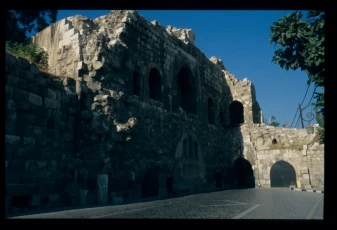
The northern wall of the Damascus Citadel

Qasr al-Hayr al-Sharqi, Baudekoration

Dorf in den Ausläufern des syrischen Küstengebirges

Simeonskloster - Baptisterium (Taufkirche)

Ebla (Tall Mardikh), Damaskus-Tor im Süsosten der Stadtmauer
~ Ostseite, Abschnitt zur Stadt. Gesehen von der ~ Westseite nach ~ Osten. [Original:Tall Mardîkh (Ebla)']

A side of the Cavea, Palmyra Theater
[ Description by author: rechte Seite. Im Hintergrund ganz rechts der Monumentalbogen, in etwa Bildmitte die Säulen am Eingang der Diokletians-Thermen. Der Bogen und der Bogenansatz ganz links markieren den Südost-Durchgang in die Rundstraße ums Theater. Gesehen nach ~ Ost-Süd-Ost. ]

Al-Madrasa al-Ahmadiyya, Inschrift und Dekoration über dem Eingang zur Gebetshalle

Church of the monk Buhayra, the oldest church in Busra
{Original: Katdraʾiyyat}

Inschrift in der Stadtmauer von Damaskus

Qanawat, Ruine des Zeus-Tempels (Seraya)
[Original: Perystlilhof mit einfachen Säulen mit Plattenkapiteller auf hohen Basen]

View to the west. The space is 02 in general, according to the ground plan. Here the minbar 14 and secondary spaces 08-01 are seen.

Cooling bread in the street before storage

Ar-Rusafa, Basilika C, Blick nach Osten auf die Apsis
[Original: k.K6/=HQ k.K5]

Busra, Inneres der Kathedrale
[Original: HQ-k.9 Interior view, Arch]

A niche with muqarnas on the main entrance of al-Bimaristan an-Nuri

Imam Ismaʿil-Moschee, Teilansicht mit Platz vor der Moschee

Achteckiger Springrunnen im Zentrum des Innenhofes des Qasr al-Banat ("Mädchenschloss")

Ruins of Qalʿat ash-Shugr wa-Bakas on the edge of a mountain slope

Traditionelles Wohnhaus im Viertel "al-Almaji"
Fotografie der Hauptfassade des Hauses im Süden während der beginnenden Renovierungsarbeiten und nach Verlust des hölzernen Erkers "Kishk". Mehrere Bilder sind zu einem Panorama zusammengesetzt worden.

Ruinen des Qasr Says (sog. Palast von al-Walid) in Jabal Says
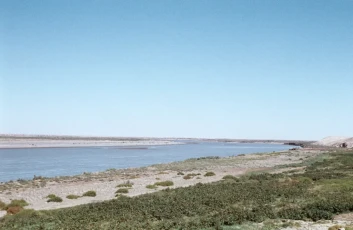
View of the Euphrates river with very shallow banks

Simeonskloster - Pilgerkirche des hl. Simeon Stylites, Blick über das Zentraloktogon nach Norden
[Original: Oktogon von Süden]
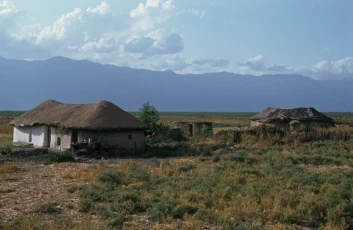
in the Ghab plain: thatched mud houses, 1963

Bimaristan an-Nuri, courtyard

Bimaristan Arghun, Ansicht des südlichen Innenhofs - Springbrunnen und Iwan

Nahiyat Tall Tamir, Entrance corridor in front of the collapsed cupola house
The Assyrian villages on the Khabur with their domed houses were built by the French Mandate Government for Christian refugees from Turkey and Iraq.

Al-Madrasa al-Hallawiyya, courtyard and basin

Maʿlula, Felsgrab
[ Description by author: auf dem Kloster-Plateau. Der Guide Bleu "Near East" spricht nur von "ancient tombs", ohne Hinweise auf heidnisch oder christlich. Bei diesem hier wird allerdings gesagt, dass der eine Adler (Bild 0460) und, wenn ich richtig verstehe, die Nische Bild 0458 byzantinisch seien. Ich muss allerdings sagen, dass für mein Laienverständnis eher der "starre" Adler von Bild 0462 als der "schwungvolle" von Bild 0460 byzantinisch wirkt .......- Der GPS-Tag ist apporximativ. ]
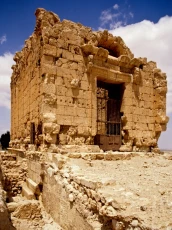
View from southeast, Ithriya Temple
Auf der linken Seite ist gut das Podium zu erkennen. Gesehen von ~ Südosten. [Original:'Ithriya (Seriana),']

Telegraph column, Sahat (square) al-Marja
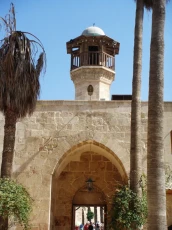
Al-Madrasa as-Sultaniyya, main entrance and minaret

Große Moschee, Gebetssaal, Schrein des Propheten Zakariya
Der Schreinkabinenraum des Propheten Zakariya - des Vaters des Propheten Yahya, oder in der christlichen Tradition Johannes des Täufers - liegt links (östlich) von der Hauptgebetsnische (Mihrab) und bildet die Vorderseite des zentral gelegenen Hauptschiffes der Gebetshalle. Er ist durch ein kupfernes Gitter abgschirmt und wird von einer kleinen Kuppel bekrönt. Der Schreinraum des Propheten Zakariya wurde nach der langen Inschrift über ihm von 1120 AH / 1708 n. Chr. renoviert und dekoriert. Der Schreinraum von Zakariya zeigt ein charakteristisches osmanisches Merkmal. Es ist mit mehreren Arten von Keramikfliesen geschmückt. Es gibt sechseckige Fliesen, die auf einem frühen Iznik blau-weißen Prototyp aus dem 16. Jahrhundert mit prallen Pfingstrosenmotiven basieren. Eine zweite Gruppe von Fliesen ist vom Typ 'Felsendom'. Außerdem gibt es zwei Arten von rechteckigen Bordürenfliesen, die mit kreuzförmigen spitzbogigen Medaillons zwischen Arabesken und Blättern verziert sind. Es werden zwei verschiedene Farbschemata verwendet: zum einen Schwarz auf türkisfarbenem Grund, zum anderen Apfelgrün, braun umrandet auf weißem Grund.

A carpet manufacturer from Al-Bab rolls out a finished felt carpet
Photographs of a manufacturing facility for felt carpets in Al Bab as part of the "Aleppo Stadtarchivprojekt" of GIZ (German Corporation for International Cooperation) in 2008

A side of Krak des Chevaliers
[Original: Große Orientreise Nr.63 mit Rotel-Tours: Amman-Bagdad-Uruk-Babylon-Arbil-Mosul-Hatra-Samara-Mari-Dura Europos-Aleppo-Dayr Saman-Ugarit-Palmyra-Jarash]

Jamiʿ Aslan Dada, a marble column with a Corinthian capital decorating the prayer niche

Kharab Shams, Fernblick auf die Basilika
Säulenbasilika, 4. Jh. von weitem

Kirche im Kloster des Mönchs Buhayra, der ältesten Kirche in Busra
[Original: Bahira-Basilika, paganer Profanbau des 3. Jhs. n.Chr., der später christianisiert wurde -Außenansicht]

General view of al-Qarmani Bath and garden
An overview of al-Qarmani bath that dates back to the Mamluk period. In addition to the main big dome, the building contains many domes and vaults, interspersed with glass-covered openings that allow light to enter the inner sections of the bath. This bath was recently restored after being neglected for a very long time.

Artificial pool in the south of Mushannaf Temple

Das Mittelmeer in Tartus

Mausoleum of ash-Shaykh Khalid an-Naqishbandi
["Nr.A"] (see catalogue-no. A; in: Meinecke, Michael, in: Damaszener Mitteilungen I/1983)

Burj as-Saʿa, Qastal - Fenster

Saydnaya, Eingang zur Kirche St. Peter
[ Description by author: oder kleiner Tempel von Bild 0421: Eingang. Noch gut erhalten ist der Türsturz. Die Portalöffnung selbst ist verkleinert, Vermutung: der / die große(n) Türflügel gingen kaputt, Geld für neue war nicht da (vielleicht wegen des Baues des Marienklosters ?), und so kam man auf die Idee, die Portalöffnung zu verkleinern. Womit ? Der Stein ist ein Monolith, er könnte als Eingang von einem anderen Gebäude stammen - diese Eingänge bestehen aber üblicherweise aus mindestens drei Steinen. War es ein "Trog" (welcher Art auch immer, selbst ein Sarg), aus dem man den Boden herausgemeißelt hat ? ]

Khan al-Jumruk, innere Eingangsfassade

Raqqa, Qasr al-Banat, ornamentierte Mauersteine
Neg. Nr. 83/54

Während eines Sandsturms vom Museumsfenster aus aufgenommenes Foto auf den Suq von Dayr az-Zawr

A village with reed thatched roofed houses in al-Ghab Plain
[Original: Dorf mit z.T. traditionellen schilfgedeckten Häusern im Ghab-Gebiet]

Der Schrein des Shaykh ʿAqil al-ʿUmari al-Manbiji

Restoration of a part of a decorated wooden panel with ‘Ajami decoration of the Damascus Room in the Dresden Museum for Ethnology

Raqqa-Ost, Ostpalast, Stuckdekorationen
Raqqa II; Eastern Eastpalace; relief decoration, bunch of grapes

Courtyard of Khan Murad Basha (Museum of Maʿarrat an-Nuʿman)
[Original: Khan Murad Pascha, osman. (heute Mosaiken-Museum)]

Blick in den Innenhof des Khan al-Wazir

Khusrawiyya, Friday Mosque, view of an window with ablaq and ceramic tiles

At-Takiyya al-Ikhlasiyya (az-Zawiya ar-Rifaʿiyya), courtyard

Baalshamin temple from the inside, 2nd c. AD
The small temple was consecrated to the Canaanite god of heaven. In 2015 it was blown up by ISIS.

Hammam al-Bayyada, the main entrance

A Bedouin family in one of the villages of the Euphrates Valley

Habuba Kabira, Konstruktion der Ecke eines Lehmziegelhauses

Busra, Teilbereich der Zitadellenmauer

Die auf einem Hügel liegende Burg al-Mudiq
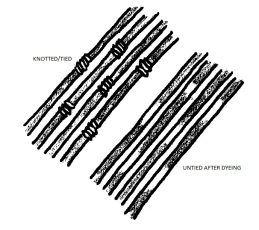
Drawings of an Ikat design
Drawings by Estibaliz Sienra Iracheta to illustrate processes of traditional textile manufacturing
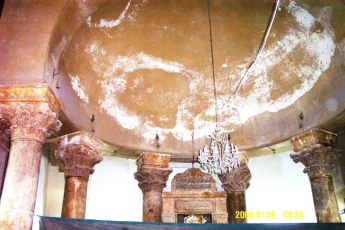
Al-Madrasa al-Hallawiyya, domed prayer hall which houses parts of the 5th century cathedral

Maʿbad ad-Dumayr (temple), locally known as "the castle"

Agriculture in the Coastal Mountains (al-Jibal as-Sahiliyya)
[Original: Bewässerte Zitruspflanzung im Vorland d. Ansariyengebirges]

Kloster Unserer Lieben Frau von Saydnaya

Reste von Wassermühlen an den Wasserfällen von Tall Shihab

Excavation work in Tall Brak
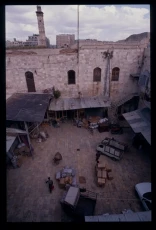
Aleppo, Khan as-Sabun, view of courtyard towards west

Junge in einer Metallwerkstatt in Raqqa

On the western shore of Jabbul-Salt Lake, dome houses with ventilation openings of the living room

The way to the monastery, northwest of Palmyra, Jazil
[ Description by author: zum Fels-"Balkon". ]

Frauen und Mädchen im Aufbewahrungsbereich des Beduinenzeltes in ad-Duwaym
Die alte Frau trägt einen Gürtel aus Brettchenweberei.

Vaulted hall in the old city of Tartus
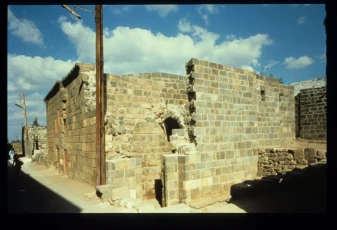
Busra, Hammam Manjak, exterior view

View from east to the west-north

At-Takiyya al-Mawlawiyya, minbar in the prayer hall (Samah Khana)

Busra, Hammam Manjak, Seitenansicht

Palmyra / Tadmur, view from afar to Ba‘alshamin Temple
[Original: Baal-Schamin-Tempel, 60 - 150 n.Chr. Im Vordergrund Bad der Zenobia]
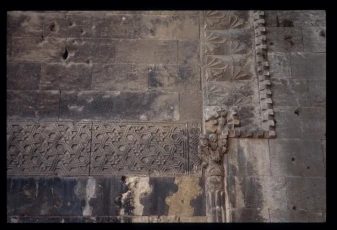
Khan Qurdbak, decoration details above a window in the iwan

Madrasat al-Firdaws, Marmor-Gebetsnische (Mihrab) mit geometrischen Motiven
[Original:'Madrasa al-Firdaus, Halab / Aleppo. Mihrâb.].

Traditionelle Weizentenne in der Hawran-Ebene

Reliefdekoration an einer Arkade in der Kirche von Qalb Lawza

Simeonskloster, Taufbecken

Busra, Hammam Manjak

In the tent of a semi-nomadic family from the Maskana region, with storage bags in the background.

Bel-Tempel, Cella - Nord-Thalamos
[ Description by author: Cella: Nord-Thalamos für die Götter-Triade Aglibol (Mondgott) - Bel (oberster Himmelsgott) - Yarhibol (Sonnengott). ]

Simeonskloster - Baptisterium
[Original: Baptisterium mit oktogonalem Zentralraum]

Remains of tower tomb
[ Description by author: Blick in die Cella von ~ Südwesten. ]

View to the Qalamun Mountains from Halbun

Madrasat al-Firdaws, the marble prayer niche (mihrab) decorated with floral and geometric motifs
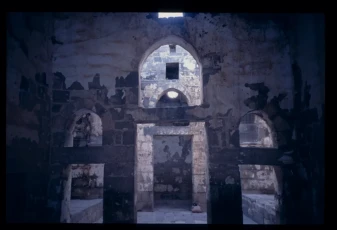
Busra - Jamiʿ (mosque) al-Mabrak

Eastern side of Damascus Gate, Ebla (Tall Mardikh)
~ Ostseite, äußerer Abschnitt, gesehen von der Westseite nach ~ Süden. [Original:Tall Mardîkh (Ebla)']

Qalʿat ash-Shugr wa-Bakas, Burgruinen auf einem Bergvorsprung

Qatna, Stadtareal innerhalb der Umfassungsmauer, Ausgrabung
. [Original: Al-Mishrifa / Qatnâ']

Al-Madrasa al-Hallawiyya, korinthisches Säulenkapitell
[Original:'Al-Madrasa al-Halâwiya, Halab / Aleppo. Das "Windstoß"-Kapitell der Säule rechts der Tür.'].
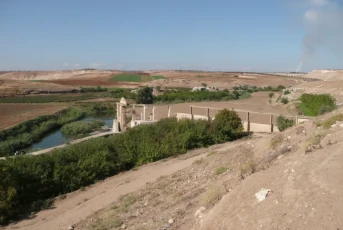
Eine verlassene ländliche Noria
Im ländlichen Gebiet von Nasiriya, nördlich von Hama, finden sich Überreste einer Noria am Orontes. Die steinerne Basis der Noria und die Überreste eines Aquädukts mit seinen Säulen sind noch erkennbar.

Al-Matbakh al-ʿAjami, Kuppel des großen Iwans

Jamiʿ Aslan Dada, interior view of the hall dome

Mushabbak, Byzantine basilica, general view from southeast

Umayyaden-Moschee, das mamlukische Qaytbay-Minarett an der Nordwestecke

Roman capital in the great mosque (al-Jamiʿ al-Kabir), Maʿarrat an-Nuʿman
Spolie am größeren Bau im Hof. Auch hier zweifle ich - wegen der Assymmetrie - ob es sich ursprünglich um ein Säulenkapitell handelt. Und die "Flachheit" des Dekors - kein Akanthus-"Korb", sondern eher ein "übergezogenes Netz", läßt an frühe arabische Kapitelle (z.B. 'Anjar) denken ....... [Original: Ma'arat an-Nu'mân (Arra)']
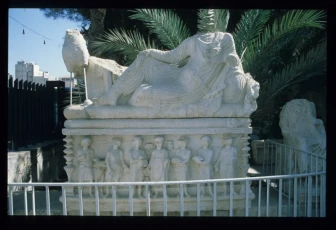
Sarcophagus with relief decoration
[Original: Palmyrenischer Sarkophag. Auf dem Deckel der gelagerte Grabherr in sassanidischer Tracht mit den Rangabzeichen eines einheimischen Karawanenchefs. Auf dem als Kline gestalteten Kasten in der Mitte der Grabinhaber beim Opfer mit den Rangabzeichen eines palmyrenischen Hohenpriesters und zugleich in der römischen Amtstracht eines togatus. Auf ihn schreiten zwei mal drei Gestalten zu, die Opfergaben bzw. Opfergerät bringen. 2. V. 3. Jh.]

The Khabur river near Raʾs al-ʿAyn, a small cable ferry from empty barrels for crossing the river

Bimaristan Arghun, main courtyard - capital decorated with muqarnas

Kafra, in the courtyard behind a huge central hall house

Takiyyat ash-Shaykh Abu Bakr, al-Midan-Eingang

Eine Zusammenkunft von Männern in einem Empfangsraum mit Wandbehang

Dayr az-Zawr, Hängebrücke über den Euphrat
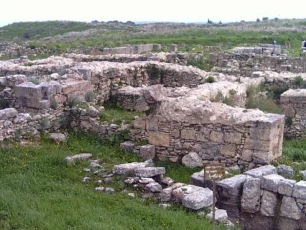
Teilansicht des archäologischen Geländes von Ugarit
shap_import_74018

Khan al-Wazir, Galerie im 1. Obergeschoss
Jamiʿ as-Saffahiyya, minaret

The Seljuk watermill ''Bab as-Salam watermill'' from the inside, Damascus
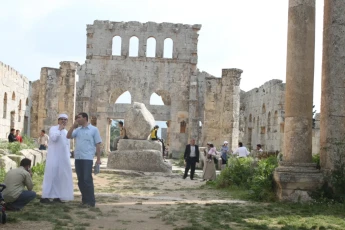
Monastery of St Simeon Stylites, remains of the Column of Saint Simeon the Stylite
St. Simeon is said to have spent part of his life here and perched on a column. The column’s remains are located in the middle of the octogonal central building.

Roman tower tomb in Sarrin
Not exactly locatable tower tomb, which is dated 74 AD by its inscriptions. To note the high set canulated half columns [Original: 'SIRRIN, Grabturm (74 n. Ch.)']

A herd of sheep grazing in front of Shayzar Castle

Afamiya, Kolonnadenstraße (Cardo Maximus)

Teilansicht der Burgamuer der Burg al-Mudiq mit ihren Türmen

View of the roofs of houses in the old city of Aleppo
One of the poor neighborhoods in the old city of Aleppo, showing modest, informal rooftops filled with satellite receivers.
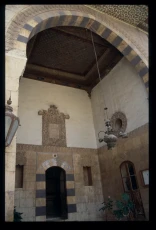
Bayt Ajiqbash, the splendid decorated iwan

Citadel of Aleppo, the Museum - inscription

A flock of pigeons in the old city of Damascus
A scene of a flock of pigeons gathering over the rooftops

Stone coffins in the southern Palace, Ebla (Tall Mardikh)
shap_import_48464

Busra, Hammam Manjak, Nische im Heißbadetrakt (Juwwani)

Jamiʿ as-Saffahiyya, Portalnische und Minarett
shap_import_64338
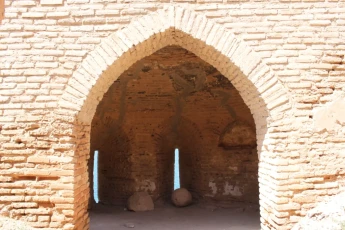
At-Tabqa, Jaʿbar Castle, Entrance of a bastion with loopholes

Traditionelles Gericht serviert in einem Dorf bei at-Tabqa

Spolia of crowns of columns for decorating a courtyard, ʿAyn al-ʿArus
Spolia in courtyard

‘Ajami decoration in Qasr al-‘Azm, Damascus
shap_import_97594

City center of Raqqa with a barber, small suq-shops and mobile traders of vegetables and fruits

Treppe und alte Holztür in einem traditionellen Haus in Maʿlula

Jabla, Sultan-Ibrahim-Moschee, bogenförmiges Portal mit Ablaq-Dekor

Mud bricks, prepared for the restoration of ar-Raqqa Wall

View over the floodplain of the Euphrates valley to the village on the eastern steep bank

Jamiʿ Aslan Dada, hofseitige Eingangsfassade der zusätzlichen Gebetshalle (al-Hijaziyya)

Al-Madrasa al-Ahmadiyya, northern portico

Jabla, Remains of the Roman Theater

Ruinen des Südtempels in 'Atil

Khan Murad Basha (Museum von Maʿarrat an-Nuʿman), Sarkophag
[Original: Khan Murad Pascha, Weinspende-Grabreliquar, 6. Jh. (?)]

Al-Madrasa al-Hallawiyya, Innenhof mit Wasserbecken

Qalʿat Burqush, Blick vom Süden auf die Byzantinische Kathedrale
[ Description by author: der byzantinischen Basilika, gesehen von ~ Süden. Links ein Stück der Südwestwand, rechts schaut man durch die eingestürzte Südost-Wand in die Gewölbe. Der Stein unter dem Bord links entspricht in seiner Höhe genau dem Stein rechts: der ganze Zwischenraum ist als Mauer zu denken. ]
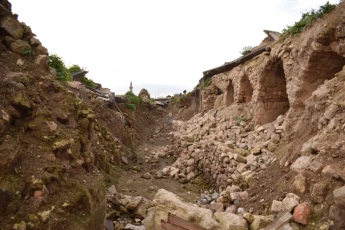
Suq ad-Diraʿ, a general view of the destruction of the suq to the west

Khan Asʿad Basha al-ʿAzm, 1754
Der größte Handelsbau von Damaskus mit dem markanten Wechsel von Basalt und Kalkstein wurde vom Gouverneur Asʿad Basha al-ʿAzm errichtet.
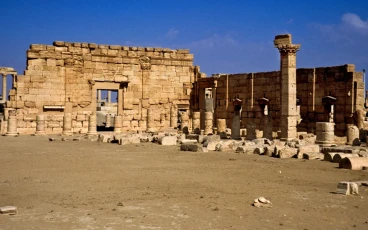
View from southwest, Agora
[ Description by author: Blick von ~ Südwesten diagonal über den Platz mit Resten der Portiken. Ganz rechts ein Durchgang zum Annex., vgl. Bild 0711 ! ]

Blick auf die Burg (Qal'at) Salah ad-Din

Signboard of Afqa bath in Palmyra
[Original: Straßenschild, Schwefelquelle]

Bimaristan Arghun, view of side portico of main courtyard

Qubbat as-Sayyar (Qasyun-Gebirge)

Aleppo in den Dreißigern, Luftbild in Richtung Nordwesten mit der Zitadelle und der Altstadt im Hintergrund
Auf dieser Aufnahme sind links die Areale des Basars mit der großen Moschee zu erkennen. Auf dem Torbau der Zitadelle sieht man noch Reste der Kuppeln des Tronsaals. Beschriftung uf der Rückseite des Photos [1988/144]. On the back of the photos: ['1988/203']. [Objekt: Reproduktion SW-Fotos, 24.Juni 1988, Peter Grunwald, Film 1 (2), Ende Film 2]

('Ain) Manîn, Treppe und Eingang in zwei Hallen eines römischen, religiösen Gebäudekomplexes
[ Description by author: Detail aus Bild 0397: Freitreppe zur großen Halle und Eingang der kleinen Halle. ]

Palmyra, Palmenhain, Blick auf den Bel-Tempel

Hammam Bahram Basha, Eingangsfassade

Excavation of Abbasid ruins in Kharab Sayyar

Maps of Aleppo: city center and historical suburban aereas, 1982
Thematic map of Aleppo city-center and historical suburban aeras, showing historical monuments. Scale 1:2000, ruler and legend, [Original in German: Aleppo: Innenstadt und alte Vorstadtquartiere | Karte 1 Westblatt & Ostblatt] Inventory no. stamp: Museum für Islamische Kunst Isl 85/31 /2 Berlin-Dahlem. Part of TAVO Reihe B Nr. 58

Bab al-Maqam, Torbogen

Am Gipfel des Hermon-Gebirges (Jabal Haramun)

General view of Ibn Wardan Palace
[Original: sakraler Zentralbau und Palast, Palast]

Traditionelles Aleppiner Haus
In diesem Aleppiner Haus befand sich vor dem Krieg ein Architekturbüro. Der Hof im Bild ist der perfekte Ort für die Pause der Mitarbeiter.

Raqqa, the archway of Baghdad Gate
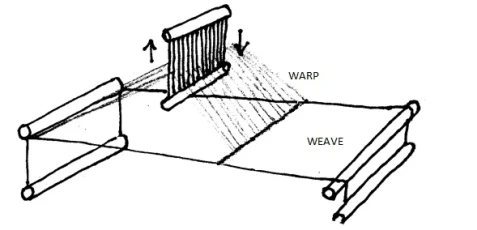
Function of shafts or heddles
Drawings by Estibaliz Sienra Iracheta to illustrate processes of traditional textile manufacturing

Umayyaden-Moschee, Innenhof, die Fassade der Gebetshalle mit Qaytbay-Minarett
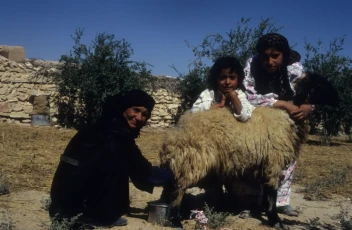
Habuba Kabira, Milking a goat in the courtyard: Grandmother and granddaughters

Valley of the Tombs, Tomb of Jambliku - lintel of the entranceway door
[ Description by author: Der Türsturz, ebenfalls mit zweisprachiger Inschrift. ]

Roman tower tomb in Sarrin

Bimaristan Arghun, open dome above the octagonal courtyard

At-Takiyya al-Mawlawiyya, sabil (fountain)

A carpet manufacturer rolls out a finished felt carpet in his workshop in Al-Bab
Photographs of a manufacturing facility for felt carpets in Al Bab as part of the "Aleppo Stadtarchivprojekt" of GIZ (German Corporation for International Cooperation) in 2008

Muzayrib - millstone within an ancient watermill

Salah ad-Din castle, the upper part of the mosque entrance, lobed arch with muqarnas
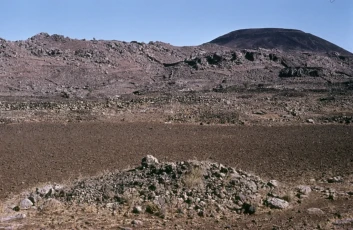
Jabal al-ʿArab, natural landscape of volcanic mountain

Maronite Cathedral, general view from the outside

Madrasat al-Firdaws, Arkadenhof nach Süden

Zitadelle von Aleppo - Eingangstorbau, fliegender Händler im Vordergrund

Khan as-Sabun, Innenhofansicht - Blick auf die östliche Galerie, nördliche Fassade und das Hofgebäude

Ansicht des Innenhof der Burg Marqab

Tartus, ash-Shaykh Badr, Entrance gate to al-Kahf castle

Grabrelief mit Büste eines palmyrenischen Ehepaars
[Original: Museum: Grabrelief für ein Ehepaar]

Manbij, Friedhof und dahinter liegende neue Gebäude am östlichen Stadtrand, von Süden her gesehen

Al-Madrasa al-ʿUmariyya al-Kubra - southern arcade

A metal workshop in the city of Raqqa

Tall Dahab, Central hall house , sleeping platform in the foreground
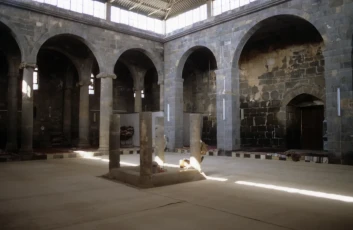
The courtyard of al-Jami‘ al-ʿUmari in Busra

Waqf Ibshir Mustafa Pasha, Kartierung der Schäden (Englisch)
Der waqf (Stiftungs-Komplex) von Ibshir Mustafa Pasha hat in mehreren Bereichen schwere Schäden erlitten. Dazu gehören der Khan auf der Nordseite und die östliche und westliche Qaysariyya. Ohne vorherige Trümmerbeseitigung kann keine abschließende Aussage über das Ausmaß des Schadens getroffen werden. Höchstwahrscheinlich kam es in den von der Tunnelbombenexplosion vom April 2015 betroffenen Gebieten zu einem Totalschaden. Der westliche Teil des waqf-Komplexes, einschließlich seiner Vorderfront, steht noch, ist aber deutlich beschädigt. Zwei der wichtigsten Gebäude des Waqf-Komplexes von Ibshir Mustafa Pasha sind in Teilen erhalten geblieben: die Moschee und das Kaffeehaus im Süden. Die einzigartig dekorierte Fassade der Halle des Kaffeehauses sowie die erste Gewölbezeile wurden zerstört. Der Kern der Halle wurde nur teilweise beschädigt, während der Abschnitt der zentralen Kuppel mit ihrer hohen Laterne größtenteils zerstört wurde.

Jurn Kabir, eine Frau versucht ihre Aussteuer (Teppiche und Vorratssäcke) zu verkaufen

The main mihrab, which has mosaic in its dome. The space is 02 in general, according to the ground plan. Here wb.01 of the secondary space 07. is seen.

Ausflugslokal in Bludan

Jamiʿ Sharaf, Qastal - Inschrift

Habuba Kabira, Construction of the relieving arch, on which 2 cantilever domes are to rest

Al-Madrasa al-ʿUmariyya al-Kubra - view from the south
writing on the photo's back ['567. ''Photographie, Francois MARTIN, 19, Bd du Pont d'Aive, 1205 GENEVE'. Foto M. von Oppenheim, reproduziert nach Phototheque M. von Berchem Nr. 567 (1035). (----> Gent, Foundation Max van Berchiem). Org, Catalogue (1975) 50: Madrasa'Umariya. Conv interieure. =Nr. 38.']
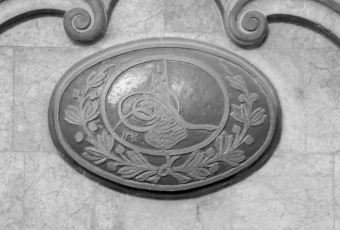
Tughra of sultan over the entrance of ash-Shaykh Muhyi ad-Din Ibn ʿArabi Mosque
Separaiting Sheet 82/IX

Tall Mardikh (Ebla), Blick in einen rekonstruierten Raum des Palstes G
shap_import_48458

Blick auf die Ruinen von Palmyra und die Ibn Maʿn-Burg

View into tent of nomadic family of Tayy-tribe

Courtyard of the Great Mosque, view towards east

Abdelraouf Baydoun working with the craft of ‘Ajami in his workshop in Malaysia

Salkhad - historical pond (birket)

Aleppo, Khusrawiyya Complex, siteplan of the building parts (English)
The Khusrawiyya is severely destroyed. The northern arcade and parts of the western wing of the complex are damaged. There are parts which are still under rubble. The degree of damage is around 80%. The center of the explosion crater, produced in 2014, is located beneath the prayer room, i.e. in the domed hall of the Friday mosque, which doesn’t stand anymore. Most likely, the foundations are lost inside the inner area of the crater, while the rest of the area may contain remains of the building, perhaps sufficient for possible reconstruction. No action regarding the protection or management of the rubble has been done yet.

Great Mosque of Aleppo, courtyard, horizontal sundial

Amrit, Melqart temple (Eshmoun), central shrine

Qanawat, Blick auf das Nymphäum

General view of the architectural remains, Sirjilla

Madrasat al-Firdaws, view to south - courtyard and arcades

Jisr ash-Shughur, Qalʿat ash-Shugr wa-Bakas, the ruin of the twin crusader castle

Archaeological finds from Raqqa, exhibited in the Damascus National Museum
Floral frieze decoration; National Museum Damascus, from ar-Raqqa

Palmyra, exterior view of Qalʿat Ibn Maʿn (castle)

Hama, Burg al-Madiq, Blick einen einen Turm

Khan al-Jumruk, Aufrisszeichnung der inneren Eingangsfassade

Jabal al-ʿArab, Camel

Isometrie of the Royal Palace G, Ebla (Tall Mardikh)
[Original: Grabungszeichnung. Hier ist die Rampe (vgl. Bild 1190 !) als Rampe gezeichnet, dafür fehlt bei der Treppe in der Bildmitte die Fortsetzung nach oben]

Izraʿ, al-Jamiʿ (Mosque) al-ʿUmari - inscription on basalt stone

Fountain in al-ʿAzm Palace

Bayt Junblat, southern iwan - decoration of marble and faience tiles

The Monastery of St Sergius, Maʿlula

Tetrapylon vor Sonnenuntergang
[ Description by author: Abendstimmung. Gesehen von ~ Nordosten - der GPS-Tag ist approximativ ! ]

Part of the northern wall of the Damascus Citadel

Blick vom Palmhain zur Südostecke des Bel-Tempels mit vorbeireitenden Kindern

Jamiʿ al-Utrush, general view of western facade and minaret

Bayt Dallal, iwan with a wooden canopy

General view of Husn Sulayman

Qanawat, römischer Sarkophag mit reliefiertem Dekor

Pointed arch in the Najm Castle (Qalʿat Najm)

Bayt Junblat, southern Iwan - decoration detail of marble and ceramic tiles

Szene im Barada-Tal in den 1960er Jahren

Theater, Blick auf Proszenium und Scaenae Frons
[ Description by author: und Cavea. Die Bühnenwand soll noch zwei weitere Etagen gehabt haben: wenn man in der Säulenstraße außen an ihr vorbeilief, muss man ziemlich "erschlagen" worden sein ....... Man beachte das Datum, für einen neueren Zustand vgl. Bild 0727 ! Blick nach ~ Nord-Nord-Ost. ]

Al-Madrasa ar-Rukniyya al-Barraniyya - view from the south

Bayt Ghazala, ʿAjami-Holzdecke im südlichen Sitzraum der Hauptempfangshalle (Qaʿa)

Raqqa, Bagdad-Tor, Rekonstruktionszeichnung
Drawing of total reconstruction [on original: III, Abb. 2, S. 12]

Jabʿadin, eine Felskante im Sinnir-Gebirge

Sinaniyya Street: traffic scene with tram in 1918
In the Sinaniyya street traditionally the pilgrimage-caravan to Mecca started. From 1904 to 1967 a tram line ran here.

Tall Dahab, Rückseite des Gästehauses mit umlaufendem plastischen Dekor

Neubau eines Hauses mit abgeflachten Kuppeln in einem Dorf südlich von Tall Abyad

At-Turn, Double-dome house on the edge of the steppe close to Maskana
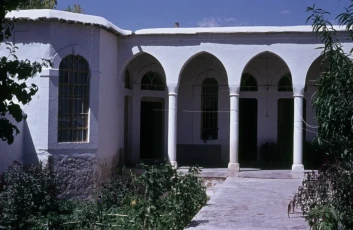
Yabrud, Residential house with covered terrace (riwaq)

Raqqa-Ost, Nordkomplex, section 7, Ausgrabung
[ 87/ 58/ 1754] =[ photo's name as: year/ film no./ photo no,].. (Naming the area of the photo was done according to the list, although some they are similar but were done in different areas.)

Raqqa, Ansicht der reich dekorierten Außenseite des Stadttores (Bab) Baghdad

Jamiʿ al-Utrush, northern entrance

Al-Matbakh al-ʿAjami, Muqarnas-Zwickel der Iwan-Kuppel

Tall Mumbaqa, Fest in einem Ziegenhaarzelt aus Anlass der Ausgrabung
Tanz und Musik beim Grabungsfest

The statue of Harun al-Rashid in Raqqa

Ruine des byzantinischen Prätoriums von Barbalissos/Balis, Blick von Osten

Citadel of Aleppo, Temple of the Weather God, early 1st millennium BC
The remains of the Hittite temple on the citadel hill, discovered during excavations in the 1990s, show mixed creatures and gods on basalt relief stones.

Interior view of a grave carved in the rocks, Maʿlula
[ Description by author: auf dem Kloster-Plateau: Rückwand und Teil der rechten Seitenwand. Vgl. Bild 0460 ! ]

Damascus, Hammam al-Qaramani
Arch with tympanum of a gate? Hammam al-Qaramani

Damaskus, Sinâniya-Moschee, Fassade, 1518 erbaut
[ Description by author: Erbaut 1590. Eingangs-"Iwan", Minarett und Kuppel. ]

Madrasat al-Firdaws, Überblick auf den Innenhof mit Arkaden

Karte Aleppos: "Historische Abfolge des Baubestands", 1982
Thematische Karte von Aleppos historischer Altstadt: Historische Abfolge des Baubestands. Maßstab 1:2000, Maßstabsleiste und Legende.

Damascus,Umayyad Mosque, pigeons in the courtyard
Pigeons in the courtyard of the Umayyad Mosque

Modern painted panels with ‘Ajami decoration in Ziad Baydoun´s workshop in Malaysia

Raqqa. Teilansicht des Qasr al-Banat

Raqqa-Ost, ausgegrabene Wandverkleidungen aus Stuck

Al-Madrasa al-Ahmadiyya, capital

ar-Rusafa -interior view- North Gate of the basilica

Nahiyat Tall Tamir, Die abgeflachten Kuppeldächer haben gerade einen neuen Verputz erhalten
Die assyrischen Dörfer am Khabur mit ihren Kuppelhäusern baute die französische Mandatsregierung für christliche Flüchtlinge aus der Türkei und dem Irak.

Blick in das Innere der Burg (Qal'at) Marqab

Die Fassade der Burg (Qal'at) Arwad

A side of al-Mudiq castle in Hama shows some of its towers

Lehmkuppelhäuser bei as-Safira im Regierungsbezirk Aleppo

Qalʿat Ibn Maʿn, Zugangsbrücke

Courtyard from the northeast, portico - Temple of Bel
[ Description by author: Portikus der Nordostecke, Standort zwischen den Säulen und dem Mauereck, Blick nach Südwesten. Nord- und Ostportikus haben die selbe Höhe. Zwischen den Säulen erkennt man links / Mitte den Tempel, rechts die Propyläen. ]

Al-Madrasa al-ʿUmariyya al-Kubra, Ansicht einer Innenhoffassade

Kharab Sayyar, Stuckfragmente

Museum von Arwad - Burg von Arwad

Jurn Kabir, in the center of a traditional double-room house (areas for living, sleeping, supplies, kitchen)

Jamiʿ al-Khayr, main entrance details from the inside

Im Dorf Jurn Kabir wurden 1998 noch kleine Besen zum Verkaufen von Hand hergestellt

Jamiʿ al-ʿAdiliyya, corbel with muqarnas supporting an arch in the inner portico

Lage der einstigen Wassermühle von al-Ashnan am Fuß des Qasyun-Bergs in Damaskus
shap_import_77199

Maronitische Kathedrale St. Elias, Hauptfassadenansicht (West)

Khan al-Wazir, main entrance and the sabil

Al-Madrasa al-Hallawiyya, Eingang - verbaute Spolie an der Basis, ehemals Taufstein in der früheren Kathedrale

Yabrud: residential buildings as road-accompanying development
Street view with central hall house. This type of house is a local variation (of the Qalamun Mountains) of a house form known since mid of the 19th century, mostly from Lebanon. It has a shaded entrance with an arcade of three arches on round columns on the ground floor, above it on the upper floor a repetition as open seating area. Stone façade is made of cleanly carved limestone and slender arched windows. On the upper floor, a balcony extends over the entire facade. These houses might have been built in the first quarter of the twentieth century.

Qanawat, General view of the nymphaeum

At-Takiyya al-Ikhlasiyya (az-Zawiya ar-Rifaʿiyya), Detailansicht der Sala-Fassade an der Ostseite des Innenhofes

Eine der drei kleineren Gebetsnischen, Umayyaden-Moschee
[ Description by author: Einer der drei Neben-Mahârîb: jeder ist einer anderen Rechtsschule zugeteilt. Vgl. Bild 0225 ! ]

Khan as-Sabun, window and decoration above the entrance

Reliefdekoration entlang der Stufen des Haupteingangs an der Südseite des Tempels von ʿAyn Dara

A view from a high peak of the Anti-Lebanon Mountains

Habuba Kabira, die aufgeschichteten Ziegel unter dem Entlastungsbogen werden vom Baumeister entfernt

Yabrud: Wohnhäuser als straßenbegleitende Bebauung
Straßenansicht mit Mittelhallenhaus. In Bildmitte eine lokale Variation (des Qalamun Gebirges) der seit der Mitte des 19. Jh aus dem Libanon bekannten Hausform: beschattete Eingangsarkade aus drei Bögen auf Rundsäulen im Erdgeschoß, darüber im Obergeschoß eine Wiederholung als offene Sitzfläche. Steinerne Fassade ist aus gehauenen Kalksteinen mit schlanken Bogenfenstern. Im Obergeschoss erstreckt sich ein Balkon über die gesamte Fassade. Die Entstehungszeit dieser Häuser wird wohl im ersten Quartal des zwanzigsten Jahrhundert sein.

Raqqa, Palast D, Stuckdekorationen
Palace D; Inst.Neg. 86/1426 Floral frieze decoration

Prestige facade of the lower northern cardo (colonnaded axis) at Afamiya
"Säulenstraße, 1,8 km lang und 37,5 m breit, nördlicher Abschnitt (glatte Säulenschäfte mit korinthischen Kapitellen) nach 115 n.Chr."

Takiyyat ash-Shaykh Abu Bakr, muqarnas decoration on the prayer niche

Khan al-Jumruk, innere Eingangsfassade - dekorierte Fensternischen
Windows of a facade in the courtyard. [Original: Khân al-Jumruk,Halab / Aleppo. Fenster im Innenhof des Gebäudes. Es stammt aus dem 17. Jh.. Vgl. Bild 1220 !. 18/04/2001 (?)']

Rohbau am Platz des Präseidenten in Raqqa

Khan As-Sabun, Fenster und Dekoration über dem Eingangsportal
shap_import_61539

Jamiʿ at-Tawashi, eastern facade - window within a rectangular niche decorated with muqarnas

Great Mosque of Aleppo, prayer hall, door of the khatib (orator) room

Blick auf das Dorf Shaykh Hilal
In diesem Teil des Dorfes stehen vorrangig Kuppelhäuser, es gibt nur wenige Flachdachhäuser.

Raqqa - Madinat ar-Rafiqa wall - Columns discovered during excavation
Raqqa II; capitals (found near city wall or in debris?)

House with mud decoration as door framing in the village of Qalʿat Najm, that was flooded by the Tishrin dam
The house consists of a double-room inside. View from south east.

A minaret rises above al-Bab ash-Sharqi

Khan at-Tutun, Innenhof

Raqqa-Ost, Nordkomplex, Glasfund
Raqqa VI East; Northern Complex; glass bowl, SW-Neg.87/801-802

Afamiya, View to the north- the Great Colonnade (Cardo Maximus)
shap_import_70676
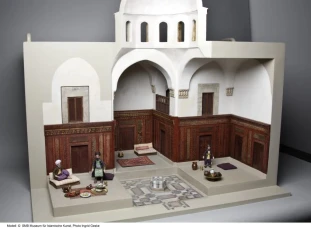
Model of the original setting of the reception room of Beit Wakil (Aleppo Room in the Museum for Islamic Art, State Museums Berlin)

Raqqa, Qasr al-Banat, Hof mit Nordiwan
[ G 88/ 19/ 236] =[ photo's name as: year/ film no./ photo no,].(ref. http://www.esyria.sy/eraqqa/index.php?p=stories&category=todayimg&filename=201003152100042)

View of towards the city and the monastery of Saydnaya

Jamiʿ al-ʿAdiliyya, capital with muqarnas of a column in the double arcade

The wheel hub of a water scoop wheel (arab. noria)

In the outer courtyard of the ʿAzm-Palace, now the museum of the arts and popular traditions of Damascus

Blick über Safita

Ar-Raqqa, Kinder und Erwachsene auf einem Pferdewagen

Umayyaden-Moschee, Arkadenbögen der Gebetshalle

Zitadelle von Aleppo - Eingangstorbau, Hauptfassade

Al-Matbakh al-ʿAjami: Qaʿa, plan and four elevations of room
Qaʿa of Matbakh al-ʿAjami, size of plan 55 x 55. Ruler.

The wooden pulpit (minbar) in the prayer room of an-Nuri Mosque

A side of al-Mudiq castle

Theater, Blick auf Proszenium und Scaenae Frons, 2. Jh. n. Chr.

Jamiʿ Aslan Dada, inscription above the hall entrance
[original: B63 Film-VI]

Tartus, ash-Shaykh Badr, Arched niche in al-Kahf Castle

Raʾs al-ʿAyn, die traditionelle Art, Baumwolle zu verpacken und zu wiegen

The suspension bridge over the Euphrates in Dayr az-Zawr

Qalʿat al-Qadmus (al-Qadmus Castle), The mosque of Hasan Jalal ad-Din

Tetrapylon
[Original: Große Orientreise Nr.63 mit Rotel-Tours: Amman-Bagdad-Uruk-Babylon-Arbil-Mosul-Hatra-Samara-Mari-Dura Europos-Aleppo-Dayr Saman-Ugarit-Palmyra-Jarash]

View from Harim Castle towards the nearby plains

Jurn Kabir, die fruchtbare Ebene des Euphrats mit Auenwald im Hintergrund vor der Flutung des Tishrin-Staudamms

Afamiya, Remains of the Great Colonnade

Spitzen von Bergketten im syrischen Küstengebirge

Khan Qurdbak, östlicher Arkadentrakt

Al-Madrasa al-Hallawiyya, Innenhof - südliche Fassade

Turbat Khaʾirbak (mausoleum), western facade - tomb chamber

al-Malikiyya - ʿAyn al-Khadra, Basalt Tomb with arabic inscription

Jamiʿ al-Utrush, Westfassade - dekorierte Fensternische

Raqqa-Ost, Tall Aswad, Grabungsfunde

Afamiya, Portikus an der Ostseite des nördlichen Abschnitt der Großen Kolonnade (Cardo Maximus)
"Säulenstraße, 1,8 km lang und 37,5 m breit, nördlicher Abschnitt (glatte Säulenschäfte mit korinthischen Kapitellen) nach 115 n.Chr."

Takiyyat ash-Shaykh Abu Bakr, al-Midan entrance

Hammam Bahram Basha, Bogenfeld des Hauptportals mit pflanzlichen Ornamentmotiven

Jamiʿ at-Tawashi, east facade - one of the two columns which frame a window

Burj Haydar, Ruinen der westlichen Basilika
[Original: Westliche Basilika, Säulenarkaden mit dorischen Kapitellen, 4. Jh.]

Porticus post scaenam, Roman Theater - Busra
[Original: Theater, Bühnengebäude (wahrsch. spätes 2. Jh.)]

Modern interpretations of the traditional craft of ‘Ajami (workshop of Aliya Alnuami)

South-west Syria: Qalamun Mountains, the village of Maʿlula with its light blue or white house paintings

Monastery of St Simeon Stylites, Narthex of south basilica (south façade of church)

Die Unterstadt von Afamiya: mit dem Museum in einer osmanischen Karawanserai und Dorfhäusern

Qatna, Stadtareal innerhalb der Umfassungsmauer, Ausgrabung
. [Original: Al-Mishrifa / Qatnâ']

Jamiʿ Sharaf, inscription above ad-Darih

Qasr al-ʿAzm, Innenhof im Erdgeschoss
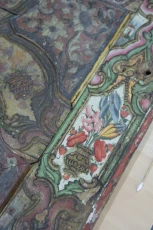
restoration of a part of a decorated wooden panel with ‘Ajami decoration of the Damascus Room in the Dresden Museum for Ethnology

Busra, Kirche im Kloster des Mönchs Buhayra, die älteste Kirche in Busra
{Original: Katdraʾiyyat}

Archäologische Funde aus dem Museum in Raqqa

Inschrift mit ornamentiertem Rahmen in der Burg von Masyaf

Die Ansicht einer Wand der Burg von Shayzar zeigt drei spitzbogige Nischen, in denen jeweils ein Eingang und darüber ein fenster liegt.nen

Raqqa, Qasr al-Banat, Column capitel with plant motifs
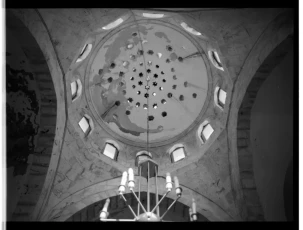
Bayt Wakil, dome of the reception hall (qaʿa) from the inside

Roman bridge in at-Tayyiba over the course of the Wadi az-Zaydi

Bel-Tempel, Relief mit geflügeltem Wesen zwischen Früchten und Pinienzapfen
[ Description by author: Relief. In der Mitte ein geflügelter Genius, der mich irgendwie an die assyrischen erinnert. Links von ihm u.a. Pinienzapfen, ein Symbol der Fruchtbarkeit Die Früchte (?) rechts scheinen mir Granatäpfel zu sein, dagegen sprechen aber die Einkerbungen. Die Anordnung gemahnt irgendwie an die "Brüste" der Artemis von Ephesus ....... ]

Aerial photo of the Jabal Haramun (Mont Hermon)
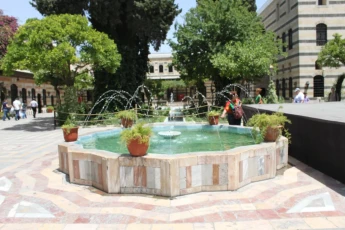
Courtyard with fountain in the family wing (so called haramlik or juwwani), Asʿad Basha al-ʿAzm Palace

Busra, Hammam Manjak, Restaurierungsarbeiten

Der äußere Bereich (barrani) des Yalbugha an-Nasiri Bades
Der äußere Bereich (barrani) ist groß und besteht aus einem zentralen Bereich mit einem überwölbten Iwan an jeder Seite. Jeder Iwan besitzt eine Plattform zum Sitzen und eine bogenförmige Nische zum Verstauen von Kleidungsstücken. Das Zentrum dieses Bereichs bildet ein achteckiges Wasserbecken mit Springbrunnen.

Bel-Tempel, ornamentierte Deckenplatte
[ Description by author: des Peristyls oder des Naos. Die alte Karteikarte sagt Naos, ich denke jetzt aber eher Peristyl: am "Bacchus"-Tempel in Ba'labak gibt es ganz ähnliche Peristyl-Platten.- Es gibt hier zwei Typen von Rosetten: eine "normale" und eine "rotierende". Letztere lässt an die "windzerzausten" Kapitelle ind Qal'at Sem'ân und in Halab denken. ]

At-Takiyya al-Ikhlasiyya (az-Zawiya ar-Rifaʿiyya), details of the hall facade situated on the eastern side of the courtyard
shap_import_65807

Al-Khubra lake in Jabal Says

Raqqa, Northeast Complex

Man with fresh bread
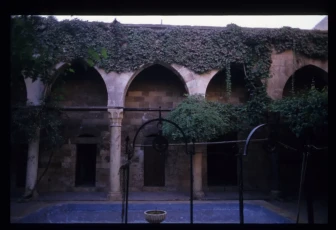
Bimaristan Arghun, view of main courtyard

Citadel der Aleppo, main entrance gateway

Bayt Wakil, fountain of the reception hall (qaʿa)

Tall Dahab, Dörfliches Gästehaus mit plastischer Dekoration der Fassade

Monastery of St Simeon Stylites, external south wall of the east basilica

Masbanat al-Jubayli, the soap bars are stacked decoratively on top of each other for drying

Jamiʿ al-Khayr, main entrance details from the inside

Monastery of St Simeon Stylites - Jabal (mountain) Samʿan

Salah ad-Din Castle, the massive castle wall with a tower on the vertical rocky edge

Palmyra, Säulenflucht des Decumanus und Qalʿat Ibn Mʿan

Living space in the tent of semi-nomadic family from the Maskana region

General view in the Limestone Massif, near al-Bara
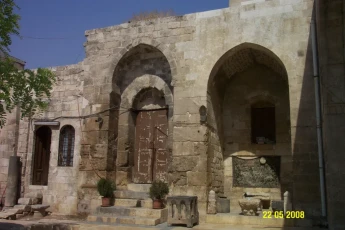
Bimaristan an-Nuri, the courtyards western facade

Busra, Bühne des Römischen Theaters, eingefasst von der islamischen Zitadelle
On the photo was mentioned: date of creation between 1985-86

General view of modern residential buildings in Saydnaya
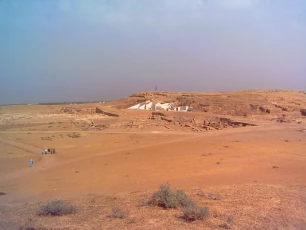
Gesamtansicht von Tall Mardikh (Ebla)
shap_import_48497

Dead Cities, Kirkbiza: A team of mule and oxen pulling a metal plough.

Camels in the Great Colonnade, Palmyra
[Original: Kamele in der Säulenstraße]

The historical centre of Maʿlula with St. Lawandius Church and hillside houses facing the valley

Al-Madrasa al-Hallawiyya, Gebetsnische aus Holz im Iwan
[Original:'Al-Madrasa al-Halâwiya, Halab / Aleppo. Geschnitzter Mihrâb von 1245, steht heute im Iwân des Hofes. Vgl. Bild 1239 !'].

A part of Zengid bridge in ʿAyn Diwar
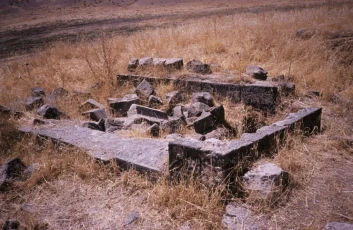
al-Malikiyya - ʿAyn al-Khadra, Basalt Tomb with arabic inscription

View into a room in Palace G, Ebla (Tall Mardikh)
shap_import_48458

Dar'a, al-Jamiʿ (Moschee) al-ʿUmari, Minarett vom Innenhof aus gesehen

Busra, Hammam Manjak, the cold section (barrani)
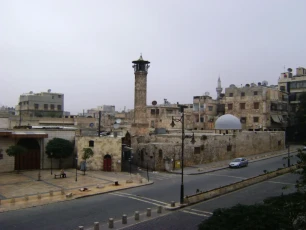
al-Mihmandar Mosque, general view from south-east

Nahiyat Tall Tamir, Small fledgeling shelters in the form of domes, to be closed by night with stones

Zum Qasr al-ʿAzm führende historische Gasse
[Original: Azem-Palast, von Asad-al-Azem 1740 begonnen, unter seinem Neffen Nasuh Pascha al-Azam Ende des 18. Jahrhunderts erweitert]

Remains of the façade, South Temple in ʿAtil
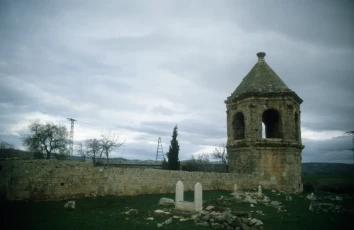
an-Nabi Huri (Cyrrhus), Roman hexagonal mausoleum, 3rd century

Eine Beduinenfrau webt mit einem horizontalen Webstuhl

Qasr al-ʿAzm, Qaʿa im Obergeschoss, Inneres mit Kuppel
Der Kuppelsaal. ['Original: Hamâ (Epiphania),']
Suq az-Zarb, general view of the suq after the destruction, view towards east
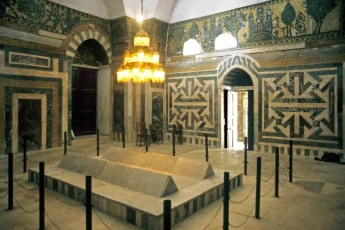
Az-Zahir Baybars Mausoleum in al-Madrasa az-Zahiriyya
[ Description by author: mit dem Grab des mamlukischen Sultans Baibars, gestorben 1277. Er war ein bedeutender Feldherr und hat den Kreuzrittern den Kraq des Chevaliers (Qal'at al-Husn) entrissen und die Mongolen 1260 besiegt. Rechts die ~ Nordwand mit dem Eingang, links die Westwand. (The date of this photo was not sure as Peter Heiske did [(wohl) 18/10/1998] ]

Befestigungsturm nördlich des Bab Antakiya, Ansicht während der Beseitigung historischer Anbauten

View of a niche inside the Castle of Harim

Busra, Jamiʿ (Moschee) al-Mabrak von außen
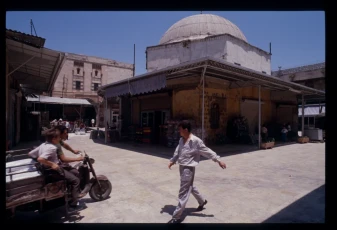
Khan al-Jumruk, general view of the mosque in the center of the Khan's courtyard

Palmenhain

Exterior view of ʿArbin watermill in Rif Dimashq

Nave and apse, Church of monk Buhayra, Busra
[Original: Bahira-Basilika, paganer Profanbau des 3. Jhs. n.Chr., Innenansicht: Triumphbogen und Apsis]

Tempel von Ithriya, Eckpilaster mit korinthischem Kapitell
und sein Kapitell, vermutlich an der ~ Nordwest-Ecke (?). [Original:'Ithriya (Seriana),']

Al-Matbakh al-ʿAjami, Muqarnas-Zwickel der Iwan-Kuppel

the damage of the minaret and the west-south part of the mosque.

Al-Madrasa az-Zahiriyya, view of the portico and the domes from outside

Tomb of Elahbel in the Valley of the Tombs, interior view
[ Description by author: Bei den Bildern 0838 - 0840 gibt es ein Problem: gehören sie zum Turm des Elahbel oder zu dem des Jambliqu ? Da aber auf allen meinen Bildern der Eingang zum Turm des Jambliqu mit einer Gittertür verschlossen ist, auf der anderen Seite alle meine Führer schreiben, dass man den Turm des Elahbel besteigen könne und wegen der Aussicht auch solle, dürfte es sich um diesen handeln. Jedenfalls befinden wir uns hier in einer höheren Etage mit Blick auf den Eingang ins Treppenhaus. Das Relief unten rechts zeigt einen typischen Palmyrener auf eine Kline - wie er an der Außenseite bzw. an der Rückwand im Erdgeschoss "fehlt" ....... ]

A self-manufactured fulling machine for the production of felt carpets
Photographs of a manufacturing facility for felt carpets in Al Bab as part of the "Aleppo Stadtarchivprojekt" of GIZ (German Corporation for International Cooperation) in 2008

Betonbewässerungskanal in der Ghouta von Damaskus
Nach dem Einzug von Zement als einem einfach zu handhabendem Baumaterial begannen die Bauern Bewässerungskanäle aus diesem Material zu bauen. Der Betonkanal im Bild lässt im Gegensatz zu den alten Kanälen, die sich in die Umgebung einfügten, das ästhetische Element vermissen.

Habuba Kabira, shell of the dome house made of dried clay bricks with quarry stone base

Hammam al-Qaramani, Ostfassade - südlicher Teil
[ Description by author: Südteil der Ostseite. Der obere Teil "modern" mit Beton ausgebaut. ]

View on the Euphrates river from Dura Europos

at-Tabqa, Jaʿbar Castle, polygonal tower.

Damascus, Glass Blowing Workshop near Bab Sharqi
Traditional mouth-blown glass workshops can still be found around the old town today. They started to decline in mid-20th century when industrialized glass manufactures spread.

Umayyaden-Moschee, West-Arkade

Jamiʿ al-Mihmandar, Portalnische - Inneres der Halbkuppel

Die Ausläufer des Anti-Libanon am Rande der Ebene von Zabadani

Ein Scheich mit seiner Familie in traditioneller Kleidung. Der Mann trägt eine schwarze Abbaya

A small pathway in the Ghuta of Damascus
The Ghuta consisted of a large number of groves separated from each other by walls or mud fences. There was often a small road between a grove and another, where it was accessed through a gate. The walls were built of rammed earth, an old tradition of rural architecture in the region.

Traditionelle Häuser eines Dorfes im Sajur-Tal

Izraʿ, al-Jamiʿ (Moschee) al-ʿUmari, Innenhof

Bayt Ghazala, ʿajami wall panels decorating the main hall (qaʿa)
[Original: B86 /Film XV]

Raqqa, Tall az-Zujaj, Block of a semi-vitrified material
Raqqa X; Glass-Tall

Mosaik Aphrodite und Ares - Gesamtaufnahme

Burg (Qalʿat) Salah ad-Din, oberer Bereich des Eingangsportal mit großflächigem Muqarnas-Dekor

Al-Madrasa al-Hallawiyya, main entrance

Raqqa, Qasr al-Banat, clay decorations

Monastery of St Simeon, Corinthian capitals decorated with wavy acanthus leaves
Capitals of the Simeon monastery are often decorated with waving acanthus leaves as a northern Syrian peculiarity.

Dura Europos (Qalʿat as-Salihiyya), Ausgrabung
Side of the Excavation

Qalʿat Ibn Maʿn, Gesamtsicht der Burg
[ Description by author: Stimmt die Standortangabe ? Dazu passt, dass der Standort etwas erhöht ist: das Zenobia Hotel liegt auf einem Hügel. Dagegen spricht das Gebäude unten links: wenn es das Tempel-Grab ist, müsste man links die Säulenfassade und keine Wand sehen. Jedenfalls: von ~ Südosten die Burg auf ihrem Bergkegel. ['Zenobia Hotel (?),'] ]

A group of semi-nomads sitting on a felt rug (left and in the rear) and on a woven rag rug (right side)

Raqqa, Qasr al-Banat, Dokumentationsblatt zum Innenhof und Nordirwan
Der „Mädchenschloss" genannte Palast hat einen von vier offenen Hallen (Iwan) umgebenen Hof. Entsprechende Grundrisstypen kennt man vor allem aus dem Iran.

Suq az-Zarb, new beginning after the destruction. View from the entrance to the west

Palmyra / Tadmur - Umgebung, al-Karasi, der östliche Altar
[ Description by author: Zwei Seiten ohne Inschrift / Relief. ]

Ein restauriertes Aleppiner Haus im Stadtviertel al-Jallum
Hof eines traditionellen Aleppiner Hauses in einer musikerfüllten Sommernacht.

Qanawat, Remains of the Temple of Zeus (Saraya)

Busra Citadel and the railway of the Hijaz line

Temporary title for Image 64135

Parts of Qalʿat Shayzar with one of the towers

Jamiʿ as-Saffahiyya, prayer niche

Gesamtsicht der Großen Moschee von Hama, historische Fotografie
Note: these photos were taken between the year 1924 - 1939. The chosen date is to be average. (photographer unkown)

Jamiʿ Sharaf, inscription on the wall of Qastal

Izraʿ - Kanisat (church) Mar Jirjis from the inside

Great Mosque, top of the minaret
The minaret of the Great Mosque was commissioned by the judge (qadi) of Aleppo during the rule of the Seljuk dynasty in Syria. The beginning of its construction is indicated in the inscription at the base and the completion date is found at the top: 483 and 489 AH / 1090 and 1096 AD. It existed until 2013. The minaret is a square shape, its shaft is approximately 45 m high and made of limestone. On its upper edge, there is a cornice formed by two rows of flat arched niches lavishly adorned by floral elements. This is topped by an open wooden gallery for the muezzin (prayer caller) and a short tower with cupola. Between the base and the top, the minaret is divided into four zones of varying height. Those are, except for the second one, decorated with blind arches formed by profiled mouldings each running uninterruptedly around the minaret’s shaft. Each zone is separated by friezes with calligraphic, artistically written, Arabic inscriptions. These exquisitely carved inscriptions are written in floriated Kufi – a script style distinguished by bold letters adorned with floral motifs – and in Naskhi script. At the base of the minaret is the signature of the architect Hasan ibn Mufrih al-Sarmani written inside a cartouche. The inscription from the minaret’s base shows that the local Aleppine judge and the Seljuk governor shared power in the city, as their names are mentioned together: “The mosques of God are only to be maintained by those who believe in God and the Last Day and establish prayer and give zakat [(alm-tax); Quran 9:18]. It was started to be built by the High Judge Ibn al-Khashshab Muhammad ibn Muhammad al-Khashshab, may God have mercy on him. In the days of al-Amin al-ʿAjal al-Muzaffar Qasim al-Dawla wa-Nasir al-Mila Abi Saʿid Aqsunqur Bak, the slave of the Commander of the Faithful, may God enhance his supporters”. The upper inscriptions indicate the names of the then ruling Seljuk sultans Malikshah I and Tutush, and of Barakat ibn Faris, commander of the urban militia.

Al-Bab, The minaret of al-Jamiʿ al-Kabir (the Great Mosque)

Drought in the Barada River, Old Damascus

Museum von Palmyra / Tadmur, Steinrelief mit figürlichen Darstellungen

Qalʿat Burqush, Reste der Portalrahmung der byzantinischen Kathedrale
[ Description by author: Sie wurde weitgehend aus Materialien des Tempels errichtet. Dieses Bruchstück hier scheint mir römisch zu sein: Einfassung eines bzw. des Portals. Interessant: sofern die Kirche den Linien der byzantinischen Substrukturen folgte - nach den Plänen ist das der Fall - ist sie nicht richtig geostet, sondern nach ~ Südosten ausgerichtet. Wollte man sparen und die Tempelmauern benutzen ? ]

Überreste eines hellenistischen Gebäudes in Afamiya

Bludan hillside houses with galleries on the foot of Anti-Lebanon Mountains

Introducing the blue dye in boiling water to the silk threads. This process is repeated several times until the silk absorbs the blue dye effectively
Al-Madrasa az-Zahiriyya, historic photo of the prayer niche
Mihrab
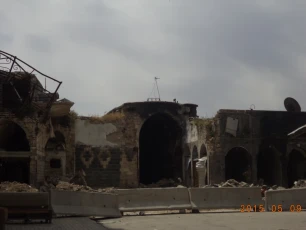
East side of the old suqs.

Ruinen des Eingangsbereich des umaiyadischen Palastes von Qasr al-Hayr al-Gharbi

Jamiʿ al-ʿAdiliyya, door of the prayer hall - decoration details and door handles

North-East Syria, the Upper Euphrates

Jamiʿ al-Khayr, ground plan
Size of plan 50 x 20, with ruler (no scale).
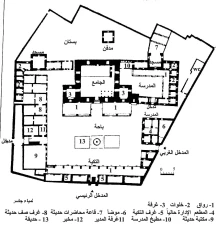
Al-Khusrawiyya, Erdgeschossgrundriss von 1988
shap_import_64425

Raqqa-Ost, Westpalast, Gabungsfunde
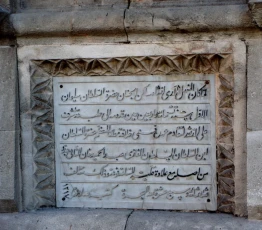
Burj as-Saʿa, inscription

Nature in Barada valley

Qasr al-ʿAzm, Obergeschoss - Hof, Portikus der Qaʿa mit Kuppel
Terrasse mit Portikus vor dem Kuppelsaal. ['Original: Hamâ (Epiphania),']

Jamiʿ al-ʿAdiliyya, decoration details in the double arcade

Detail eines Wandpaneels des Dresdner Damaskuszimmers, Museum für Völkerkunde Dresden

Great Mosque, damage mapping
The Great Mosque of Aleppo has moderate damage, except for the complete destruction of the minaret in April 2013. The degree of damage is around 30%. The western wing shows two large circular holes in the roof. There are currently no photographs available which clarify the extent of the interior damage. Several fires have affected parts of the main prayer hall causing damage especially to the southern gate and the wooden doors of the northern facade. The northern arcade was burned and its main gate partially damaged. The eastern part of the courtyard floor is torn out.

A grove with irrigation canal in the Ghouta of Damascus

A villa under construction in the Ghuta of Damascus
A view of one of the groves of the Ghouta with a villa or a summer house under construction in the middle. In the last years of the last century, rich people, both residents of the city and the villages, began to build modern residential buildings in the groves of the Ghouta, for recreation and to enjoy the beauty of nature and the freshness of the air.

Gesamtsicht mit Überresten der Stadtmauer
[ Description by author: Blick vom Gipfel, etwa hinter dem Fahnenheiligtum, nach ~ Südosten. Vorn unten das Fahnenheiligtum, davor das Prätorium und die Treppe. Dann schaut man durch die Via Praetoria nach hinten. Links das Allât-Heiligtum. Zu den Gebäuden im Hintergrund s. Bild 0801 ! ]

Interior view of Tomb Tower of Elahbel, Valley of the Tombs
[ Description by author: Erdgeschoss, Inneres. Links und rechts zwischen den Pilastern die Loculi für die Toten. Im Hintergrund die Familie des Grabinhabers, vgl. Bild 0836 ! Zur Decke s. Bild 0837 ! ]

Theater von Afamiya, Ruinen des Zuschauerraumes (cavea)

Bayt al Haj Musa (cad. no. VII 2060 and 2056)/ Reduced ground plan with ruler
Built structures under a mamluk qa'a that was destroyed before 19th century, Size of plan 28 x 38 . with ruler (no scale).

Popular restaurant on Barada River

Bayt Junblat, southern iwan - marble decoration

Palmyra, Grave in Diocletian Camp
[ Description by author: Eingang zu einem Grab in der Nähe des Fahnenheiligtums. Vgl. Bild 0760 ! ['~ kein Datum !] ]

Blick von der Burg von Harim in die umliegende Ebene

Arwad, Ayyubid fort, entrance

Qalʿat Ibn Maʿn, Luftbild der Burg von Westen

A modern three storeys building in Raqqa

Palmyra, Damaskus-Tor, Stadtmauer
[ Description by author: Gesehen von ~ Südosten. ]

Mausoleum az-Zahir Baybars, mosaics covering the southern wall

Capital of the corner column, portico of Bel Temple
[ Description by author: Tele-Ausschnitt aus Bild 0609: das Kapitell der Eck"säule". Diese Eck"säule" ist von außen gesehen ein Pfeiler, von innen sind es zwei Halbsäulen in die beiden Richtungen (vgl. Bild 0611 !). Das Ganze hat einen herzförmigen Querschnitt, s. entsprechende Fotos bei den Beirut- und Ba'labak-Bildern ! ]

Ar-Rusafa, Basilika A

Khan Qurdbak, Steindekor oberhalb eines Fensters des Iwans

Blick vom Jabal Husainiyya Richtung Diokletianslager und Allat-Tempel

Ziehende Beduinen mit Eseln, Kameln und einer Sänfte in der Region al-Hawl

General view of ʿAyn al-ʿArus

General view of the Umayyad Mosque, Damascus
Inner courtyard, vault, corridor, minaret, dome

Raqqa, Qasr al-Banat, Lehmziegelornamente

Al-Matbakh al-ʿAjami, Muqarnas-Zwickel der Iwan-Kuppel

Suq ad-Dahsha, general view of the suq

Burj as-Saʿa, spouts of the Qastal

Sarkophag mit Skulptur und Reliefs des Verstorbenen
[Original: Palmyrenischer Sarkophag. Auf dem Deckel der gelagerte Grabherr in sassanidischer Tracht mit den Rangabzeichen eines einheimischen Karawanenchefs. Auf dem als Kline gestalteten Kasten in der Mitte der Grabinhaber beim Opfer mit den Rangabzeichen eines palmyrenischen Hohenpriesters und zugleich in der römischen Amtstracht eines togatus. Auf ihn schreiten zwei mal drei Gestalten zu, die Opfergaben bzw. Opfergerät bringen. 2. V. 3. Jh.]

Bimaristan an-Nuri, mill stones nade of basalt

Al-Madrasa al-Hallawiyya, main entrance

Olivenhain in der Ghouta von Damaskus
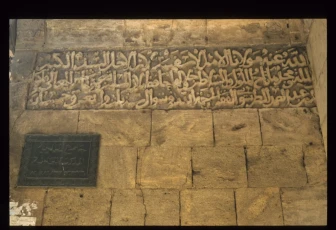
Al-Madrasa al-Hallawiyya, entrance - Zengid inscription in Naskhi script

Dar'a, al-Jamiʿ (Moschee) al-ʿUmari, Gebetshalle

The Nabataean gate with its main arch, columns and capitals

Temple of 'Ayn Dara, Giant footprints carved into the stone floor

Fragments of stucco, Kharab Sayyar

Al-Madrasa al-Hallawiyya, entrance - Ottoman inscription above the gateway
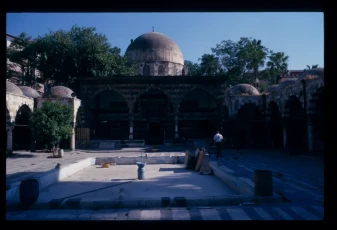
The courtyard of the Madrasa as-Sulaymaniyya

Al-Matbakh al-ʿAjami, Muqarnas-Zwickel der Iwan-Kuppel

The northern arcade of the inner courtyard (juwwani), Asʿad Basha al-ʿAzm Palace

Qasr al-ʿAzm, Innenhof im Erdgeschoss, Wasserspeier des Brunnenbeckens

Qasr al-Hayr al-Gharbi, Gewölbebogen
[ Description by author: Blick nach Osten - vielleicht durch das Westtor ? Oder geht der Blick durch die Ostmauer auf andere Gebäude (z.B. den Khân) ? ]

Suq ad-Dahsha, Ansicht der Marktgasse

Bayt Jubran Afandi Shamiyya im Viertel Bab Tuma, Innenhof mit Brunnenbecken und Iwannn
Bahra mit Liwan

Die Innenseite des Stadttores (Bab) Baghdad in Raqqa

Maronitische Kathedrale St. Elias, einer der beiden Spitzürme - Gesamtansicht

Tempel von Mushannaf, Pilasterkapitell in der Südwestecke

Citadel of Aleppo, general view of the Gate Tower

Al-Madrasa az-Zahiriyya, general view of the entrance

Aliya Alnuami

al-Madrasa al-Hallawiyya, nördliche Fassade - Marmortafel mit Datumsinschrift 1315 AH und Tughra des Sultans ʿAbd al-Hamid Khan
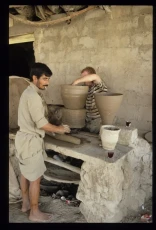
Pottery manufacturing in the Khabur region, probably in al-Busayri

Waqf Ibshir Mustafa Pasha, Kaffehaus, Innenraum nit Kuppel und Muqarnas-Pendentifs

Jurn Kabir, in einem traditionellen Doppelraumhaus (mit Bereichen zum Wohnen, Schlafen, Aufbewahren und Kochen)

View from Masyaf Castle towards the city

General view of the Great Mosque of Hama
Note: these photos were taken between the year 1924 - 1939. The chosen date is to be average. (photographer unkown)

Maʿarrat an-Nuʿman, Ruinen der Zitadelle
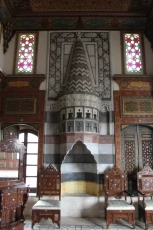
Qasr al-ʿAzm, decorative niche in the dome hall

Izraʿ, Kanisat (Kirche) Mar Jirjis, Schnitt
[Original: Kirche St. Georg]

Al-Madrasa as-Sultaniyya, marble prayer niche

Kleines Wadi in der Syrischen Wüste

Jabla, Sultan-Ibrahim-Moschee, Innenhof mit Wasserbecken

Burj as-Saʿa, oberer Portalbereich

Ecological and botanical garden near Damascus citadel
Ecological and botanical garden

Raqqa, Northeast Complex
Raqqa VIII; North-East Complex, s.SW-Neg.89/551

Raqqa - the excavations of the site "East of Raqqa" - Eastern Palace
Raqqa V; Restoration of Eastern Palace

A robust 4 cm thick felt carpet made of wool in the manufacturing facility for felt carpets in Al-Bab
Photographs of a manufacturing facility for felt carpets in al-Bab as part of the "Aleppo Stadtarchivprojekt" of GIZ (German Corporation for International Cooperation) in 2008

ʿAyn al-Khadra, Baby in a traditional wooden cradle

General view of the small palace of Qasr al-Hayr al-Sharqi
[Original: 1. Anlage]

Mushabbak, byzantinische Basilika, Ansicht von Nordosten

Umaiyaden-Moschee, Ausschnitt des mehrfarbigen Mosaiks
[ Description by author: Mittelgang, Südwand, Mittelteil.- Die Bilder 0179 - 0192 wurden mit einem High-Speed-Film gemacht, daher die mäßige Qualität ! ]

Village of ʿAyn al-Khadra, in the living room of the central hall house of a Kurdish family

Burial tombs in the rocks? northwest of Palmyra, Jazil
[ Description by author: Jeweils für mehrere Personen ? ]

Qanawat, lokales Teppichhandwerk

The historical watermill of ʿAyn al-ʿArus

Computermodell des Hermon-Gebirges
[Original: Hermon Computeraufn.]

Al-Madrasa as-Sultaniyya, marble prayer niche
The mihrab is another fine example of marble marquetry, with recessed panels bordered by a relief molding in the central half-cylinder, horizontal coursing in the niche head, and a well developed interlace occupying the spandrels. Columns, capitals, and bases are again contemporary. (Allen, Terry. "Madrasah al-Sultaniyah". In Ayyubid Architecture. Occidental, CA: Solipsist Press, 2003. http://www.sonic.net/~tallen/palmtree/ayyarch/ch8.htm#alep.msul)

Hypogäum der drei Brüder, Innenansicht mit Wand- und Deckenfresken
[ Description by author: Linke Wand, Rückwand und Decke der freskierten Halle. In der Lünette Achill auf Skyros, in der Decke die Entführung des Ganymed. ]

Al-Bara, oil mill, 5th-6th c.
The locally grown olives were pressed in oil mills. The well-preserved production site clearly shows the various work areas.

Raqqa, Tall Aswad, Zeichnung eines Brennofens

ʿAyn al-Khadra, Die ehemalige Schule aus Lehmziegeln am Dorfrand, die nicht mehr benutzt wird

Jamiʿ al-Utrush, prayer hall

Römische Brücke in at-Tayyiba über den Lauf des Wadi az-Zaydi

The view of a wall in Shayzar Castle shows three tipped arched niches, each with an entrances and a window.

Suq ad-Diraʿ, Zerstörungsschäden der Suq-Gasse, Blick nach Westen

Remains of Qasr Says or the palace of al-Walid in Jabal Says

General view of Maʿlula
[ Description by author: Gesehen bei der Anfahrt von ~ Süden. Auf dem Berg hinten links Kirche und Kloster der Heiligen Sergios (Mâr Sarkîs) und Bacchos.- Ma'lûlâ und eine Nachbargemeinde sind die einzigen Orte, in denen noch bis ins 20. Jh. Aramäisch gesprochen wurde, heute ist es praktisch ausgestorben.- Der GPS-Tag ist approximativ. ]

Dome of the mausoleum (turba) and madrasa of Amat al-Latif daughter of the an-Nasih al-Hanbali
[Original: ( mm 84 )]

Jamiʿ Sharaf, the minaret

Waqf Ibshir Mustafa Pasha, Kaffeehaus, Halle
Die außergewöhnlich reich dekorierte Fassade der Halle des Kafeehauses sowie die erste Gewölbereihe wurden zerstört. Das Innere der Halle wurde nur teilweise beschädigt, während die Kuppel mit ihrer hohen Laterne zum Größtenteil zerstört wurde.

Al-Madrasa as-Sultaniyya, entrance - inscriptions surround the iwan and above its arch

Blick von einem hohen Gipfel des Anti-Libanon

Qanawat, women in traditional dress at a well

Bayt Dallal, iwan ceiling and canopy

Große Moschee von Aleppo, Innenhof, horizontale Sonnenuhr
shap_import_60568

Propylaea of Jupiter Temple, Damascus
[ Description by author: des Períbolos des ehemaligen Tempels des Jupiter Damascenus, gesehen von ~ Osten (= Innenseite). Am Tympanon ist rechts zu erkennen, dass es sich um einen "Syrischen Bogen" handelte. Vgl. Bild 0151 und 0152 ! ]

Ceiling and Reverse side of the ceiling of Bayt Ḫazīna-Kātibī / Niẓām with ‘Ajami decoration
detail of the šīša-ceiling with panels (ṭabaq) painted alternately on green and red ground and view from above on the construction of the šīša-ceiling

Busra - Jamiʿ (mosque) al-Mabrak, the courtyard

At-Takiyya al-Ikhlasiyya (az-Zawiya ar-Rifaʿiyya), Inschrift oberhalb des Eingangs der Gebetshalle

Qalb Lawza, Basilika, 5.Jh., Blick auf die Hauptfacade von Süd-West

Al-Madrasa ash-Sharafiyya, Inneres der Mihrab-Kuppel mit Muqarnas und Rippenkalotte

Raqqa, Qasr al-Banat, Lehmziegelornamente

Palmyra, Stadtmauer
[ Description by author: Blick nach ~ Nordwesten. Vor der Mauer ganz rechts der Annex, zwischen den beiden Mauern liegt die Agora, bei der Säule ist der Eingang zum Bankettsaal, darüber die Burg. Im Verlauf der Mauer erkennt man ganz hinten das Diokletians-Lager.- Die Mauer wird bald als Diokletianisch, bald als Justinianisch bezeichnet: vermutlich unter Diokletian (rund 300 n. Chr.) erbaut und unter Justinian (ca. 550. n. Chr.) erneuert / verstärkt. ]

Fresco paintings on the ceiling of tomb tower of Elahbel

Umayyaden-Moschee, Minarett der Braut (al-ʿArus)

General view of Halabiyya ruins

Great Mosque, Minaret
The minaret of the Great Mosque was commissioned by the judge (qadi) of Aleppo during the rule of the Seljuk dynasty in Syria. The beginning of its construction is indicated in the inscription at the base and the completion date is found at the top: 483 and 489 AH[11] / 1090 and 1096 AD. It existed until 2013. The minaret is a square shape, its shaft is approximately 45 m high and made of limestone. On its upper edge, there is a cornice formed by two rows of flat arched niches lavishly adorned by floral elements. This is topped by an open wooden gallery for the muezzin (prayer caller) and a short tower with cupola. Between the base and the top, the minaret is divided into four zones of varying height. Those are, except for the second one, decorated with blind arches formed by profiled mouldings each running uninterruptedly around the minaret’s shaft. Each zone is separated by friezes with calligraphic, artistically written, Arabic inscriptions. These exquisitely carved inscriptions are written in floriated Kufi – a script style distinguished by bold letters adorned with floral motifs – and in Naskhi script. At the base of the minaret is the signature of the architect Hasan ibn Mufrih al-Sarmani written inside a cartouche. The inscription from the minaret’s base shows that the local Aleppine judge and the Seljuk governor shared power in the city, as their names are mentioned together: “The mosques of God are only to be maintained by those who believe in God and the Last Day and establish prayer and give zakat [(alm-tax); Quran 9:18]. It was started to be built by the High Judge Ibn al-Khashshab Muhammad ibn Muhammad al-Khashshab, may God have mercy on him. In the days of al-Amin al-ʿAjal al-Muzaffar Qasim al-Dawla wa-Nasir al-Mila Abi Saʿid Aqsunqur Bak, the slave of the Commander of the Faithful, may God enhance his supporters”. The upper inscriptions indicate the names of the then ruling Seljuk sultans Malikshah I and Tutush, and of Barakat ibn Faris, commander of the urban militia.

Bayt Ghazala, courtyard - northern facade
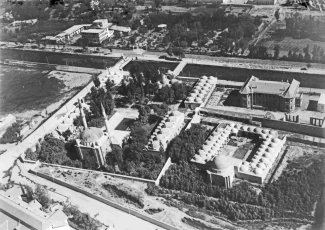
Old aerial photo of at-Takiyya as-Sulaymaniyya, Damascus
[Original:'Damaskus, Großes Derwisch-Kloster (Luftbild)']. The Bavarian air force division 304b was based in Palestine from 25. October 1917 and was involved in the First World War until the division left the region, over Aleppo, in mid September 1918. During that period, over 3000 glas photographs, mostly aerial, have been made. Those early photographs were important for the archaeological research in the Middle East region.

Citadel of Aleppo, main entrance gateway
[Original: Zitadelle, Haupttor, Vortor und Brücke]

Making of burghul in Yabrud during the sixties
A man stirs with a shovel in a large vat during the production of the Burghul (Bulgur). In this process, the wheat grits of durum wheat or common wheat pass through the stages of paraboiling (hydrothermal pre-treatment), subsequent drying, mechanical removal of the exposed bran, cutting of the grain with a grit cutter and subsequent sieving into various grain sizes. Here we see a rural scene of traditional production by precooking the wheat in a large copper vat.

Burning and damage inside the rooms of the eastern part of the courtyard. The space is 06 in general, according to the ground plan. The secondary space 02, and most likely space 08 are seen.

Die historische Mühle in Ayn al-ʿArus

Jisr ash-Shughur, Qalʿat ash-Shugr wa-Bakas, eine allgemeine Ansicht des Tales um die Burgen herum

Al-Bara, pyramid tomb A, 6th c.

Bootsfahrt auf dem Euphrat beim Jabal ʿAruda

Jamiʿ Manjak, Innenhoffassaden mit Ablaq-Mauerwerk

Takiyyat ash-Shaykh Abu Bakr, the prayer niche (mihrab)
shap_import_65912

Die Eingangsfassade des Bahram Pasha-Bades

Jamiʿ al-Utrush, Nordportal

Jamiʿ Aslan Dada, Kuppel der Halle - Überleitung zum Tambour mit Trompenbogen und Muqarnas-Kapitell

Jurn Kabir, In einem traditionellen Wohnraum, ausgestattet mit Holztür und -fenster, Wasserbecken und Filzteppich (lubbad),

Remains of ar-Raqqa Wall built of mud brick
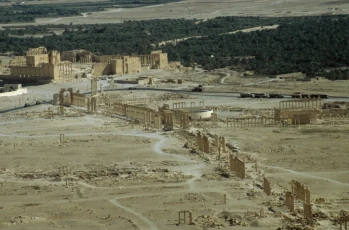
A general view of the remnants of the ancient city of Palmyra towards the south eastern palm groves

1 pound, 27 mm, 1968 – restrike 1971

‘ataba ceiling in the main courtyard, north wing of the Qasr al-‘Azm in Damascus, today known as the "Bride´s Room"
shap_import_97595

Bayt Wakil, Aufsicht auf den Steinfußboden in der ʿAtaba der Empfangshalle (Qaʿa)

Habuba Kabira, View from the inside of the room while constructing the dome

Tall Shaykh Hamad (Dur Katlimmu) - Excavations
[Original:'TALL SAIH HAMAD']

Interior view of Mar Taqla Monastery, Maʿlula
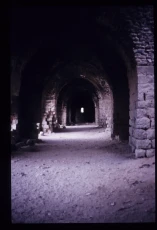
Khan Dannun, arcade

Busra, Decumanus maximus looking west from the nymphaeum

ʿAyn Diwar, The Zengid bridge on the Tigris

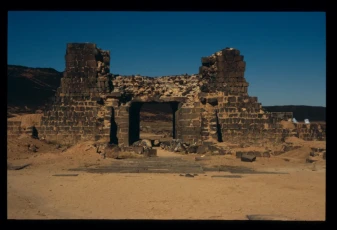
Remains of the entrance of al-Walid palace, Qasr Says in Jabal Says

Madrasat al-Firdaws, inscription

Exterior view of the dome and the minaret, Jamiʿ al-Imam Ismaʿil

Raqqa, Western Palace, aerial view of excavation site
The aerial picture shows how the site looked during its excavation. At the edge of the excavation site, clay bricks are laid out for drying. [Original on the back: '86']

Interior view of the Hypogeum of Artaban in the south-eastern cemetery area
[ Description by author: Die Exedra mit dem Grabinhaber auf seiner Totenkline, umgeben von seiner Familie. Außerdem sind in diesem Grab einige der Platten mit den Reliefbüsten der Verstorbenen erhalten, die die Loculi nach vorn abschlossen. ]

Raqqa, Qasr al-Banat, Innenhof mit Südiwan

Theater von Afamiya, Ruinen der Frontseite des Bühnenhauses

Bayt Junblat, Innenhof mit Nord-Iwan

A renovated Aleppine house in al-Jallum neighborhood
The courtyard of one of a traditional Aleppine house on one summer night filled with music.

Al-ʿArus minaret of the Umayyad Mosque

Jurn Kabir, flatbreads are rolled out with a stick, so that they can become wafer-thin and can be baked on the tray over the fire.

Palmyra, Nabu-Tempel, Propyläen
[ Description by author: Gesehen von ~ Süd-Süd-Ost. Im Tor sieht man hinten die Säulen der Diokletians-Thermen, hinter der rechten Türrahmung den Altar und dahinter die Treppe zum Podium des Tempels. Der Altar hat die Form eines Naiskos (vgl. Bild 0680 !), wie z.B. in Qal'at Faqra im Libanon. ]

Bayt Ajiqbash, carved stone at the courtyard

A capital decorated with acanthus leaves, Monastery of Saint Simeon
[Original: -k.K6/=HQ k.K24]

Simple muqarnas in the Castle of Harim

Südtempel in ʿAtil, Blick auf die Haptfassade
Roman temple

Qasr al-ʿAzm, Innenhof im Erdgeschoss

Busra, Roman Theater surrounded by the Islamic Citadel

Afamiya Theater, remains of Cavea

Citadel of Aleppo, main entrance gateway
[Original: Zitadelle, v.a. vom Ayyubiden-Sultan Zahir Ghazi (reg. 1193 - 1215) umgestaltet. Haupttor mit achtbogiger Brücke]

Entrance and minaret of as-Sibaʿiyya mosque, Damascus

Laden im Suq al-Buzuriyya, Altstadt von Damaskus

Die Kilaniyya-Noria, gelegen an dem 1982 zerstörten Kilani-Palast, historische Fotografie
Hinweis: Dieses Foto wurde zwischen den Jahren 1924 - 1939 aufgenommen. Das gewählte Datum soll ein Durchschnittswert sein. (Fotograf unbekannt)

An olive grove in the Ghouta of Damascus
A scenary in the Ghouta of a field filled with perennial olive trees. It seems, from the ladder leaning on a tree, that it is the harvest season.

Jisr ash-Shughur, Qalʿat ash-Shugr wa-Bakas, Kreuzritterburgen, Steinbogen

Khan Qurdbak, Grundriss Iwan mit Untergeschoss der benachbarten Qaʿa

General view of the Umayyad Mosque shows the dome and the three minarets of the mosque
[ Description by author: Blick vom Hotel Burj al-Farâdîs nach ~ Osten auf die Umayaden-Moschee. Links (~ Nordseite) das Brautminarett, vorn rechts das Minarett von Qait Bay, hinter der Kuppel das Jesus-Minarett. ]

Safita, General view of the city showing the Donjon of the Templars

Raqqa-Ost, Tall Aswad, Ausgrabung im 1985
[1985/72/995] = [photo's name as: year/ film no./ photo no.]
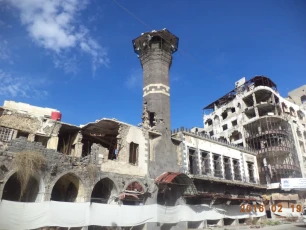
The damage of the western part of the facade and the minaret.

One of the entrances in Qalʿat Salah ad-Din (castle)
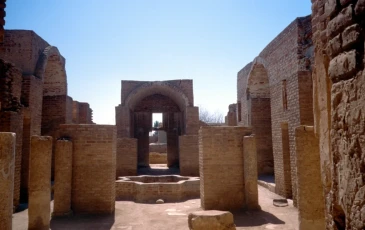
Raqqa, Qasr al-Banat, courtyard with southern Iwan

Remains of the gateway of the Umayyad complex at Qasr al-Hayr al-Gharbi

Mushabbak, byzantinische Basilika, Ansicht von Südosten

Afamiya, Northern Roman baths

One of the towers of Shayzar Castle

Detail des Staudamms von Kharbaqa, Quelle

ar-Rusafa, North Gate of the city wall, interior
[Original: 7-Syr98/17-14]

Ajiqbash house, view of the courtyard, south-east corner
The former courtyard house of a merchant family served as Aleppo’s Museum of Popular Traditions. The house is severely damaged, especially the open living space facing the courtyard (Iwan).

Schuhmacher im Suq Midhat Basha

Al-Madrasa al-Kamiliyya, interior view of prayer hall dome

Blick auf die Zitadelle von Damaskus von Nordwesten
Die beiden Türme, die die Zitadelle von Westen her schützten, sind im Bild deutlich zu erkennen. Hinter den Büschen ist die Statue von Salah ad-Din auf seinem Pferd zu sehen.

Offener Hof im Obergeschoss der Burg Najm (Qalʿat Najm)

Children from the region, Krak des Chevaliers in the background

Yabrud, Felder und Pappelanpflanzung

Gesamtansicht der Burgruine Shayzar (Qal'at Shayzar)

Dura Europos (Qalʿat as-Salihiyya), Roman amphitheater
theater

Khan al-Hibal, Grundriss

Tall Dahab, Mit Zement befestigte Stelle, wo abgespült oder gewaschen wird, evtl. kann dort Körperwäsche stattfinden

Nahiyat Tall Tamir, Today empty domed houses in an Assyrian village seen from the street side
The Assyrian villages on the Khabur with their domed houses were built by the French Mandate Government for Christian refugees from Turkey and Iraq.

Arch bridge over the Orontes River, which leads to the Shayzar Castle

Jamiʿ al-Utrush, western entrance
The gate is inside a decorated niche.

Motifs in Saz style, Aleppo Room wall frame, early 17th century

Traditionelle Häuser in Darkush am Ufer des Orontes

Al-Madrasa al-Hallawiyya, entrance - Zengid inscription in Naskhi script

Madrasat al-Firdaws, oktogonales Brunnenbecken mit gelapptem Rand im Zentrum des Innenhofes

Jurn Kabir, Bau eines Raumes aus Bruchsteinen mit Lehmmörtel

View of the church at Ibn Wardan Palace
[Original: Kirche (Kuppelbasilika mit Emporen), Westfassade (?)]

Jamiʿ al-ʿAdiliyya, general view of the prayer hall

Jabla, Sultan Ibrahim Mosque, Interior view of a dome
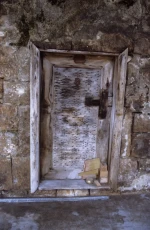
Damascus, An old wooden door

Monastery of St Simeon Stylites, view the west basilica

Barada River, near Victoria Bridge
shap_import_51655

Euphrat-Staudamm in Nahiyat at-Tabqa

Vineyard in the Ghuta of Damascus
The farmers in the Ghuta used some techniques and agricultural processes including grafting. The vine was grafted with white, black and red grapes.

Busra - Southern Roman Bath (al-Hammam ar-Rumani al-Janubi)
Exterior view to north, palaestra of the South Baths

Bayt Junblat, Süd-Iwan (großer Iwan)
[Original:'Qasr Jumblât, Halab / Aleppo. Der Süd(?)flügel mit dem großen Iwân, gesehen von ~ Norden, wohl aus dem Iwân des Nordflügels. Das Gebäude stammt aus der 2. Hälfte des 16. Jhs.. Vgl. Bild 1302 - 1306 !].

Raqqa, Qasr al-Banat, star-shaped fountain in centre of the courtyard

Madrasat al-Firdaws, details of lobed octagonal basin

Village on western shore of Jabbul-Lake, dome houses with stone inlay on the top

General view of Maʿlula town in 1930s
Note: these photos were taken between the year 1924 - 1939. The chosen date is to be average. (photographer unkown)

Apse of basilica, al-Bara

Al-Madrasa al-Ahmadiyya, Eingang zum Grabraum

Remains of the pendentifs carrying the dome of the church at Ibn Wardan Palace
[Original: Kirche (Kuppelbasilika mit Emporen)]

Spinning with a suspended spindle
Drawings by Estibaliz Sienra Iracheta to illustrate processes of traditional textile manufacturing

Several plans of masuoleums (turba) in Damascus
Plans of Turbas in Damascus: 105 Shibliyya, 106 Rayhan [Hand written: No. 84 Kadastre II/5 1380 (?)], 107 Takritiyya, 108 Zahiriyya, 109 Khatuniyya

Hammam al-Bayyada, the cold section (barrani)

Die Aleppo-Seife wird zum Trocknen aufgestellt. (Aj-Jubayli Seifen-Manufaktur)
Im Bild sind die überwölbten Gänge im oberen Stockwerk der Seifen-Manufaktur zu sehen. Die Seifenstücke sind zwischen den Bögen zum Trocknen aufgestellt.
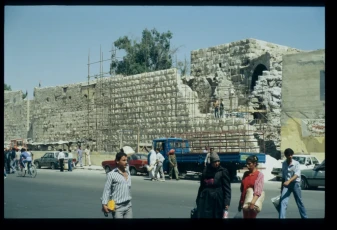
The citadel of Damascus during the restoration in 1985

Khan Qurdbak, südlicher Teil mit Iwan des mamlukischen Palastes

Blick in eine Nische in der Burg von Harim

Great Mosque, people in the courtyard

Tempel von Ithriya, Gesamtsicht
Gesehen von ~ Osten (sofern ich das Satellitenfoto richtig gedeutet habe !).- Zur genaueren Information s. das PDF Nr 1087 ! Die Verzierung links und rechts des Tores erinnert an Nîha im Libanon. Der Tempel soll ein Prostylos gewesen sein und aus dem 3. Jh. stammen. [Original:'Ithriya (Seriana),']

Zitadelle von Aleppo - Große Moschee, Minarett
Hinweis: Dieses Foto wurde zwischen den Jahren 1924 - 1939 aufgenommen. Das gewählte Datum soll ein Durchschnittswert sein. (Fotograf unbekannt)

Jurn Kabir, the traditional type of the double room house, which is divided inside by a transverse wall.

Jamiʿ Aslan Dada, korinthisches Kapitell einer marmornen Ecksäule der Gebetsnische

Jamiʿ as-Saffahiyya, entrance

Bayt Dallal, ʿAjami-Holzdecke einer Qaʿa
![[S.156 Abb.174]](https://syrian-heritage.org/wp-content/plugins/justified-image-grid/timthumb.php?src=https%3A%2F%2Fsyrian-heritage.org%2Fwp-content%2Fuploads%2F2020%2F04%2Fshap_import_52442-1024x699.png&h=230&q=90&f=.png)
[S.156 Abb.174]

The historical sulfur spring of Afqa
[ Description by author: Wie Bild 0581, leicht geänderter Blick: Altar, Säule, "Treppe", Altar. ]
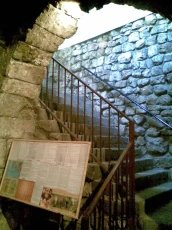
Die Treppe in die Ananias-Kapelle im Bab Tuma-Viertel
Die Ananias-Kapelle ist über eine schmale Treppe mit kleinen Steinstufen erreichbar.

Busra, Ansicht der Zitadelle
On the photo it was mentioned: date of creation between 1985-86

Die Radnabe eines Wasserschöpfrades (arab. noria)

Al-Madrasa al-Muqaddamiyya, a groin vault in the entrance
Inscription of foundation in 1168, oldest Inscription in Naskhi in Aleppo

Eine Frau aus ländlicher Gegend mit traditioneller Kleidung

Jamiʿ al-Mihmandar, the entrance half dome

Qal‘at (castle) Shayzar from the inside

23/5000 Qasr (Palast) al-Banat

Eine Kammer im Bad der Burg von Harim

Squinch of the dome in the hall of upper floor, Qasr al-ʿAzm
Kuppelsaal: eine Trompe der Kuppel mit einer Art Muqarnas. ['Original: Hamâ (Epiphania),']

Busra - Birkat (Becken) al-Hajj

View on the Euphrates river from Dura Europos
und Euphrat-Auen, gesehen von nördlich der Zitadelle nach ~ Osten.

Mosque of as-Sayyida Zaynab, Nahiyat Babbila
[ Description by author: Sayyida Zainab ist eine Tochter von 'Ali und Fatima, somit Schwester von Husain und Hasan und Enkelin des Propheten, außerdem Tante der Sayyida Raqîya, einer Tochter Husains, die ebenfalls in Damaskus begraben ist (vgl. Bild 0251 - 0253 !). laut sunnitischer Tradition ist Sayyida Zainab allerdings in Kairo begraben ....... Die Anlage wurde ab 1990 errichtet, vermutlich weitgend mit Geld aus Iran.- Gesehen von ~ Norden. ]

Homs, al-Jamiʿ an-Nuri, Hauptgebetsnische

A concrete irrigation canal in the Ghouta of Damascus
As cement became as an easy-to-use building material, farmers began building irrigation channels using that material. The concrete canal in the picture seems to be missing the aesthetic element, unlike the old canals that were corresponding to the surrounding environment.

Blick auf das Mittelmeer in Baniyas

Bühne des Römischen Theaters und aiyubidische Zitadelle, Busra
[Original: Theater, Bühnengebäude (wahrsch. spätes 2. Jh.)]

Ash-Shaykh Hasan Mausoleum
Photo of Mausoleum des Gouverneur Ahmad Pasha, in Maidan

Tempel von ad-Dumayr, Innenraum
[ Description by author: Gesehen nach ~ Nordwesten. Man blickt auf die innere Schmalwand mit rechts und links den beiden "Kammern" (deren Rückwand die originale äußere ~ Westwand ist) und in der Mitte dem Durchgang, dessen "Rückwand" die islamische Zumauerung bildet. Vgl. Bild 0384 - 0386 ! ]

Mushannaf, Small Roman Temple

ar-Rusafa, Basilka A, Blick in das Hauptschiff mit Bema

Kloster des Heiligen Sergius in Maʿlula

Hypogäum der drei Brüder, Innenansicht mit Wand- und Deckenfresken

At the upper reach of the Khabur near Raʾs al-ʿAyn

Al-Matbakh al-ʿAjami, muqarnas squinches of the iwan dome

Al-Madrasa al-Hallawiyya, entrance of the prayer hall

One of the towers of Damascus Citadel
View of a tower of the eastern façade of Damascus Citadel. The tower looks rectangular, topped by a set of machicolations.

Marmor-Kenotaph neben dem Grab von Salah ad-Din al-Ayyubi, ein Geschenk Kaiser Wilhelms II. anläßlich seines Besuchs in Damaskus 1898
[ Description by author: Der Kenotaph Salâhu d-Dîns. Das Grabmal war völlig vernachlässigt, bis es Wilhelm II auf seiner Orientreise 1898 restaurieren ließ und diesen Steinsarkophag stiftete. Davon berichtet die Inschrift oben links, vgl. Bild 0230 ! Zu dem weitgehend verdeckten älteren Holzsarkophag s. Bild 0229 ! (The year of the photo is not sure according to Peter Heiske ) ]

Jurn Kabir, children at the sabil of a private house, where people passing find potable water

Exterior view of Qalʿat Arwad (citadel)

Blick auf den Orontes

Khan al-Jumruk, im Hof Blick nach Norden auf die innere Eingangsfassade

Aghabani table cloth

Jamiʿ al-Khayr, a wooden internal balcony (sudda) above the prayer hall entrance

Eine Beduinenfrau webt an einem horizontalen Webstuhl

Entrance gate to the city of Ugarit
[Original: Ausfalltor in Ugarit]

An alley in Halbun

A boy is presenting a woven Kilim tapestry made by his mother

Tanz auf der Terrasse des Thekla-Klosters am Heiligkreuzfest in Maʿlula

Restoration works at the Citadel of Damascus

General view of Masyaf Castle

Jisr ash-Shughur, Qalʿat ash-Shugr wa-Bakas, a twin crusader castle, stone arches

Blick über Husn Sulayman

Az-Zawiya al-Hilaliyya, northern facade (library)

A view from Qalʿat Shumaymis towards the surrounding plains

Raqqa - "East of Raqqa" site - Western Palace, Glazed pottery
West Palace; Glazed pottery, waster pottery

Damaskus, Khan Asʿad Basha al-ʿAzm, eine kreisförmige Öffnung im Dach des Hofes

Jisr ash-Shughur, Qalʿat ash-Shugr wa-Bakas, der Weg um die beiden Burgen herum

Part of the walls, Qalʿat Harim

Dörfer und die fruchtbare Flussaue des Euphrattal, die vom Tishrin-Stausee überflutet wurden
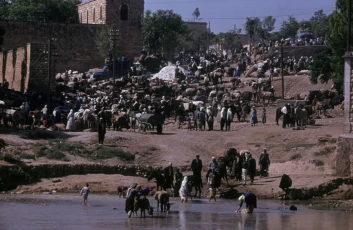
Menschenansammlung in ʿAfrin zur Zeit der Baumwollernte
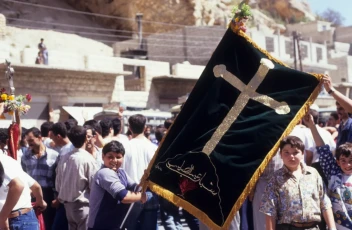
On september 14th at the Holy Cross Feast in Maʿlula, with the standard of the Holy Cross Youth

Bimaristan Arghun, Hauptinnenhof - Blick auf die südliche Fassade
shap_import_60905

Ploughing at a grove in the Ghouta of Damascus
Habuba Kabira, view into a plastered cantilever dome with openings and decorative layer

Hiraqla victory monument: glass jar

Das Dorf Al-Qirata am Nordhang des Sajur-Tales, alte, gekälkte Häuser sichtbar

Citadel of Aleppo, Great Mosque - dome of the prayer hall

Eine alte Holztür in Damaskus

Straßenszene in einem Suq von Dayr az-Zawr
[Original: Große Orientreise Nr.63 mit Rotel-Tours: Amman-Bagdad-Uruk-Babylon-Arbil-Mosul-Hatra-Samara-Mari-Dura Europos-Aleppo-Dayr Saman-Ugarit-Palmyra-Jarash]

Jamiʿ Sharaf, mamlukisches Emblem (Rank)
Dar'a, al-Jamiʿ (mosque) al-ʿUmari- main door from the inside

Busra - Südliches Römisches Bad (al-Hammam ar-Rumani al-Janubi)
Südtherme, Vorhof vor der Restaurierung
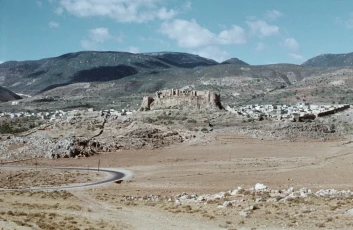
A distant view of Masyaf castle and town

Al-Madrasa as-Sultaniyya, nördliches Fenster des Mausoleums von al-Malik az-Zahir Ghazi

The minaret of Jamiʿ (Mosque) ash-Shaykh Muhyi ad-Din Ibn ʿArabi
[ Description by author: Da dieses Bild von der Filmnummer zwischen dem Darwîsch-Kloster (Bild 0356) und der Moschee Shaikh Mûhi d-Dîn al-'Arabi (Bild 0358) steht, dürfte es sich um das MInarett eines der beiden Gebäude handeln. ]

Jamiʿ Sharaf, alte Gebetsnische (Mihrab)

A lateral Iwan at Bayt Jubran Afandi Shamiyya, Bab Tuma
Seitenliwan

Izraʿ, al-Jamiʿ (Moschee) al-ʿUmari, Außenfassade

In al-Hayat im Balikh-Tal: Prozess der Gipsherstellung ist beendet (3. Schritt): der natürliche Gipsstein wurde durch Brennen zu Gips als Baumaterial
(Siehe auch 1. und 2. Schritt der Gipsherstellung)

In the Syrian desert: the separation of the living and the storage compartment in a bedouin tent with the help of a stick mat (arab. zarb)
Large patchwork curtains cover the stacks of bedding and - as here - the partition wall separating the two tent sections. The girls of the family sew these huge patchwork curtains. The living compartment of the tent is visible on #2852 and #2853.

Bayt Wakil, section drawing of the hall facade
Size of plan 30 x 26, no scale.

Citadel of Aleppo, entrance of the Palace of al-Malik al-ʿAziz Muhammad

Madrasat al-Firdaws, mausoleum - inscription above wall cabinet

Jamiʿ Aslan Dada, the hall dome - octogonal tambour on squinches

Takiyyat ash-Shaykh Abu Bakr, interior view: courtyard, rooms from outside, arcade and the inner entrance

Burg (Qal'at) al-Marqab, Innenhof und Kapelle

Qatna, Stadtareal innerhalb der Umfassungsmauer, Ausgrabung
. [Original: Al-Mishrifa / Qatnâ']

ar-Rusafa, Ziegenhaarzelt, das für eine Trauerfeier zur Beerdigung errichtet wurde

Ruins of the wall of Qalʿat Shumaymis (castle)
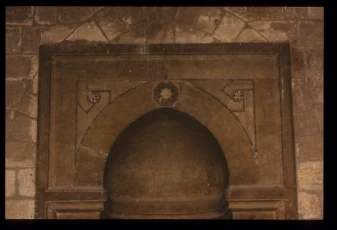
Al-Madrasa al-Kamiliyya, niche (mihrab) in the prayer hall

Burj al-Ghanam, general view of the tower's west-south corner

Busra, Hammam Manjak, Restoration works

Camels and camel herder on way home after transporting cotton sacks in the fields of the Euphrates valley

Suq Aslan Dada, reconstruction of northern entrance and eastern wall of Khan as-Sabun, view towards southwest

Gesamtansicht der Burg Ja'bar
Hinweis: Dieses Foto wurde zwischen den Jahren 1924 - 1939 aufgenommen. Das gewählte Datum soll ein Durchschnittswert sein. (Fotograf unbekannt)

General view of Jabal Haramun (Mount Hermon)

View from the Philippeion to the city, Shahba

Alte Zisterne in der Lejat

Suq al-ʿAttarin, Ansicht der zerstörten Marktgasse, Blick nach Osten

General view of the Valley of Tombs
[Original: Palmyra u. Nekropole]

A side of the Cavea, Palmyra Theater
[ Description by author: linker Teil. Die Cavea soll ursprünglich etwa dreimal so viele Sitzreihen gehabt haben: das Theater von Palmyra war eines der größten im Nahen Osten. Es wurde allerdings niemals vollendet ....... Im Hintergrund ganz links die Burg, weiter rechts und näher der Tetrapylon. Der Bogen rechts in der Kolonnade markiert den nordwestlichen Durchgang zur Rundstraße ums Theater. Gesehen nach ~ Nordwesten. ]

Waqf of Ibshir Mustafa Pasha, Coffeehouse, interior, dome and muqarnas squinches

Badiyat ash-Sham, a small road

Ausflugslokale an den Ufern des Barada

A traditionally crafted tapestry cover (Kilim)

Mushabbak, byzantinische Basilika

in der Ghab Ebene: strohgedeckte Lehmhäuser, 1963

Kaffeehaus Aslan Dada (nicht erhalten)

Al-Madrasa al-Hallawiyya, wooden prayer niche in the iwan
[Original:'Al-Madrasa al-Halâwiya, Halab / Aleppo. Geschnitzter Mihrâb von 1245, steht heute im Iwân des Hofes. Vgl. Bild 1239 !'].
Shard of colored pottery, ar-Raqqa Museum

Raqqa, Qasr al-Banat, Wandgliederung mit Lehmziegelornamenten
Neg. Nr. 83/5-33A/34
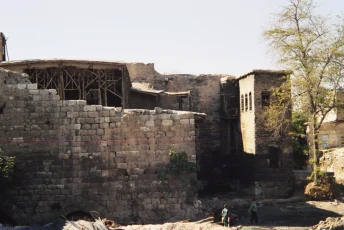
Exterior view of Seljuk watermill ''Bab as-Salam watermill'', Damascus

Great Mosque of Aleppo, prayer hall interior
Aleppo Great Mosque, prayer hall interior

Jamiʿ at-Tawashi, Ostfassade - vertikale Fensternische mit Muqarnas-Dekor

Bel Temple, column with Ionic captial on the south facade of the cella
[ Description by author: Tele-Aussschnitt aus Bild 0614: das jonische Kapitell der linken Halbsäule der Cella-Südwand. ]

Siegesmonument von Hiraqla, Grundriss Erdgeschoss
Rekonstruktionszeichnung des Erdgeschosses, Zeichnung zeigt die Wände (mit Maßstab)

Bel-Tempel, Peristyl-Balken mit Frauendarstellung
[ Description by author: LInke Seite oben des Balken Bild 0642, 0643: noch einmal verschleierte Frauen. ]
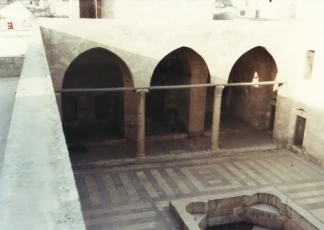
Al-Madrasa az-Zahiriyya, courtyard and arched arcade
shap_import_66073

Maronitische Kathedrale St. Elias, einer der beiden Spitztürme

Khan Qurdbak, courtyard - southern and eastern porticos

Jabal ʿAruda, ruins of a temple from the middle of the 4th millennium BC

Madrasat al-Firdaws, Innenhof mit Westarkade

Balcony above main portal of Khan al-Harir

Interior view, courtyard of Jamiʿ al-Imam Ismaʿil

Minaret of the great mosque, (al-Jamiʿ al-Kabir), Maʿarrat an-Nuʿman
und Bauten aus Spolien im Innenhof. [Original: Ma'arat an-Nu'mân (Arra)']

Im Hinterland von Yabrud in den 1960er Jahren: Pflügen mit hölzernem Pflug und 2 Pferden

Glasierte Keramikscherbe aus dem Museum von Raqqa

Die Burg (Qalʿat) Salah ad-Din liegt im waldigen Gebiet des syrischen Küstengebirge

Making pickles

Diokletianslager, Fahnenheiligtum
[Original: Blick von der Principia auf die Ausgrabungen (Principia = official places of the army officers)]

Tomb of Elahbel in the Valley of the Tombs, facade
[ Description by author: Oberer Teil der Fassade. Im Bogen eine Kline für den Toten, dessen Hochrelief allerdings fehlt. Unten in einer Tabula ansata eine zweisprachige Inschrift. Gesehen von ~ Süden. ]

Säulenstraße, Antennen-Berg - Blick nach Südosten
[ Description by author: 3. Abschnitt. Ganz links das Tempelgrab, ganz rechts der Tetrapylon und dahinter der Monumentalbogen. Unterhalb des Tempelgrabes ein Stück der Stadtmauer. Gesehen nach ~ Südosten. ]

Bel-Tempel, Temenos mit Propyläen
[ Description by author: Die Propyläen - die arabische Bastion - von der Hofseite, also von ~ Osten. ]

Bayt Junblat, Süd-Iwan, zentrale Tür an der Stirnseite
[Original:'Qasr Jumblât, Halab / Aleppo. Iwân des Süd(?)flügels: die mittlere Tür.].
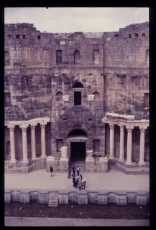
Busra, the Roman theater stage is surrounded by the Islamic citadel
On the photo was mentioned: date of creation between 1985-86

Jisr ash-Shughur, the ruins of Qalʿat ash-Shugr wa-Bakas, a twin crusader castle

The tower tombs, Valley of the Tombs
[ Description by author: in der rechten Bildhälfte. Ich habe den GPS-Tag nach der Angabe auf der Karteilkarte "vom Südwest-Hügel" (damit könnte der Hang des Jabal al-Mantâr gemeint sein) gesetzt. Eine andere Möglichkeit wäre: aus der Gegend des Turms des Jambliqu, denn auch dieser Hügel (und ist eher ein "Hügel" !) liegt südwestlich in Bezug auf die Stadt. Die Blickrichtung jedenfalls muss nach Nordwesten oder Westen sein. ]

Afamiya, Ruinengelände

Qal‘at Shayzar ( Citadel), An Arabic inscription on top of the citadel entrance.

Basalt orthostats on the western side of ʿAyn Dara Temple

Qunaytra, Ansicht zerstörter Gebäude

Innenseite der Südwand des Turm 3 von Halabiyya

Bayt Dallal, courtyard view from the iwan
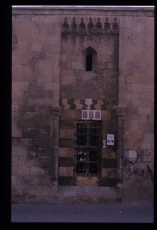
Jamiʿ at-Tawashi, eastern facade - window within a rectangular niche decorated with muqarnas
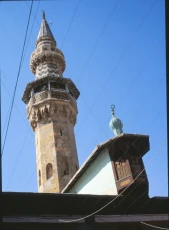
The minaret of Jamiʿ (Mosque) ash-Shaykh Muhyi ad-Din Ibn ʿArabi

Hama, Burg al-Madiq, Blick auf einen Turm

View of a road in al-Ghab Plain

Jamiʿ al-Khayr, Hauptportal Innenhofseite

Reliefdekoration an einem Bogen in der Kirche von Qalb Lawza

Ruine eines Gebäudes in Jabal Says

Access to the Castle's interior, Qalʿat Ibn Maʿn
[ Description by author: Der typische abgeknickte Zugang ins Innere der Burg. ['Qal'a, 25/03/2002 (?)'] ]

'Ain as-Sâhib, Felsgräber
[ Beschreibung des Autors: Auf dem linken Hang. Zu dem links oben und in der Mitte s. Bild 0408 ! Ob sich unter dem Felsüberhang weiter nach unten und rechts auch ein Grab befindet ? Die Felswand gleich über den Bäumen links wirkt auffallen geglättet, in Petra würde ich sagen "vorbereitet" ....... ]

Madrasat al-Firdaws, general view of the courtyard and the arcades

Raqqa, Nordost-Komplex
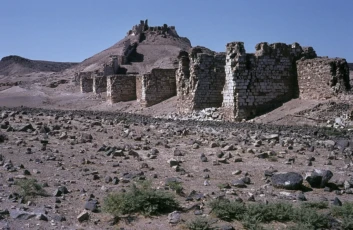
Outside of the surrounding wall of Halabiyya fortress

Archaeological finds from Raqqa, exhibited in the Damascus National Museum
Glazed pottery figure from ar-Raqqa; now in National Museum Damascus; Mus.Nr.5819; Height 46,5 cm

Der historische Ortskern von Maʿlula mit der Lawandius-Kirche und den zum Tal gewandten Hanghäusern

Hinterland of Yabrud in the early sixties: Ploughing with wooden plough, pulled by two horses

Suq al-ʿAttarin, Ansicht der zerstörten Marktgasse, Blick nach Westen
Diese Gasse des Großen Bazars war auf Gewürze, Kräuter und ätherische Öle spezialisiert. Sie brannte im Dezember 2012 ab.

Aleppo: Khan al-Wazir, 17th C., interior facade

Habuba Kabira, Bau des Sockels für ein Lehmziegelhaus

Maps of Aleppo: historical city and outskirts. 1969 with revisions in 1979 and 1982
Thematic map of Aleppo inner city and outskirts, showing remarkable buildings and main features of land use within the modern city districts. Scale 1:5000, ruler and legend, [Original in German: Aleppo: innenstadt und Außenbezirke: Bemerkenswerte Gebäude und Grundzüge der Flächennutzung in den Neustadtquartieren | Karte 5] Inventory no. /stamp: 4° 629 192-Ktn / Bibliothek Preussischer Kulturbesitz. Part of TAVO Reihe B Nr. 58

Palmyra, Tetrapylon mit Rosengranitsäulen aus Assuan
[Original: Tetrapylon mit Rosengranitsäulen aus Assuan (nur noch eine original)]

Salzgewinnung, vermutlich in as-Sabkha im Euphrat-Tal
[Original: Salzgewinnung im Euphrattal]

Jamiʿ at-Tawashi, eastern facade - window within a rectangular niche decorated with muqarnas
[Original:'Jâmi' at-Tawâshi, Halab / Aleppo. Erbaut 1348. Hier ein Fenster - wie es scheint, auf Straßenniveau. Vgl. Bild 1285, 1286 ! - Zum GPS-Tag: allgemein auf das Gebäude gesetzt, da ich nicht angeben kann, auf welcher Seite der Standort war.'].

A stairway leading to the upper floor, Najm Castle (Qalʿat Najm)

Homs, Jamiʿ an-Nuri, the main mihrab
Jamiʿ an-Nuri has a three mihrabs, this is the main one. It has mosaic in its half-dome.

Turmgrab des Elahbel im Tal der Gräber (Westnekropole)
[Original: Südwestnekropole, Hypogäum der „Drei Brüder“, Mitte 2. Jh. erbaut, bis 259 belegt]

View of several buildings inside al-Marqab castle

Courtyard of family wing (so called haramlik or jummwani) in Asʿad Basha al-ʿAzm Palace

Picnic on the Euphrates bank, al-Furat al-Aʿla (the Upper Euphrates Valley)

Bayt Junblat, the large courtyard and iwan
A view of the large courtyard of Junblat house, and in the center there is a large water basin built from the outside in the style of Ablq, in which stone rows alternates between yellow and black color. The iwan in the picture is one of the highest in traditional Aleppo houses. The iwan is covered with blue and white glazed ceramic tiles.

Diokletians-Thermen, Türdurchgänge
[ Description by author: in oder bei den Thermen. Da nur die Türrahmen in sehr verwittertem Zustand (Kalkstein !) übrigblieben, erinnert das Bild an Dolmen ....... Im Hintergrund der Monumentalbogen von innen. Der GPS-Tag ist approximativ ! Gesehen von ~ Nordwesten. ]
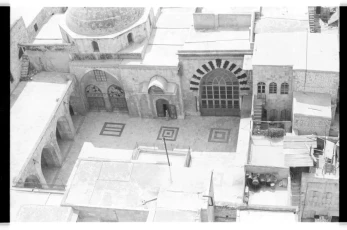
Al-Madrasa al-Hallawiyya, general view of the madrasa from the Great Mosque minaret

Die Naturlandschaft des Tigris-Tales

Jamiʿ Aslan Dada, dome of the prayer hall (qibliyya)
The place of al-Ashnan watermill on the foot of Qasyun mountain
shap_import_77199

Diokletians-Thermen, Inneres
[ Description by author: Links das Peristyl des Beckens (dass es ein Becken ist, erkennt man auf Bild 0693, 0694 !), ganz rechts das Propylon, hinten die Innenseite des Monumentalbogens. Gesehen von ~ Nordwesten. ]

Raqqa-Ost, Tall Aswad, Töpferei
Raqqa IV; Tall Aswad; Pottery garden probl. near excavation house in Tall Bi'a

Shaykh Anas Schrein, Berg al-Tar, süd-östlich von al-Mayadeen

Ruinöser Überrerst der Burg Shayzar

Salkhad - The Ayyubid minaret

Palmyra / Tadmur - Umgebung NW, Jazil, das Höhlenkloster
[ Description by author: Trotz der völlig anderen Landschaft musste ich an das Höhlenkloster Dair Mâr Marûn am 'Assi in der Nähe von Hirmil im Libanon denken (Bilder dort !). ]

Afamiya, Kolonnadenstraße (Cardo Maximus)
[Original. "Säulenstraße, 1,8 km lang und 37,5 m breit, nördlicher Abschnitt (glatte Säulenschäfte mit korinthischen Kapitellen) nach 115 n.Chr."]

Palmyra, general view of the Tetrapylon

At-Tabqa , Jaʿbar Castle, Bastion with loopholes.

Umayyaden-Moschee, Ausschnitt der Mihrab-Dekoration
[ Description by author: Mihrâb: "Borte" über dem unteren Teil der Nische. ]

Jamiʿ al-Qayqan, Haupteingang

Salkhad - The Ayyubid minaret

Achse einer Noria (Wasserschöpfrad)
Die hölzerne Achse einer Noria wird “das Herz” genannt. Sie steht auf einem Holzsockel, der wiederum auf einem Steinsockel auf dem Grund des Flussbettes aufgestellt ist.

Historische Fotografie des West-Eingangs der Jamiʿ an-Nuri, Homs
The main western entrance to the courtyard.

VW-"beatle" in the center of the Ghab Plain

General view of Qalʿat Ibn Maʿn
[ Description by author: Tele + Ausschnitt. Blick von ~ Südosten. Der Standort muss nicht der angegebene sein: jeder Punkt auf dieser Linie zwischen Hauptstraße und Stadtmauer ist möglich ....... ['Zenobia Hotel (?),'] ]

Bewässerungskanal in der östlichen Ghouta
![[S.156 Abb.170]](https://syrian-heritage.org/wp-content/plugins/justified-image-grid/timthumb.php?src=https%3A%2F%2Fsyrian-heritage.org%2Fwp-content%2Fuploads%2F2020%2F04%2Fshap_import_48714-1024x697.png&h=230&q=90&f=.png)
[S.156 Abb.170]

Ein Bauer in der Badiyya zeigt die traditionellen Kissen, die seine Frau gewebt hat

Figürliche Fassadendekoration am Turmgrab des Iamblik, Tal der Gräber (Westnekropole)
[ Description by author: Linke Seite des Fassadendekors: der bärtige Kopf als Träger der unteren und die Nike (Sirene / Harpye) als Träger der oberen Konsole. Gesehen von ~ Osten. ]

Gewölbte Schießscharte im Berg Jaʿbar

A cart dragged by a young horse to transport goods in ar-Raqqa

Jisr ash-Shughur, Qalʿat ash-Shugr wa-Bakas, Kreuzritterburgen, die Ruinen der Burgen

Tall al-Biʿa, Luftbild
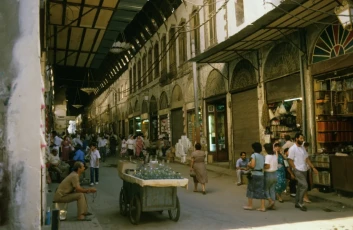
In Suq al-Buzuriyya with its many small spices and remedy shops

Jisr ash-Shughur, Qalʿat ash-Shugr wa-Bakas, Kreuzritterburgen, die Ruinen der Burgen

Bayt Ghazala, 17. Jh., Grundriss des Erdgeschosses
Das einzige Wohnhaus mit eigenem Bad (Hammam) und sechs Höfen. Es hat großen Schaden genommen; seine hölzernen Innenausstattungen (ʿajami) werden vermisst.
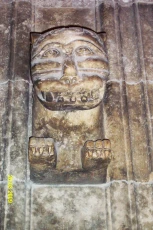
Citadel of Aleppo, Gate of Two Lions - the Smiling Lion

Gesamtansicht der Burg (Qalʿat) Shumaymis
auf ihrem Vulkankegel (oben als Fels und im Mauerwerk Basalt !). Gesehen von entweder Südwesten (so der GPS-Tag) oder von Südosten, von der Straße Hamâ - Salamiya. [Original: Qal'at ash-Shamîmîs']

Jamiʿ al-Maydani, Minarett

Suq Istanbul al-Jadid, view to north of the destroyed market

Jamiʿ al-ʿAdiliyya, muqarnas decorationg a niche on the right side of the prayer hall's entrance
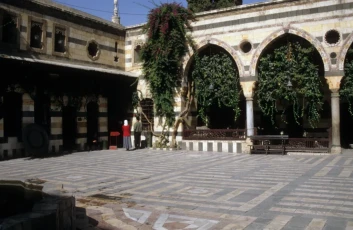
Qasr (palace) Asʿad Basha al-ʿAzm, inner courtyard

Bogenbrücke über den Orontes, die zur Burg (Qal'at) Shayzar führt

Hochzeitsfest in einer Straße des Mukhayyam al-Yarmuk in Damaskus
Wedding party

al-Husn Church, Remains of the basilica after its demolition and turning the site into an agricultural field

Takiyyat ash-Shaykh Abu Bakr, Innenhofansicht mit Portikusarkaden und Zimmern
Bahra mit Moscheefront 1917?

Raqqa, Baghdad-Tor, Fassadengestaltung mit Nischen und Halbsäulchen

Jamiʿ al-Mihmandar, Gebetshalle - Inneres der Kuppel

Bauinschrift an der Ziatdelle von Damaskus

Raqqa-Ost, Tall Aswad, Ausgrabung im 1985
[1985/72/977] = [photo's name as: year/ film no./ photo no.]

Nische in einer Außenmauer der Burg von Harim

Turbat az-Zahir Baybars, mosaics covering the southern wall of the mausoleum
al-Madrasa az-Zahiriyya [ Description by author: Ecke zwischen ~ West- und Nord-Wand. ]

Dar'a, al-Jamiʿ (mosque) al-ʿUmari- A photo taken from the minaret showing the courtyard and the prayer hall

The Byzantine Tower in Qasr al-Hayr al-Gharbi
[Original: "Heir al-Garbi"]

A sculpture of a woman, showing clothes and jewelry details

Excavation works, Dura Europos (Qalʿat as-Salihiyya)
Side of the Excavation

Waqf of Ibshir Mustafa Pasha, Mosque, decoration

scan 1996 الشعيبية

Zu diesme Zeitpunkt in ad-Duwaym im Nahyat al-Yarabiyya aufgebautes Beduinenzelt
Die Familie gehört zum berühmten alten Stamm der Tayy.

Takiyyat ash-Shaykh Abu Bakr, äußerer Eingang und Minarett

Mausoleum des ash-Shaykh Khalid an-Naqishbandi
["Nr.A"] (see catalogue-no. A; in: Meinecke, Michael, in: Damaszener Mitteilungen I/1983)

Jurn Kabir, Woman demonstrating the production of a rod mat (arab. zarb) with the help of stone weights

Das Wasser des Khabur ist nahe Raʾs al-ʿAyn stark schwefelhaltig

Fresco on the Northern aisle of the church, Monastery of Mar Musa al-Habashi
[ Description by author: Nördliches Seitenschiff, erster Pfeiler: Engel. ]

Entrance door of the textile factory of the Mezannar family

Al-Madrasa al-Kamiliyya, Innenhof mit Iwan

As-Sa'a roundabout in the city of Raqqa

Tall Mumbaqa, View to the north: shore of Assad-Lake with pumps
Irrigation pumps on the reservoir bank

View of western facade of the Cathedral, today Tartus Museum
[Original: Kathedrale Nôtre-Dame, 1123 beg., von Saladin 1188 weitgehend zerstört, Ende 12. Jahrhundert Neubau, Westfassade]

Afqa-Quelle - das schwefelhaltige Wasser des historischen Bads
[Original: Efqa-Quelle]

Bayt Wakil, Innenhof mit Springbrunnen

Aleppo: gestreifte Facade des Mamlukisch-Osmanischen Hammam Yalbugha an-Nasiri
Ein Blick auf die Außenfassade des Yalbugha-Bades, die mit abwechselnd schwarzen und gelben Steinreihen (Ablaq) dekoriert ist. Der Eingang ragt hoch auf. Die Laterne der Kuppel besitzt Fensteröffnungen, durch die Licht in das Innere einfallen kann.

Ornamentierter Portalsturz, Tal der Gräber (Westnekropole)
[ Description by author: Der Türsturz der Anlage.- Die Farbe ganz rechts ist nachträglich eingesetzt: diese rechte Seite war grellweiß überstrahlt ! ]

Qasr al-Hayr al-Sharqi, Blick auf die westliche Umfassungmauer

Tall al-Biʿa - general view

Archaeological finds from Raqqa, exhibited in the Damascus National Museum
Floral frieze decoration; National Museum Damascus, from ar-Raqqa

Bas-relief with geometric and floral motifs
[Original: Große Orientreise Nr.63 mit Rotel-Tours: Amman-Bagdad-Uruk-Babylon-Arbil-Mosul-Hatra-Samara-Mari-Dura Europos-Aleppo-Dayr Saman-Ugarit-Palmyra-Jarash]

Agriculture in the Syrian Jazira

General view of the village and castle of Shayzar along the Orontes river

Ein Aleppiner Wohnhaus
Blick auf die Innenhofecke eines Aleppiner Wohnhauses. Die beiden Fassaden zeigen mehrere Fenster mit bogenförmigem Abschluss.

Dahiyat as-Salihiyya at-Tarikhiyya, von al-ʿAfif aus gesehen

Sculpture on sacrophagus
[ Description by author: Bei Bild 0873 - 0877 handelt es sich um den selben Sarkophag, vielleicht gehört auch Bild 0872 dazu.- Diese Sarkophage bestehen aus zwei Teilen: dem Kasten, der in der Form einer Kline mit Polster gearbeitet ist, und dem Deckel, der den liegenden Toten darstellt. Bei der Kline sind bis in feinste Details Holzschnitzereien nachgeahmt, bei dem Polster und insbesondere bei den Gewändern die feinsten bestickten Stoffe. Unter der Kline sind Szenen dargestellt, hier wohl Diener, die für ein (Toten)Mahl oder (Toten)Opfer rüsten. Auch die Szene von Bild 0872 "spielt" unter einer Kline: aus dem Alltag des Toten, wohl eines Handelherrn. ]

Building the walls of the example dome house in Taanayel (Libanon)
The picture shows the ready mud bricks and the first stage of building the walls of the traditional Syrian dome house in Taanayel

Khan Sulayman Basha, Blick in den Innenraum
[ Description by author: Erbaut 1732. Die beiden Kuppeln existieren nicht mehr, aber auch die Bögen mit den riesigen Trompen sind eindrucksvoll. ]

Khan Asʿad Basha al-ʿAzm, 1754
The largest commercial building of Damascus with the distinctive change of basalt and limestone was built by the governor Asʿad Basha al-ʿAzm.

Khusrawiyya-Komplex, Ansicht von der Zitadelle aus, Khan ash-Shuna im Vordergrund, 2000

Tempel von ad-Dumayr (Thelsae), Portalfassade von Westen gesehen

Qal‘at Shayzar (Citadel), the upper part of the entarnce.

Az-Zahir Baybars Mausoleum in al-Madrasa az-Zahiriyya
[ Description by author: ~ Südwand mit dem Mihrâb. Unten links ein Stück des Grabes. (The date of this photo was not sure as Peter Heiske did [(wohl) 18/10/1998] ]

Gothische Kreuzrippengewölbe im Krak de Chevaliers (Qal'at al-Husn)

Burg (Qal'at) Yahmur, Donjon und Eckturm der Burgbefestigung
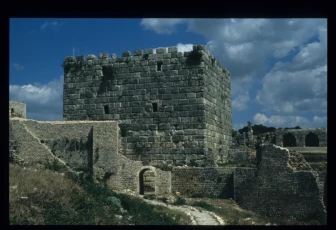
One of the towers of Qalʿat Salah ad-Din

Blick auf das Barada-Tal

A model of Bel Temple
[ Description by author: Modell, gesehen von ~ Nordwesten. Zu sehen der Tempel in seinem Hof und die Peribolos-Mauer mit den Propyläen. Der Tempel wurde um 30 n. Chr. geweiht, die Propyläen im 12. Jh. in eine arabische Bastion umgewandelt (Bauinschrift s. Bild 0599 !). Im linken Teil sieht man den Eingang zum Tunnel der Rampe unter den Peribolos (s. Bild 0606 !): hier wurden die Opfertiere in einer Prozession zum Altar im Hof geführt. Zu erkennen ist auch, dass der Tempel quer orientiert ist - interessanterweise wie die islamische Moschee ! ]

The upper part and keystones of the apse, Basilica of Qalb Lawza
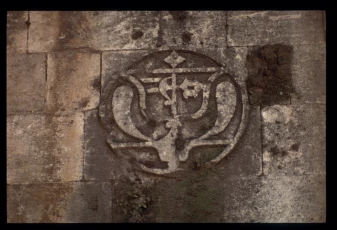
Khan Qurdbak, southern portico - Mamluk rank

al-Burayj, a side of Saint Daniel Monastery

EIne Frau mit einer siebgedruckten Kopfbedeckung namens Habari

al-Husn Church, Remains of the basilica after its demolition and turning the site into an agricultural field

View to the west.

Afamiya, Blick in die Ruinen

A view at the Mediterranean Sea, Baniyas

Waqf Ibshir Mustafa Basha, south western corner with former sabil

A group of columns, remains of the southern Roman baths in Busra
A view of part of the southern Roman baths in Bosra dating back to the 2nd century AD. A series of well-preserved columns topped with ionic capitals appear here. This type of capitals appeared in the Greco-Roman Period and is characterized by spiral motifs.
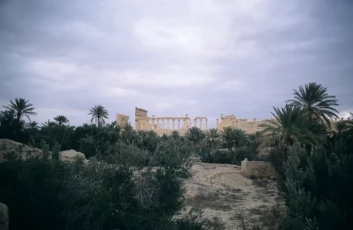
Palmyra, Palm grove, view at Bel Temple

A side of the cavea, Roman Theater at Busra
[Original: Theater, Cavea für 15.000 Zuschauer (Halbkreis von 102 m) und Bühnengebäude]

A view from the archaeological Tall Abyad towards the Balikh plain

Raqqa, Qasr al-Banat, clay decorations
Neg. Nr. 83/5-31A/32
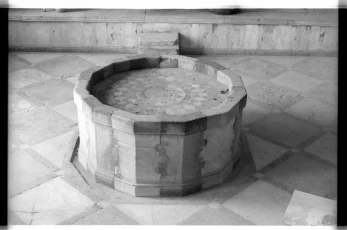
Bayt Ghazala, fountain in the main reception hall (qaʿa)
[Original: B88- Film II]

Suq ad-Dahsha, general view of the suq
![Baniyas, Blick auf die Mittelmeerküste mit Industriekomplexen [Gewerbe, Bodenschatze energie]](https://syrian-heritage.org/wp-content/plugins/justified-image-grid/timthumb.php?src=https%3A%2F%2Fsyrian-heritage.org%2Fwp-content%2Fuploads%2F2020%2F04%2Fshap_import_48895-1024x699.png&h=230&q=90&f=.png)
Baniyas, Blick auf die Mittelmeerküste mit Industriekomplexen [Gewerbe, Bodenschatze energie]

Die Audienzhalle in der Zitadelle von Damaskus
Auf diesem Bild sind die römischen Säulen zu sehen, die die zentrale Kuppel der Audienzhalle tragen.

Installation of dyed warp threads for weaving in the textile factory of the Mezannar family in Damascus

Raqqa - "East of Raqqa" site - Tall Aswad, excavation in 1985
Tall Aswad

Maʿarrat an-Nuʿman, domed structure (mashhad) and minaret of the Great Mosque

Jamiʿ al-Utrush, dome and muqarnas squinches of the tomb

Zayzun waterfalls of a tributary to Yarmuk river, which is there the border between Syria and Jordan

Big stairs lead to the upper floor, Royal Palace G, Ebla (Tall Mardikh)
Die große Rampe im Nordwestteil des Palastes (nach rechts geht es zur großen Treppe). Auf einem Internet-Bild wird sie als (Rampe einer) "Ziggurat" bezeichnet, dann stünden wohl der Rote Tempel / Ishtar-Tempel D auf dieser Ziggurat. Arber: wie passt das mit dem Palast zusammen ? Oder stammt diese Ziggurat aus der zweiten Blütezeit von Ebla und hat den Palast (teilweise) überlagert ? [Original:Tall Mardîkh (Ebla)']

The dome of the treasury, decorated with mosaics in the courtyard of the Umayyad Mosque

Teilansicht der Burg Najm (Qalʿat Najm) und Euphrat

Der Euphrat im Gouvernement ar-Raqqa

A building under construction in the President's Square in Raqqa

Maronite Cathedral, one of the catherdral pointed towers

Außenansicht des Mausoleums von Salah ad-Din al-Ayyubi, Damaskus
[Original: Damaskus. Hinter d. Omajadenmoschee]

Repairing of shoes in Suq Midhat Basha

Madrasat al-Firdaws, Westwand des Iwan gegenüber der Gebetshalle

As-Sinaniyya-Moschee, Minarett, oberer Bereich mit Fliesen-Dekor
[ Description by author: Der "Korb" für den Mu'azzin. ]

Kirche von Qasr Ibn Wardan

Siegesmonument von Hiraqla, Isometrische Rekonstruktion

Jamiʿ al-Mihmandar, Gebetshalle - Minbar (Kanzel)

Khan al-Hibal, nördliche Innenhoffassade

Ar-Rusafa, Basilika A, Weit- bzw. Doppelarkaden, Blick aus dem südlichen Seitenschiff nach Nordwesten
[Original: 1945 Geschenk Prof. Friedrich Sarre]

Ein traditionell hergestellter Webteppich aus vier Bahnen, der durch Stickerei verziert wurde

Waterfall of Zayzun in the Yarmuk valley in 1918
[Original: 'Wasserfall von Zezun im Jarmuktal']. The Bavarian air force division 304b was based in Palestine from 25. October 1917 and was involved in the First World War until the division left the region, over Aleppo, in mid September 1918. During that period, over 3000 glas photographs, mostly aerial, have been made. Those early photographs were important for the archaeological research in the Middle East.

Reisende und Ortsansässiger auf dem Gipfel des Hermon (Jabal Haramun)

Qalʿat Burqush, Byzantinische Kathedrale
[ Description by author: Ein anderer Typ der byzantinischen Kapitelle. Im Hintergrund Trommeln von Halbsäulen. ]

Raqqa - Qasr al-Banat, inner courtyard

Ghuta of Damascus, artificial irrigation canal system

View of the stage and the scaenae frons, Theater of Palmyra
[ Description by author: und Cavea. Die Bühnenwand soll noch zwei weitere Etagen gehabt haben: wenn man in der Säulenstraße außen an ihr vorbeilief, muss man ziemlich "erschlagen" worden sein ....... Man beachte das Datum, für einen neueren Zustand vgl. Bild 0727 ! Blick nach ~ Nord-Nord-Ost. ]

Künstlicher Bewässerungskanal in der Oberen Euphratregion

Jabla, Mosque of Sultan Ibrahim, Arabic calligraphy

Befestigungsturm nördlich des Bab Antakiya, Ansicht einer Turmseite nach der Beseitigung ungenehmigter Anbauten

Busra, Blick in die Kathedrale, 6. Jh.
[Original: Kathedrale (den Märtyrern Sergios und Bacchios und dem Leontios geweiht), 512/13]

Euphrates plain near the mouth of the Sajur, limestone massif on the south side ((before the flooding of lake Tishrin)

Zitadelle von Aleppo - Thronhalle, Innenansicht

Restaurierungsarbeiten an der Zitadelle von Damaskus im Jahr 1985

ar-Rusafa, Basilika A, view from west of the bema and the apse

Damascus, Khan Asʿad Basha al-ʿAzm, windows on the tambour of one of the domes

The inner western facade of ad-Dumayr Temple
[ Description by author: Detail aus Bild 0390: der Durchgang und die beiden "Kammern". ]
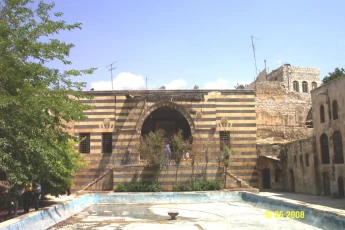
Bayt Junblat, courtyard and northern iwan

View on the Euphrates river from Dura Europos
Blick von der Abrutsch-Kante nach ~ Osten in die Euphrat-Auen.

Khan Qurdbak, eastern portico

Pavilion on the left of the Qasr al-Hayr al-Sharqi gate
[Original: Pavillon vorm linken Tor]

Qanawat, Nymphäum

Suq Aslan Dada, general view of the suq damages, view towards south

Afamiya, Ruinengelände

A chamber in the bath of Harim Castle

Sahl Hawran (Hawran Plain), The traditional operation of threshing wheat

Al-Madrasa al-Hallawiyya, Gebetsnische aus Holz im Iwan

The Mihrab of at-Taynabiyya Mosque
[ Description by author: Der Mihrâb oder ein Mihrâb der Moschee. Vermutlich konnte ich ihn nur sehen, weil sich die Moschee in Restauration befand. ]

Theater, Türsturz - ornamentale Details
[ Description by author: Rückseite des Tores von Bild 0721, Detail der rechten Seite. Man erkennt links eine Büste ohne Kopf, daneben ein sitzendes Huftier oder vielleicht einen Faun. Dieses/r entspricht genau der Figur ganz links auf der linken Spolie in der arabischen Bastion Bild 0598 ! Vgl. auch Bild 0754 ! ]

Bayt Jubran Afandi Shamiyya im Viertel Bab Tuma, Iwan
Seitenliwan

Jabla, Sultan-Ibrahim-Moschee, arabische Inschrift

Qalʿat Ibn Maʿn, Raumteil im Innern der Burg

Natural diversity in the Jabal Haramun (Mount Hermon)

The shrine of Shaykh ʿAqil al-ʿUmari al-Manbiji
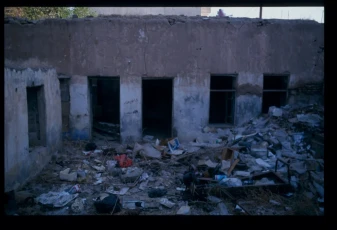
An abandoned building in Circassian district, Raqqa
[Original: Tscherkessenviertel]

Qasr Asʿad Basha al-ʿAzm, courtyard and arcade
The palace of the governor’s family al-‘Azm houses today a Museum of Arts and Popular Traditions.

Fresco on the western wall of the church, Monastery of Mar Musa al-Habashi
[ Description by author: Jüngstes Gericht an der Westwand, Details. Drei Register der linken Seite, in der Mitte vier Mal "Abrahams Schoß". Interessant ist die Figur unten rechts, die etwas "von oben" empfängt: ihre Harartracht erinnert sehr an die von Bild 0483 ! Dort vermutete ich eine Dornenkrone, das trifft hier aber gewiss nicht zu ! ]

Qasr al-Hayr al-Sharqi, upper part of a tower

Tall Dahab, Central hall house - the width of the hall corresponds to the recess in the facade, the loggia is used for the stay

Motifs of quarter flowers in Kara Memi, Aleppo Room wall frame, early 17th century
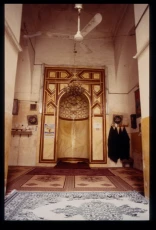
Al-Madrasa ash-Sharafiyya, prayer niche decorated with geometric patterns

Simeonskloster - Pilgerkirche des hl. Simeon Stylites, Kapelle, Inneres der Apsis

Blick von der Burg in Masyaf auf die Stadt

Dar'a, al-Jamiʿ (Moschee) al-ʿUmari, Gebetshalle

Al-Madrasa al-Hallawiyya, Gesamtüberblick vom Minarett der Großen Moschee

Minaret and dome of al-Imam Ismaʿil Mosque, Salamiyya
Gesehen vermutlich vom Dach des Hauses der Ghâli (Hishâm und Amjad) nach ~ Westen, vgl. Bild 1049 ! - Salamiya ist der (syrische) Hauptort der Ismailiten (Zweig der Shî'a) unter ihrem (derzeitigen) Oberhaupt Karîm Aga Khân. [Original: 'Salamiya (Salamias)']

Harran al-ʿAwamid, die Hayat bin Qays al-Harani- Moschee

Blick von der Burg von Harim in die umliegende Ebene

The Great Colonnade, Palmyra
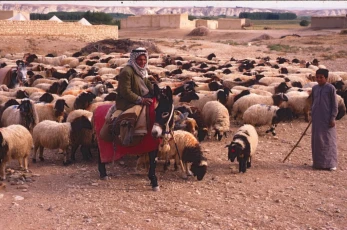
In the Euphrates valley in Jurn Kabir, shepherd herding the flocks of his village

Part of Qaws Hadrian (Arch of Triumph) from the inside
[ Description by author: Linker Ansatz des großen Bogens der 2. "Scheibe". ]

Al-Matbakh al-ʿAjami, Muqarnas-Zwickel der Iwan-Kuppel

Courtyard of al-Jamiʿ al-Kabir showing the treasure dome and the minaret

Khan al-Wazir, decorations and windows on top of the internal facade of the khan's entrance
[Original:'Khân al-Wazîr, Halab / Aleppo.Ausschnitt auf die Fenster der Innenfassade von Bild 1250.'].

Raqqa-Ost, Ostpalast, Grabungsfunde - Keramik
Eastern East Palace, SW.Neg. 84/500-501

Great Mosque, prayer hall, Shrine of the Prophet, ceramic tiles Zakariya
shap_import_60397

ar-Rusafa, Bedouin women cook sheep meat on open fireplaces on the occasion of the desert festival

Capital of column, portico of Bel Temple
[ Description by author: Ein Kapitell des Portikus, vielleicht aus dem Nordost-Bereich. ]

Burj as-Saʿa, mechanical clock

Nahiyat Tall Tamir, The domes of the houses built in the 1930s were often flattened later.
The Assyrian villages on the Khabur with their domed houses were built by the French Mandate Government for Christian refugees from Turkey and Iraq.

Busra - Madrasat Abu al-Fidaʾ and Birkat (pool) al-Hajj

Raqqa, Palast D, Stuckdekorationen
Palace D; Inst.Neg. 86/1428 Floral frieze decoration
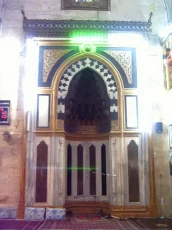
Jamiʿ al-ʿAdiliyya, the prayer niche (mihrab)
shap_import_64448

Habuba Kabira, Mischung von gesiebtem Rohlehm, Häcksel und Wasser, um daraus Lehmziegel herzustellen

Al-Madrasa as-Salimiyya, Blick über die Kuppelarkaden des Innenhofs auf die Moschee der Takiyya as-Sulaymaniyya

Al-Madrasa al-Hallawiyya, Haupteingang

Bayt Junblat, Süd-Iwan (großer Iwan)

Raqqa-Ost, Tall Aswad, Ausgrabung im 1985
[1985/24/401] = [photo's name as: year/ film no./ photo no.]. ["s.a. Dias"]

Der nord-östliche Turm der Zitadelle von Damaskus
Einer der schönsten Türme der Zitadelle von Damaskus mit seinen sorgfältig gearbeiteten Steinblöcken. Dieses Bild zeigt deutlich die Maschikulis und Schießscharten.

A favissa or ritual pits east of Ishtar temple, Tall Mardikh (Ebla)
shap_import_48474

Burg (Qal'at) Shayzar, ein Schäfer überquert mit seiner Herde die Bogenbrücke zur Burg.

Al-Madrasa al Ahmadiyya, nördliche Portikus

Bridge over the Euphrates at Raqqa

Interior view of the monastery, northwest of Palmyra, Jazil
[ Description by author: Bestimmung / Zwecke dieses Raumes ??? Vgl. Bild 0903 ! ]

Blick auf die Stadtmauer von ar-Raqqa mit einem rundbogigen Tor und zwei Türmen

Salkhad, aiyubidisches Minarett

part of the Muqarnaṣ cornice of the Aleppo Room, Museum for Islamic Art, Berlin

The village al-ʿAmarna, with the tall (left) and the Euphrates plain in the back

Topographische Kartensammlung "UAR North (Syrian) region, district El Furāt" von 1960
Fotoreproduktion einer topographischen Karte der Umgebung von Raqqa, Maßstab 1:25.000 (Teilweise von Hand in Maßstab 1:20.000 korrigiert). Basierend auf einer kombinierten kontur-/stereo-topographischen Vermessung von 1959. Clarkes Ellipsoid von 1880. Lamberts Koordinatensystem (Levante-Zone). Mediterranes Höhensystem (Beiruts)

Maʿarrat an-Nuʿman, domed structure (mashhad) and minaret of the Great Mosque
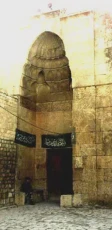
Madrasat al-Firdaws, Hauptportal
shap_import_62841

Traditional houses of the town of Darkush, located on the Orontes river
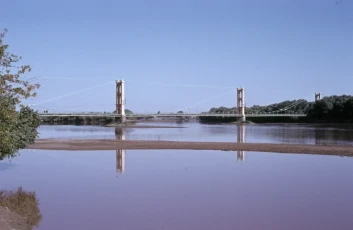
The suspension bridge over the Euphrates in Dayr az-Zawr

At-Takiyya al-Ikhlasiyya (az-Zawiya ar-Rifaʿiyya), hall facade situated on eastern side of the courtyard

Raqqa-Ost, Nordkomplex, Grabungsfund
Ra-O-NK. 146, Ceramic. [original: 'Keramik']. [original:' s. unten Nr. 18'].[ 89/54/863] =[ photo's name as: year/ film no./ photo no,].

At-Takiyya al-Mawlawiyya, Inschrift über der Gebetsnische des Samah Khana

Kharbaqa Damm: Einer der Staudämme, die gebaut wurden, um die saisonalen Überschwemmungen in der Badia (Wüstensteppe) zu reduzieren
[ Description by author: Steiler Blick nach oben aus dem Flussbett. ]

Agricultural fields, cow and irrigation pipe on the coast of Baniyas

Ebla (Tall Mardikh), Palast der Archive
Die große Rampe im Nordwestteil des Palastes (nach rechts geht es zur großen Treppe). Auf einem Internet-Bild wird sie als (Rampe einer) "Ziggurat" bezeichnet, dann stünden wohl der Rote Tempel / Ishtar-Tempel D auf dieser Ziggurat. Arber: wie passt das mit dem Palast zusammen ? Oder stammt diese Ziggurat aus der zweiten Blütezeit von Ebla und hat den Palast (teilweise) überlagert ? [Original:Tall Mardîkh (Ebla)']

Bel-Tempel, Cella von Südosten

Qasr al-Hayr al-Gharbi, Blick nach Süden
[Original: Mo. Nach S.]

Children are preparing themselve for a wedding procession. The two small children are still wearing their school uniform

Khan Qurdbak, Grundriss Erdgeschoss

Busra, Hammam Manjak, Islamisches Museum
Eröffnung des Islamischen Museums

Al-Madrasa al Kamiliyya, Iwan of the courtyard

Al-Madrasa al-Hallawiyya, Iwan

Aghabani with customized geometric design combining leaves, flowers and branches

Burg (Qalʿat) von Shumaymis, Ruinen der Burgmauer

Busra, The hot section (juwwani) of Hammam Manjak
Hamam Manjak

Al-Madrasa ash-Sharafiyya, Gebetsnische mit geometrischen Flechtbandmustern

Al-Madrasa al-Ahmadiyya, ablutions fountain

Jamiʿ ash-Shuʿaybiyya, west facade - a cornice with floral motifs and a Qur'anic text in Kufic script

Wadi az-Zaydi, Ancient bridge
near Busra, Bridge

Allltägliche Szene vor zwei Läden in Raqqa

Khan al-Jumruk, Ansicht der Moschee im Zentrum des Innenhofes

Bayt Dallal, Blick über den Hof aus dem Iwan

Popular restaurants on both banks of the Barada River
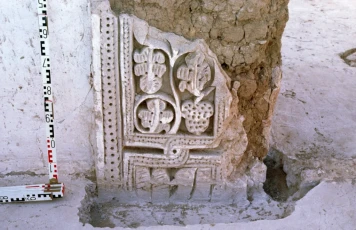
Raqqa, "East of Raqqa" site - Western Palace, vegetable stucco ornaments

Tall Shaykh Hamad (Dur Katlimmu) - Excavations

Qalʿat Burqush, Reste der Fassade eines römischen Tempels
[ Description by author: Fassade, gesehen von ~ Südwesten. ]

Nahiyat Tall Tamir, Fladenbrote backen an der Tannurwandung (Tannur im Boden eingetieft)

Afamiya, Bauteil mit ionischen Dekorationsformen

Bayt Ghazala, courtyard - northern facade
View of courtyard facade [Original: Privathaus, Innenhof] Pl. Nr. Aufnahme Enderlein, Foto-Verz. Nr. 11028 A 18

Husn Sulayman, Cella of the temple

Bayt Wakil, iwan

Tempel von ad-Dumayr, landläufig "die Burg" genannt

Der Euphrat nahe Tall Sabi Abyad

Bucket wheel (noria) and aqueduct in 1930
Note: these photos were taken between the year 1924 - 1939. The chosen date is to be average. (photographer unkown)

Al-Madrasa al-Ahmadiyya, courtyard and southern portico

Felsvegetation im syrischen Küstengebirge

Die Fassade eines Bades in Shahba
Die Bäder von Shahba zählen zu den größten bekannten Bädern des 3. Jahrhunderts n. Chr., erbaut von Kaiser Philipp dem Araber. Das Bild zeigt eine Fassade von einem der Badbereiche. Sie hat einen zentralen Eingang mit einem Rundbogen und zwei rechteckige Nischen an den Seiten, die mit einem Rundbogen abschließen.

Dar'a, al-Jamiʿ (mosque) al-ʿUmari - Inscription on the eastern arcade

Blick auf eine Seite der Burg (Qalʿat) Shumaymis, as-Salamiyya

Twisted column - The Great Colonnade at Afamiya

Bayt Ghazala, ʿAjami-Holzdecke im südlichen Sitzraum der Hauptempfangshalle (Qaʿa)

Windows on the monastery's facade, northwest of Palmyra, Jazil
[ Description by author: in der "Fassade" - ein gewisses ästhetisches Bemühen ist unverkennbar, leider haben Felsabbrüche viel vernichtet. ]

Blick auf einen Teil der Stadt Harim, am nordwestlichen Hang eines Berges gelegen

Hand printed table cloth from Hama at Hassan's Shop, Old Damascus

Dayr Zakka (monastery), porch (narthex) of the church with mosaic floor, 6th C.
This mosaic dates back to 509 AD. [von 509 n.Chr.]. [Kalla (1999) 134]: [Gabor Kalla: Christentum am oberen Euphrat. Das byzantinische Kloster von Tall Bi'a. in: Antike Welt 30/2 (1999)].

Glasierte Keramikscherbe aus islamischer Zeit aus dem Museum in Raqqa

Tartus, Kathedrale, Innenansicht des ruinösen Kirchenschiffs
Innenansicht der Kathedrale von Tortosa mit Hirten im ruinösen Kirchenschiff. Reproduktion eines Stiches von W. H. Bartlett. Angenommener Entstehungszeitpunkt um 1830. [Original: Christian Church at Tortosa]

Al-Jamiʿ an-Nuri, oberer Teil des Minaretts

Citadel of Aleppo, Entrance Gateway

Remains of arches belonging to the entrance of Jupiter temple

Bayt Ghazala, view of the bathhouse

A horse-drown carriage carrying children and adults in ar-Raqqa

Maronitische Kathedrale St. Elias, einer der beiden Spitztürme - unterer Teil

Ground plan of buildings in southern Suwayqat Ali in Farafira quarter.
Part of Farafira, Cad.district VII-3-1, incl. Matbakh al-Ajami before destruction by street [27]/see book Suwayqat Ali, p. 45. size of plan 55 x 45 .with ruler (55 x 45).

Courtyard and mosque, at-Takiyya as-Sulaymaniyya
[ Description by author: und Innenhof mit Wasserbecken, gesehen von ~ Nodwesten. Links ein Ausstellungsstücke der Armee: irgendeine MIG ....... ]

Al-Madrasa az-Zahiriyya, general view of the entrance

Busra, al-Jami‘ al-ʿUmari and Hammam Manjak, exterior facades

Qarqbiza, Gesamtansicht des Ruinengeländes


Dar'a, al-Jamiʿ (Moschee) al-ʿUmari, Innenhof und Gebetshalle, vom Minarett aus fotografiert
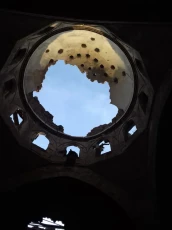
Temporary title for Image 91128

Weidende Schafe am Rande der Ghab-Ebene
[Original: Kleintierherde am Rand d. Ghab]

Bayt Wakil, reception hall

Guesthouse of a wealthy family in Maskana, attached is an iwan

Khan Qurdbak, iwan, section east-west
Size of plan 70 x 50 . with ruler (no scale).

Destruction of the illegal shops in the outside part of the northern part to show the wall and a tower.

Qal‘at Shayzar (citadel), Archery road.

Das schneebedeckte Hermon-Gebirge
[Original:'Hermon-Gipfel, mit Schnee bedeckt, rechts im Hintergrund der Antilibanon']. Die bayerische Luftwaffen-Division 304b war vom 25. Oktober 1917 an in Palästina stationiert. Sie war am Ersten Weltkrieg beteiligt, bis die Division Mitte September 1918 die Region über Aleppo verließ. Während dieser Zeit wurden über 3000 Glasfotos, meist aus der Luft, gemacht. Diese frühen Fotografien waren wichtig für die archäologische Forschung in der Region des Nahen Ostens.

Sacrophagi in the Hypogeum of the Three Brothers
[ Description by author: Die Sarkophage, als Triclinium angeordnet. ]

Archäologische Funde aus Raqqa, ausgestellt im Damaszener National Museum

A photo of the courtyard of Bayt Shaykh Qatana before demolition
Blick ü.d. Hof auf den Liwan

Restaurierungsarbeiten an der Zitadelle von Damaskus

Qalʿat al-Marqab (Castle), Central courtyard and chapel

Bayt Mustafa al-Jabiri (Bayt Kataster VII 2056) vor der Zugehörigkeit zum Waqf al-Jabiri (Stiftung)

Jamiʿ Aslan Dada, Iwan, Inschrift über dem Eingang zur Halle

General view of Safita city

Suq az-Zarb, view towards west of the suq after the destruction

Ar-Raqqa, Reste der Südarkade der Großen Moschee (al-Jamiʿ al-ʿAtiq)
[ G 88/ 07/ 075] =[ photo's name as: year/ film no./ photo no,].. On the back of the photos:[everything is Raqqa without 073] ['Alles Raqqa, ausser 073']

Ar-Rusafa, Bögen des sog. Doppelapsidenbaus
[Original: k.K6/=HQ k.K6]
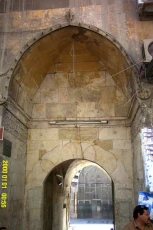
Al-Madrasa al-Hallawiyya, main entrance

Qalb Lawza, Basilica of 5th c., West and south facades from southwest

Ar-Rusafa, general view of the remains of Basilica A

Spools in the textile factory of the Mezannar family

Kleine Straße in der Syrischen Wüste
[Original. k.K6/=HQ k.K34]

Ein verlassenes Gebäude im Tscherkessischen Viertel in Raqqa
[Original: Tscherkessenviertel]

Bayt Junblat, southern iwan (the great iwan)

Khan Qurdbak, Iwan des mamlukischen Palastes

Afamiya, Ruinengelände

Damaskus, Propyläen des römischen Jupiter-Tempels

Jebrud: Steinerne Fassade eines antiken Gebäudes

Qalʿat Burqush, Südwestseite der Byzantinischen Kathedrale
[ Description by author: der byzantinischen Basilika. Sie dienten zur Erweiterung der Terrasse des römischen Tempels nach Südwesten. Hier zu sehen die Südwest-Seite. Sie ist eingestürzt, so dass man die gegenüberliegende Wand der ersten Halle mit den Ansätzen der Gewölbe-Gurte sieht. Gesehen von ~ Südwesten.- Für alle Burqush-Bilder gilt: die GPS-Tags sind nur approximativ, aber sicher sehr nahe am Punkt. ]

Raqqa-Ost, Ostpalast, vegetabile Stuckdekorationen
Floral frieze decoration, Raqqa II; Eastern East-Palace

A central passage in the Castle of Harim

Bayt Dallal, geometrical floor design in front of the iwan

Qatna, Stadtareal innerhalb der Umfassungsmauer, Ausgrabung
. [Original: Al-Mishrifa / Qatnâ']

Propylaea of Jupiter Temple, Damascus

Bayt Ghazala, courtyard and western facade - main hall's (qaʿa) facade
Hof mit Bahra und Qa'a-Front

as-Saray al-Kabir, a view of the plaza in front of Aleppo citadel’s entrance
A picture taken before the war from as-Saray al-Kabir that shows the plaza opposite the entrance of the Aleppo Citadel. This square is furnished with basalt and limestone tiles and palm trees

Palmyra, Große Säulenstraße

Drawings by Estibaliz Sienra Iracheta to illustrate processes of textile manufacturing
Drawings by Estibaliz Sienra Iracheta to illustrate processes of traditional textile manufacturing

In Kirkbiza: Bauer, der mit einem Metallpflug sein Feld pflügt, der von einem Muli und einem Ochsen gezogen wird.

Suq ad-Diraʿ, Ansicht der zerstörten Suq-Gasse, Blick nach Westen

Madrasat al-Firdaws, view of the southern arcade and the prayer hall entrance

Ceiling of the prayer hall, Umayyad Mosque
[ Description by author: Ein Stück Decke, vermutlich ijm Transept. ]

A staircase in Ibn Maʿn Castle

Blick auf das Orontes-Tal bei Niedrigwasser

Haus Wakil, 1976, Alltagsszene im Innenhof
Alltag in einem Innenhof des Hauses Wakil, aus dem das sog. Aleppo-Zimmer des Museums für Islamische Kunst in Berlin stammt. Das Haus diente zeitweise als Waisenhaus der griechisch-orthodoxen Kirche.
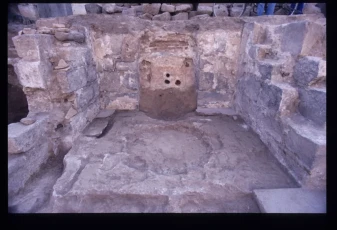
Busra, Hammam Manjak before the restoration work
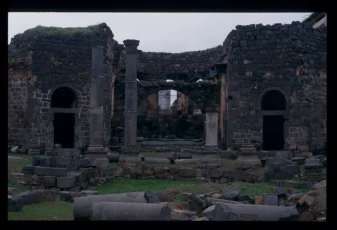
Busra, View into the Cathedral, 6th c. AD

Al-Madrasa az-Zahiriyya, general view from the outside

Waqf of Ibshir Mustafa Pasha, Coffeehouse, the hall
The core of the hall was only partially damaged, while the section of the central dome with its high lantern was, for the most part, destroyed.

Al-Matbakh al-ʿAjami: östliche Qaʿa, Schnitt Ost-West, Blick nach Süden

Qasr al-Hayr al-Sharqi, obere Abschluss eines Turmes

Takiyyat ash-Shaykh Abu Bakr, innerer Eingang

Madrasat al-Firdaws, general view to north - courtyard, eastern arcade and iwan

Shaykh Shibli shrine - al-Tar mountain, south -east of al-Mayadeen

Burj al-Ghanam, Gesamtansicht von Südwesten

As-Sabuniyya Mosque, the main facade with muqarnas and rich decorations

Busra - Jamiʿ (mosque) al-Mabrak from the outside

Natural view near the village of ʿArna on Jabal ash-Shaykh

Remains of the western entrance to the Temple of Jupiter, behind it the minaret of Qaytbay
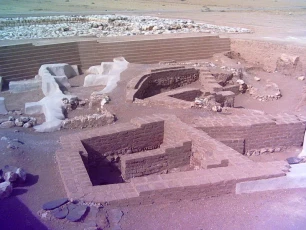
Tall Mardikh (Ebla), Blick in ein Votivdepot des Ishtar-Tempels
shap_import_48474

Haupteingang der Kirche, Qasr Ibn Wardan
[Original: Kirche (Kuppelbasilika mit Emporen), Tür der Südseite]

Raqqa, Qasr al-Banat, clay decorations
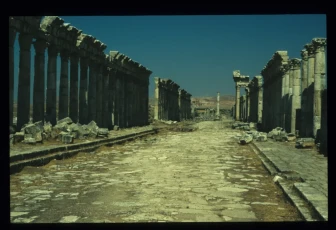
Afamiya, The Great colonnade (Cardo Maximus)

Al-Bimaristan an-Nuri, Ornaments above the door lintel

Gesamtansicht von Ma'lula
[Original: Malulla bei Damaskus, orientalischer Grundriss]

Raqqa - Baghdad-Tor

Ebla (Tall Mardikh), basalt basin was often used for the purposes of worship
(Kult)Wanne. Sie erinnert an die aus Mishrifa, vgl. Bild 0968 ! Der GPS-Tag ist approximativ. [Original:Tall Mardîkh (Ebla)']

Al-Madrasa al-Kamiliyya, Innenhof mit Fassade der Gebetshalle

Jamiʿ Aslan Dada, entrance of the additional prayer hall (al-Hijaziyya)

Euphrat-Staudamm und Assad-See in Nahiyat at-Tabqa
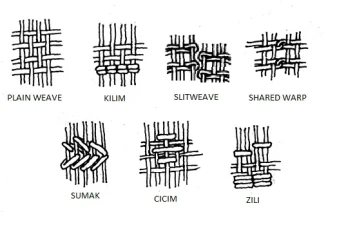
Techniques of tapestry weaves
Drawings by Estibaliz Sienra Iracheta to illustrate processes of traditional textile manufacturing

Jamiʿ Sharaf, Inschrift über dem Sabil

Bab Antakiya, Haupttor

Hiraqla victory monument - plan of ground level
Reconstruction drawing of gound level. Plan showing construction system. (with ruler)

Archäologische Funde aus Raqqa, ausgestellt im Damaszener National Museum
Pottery vessel from ar-Raqqa; National Museum Damascus; Mus.Nr.16067; R.6

Kloster Unserer Lieben Frau von Saydnaya, Gesamtsicht

Simeonskloster, Kapitelldekoration mit Kreuzmotiv

Al-Madrasa al-ʿUmariyya al-Kubra, Innenbereich

Maronitische Kathedrale St. Elias, Altarraum

Blick von fern auf die Burg von Shayzar

Madrasat al-Firdaws, lobed octagonal basin in the centre of courtyard

Theater, Cavea - Westseite
[ Description by author: linker Teil. Die Cavea soll ursprünglich etwa dreimal so viele Sitzreihen gehabt haben: das Theater von Palmyra war eines der größten im Nahen Osten. Es wurde allerdings niemals vollendet ....... Im Hintergrund ganz links die Burg, weiter rechts und näher der Tetrapylon. Der Bogen rechts in der Kolonnade markiert den nordwestlichen Durchgang zur Rundstraße ums Theater. Gesehen nach ~ Nordwesten. ]

Mosaic of the sea goddess "Thetys", Shahba Museum

Tall Mumbaqa, Women prepare food for the banquet of the excavation

Bab al-Hadid, south-west facade of the gate tower

Busra, al-Jami‘ (mosque) al-ʿUmari - the prayer hall

Archäologische Grabung in Balis

Zerstörte Gebäude in Qunaytra

Kafra, im Innenhof hinter einem großen Mittelhallenhaus

At-Takiyya al-Mawlawiyya, Westfassade - al-Midan

Monastery of St Simeon Stylites, cross surrounded by decorations

Raqqa-Ost, Nordkomplex, Glasfund
Northern Complex; glass jar (fragmented)

Citadel of Aleppo, Maqam Ibrahim - inscription in the courtyard

Safita, The Donjon of the Templars with a chapel in the ground floor

Qasr Asʿad Basha al-ʿAzm, Innenhof des Familienwohnbereichs (haramlik oder juwwani genannt)

Khan Dannun, Innenhof

Great Mosque of Aleppo, courtyard with fountains, minaret, northern and western arcades

Bel-Tempel, Nordwest-Ecke der Portikus
[ Description by author: Die Nordwest-Ecke des Portikus. gesehen von ~ Südosten / Süden. ]

Takiyyat ash-Shaykh Abu Bakr, the minaret

The donjon and the corner tower of Yahmur Castle

Bayt (Haus) Dada, Tür in den Empfangsraum (qaʿa)
Tür v. Liwan zur Qa'a

Palmyra, Diokletianslager, Tempel der Allat
[ Description by author: Gesehen von ~ Nord-Nord-Ost: rechte Seite und Rückwand. Ganz links das Temenos-Tor. ]

Raqqa - Madinat ar-Rafiqa wall - one of the wall tower
[original: Stadtmauer / Innenseite. Turm 80']. [83/72/12] =[ photo's name as: year/ film no./ photo no,]. on the back of the photos: [83/72]

Kuppel des Maqam Salah ad-Din al-Ayyubi
[ Description by author: Der Bogen rechts und das anschließende Grab sind die einzigen Reste der Madrasa 'Azaziya, gegründet von einem Sohn Salâhu d-Dîns, wo dieser 1195, zwei Jahre nach seinem Tode, beigesetzt wurde.- Gesehen nach ~ Nordwesten. ]

A general view of az-Zabadani city, which lies on the foothills of the the Anti-Lebanon Mountains

Kharab Shams, Fernblick auf die Basilika
[Original: Säulenbasilika, 4. Jh. von weitem]

Römisches Theater, 2. Jh. n. Chr.
Die syrische Antikenverwaltung hatte vor dem Krieg das Theater ausgebessert, um es als Veranstaltungsort zu nutzen. Während der Herrschaft des ISIS fanden dort Hinrichtungen statt.

Khan Qurdbak, Steinornamentik
Detailaufnahme einer prächtigen Steinornamentik: in der von geflochtenen Blendsäulchen flankierten Fensternische befinden sich über dem Fenstersturz ein gerader Entlastungs- (Überfang)bogen mit abweselnd farbigen Keilsteinen im sogenannten Zickzackmuster. Darüber befindet sich, auf Höhe des Säulchenkapitells, ein Flachrelief aus geometrischem Flechtwerk. Daneben erweitert sich der Rahmen um die Nische durch ein doppeltes Muqarnas-Band, umsäumt von einem Zahnschnittfries

The northern entrance of the historical city of Dura Europos (Qalʿat as-Salihiyya), end of 4th century BC
Main Entrance, Courtyard

A modern building and a traditional mud fence in one of the Ghouta fields of Damascus

Khan Qurdbak, Haupteingangsportal

Kitbugha Mausoleum im Qasiyun-Gebirge
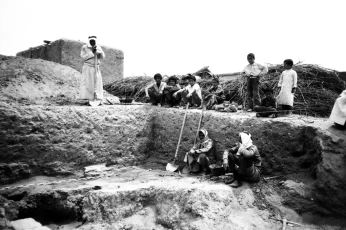
Raqqa - "East of Raqqa" site - Tall Aswad, excavation in 1985
[1985/24/401] = [photo's name as: year/ film no./ photo no.]. ["s.a. Dias"]

A view of the Mosque of at-Takiyya as-Sulaymaniyya with Qasyun mountain in the background

Raqqa, Nordostkomplex

Qalʿat ash-Shugr wa-Bakas, Burgruinen auf einem Bergvorsprung

Bayt Junblat, Süd-Iwan, Wanddekoration mit Marmorplatten und Fayencefliesen

Bayt Shaykh Qatana, Innenhofansicht vor dem Abriss
Tür zum Hof

Khan al-Jumruk, detail of exterior facade of the khan's entrance

Khan al-Hallabat, General view from southeast
[ Description by author: des Forts, gesehen von ~ Südosten. Es liegt an der späteren Strata Diocletiana zum Schutz der Verbindung Palmyra - Damaskus. ]

Blick über die fruchtbare Ebene von Zabadani

Maronite Cathedral, main entrance

Ökologisch-botanischer Garten neben der Zitadelle von Damaskus
Ecological and botanical garden

Archaeological finds from Raqqa, exhibited in the Damascus National Museum
Luster ceramic bowl from ar-Raqqa; National Museum Damascus; Mus.Nr.13076

Salkhad, Ruinen inmitten eines Weingartens

Blick nach Südosten auf ʿAyn al-ʿArus-Karstteich

Siegesmonument von Hiraqla (nahe Raqqa)
Hiraqla (near ar-Raqqa), (MM: DAI 93/158)

Raqqa - the excavation in the site "East of Raqqa", the Eastern Complex, clay decorations

A part from the ruins of Ebla (Tall Mardikh)
shap_import_48455

Al-Madrasa al-Hallawiyya, courtyard, portico and basin

Eine Frau beim Füllen von Lehmziegelformen in einem Dorf im Gouvernement ar-Raqqa

Burg (Qalʿat) Salah al-Din, massive Burgmauern oberhalb der senkrechten Felswand

Jamiʿ ar-Rumi, Ansicht des Minaretts

Al-Matbakh al-ʿAjami: annex, ground floor plan
Annex building in the north of Matbakh al Ajami, size of plan 50 x 36. Ruler.

Tall Dahab, Bettzeugstapel im großen Familienwohn/Aufbewahrungsraum

Al-Madrasa as-Sharafiyya, Innenfassade des Hauptportals

Aleppo: Citadel, Palace, 13 C.

Turmgrab des Elahbel, Deckenfresken

General view of Najm Castle (Qalʿat Najm)

Raqqa, al-Jamiʿ al-ʿAtiq, Remains of the southern arcade from the inside

Raqqa - finds discovered in the site "East of Raqqa", the Eastern Complex
Ra O-OK 221 Oil lamp. [original: 'Öllampe']. [ 89/53/836] =[ photo's name as: year/ film no./ photo no,].

Ausgrabung der abbasidischen Ruinen von Kharab Sayyar

Diversity of vegetation and protruding rocks in the Syrian coastal mountains (al-Jibal as-Sahiliyya)

At-Takiyya as-Sulaymaniyya, überkuppelte Arkade und dahinter sichtbare Kuppeln der angrenzenden Räume

A mechanical loom in the textile factory of the Mezannar family

Al-Matbakh al-ʿAjami, the great iwan dome

Umayyaden-Moschee, Goldgrundmosaik in der West-Arkade

The historical sulfur spring of Afqa
[ Description by author: Beim Austritt des Kanals, Blick nach ~ Nordosten. Vorn rechts die "Treppe", links ein Altar, hinten die Säule und links von ihr noch ein Altar. ]

Bauern auf dem Heimweg aus ihrem Palmenhain fahren am Bel Tempel vorbei

Habuba Kabira, during the construction of cantilever domes, the mortar is pulled up using a bucket

al-Husn Church, remains of basilica's wall, which constitue the boundary of an agricultural field

Inside the city wall, excavation work, Qatna
. [Original: Al-Mishrifa / Qatnâ']
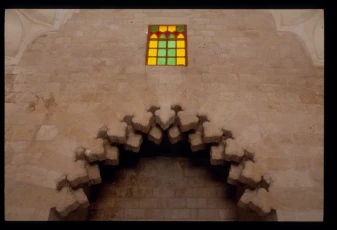
Al-Matbakh al-ʿAjami, small iwan - detail view of archway

Closed arched entrance, Qasr al-Hayr al-Gharbi

Afamiya, Blick auf die nördlichen römischen Bäder

Gesamtansicht des Palasts (Qasr) Ibn Wardan
[Original: sakraler Zentralbau und Palast, Palast]

Madrasat al-Firdaws, Marmor-Gebetsnische (Mihrab) mit geometrischen Motiven

Plan des Krak des Chevaliers
[Krak, Plan]

Palmyra Theater, view to proscenium and scaenae frons, 2nd c. AD

A view of Qalʿat Shayzar along the Orontes river
View at Qalʿat Shayzar

Busra - Jamiʿ (Moschee) al-Mabrak

Remains of the Umayyad Qasr al-Hayr al-Gharbi
[Original: "Heir al-Garbi"]
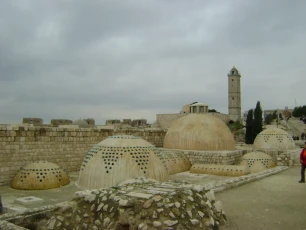
Citadel of Aleppo, exterior view of the domes of the Hammam

Qanawat, römischer Sarkophag mit Ornamenten
[Original: Rechteckige Grabkammer hinter der östlichen Exedra der Basilika: christlicher Sarkophag]

Stone carved panel on the ʿAyn Diwar bridge

Orchards in the Anti-Lebanon Mountains

Hammam Bahram Basha, the cold section (barrani) after the destruction
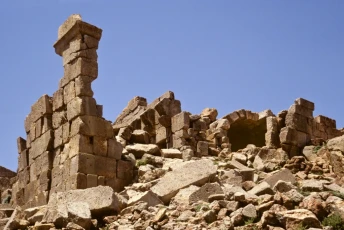
The Byzantine basilica, view from the south, Qalʿat Burqush
[ Description by author: der byzantinischen Basilika, gesehen von ~ Süden. Links ein Stück der Südwestwand, rechts schaut man durch die eingestürzte Südost-Wand in die Gewölbe. Der Stein unter dem Bord links entspricht in seiner Höhe genau dem Stein rechts: der ganze Zwischenraum ist als Mauer zu denken. ]

Habuba Kabira, clay bricks are drying - at the edge of the village, because there is enough space

Bayt Ghazala, Springbrunnen in der Hauptempfangshalle (Qaʿa)

Qanawat, Blick auf die Ruinen des Rabbos-Tempels

Busra, Roman Theater

Eine traditionell hergestellte Decke (Kelim)

An aerial photograph of the city of Raqqa, showing the wall and the old mosque (original photo: Mohamad Al-Roumi)

Shahba, Exterior view of the Roman Theatre/ Philippopolis

(Bad) Hammam ʿAbd al-Basit, Grundriss
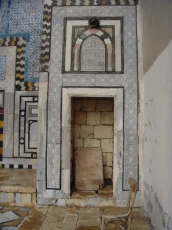
Bayt Junblat, southern iwan - decoration of marble and faience tiles

Ebla (Tall Mardikh), (Kult)Wanne aus Basalt
(Kult)Wanne. Sie erinnert an die aus Mishrifa, vgl. Bild 0968 ! Der GPS-Tag ist approximativ. [Original:Tall Mardîkh (Ebla)']

A woman in a rural area with traditional clothes

Raqqa - the excavations of the site "East of Raqqa" - Eastern Palace
[ 89/45/589] =[ photo's name as: year/ film no./ photo no,].

Männer in ihren traditionellen Trachten in den Dörfern bei at-Tabqa

Cathedral of Our Lady of Tortosa, southern side, today Tartus-Museum

Bayt Wakil, Springbrunnen der Empfangshalle
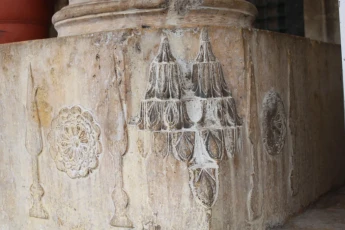
Jamiʿ al-ʿAdiliyya, decoration details in the double arcade

Ruins of Qalʿat ash-Shugr wa-Bakas on the edge of a mountain slope

Citadel of Aleppo, plant ornament

Die Ebene von Zabadani mit Felderwirtschaft und Baumpflanzungen

Village alley in the Balikh region with calf and goats

Jamiʿ al-Mihmandar, prayer hall entrance

Afamiya, The Great colonnade (Cardo Maximus)
shap_import_70671

Bayt Junblat, Nord-Iwan, Wanddekoration mit Marmorplatten und Keramikfliesen
[Original:'Qasr Jumblât, Halab / Aleppo. Inneres des Nord-Iwâns.].

Das Nabatäer-Tor mit seinem großen Bogen, Säulen und Kapitellen

ThMap of the irrigation oasis of Damascus in 1969
The irrigation oasis of Damascus - attempt a summary display. Ledend and ruler. [Original: Die Bewässerungsoase von Damaskus - Versuch einer Überblicksdarstellung]

Bayt (Haus) Quawatli, Baudekoration im Empfangsraum (qaʿa)
Kämpferkonsole in der Qa'a

Damaskus, Khan Asʿad Basha al-ʿAzm, Innenansicht von Erd- und Obergeschoss

Turmgrab des Elahbel - Inneres, Tal der Gräber (Westnekropole)
[ Description by author: Erdgeschoss, Inneres. Links und rechts zwischen den Pilastern die Loculi für die Toten. Im Hintergrund die Familie des Grabinhabers, vgl. Bild 0836 ! Zur Decke s. Bild 0837 ! ]

An aerial photograph of the village of Shaykh Hilal
The picture shows the distribution of buildings according to a rectilinear plan, and it is possible to identify many of the domed houses and houses with flat roofs that contain gardens.

Wakil house, Reception hall

Jamiʿ Aslan Dada, interior view of the prayer hall (qibliyya) showing the niche (mihrab)

Qasr Asʿad Basha al-ʿAzm, Innenhof des Gästeempfangsbereiches (selamlik oder barrani gennant)

(Dome) Qubbat as-Sayyar on Qasyun mountain

Waqf of Ibshir Mustafa Pasha, Coffeehouse, the hall
The core of the hall was only partially damaged, while the section of the central dome with its high lantern was, for the most part, destroyed.

Eine grasende Schafherde vor der Burg (Qal'at) Shayzar

Tall Bdiri, Haus aus großem Wohnraum und angebauter Küche

Die Buwayda-Brücke an Fuß der aiyubidischen Zitadelle in Salkhad
Hinweis: Dieses Foto wurde zwischen den Jahren 1924 - 1939 aufgenommen. Das gewählte Datum soll ein Durchschnittswert sein. (Fotograf unbekannt)

A building belongs to Qal‘at Shayzar

Al-Madrasa al-Hallawiyya, entrance of the prayer hall

View at ar-Ruj plain from an orchard

Tall Mumbaqa, Frauen bereiten Salat für das Ausgrabungsfest vor

Yabrud: Wohnhäuser mit Mittelhallengrundrissen und Dreierarkaden
Straßenansicht mit Mittelhallenhaus. Diese straßenbegleitende Bebauung zeigt eine lokale Variation (des Qalamun Gebirges) der seit der Mitte des 19. Jh aus dem Libanon bekannten Hausform: beschattete Eingangshalle mit einer Eingangsarkade aus drei Bögen auf Rundsäulen im Erdgeschoß, darüber im Obergeschoß die Wiederholung als offene Sitzfläche mit vorgesetzten Balkon. Steinerne symetrisch angelegte Fassade aus sauber gehauenen Kalksteinen und schlanken Bogenfenstern. Die Entstehungszeit dieser Häuser wird wohl im ersten Quartal des zwanzigsten Jahrhundert sein.

Flussabschnitt des Barada

Sirjilla, Mauerreste eines zweigeschossigen Gebäudes

A view of the Euphrates in Dayr az-Zawr
Jisr Dayr az-Zawr, al-Furat

Kinder bereiten sich für dem Hochzeitszug vor. Die zwei kleineren Kinder tragen noch ihre Schuluniform
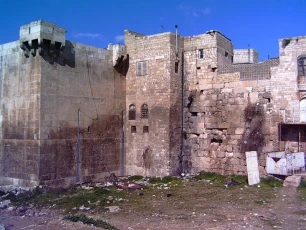
Burj al-Ghanam, Teilansicht von Südosten
shap_import_63420

A colorful marble niche in the mausoleum of az-Zahir Baybars
[Original: Zahiriya, Mausoleum des az-Zahir Baibars, 1277. Mihrab-Nische mit Marmorinkrustationen]

Blaue Qashani-Fliesen, Mausoleum von Salah ad-Din al-Ayyubi
[ Description by author: Die Inschrift über die Restaurationsarbeiten von Wilhelm II. Eine ähnliche Inschrift befindet sich im Bacchus-Tempel von Ba'labak. (The year of the photo is not sure according to Peter Heiske ) ]

‘Ajami decoration in Qasr al-‘Azm, Damascus
shap_import_97593

Wandmalereien am Eingang des Qasr al-Hayr ash-Sharqi
[Original: Malerei im Tor]

At-Takiyya al-Ikhlasiyya (az-Zawiya ar-Rifaʿiyya), details of the hall facade situated on eastern side of the courtyard

Außenansicht der seljukischen Wassermühle vom Bab as-Salam, Damaskus

Google earth- al-Husn Church 2010

Beduinenmädchen mit Satteltasche, die die Mutter gewebt hatte

Khan Qurdbak, östlicher Arkadentrakt
Coffehouse Aslan Dada (vanished)

Busra, a view into the Roman theater (3rd c), which was in Islamic times converted into a fortress

Palmyra, Diokletianslager, Sarkophag
[ Description by author: in der Nähe des Fahnenheiligtums. [' 26/03/2002 (?)'] ]
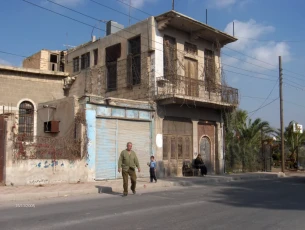
A two-story building in a village in Ghuta
It is hard to tell the exact date of this building, but it is clear from its architectural style that it dates back to the beginning of the second half of the 20th century.

Tall Bdiri near the Khabur: pilasters are stabilizing the walls of the houses

Halabiyya; remains of Basilica and Eastern wall,
[Original: Blick vom Praetorium auf Basilika, Euphrat und Reste der Ostmauer]

General view of the architectural remains, Sirjilla

Modern interpretations of the traditional craft of ‘Ajami (workshop of Aliya Alnuami)

Tal der Gräber (Westnekropole), Grabrelief einer Familie in der Fassadennische eines Turmgrabs
[ Description by author: Detail der Fassade. Im Bogen der Tote auf einer Kline, dahinter seine Familie. Unter der Kline Reste der Inschrift. ]

General view of the Krak des Chevaliers
[Original: 1150 - 1250 vom Johanniterorden erbaut, Außenansicht]

Natural landscape of the Tigris valley

Gürtel der Jungfrau Maria in der Sankt-Marien-Kirche des Heiligen Gürtels

Ausgrabungsarbeiten in der Daydariyya-Höhle

Blick auf az-Zabadani am Fuß des Antilibanon-Gebirges

Madrasat al-Firdaws, Mausoleum - Inschrift

Jamiʿ al-ʿAdiliyya, faience tiles decoration above a window
[Original: 'Jâmi' al-'Âdiliya, Halab / Aleppo. Fayence-Dekor, vgl. den aus der Takiya as-Sulaimâniya in Dimashq Bild 0122, 0123 !'].

Wasserfälle von Tall Shihab (während des Sommers)

In al-Hayat/Balikh-Tal, Prozess der Gipsherstellung (1. Schritt): Brennmaterial wurde auf Gipssteinschicht aufgelegt
(Siehe auch 2. und 3. Schritt der Gipsherstellung)

A shepherd with his herd and tourists
[Original: Große Orientreise Nr.63 mit Rotel-Tours: Amman-Bagdad-Uruk-Babylon-Arbil-Mosul-Hatra-Samara-Mari-Dura Europos-Aleppo-Dayr Saman-Ugarit-Palmyra-Jarash]

A street scene in one of the suqs of Dayr az-Zawr
[Original: Große Orientreise Nr.63 mit Rotel-Tours: Amman-Bagdad-Uruk-Babylon-Arbil-Mosul-Hatra-Samara-Mari-Dura Europos-Aleppo-Dayr Saman-Ugarit-Palmyra-Jarash]

Qalʿat (castle) al-Qadmus, Insciption

Ruinen des Tempels von 'Ayn Dara-2

A side from the ruins of Halabiyya

Qunaya: in the Museum of the Monastery of St Simeon
The museum shows everyday objects as they are often found in the earth still today: pearls, bracelets, spindles, etc.

Interior view of Qadmus Castle

Hama, al-Mudiq castle, A side of al-Mudiq castle shows some of its towers

View of a side of Najm Castle (Qalʿat Najm)

Small wadi in the desert of Badiyat ash-Sham

Deserted houses in Jabal al-Hus south of Aleppo
View at a group of abandoned, deserted dome houses appear to be in a poor condition.

Reception hall in al-ʿAzm Palace

Minarett der Großen Moschee von ar-Raqqa/ar-Rafiqa, 8./12. Jh. AD

Fotografie der Syrischen Wüste vom Anfang des 20. Jahrhunderts

Afamiya, Ruinen der Kolonnadenstraße (Cardo Maximus)
shap_import_70673

Al-Bara, oil mill, 5th-6th c.

Waqf Ibshir Mustafa Pasha, Kaffehaus, Innenraum nit Kuppel und Muqarnas-Pendentifs

Eastern facade, Jamiʿ Manjak

Jamiʿ al-Mihmandar, Minarett

Simeonskloster - Klosterkomplex

Jamiʿ Sharaf, Qastal

Jamiʿ al-Utrush, eingestürztes Dach der Gebetshalle, östlicher Teil
Hof mit Dikke [Original: Dscham'a el Utrusch]

The upper part of the entrance, as-Sinaniyya Mosque
[ Description by author: Oberer Teil mit Stalaktiten-Halb"kuppel" und Bilder-Kacheln. ]

Mari (Tall Hariri), a side of the architectural remains
[Original: Große Orientreise Nr.63 mit Rotel-Tours: Amman-Bagdad-Uruk-Babylon-Arbil-Mosul-Hatra-Samara-Mari-Dura Europos-Aleppo-Dayr Saman-Ugarit-Palmyra-Jarash]
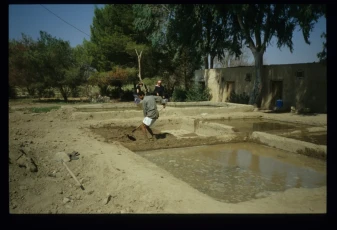
Preparation of mud for construction in one of Raqqa villages

Eastern entrance of Suq al-Hamidiyya, Old Damascus

Shahba, Im historischen Zentrum der Stadt
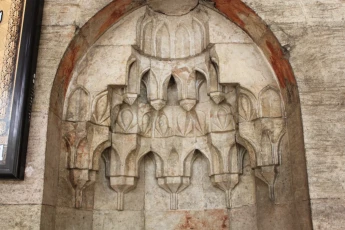
Jamiʿ al-ʿAdiliyya, muqarnas decorating a niche on the right side of the prayer hall's entrance
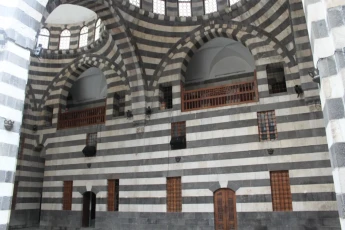
Damascus, Khan Asʿad Basha al-ʿAzm, a wall topped with domes on pendentives

Tall Mardikh (Ebla), Rekonstruierte Treppe im königlichen Palast GPalast
shap_import_48446

Raqqa, Qasr al-Banat, Lehmziegelornamente
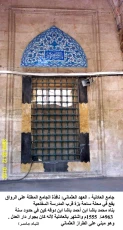
Jamiʿ al-ʿAdiliyya, prayer hall - one of the windows on the northern facade

Marble cenotaph next to the tomb of Salah ad-Din, was presented by German Emperor Wilhelm II during his visit to Damascus in 1898
[ Description by author: Der Kenotaph Salâhu d-Dîns. Das Grabmal war völlig vernachlässigt, bis es Wilhelm II auf seiner Orientreise 1898 restaurieren ließ und diesen Steinsarkophag stiftete. Davon berichtet die Inschrift oben links, vgl. Bild 0230 ! Zu dem weitgehend verdeckten älteren Holzsarkophag s. Bild 0229 ! (The year of the photo is not sure according to Peter Heiske ) ]

Umayyad Mosque, the facade of the prayer hall is covered with golden and colored mosaic
Originally, the entire courtyard façade was covered with mosaics. They show fantastic landscapes, which are interpreted as a representation of paradise.

General view of Qarqbiza remains

Bimaristan Arghun, southern courtyard - view of open dome
shap_import_60897

Bel-Tempel von Norden
[ Description by author: Morgendlicher Fernblick auf die ~ Nordseite. Woher ? Nach der Google-Karte erscheint das Tetrapylon-Hotel als Standort am wahrscheinlichsten: das kenne ich aber von meinen Aufenthalten nicht. In der selben Gegend befinden sich aber das Tower Hotel und auch das Middle East Hotel: in beiden war ich. Vielleicht wurde auch eines der beiden umbenannt ? ['[Tetrapylon Hotel],'] ]

Al-Madrasa az-Zahiriyya, der Eingang ist reich geschmückt durch Ablaq-Mauerwerk, ein Muqarnas-Gewölbe und Inschriften

Raqqa - Madinat ar-Rafiqa, Stadtmauer - Kapitelle, die während der Ausgrabung gefunden wurden
Raqqa II; Kapitelle (gefundenn nahe der Stadtnauer oder dem Abraum?)

Palmyra, Blick vom Höhenzug zum Tal der Gräber und den Palmhainen

Al-Madrasa as-Sultaniyya, northern window of al-Malik az-Zahir Ghazi tomb
The window topped by an inscription panel

Inner face of the southern walls of Halabiyya, tower 3

The minaret of the Mosque of Shaykh ʿAqil al-ʿUmari al-Manbiji
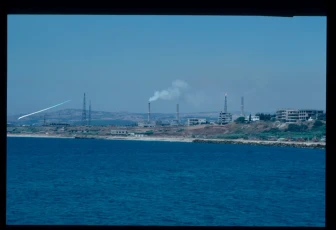
A view of the Mediterranean coast, in the back is the industrial sector, Baniyas

Archaeological finds from Raqqa, exhibited in the Damascus National Museum
Relief decorated Frieze; National Museum Damascus from ar-Raqqa
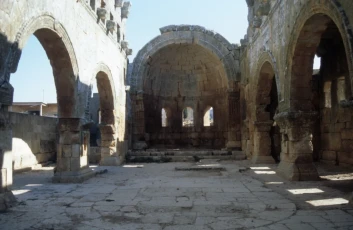
Qalb Lawza, Basilica of 5th c., central view at nave and apse

Busra, Hammam Manjak, Restaurierungsarbeiten

A photo showing tomb towers, part of modern city and the oasis

Shahba, Ruinen eines hexastylen Tempels
Hinweis: Dieses Foto wurde zwischen den Jahren 1924 - 1939 aufgenommen. Das gewählte Datum soll ein Durchschnittswert sein. (Fotograf unbekannt)

Remains of Islamic Jaʿbar castle
Note: these photos were taken between the year 1924 - 1939. The chosen date is to be average. (photographer unkown)

Women wearing screen-printed headscarfs (Habari)

Raqqa, A side from al-Banat Palace

Raqqa-Ost, Tall Aswad, Ausgrabung im 1985
[1985/24/395] = [photo's name as: year/ film no./ photo no.]. ["s.a. Dias"]

Narrow hidden alley in the city of Halle, Germany

Busra, Hammam Manjak, Restaurierungsarbeiten

Khan Qurdbak, iwan, ground floor plan
Ground floor with iwan [21], size of plan 70 x 45. with ruler (no scale).

Busra, View into the Cathedral, 6th C.
[Original: Kathedrale (den Märtyrern Sergios und Bacchios und dem Leontios geweiht), 512/13]
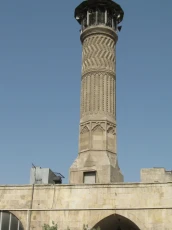
Jamiʿ al-Mihmandar, minaret

Qalʿat Salah ad-Din von außen

Bab as-Salam, portal with coloured stone layers (ablaq)

Ein Ziegenhirte mit Herde und vorbeigehendeTouristen
[Original: Große Orientreise Nr.63 mit Rotel-Tours: Amman-Bagdad-Uruk-Babylon-Arbil-Mosul-Hatra-Samara-Mari-Dura Europos-Aleppo-Dayr Saman-Ugarit-Palmyra-Jarash]

Umayyad Mosque, the famous golden mosaic of the facade of the prayer hall overlooking the courtyard
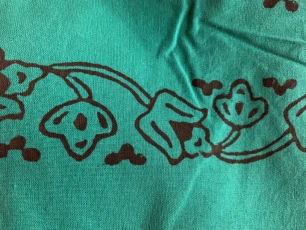
Hand printed table cloth from Hama at Hassan's Shop, Old Damascus

Raqqa, City Wall
Nicephorium; City Wall

Temple of ad-Dumayr from the inside
[ Description by author: Gesehen nach ~ Nordwesten. Man blickt auf die innere Schmalwand mit rechts und links den beiden "Kammern" (deren Rückwand die originale äußere ~ Westwand ist) und in der Mitte dem Durchgang, dessen "Rückwand" die islamische Zumauerung bildet. Vgl. Bild 0384 - 0386 ! ]

Ruinen eines Gebäudes in Qasr al-Hayr al-Sharqi
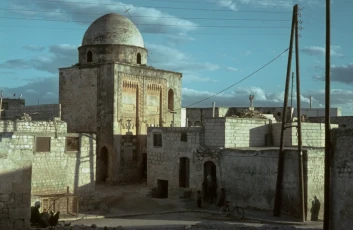
Maqam Ughulbak, general view from the outside

Masbanat al-Jubayli, a soap cooking pot
The process of cooking the laurel soap is done in a large container, usually located in the ground floor of traditional soap manufactory.

The Throne Hall in Damascus Citadel
This photo shows Roman columns that support a central dome.

A view towards the Euphrates, Jabal ʿAruda

Archäologische Grabung in Tall Sabi Abyad

Bel-Tempel, Cella - Süd-Thalamos, Monolith-Decke

Ghuta of Damascus, olive trees in a grove

Die Oberburg der Burg (Qalʿat) Shumaymis
Nach dem Licht und dem, was auf dem Satellitenfoto zu erkennen ist, muss dies die Südmauer sein. Man sieht gut, wie ein Stein-Mörtel-Kern mit Basaltquadern verblendet wurde. . [Original: Qal'at ash-Shamîmîs']
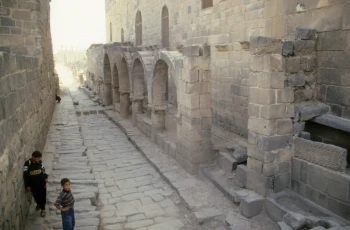
Busra, Vaulted arcade, eastern facade of al-ʿUmari Mosque

Palmyra, View of the remains of Diocletian's Camp
[ Description by author: Blick vom Hang des Jabal al-Husainiya oberhalb des Fahnenheiligtums nach ~ Südosten. Ganz unten das Fahnenheiligtum, davor der Platz des Präteriums, davor ein Vestibül mit vier (nur eine steht) monolithischen Säulen, dann nach hinten die Via Praetoria, die hinter den Säulen in der Mitte von der Via Principalis geschnitten wird. Daran, links davon, der Allât-Tempel. Außerdem erkennt man ganz hinten gleich rechts der Mitte den Tetrapylon, weiter rechts den Bel-Tempel. ]

Archäologische Funde aus Raqqa, ausgestellt im Damaszener National Museum
Luster ceramic bowl from ar-Raqqa; National Museum Damascus; Mus.Nr.13076

Dieselverkäufer in Raqqa

Aleppo: Eingang zur Zitadelle, 12. –16. Jh.


Der Holz-Sarkophag von Salah ad-Din al-Ayyubi
[ Description by author: Der ältere (alte ?) Holz-Sarkophag Salâhu d-Dîns. Ich glaube, es ist ebenfalls ein Kenotaph, somit bliebe unklar, wo der Leichnam heute ist. (The year of the photo is not sure according to Peter Heiske ) ]

View from south, Qalʿat Ibn Maʿn
[ Description by author: Die Burg des Fakhru d-Dîn al-Ma'ni, gesehen von ~ Süden. ]

Salah ad-Din statue situated in front of the western facade of Damascus citadel

Jabla, Innerer Hafen

Remains of fortifications in Halabiyya-Zalabiyya

Bridge over deep ditch reaching the Castle of Ibn Maʿn

Al-Bara, Pyramid Tomb A, 6th century
"Größeres Grabmal (im Grundriß quadratischer Raumkubus mit pyramidalem Dach), sp. 6. Jh."

an-Nabi Huri (Cyrrhus), Roman bridge on the Afrin river

Raʾs al-ʿAyn, künstlicher Bewässerungskanal

Sirjilla, large press (P.01, House 09, southern annexe)
Trip of the IFEAD, the dead cities [voyage IFEAD, villes mortes]

Al-Matbakh al-ʿAjami, facade of the southern section of the great hall

At-Takiyya al-Mawlawiyya, inscription above the prayer niche

Qasr Asʿad Basha al-ʿAzm, Deckenornament

Jamiʿ ar-Rumi, Ansicht des Minaretts

Bab al-Maqam in Aleppo, general view

Blick auf einen Ausschnitt der Stadtmauer in Damaskus
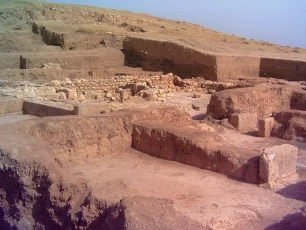
Tall Mardikh (Ebla), Blick über die Ruinen
shap_import_48466

Qasr Asʿad Basha al-ʿAzm, Innenhof und Arkaden
Der Palast der Gouverneursfamilie al-ʿAzm, ist heute ein „Museum für Kunst und Volkstraditionen“.

Jamiʿ Aslan Dada, Inneres der Gebetshalle (Qibliyya) mit Kuppel

Al-Madrasa al-Hallawiyya, Innenhof, nördliche Hofarkade und Wasserbecken

Qasr Ibn Wardan, the church

A woman putting mud in molds to form bricks in a village in Raqqa

Hammam al-Bayyada, general plan

Entrance to the Church of St Peter, Saydnaya
[ Description by author: oder kleiner Tempel von Bild 0421: Eingang. Noch gut erhalten ist der Türsturz. Die Portalöffnung selbst ist verkleinert, Vermutung: der / die große(n) Türflügel gingen kaputt, Geld für neue war nicht da (vielleicht wegen des Baues des Marienklosters ?), und so kam man auf die Idee, die Portalöffnung zu verkleinern. Womit ? Der Stein ist ein Monolith, er könnte als Eingang von einem anderen Gebäude stammen - diese Eingänge bestehen aber üblicherweise aus mindestens drei Steinen. War es ein "Trog" (welcher Art auch immer, selbst ein Sarg), aus dem man den Boden herausgemeißelt hat ? ]

Tall al-Bi'a, Ausgrabung des Klosters Dayr Zakka
Raq19900043.tif

Near Tall Tamir, in einem in den Boden eingetieften Tannur werden die Fladenbrote gebacken
Die assyrischen Dörfer am Khabur mit ihren Kuppelhäusern baute die französische Mandatsregierung für christliche Flüchtlinge aus der Türkei und dem Irak.

General view of the Valley of the Tombs

Töpferei in der Khabur-Region, wahrscheinlich in al-Busayri

Great Mosque of Aleppo, northern arcade, former gate of the madrasa Dar al-Quran al-ʿAshaʾiriyya

Main entrance of the church, Ibn Wardan Palace
[Original: Kirche (Kuppelbasilika mit Emporen), Tür der Südseite]

Jamiʿ al-Qayqan, general view from outside
[Original: Jâmi' al-Qîqân, Halab/ Aleppo, "Rabenmoschee" - etwa wegen der beiden wohl antiken / byzantinischen Basaltsäulen am Eingang? Eine weitere Merkwürdigkeit ist die Verwendung von Säulenstümpfen im Mauerwerk, was man sonst nur bei Festungsarchitektur sieht. Außerdem soll die Mosche "im Mauerwerk" - wo? - einen Stein mit hethitischer Inschrift bergen. 18/04/2001 (?)']


Fort V, Ebla (Tall Mardikh)
Gesehen nach ~ Süden. [Original:Tall Mardîkh (Ebla)']

A staircase was leading up to upper floor at Royal Palace G, Ebla (Tall Mardikh)
shap_import_48446

Suq Aslan Dada, rebuilding of northern entrance, view towards south

A typical Friday breakfast table in Damascus

The dome hall in the upper floor of Qasr al-ʿAzm (Palace)

Al-Madrasa al-ʿUmariyya al-Kubra, Südarkade

Al-Madrasa as-Sultaniyya, Haupteingang

Citadel of Aleppo, entrance gateways and bridge

Bayt Wakil, Inneres der Kuppel der Empfangshalle (Qaʿa)

Tartus, Museum in ehemaliger Kathedrale, Blick auf die Westfassade
![The South-western part of Bayt al-Husainin with the minrat of its mosque. [Original photo name: as-i-محمع قصر الحسيني 3_SYRHER]](https://syrian-heritage.org/wp-content/plugins/justified-image-grid/timthumb.php?src=https%3A%2F%2Fsyrian-heritage.org%2Fwp-content%2Fuploads%2F2020%2F04%2Fshap_import_75456-1024x768.png&h=230&q=90&f=.png)
The South-western part of Bayt al-Husainin with the minrat of its mosque. [Original photo name: as-i-محمع قصر الحسيني 3_SYRHER]

Eine Gruppe von Halbnomaden sitzt auf einem gefilzten Teppich (links und hinten) und einem gewebten Flickenteppich (rechts)

Jisr ash-Shughur, Qalʿat ash-Shugr wa-Bakas, a general view of the the valley around the twin castle

Tartus, ash-Shaykh Badr, Inscription in al-Kahf Castle

Habuba Kabira, Melken einer Ziege im Gartenhof: Großmutter und Enkeltöchter

Raqqa-Ost, Westpalast
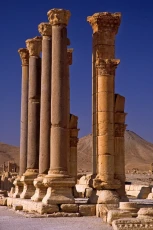
Propylon of Diocletian Baths
[ Description by author: der Anlage. Seine Säulen aus rosa Asuan-Granit überragen das Niveau der Kolonnade (s. rechte Halbsäule / Pfeiler !) und stehen in die Straße vor (hier rechts unten und Bild 0688 !). Den Randsäulen des Propylon entsprechen in der Kolonnade zwei ebenso hohe Pilaster, die wiederum mit je einem Bogen - nur noch die Ansätze erhalten - mit dem restlichen Gebäude verbunden sind. Die Thermen stammen bereits aus severischer Zeit (ca. 200 n. Chr.) und wurden ca. 300 n. Chr. erneuert. Gesehen von ~ Südosten aus dem 2. Abschnitt der Säulenstraße. ]

Main entrance of Ibn Wardan Palace
mit reicher Verzierung und Inschrift, gesehen von ~ Süden. Noch steckt es etwa zur Hälfte im Sand .......

Jamiʿ as-Saffahiyya, muqarnas decorating the upper part of the entrance

Bayt Wakil, Empfangshalle

Busra - Jamiʿ (mosque) al-Mabrak from the outside

Raqqa-Ost, Tall Aswad, Ausgrabung im 1985
Tall Aswad

Busra - Hammam Manjak - Restoration works

Inside the city wall, excavation work, Qatna
. [Original: Al-Mishrifa / Qatnâ']

Busra, Hammam Manjak, the hot section (juwwani)

Qarqbiza, Haupteingang der südlichen Kirchenfassade
[Original: "einschiffige Kirche, Haupttür der Südfassade (Villa des 3. Jhs. kurz vor 313 in Hauskirche umgewandelt - frühester datierbarer Sakralbau Syriens)"]

In al-Hayat/Balikh valley, procedure of calcination of gypsum (2nd step): the fuel was lit
(See also 1st and third step of calcination of gypsum)

Citadel of Aleppo, Barracks of Ibrahim Pasha - the Citadel Museum

Ein kleiner Junge aus einem Umsiedlungsdorf zapft Wasser von einem im Boden angebrannten Wasserhahn
Das Dorf wurde aufgrund des Baus des AL-Furat-Staudamms des Euphrats in den 70er Jahren umgesiedelt nach Nordostsyrien. Typischerweise erhielten die neuen Häuser Wellblechdächer und hatten die Wasserstelle im Hof, anstatt im Haus.

Tartus, Qalʿat al-Marqab, Crusader castle, a courtyard in the castle.

A village in the Syrian coastal mountains (al-Jibal as-Sahiliyya)

Waqf Ibshir Mustafa Basha, südwestliche Ecke mit ehemaligem Sabil (Wasserstelle)

Jurn Kabir, a tawny owl, which occurs there frequently
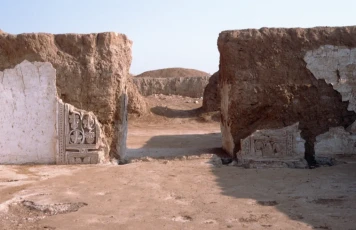
Raqqa - "East of Raqqa" site - Western Palace - vegetable stucco ornaments

Qalb Lawza, Basilica of 5th c., decorative door of reliquary room in southern facade (east)
The relics of Symeon were located in the southern apse side room. This martyrion can be recognized from the outside by the third door in the south wall and by a tiny window next to the door through which the pilgrims could be supplied with holy oil. A direct door into the sanctuary suggests that the Symeon relic was also used during the service. The windows are bordered by a particularly elaborately designed cornice band. The façade also has oblique grooves and square depressions, probably from the base of a sloping roof and its purlins.
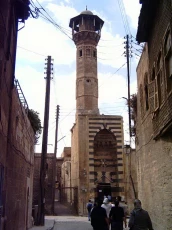
Jamiʿ as-Saffahiyya, minaret and entrance
shap_import_64337

Great Mosque, prayer hall, wooden pulpit (minbar)
The unique wooden minbar, or pulpit, belongs to the Mamluk era as indicated by the inscribed name of the Sultan al-Nasir Muhammad, son of Qalawun (d. 741 AH / 1341 AD). The carpenter’s name is Muhammad ibn ʿAli al-Mawsili.

Raqqa, the inner façade of Baghdad Gate (Bab Baghdad)
Raq19830039.tif

Kharab Shams, Blick von Süden auf Kirchenruine, 4./6. Jh. n. Chr.
Der, bezogen auf ihre Länge, sehr hohen Säulenbasilika fehlen die Außenmauern der Seitenschiffe, die wohl einst einem Erdbeben zum Opfer fielen. Die Ansätze der Sparren des niedrigeren Nebendaches, sind über den Rundbögen der Arkade zu erkennen

Hama, View of the courtyard, Great Mosque
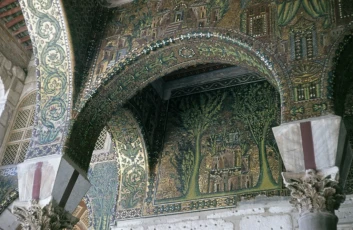
Colored mosaic in the western arcade of the Umayyad Mosque

Installation of tied and dyed warp threads for weaving in the textile factory of the Mezannar family in Damascus

Tall al-Biʿa am Zusammenfluss von Euphrat und Balikh

View from the highest part of Qalʿat Ibn Maʿn towards the Valley of the Tombs
[ Description by author: Blick vom höchsten Teil der Burg genau nach Süden. Ganz links im "Fenster" das Hotel Cham Palace, rechts daneben der Turm des Maliku, der am weitesten rechts in dieser Reihe ist der des Jambliqu. ]

Bayt (Haus) Quwatli, Decke des Empfangsraums (qaʿa)
Decke der Ataba in der Qa'a

Jamiʿ al-ʿAdiliyya, a niche on the right side of the prayer hall's entrance

A mechanical loom in the textile factory of the Mezannar family

The nature in spring, Raʾs al-ʿAyn

Im frühumaiyadischen Wüstenschloss mit den Ruinen überwölbter Räume in den westlichen Komplex

Raqqa, Stadtmauer
Nicephorium; Stadtmauer

Shaykh Shibli Schrein, Berg al-Tar, Süd-Ost al-Mayadeen

At-Takiyya al-Mawlawiyya, the kitchen entrance

Bauarbeiten entlang des Flusslaufs des Barada in Damaskus

Khan al-Jumruk, internal facade of the Khan's entrance

Citadel of Aleppo, Great Mosque courtyard and arcades

Suq ad-Diraʿ, general view of the suq
Souq al-Abba/Souq ad-dra????

Theater, Scaenae Frons - Valva Regia
[ Description by author: Die Porta Regia mit dem Durchgang zur Säulenstraße, vgl. Bild 0721 ! Gesehen von ~ Südwesten. ]

Protection of archaeological site of Mari (Tall al-Hariri) with temporary coverage
[Original: Große Orientreise Nr.63 mit Rotel-Tours: Amman-Bagdad-Uruk-Babylon-Arbil-Mosul-Hatra-Samara-Mari-Dura Europos-Aleppo-Dayr Saman-Ugarit-Palmyra-Jarash]

Courtyard of Arwad citadel

al-Hayr al-Sharqi Palace, Inside of the early Umaiyad desert castle (Western complex)

Wandschranktür des Dresdner Damaskuszimmers, Museum für Völkerkunde Dresden

Basalt-Orthostaten an der Westseite des Tempels von ʿAyn Dara

Kamelhaltung im westlichen Teil der Syrischen Wüste

Al-Matbakh al-ʿAjami: eastern Qaʿa, section east-west, view to south
Annex building in the north of Matbakh al Ajami, size of plan 25 x 30, with ruler (no scale).

View from the northeast, Temple of Bel
[ Description by author: Tele-Ausschnitt aus Bild 0586.. ['Hotel Villa Palmyra (Heliopolis ?)'] ]

Qalʿat Ibn Maʿn, Seitensicht

Hama, Gesamtübersicht über die Jisriyya/Brücken-Noria (Wasserschöpfrad)
Hier ist, auf dem Bild aus den Dreißigern des zwanzigsten Jahrunderts, das Wasserschöpfrad zu sehen, samt namensgebender Brücke, einem separaten Gebäude, sowie die Terrassen zweiser Ausflugslokale oder Kaffees. [Originale Beschreibung: Oronte eclairci NB] Hinweis: Dieses Foto wurde zwischen den Jahren 1924 - 1939 aufgenommen. Das gewählte Datum soll ein Durchschnittswert sein. (Fotograf unbekannt)

The village of Jurn Kabir before the region was flooded by the Tishrin dam

Raqqa, Baghdad Gate, geometric decorations in the niche, built with bricks

Remains of vaults in Halabiya-Zalabiya

Jamiʿ al-Maydani, the minaret

A general view of a part of monumental buildings
[ Description by author: dahinter das Areal des Bel-Tempels. Vorn links die Säulenstraße, 3. Abschnitt, dann der Tetrapylon, dahinter die Säulen der Diokletians-Thermen und dann der Monumentalbogen. Man sieht deutlich, dass die Säulentraße auch im Tetrapylon einen Knick aufweist. Rechts vom Tetrapylon das Theater, ganz rechts die Agora mit Annex und Bankettsaal. Gesehen nach ~ Südosten. ]

an-Nabi Huri (Cyrrhus), View from inside the Roman mausoleum

Raqqa-Ost, Westpalast

As-Sabuniyya Mosque, the body of the minaret is rich in decorations
[ Description by author: Fenster-Etage oberhalb des Sockels. ]

Madrasat al-Firdaws, a grave on the west of prayer hall

Al-Madrasa al-Ahmadiyya, Säulenkapitell der Portikus
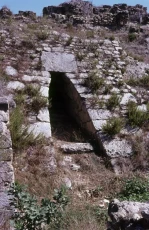
Entrance gate to the city of Ugarit

Moschee der Takiyya as-Sulaymaniyya vor dem Jabal Qasyun

Jamiʿ at-Tawashi, entrance

Euphrat-Staudamm in Nahiyat at-Tabqa

The facade of Arwad citadel

Al-Madrasa al-Hallawiyya, entrance - Zengid inscription in Naskhi script
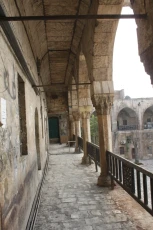
Khan al-Wazir, view of the arcade

Bab al-Maqam, part of the old city's wall

Raqqa, Madinat ar-Rafiqa, Stadtmauer mit Turm
[original: Stadtmauer / Innenseite. Turm 80']. [83/72/12] =[ photo's name as: year/ film no./ photo no,]. Beschriftung auf der Rückseite des Photos: [83/72]

ʿAyn al ʿArus, Stone arcades

Jabal ʿAruda on the right bank of the Euphrates

The gate of the northeastern wall, Agora
[ Description by author: Das hohe Tor der Nordostwand und Blick nach ~ Südwesten ins Innere. ]

Ausflugslokale an den Ufern des Barada

Waqf Ibshir Mustafa Pasha, Fassade des Kaffehauses und Fassade des Badehauses (Hammam) Bahram Pasha
Die Fassaden des Kaffeehauses des Waqf Ibshir Mustafa Pasha (links im Vodergrund) und die des älteren Badehauses von Bahram Pasha (rechts), die sich auf der Straße, die von Ost nach West im Süden des Waqf-Komplexes verläuft, gegenüberliegen, bildeten einen des am reichsten dekorierten öffentlichen Straßenraum in Aleppo.

Hillside houses of Armanaz on a mountain slope

Mushabbak, Byzantine basilica, general view from northeast

Busra, Hammam Manjak, Restoration works

Qal‘at Shayzar (castle), The stairs leading to the entrance

Al-Madrasa as-Sultaniyya, Eingang, umlaufende arabische Inschriften in Stein gemeißelt

Madrasat al-Firdaws, Decorative details of one of the arcade columns capital

Amrit, Melqart Tempel (Eshmoun), zentraler Schrein
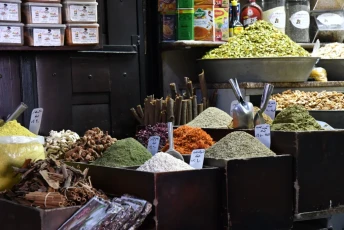
Different goods and spices on display infront of a shop in Suq al-Buzuriyya

Tall al-Mishrifa (Qatna), Ansicht der historischen Stadtmauer, innerhalb derer sich das Dorf angesiedelt hat

A small noria (water wheel) on the Orontes river
One of the small norias in Hama which appears to be very similar to the large norias with its wheel of trunks and stone base.

Baalshamin-Tempel - Cella, 2. Jh. n. Chr.
Im diesem kleinen Tempel wurde der Himmelsgott Baalshamin verehrt. Auch diesen, 2000 Jahre alten Tempel sprengte der IS in 2015.

Busra, Zitadelle, Treppenaufgang mit Bögen
HQ-k.K7 Aside from the Citadel, stairwell

Jamiʿ al-Utrush, Gesamtansicht der westlichen Straßenfassade mit Haupteingang

Khan al-Hibal, general plan

Great Mosque of Raqqa-Rafiqa, 8th/12th C.
The main mosque was built in 772 AD and renovated in the 12th century. Monumental witnesses of this history are the 25 m high minaret and the arcade wall.

Jisr ash-Shughur, Qalʿat ash-Shugr wa-Bakas, Kreuzritterburgen, Steinbögen
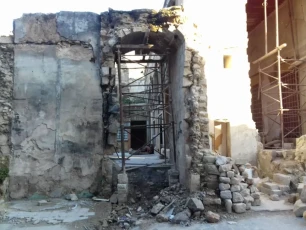
Jamiʿ al-Khayr, main entrance after the war destruction

Bayt Ghazala, courtyard - eastern facade

Bab al-Hadid, general view of the gate's entrance from the outside

Habuba Kabira, the new dome house has received its first plaster layer

Turbat az-Zahir Baybars, mosaic details covering the southern wall of the mausoleum
[ Description by author: Rechter Teil der ~ Westwand. (The date of this photo was not sure as Peter Heiske did [(wohl) 18/10/1998] ]

Bridge reaching to Ibn Maʿn Castle

Bayt Junblat, southern iwan - one of the lateral windows

A grave carved in the rock, Maʿlula
[ Description by author: auf dem Kloster-Plateau. Der Guide Bleu "Near East" spricht nur von "ancient tombs", ohne Hinweise auf heidnisch oder christlich. Bei diesem hier wird allerdings gesagt, dass der eine Adler (Bild 0460) und, wenn ich richtig verstehe, die Nische Bild 0458 byzantinisch seien. Ich muss allerdings sagen, dass für mein Laienverständnis eher der "starre" Adler von Bild 0462 als der "schwungvolle" von Bild 0460 byzantinisch wirkt .......- Der GPS-Tag ist apporximativ. ]

Entrance of a hall in the religion complex of Mnin.
[ Description by author: Die große Halle und ihre Freitreppe, gesehen von ~ Westen. ]

Tall Bdiri im Khaburtal: Pilaster stabilisieren die Wände der Häuser zusätzlich

Luftbild von Wüstenflächen in der Badiyat ash-Sham

ِAleppo, Khan as-Sabun, partial view from eastern arcade in the first floor

Porticus post scaenam, Roman Theater- Busra
[Original: Theater, Bühnengebäude (wahrsch. spätes 2. Jh.)]

Raqqa - the excavations of the site "East of Raqqa", the Eastern Complex

Schöpfrad (Noria) mit Aquädukt in ar-Rastan, 1930
Das alte Foto (Postkarte? Beschriftet Photo ARCHO) zeigt eine der Norias am Orontes-Fluss in der Stadt ar-Rastan. Das Aquädukt aus Steingewölben wird mit Wasser aus den Schaufeln der Noria versorgt.

A side from the city, showing the arch of triumph and Ibn Ma'n Citadel

Jamiʿ Manjak, Seitenansicht mit Minarett

Ruine eines Turmgrabs
[ Description by author: Blick in die Cella von ~ Südwesten. ]

The northwest corner of the portico, Temple of Bel
[ Description by author: Die Nordwest-Ecke des Portikus. gesehen von ~ Südosten / Süden. ]

A shepherd-boy with his herd, on the edge of al-Ghab Plain
[Original: Junge mit Schafe am Rand des Ghab]

Al-Madrasa as-Sultaniyya, Blick auf das Mausoleum von al-Malik az-Zahir Ghazi

Blick auf an-Nuri Moschee und Kilaniyya-Norias (Wasserschöpfräder) in Hama
[Original: Nuri-Moschee am Orontes (unter Nur ad-Din 1162/63 errichtet) und Norias]

Blick über den aus Kirche und Palast bestehenden Komplex Qasr Ibn Wardan
[Original: sakraler Zentralbau und Palast, Palast, 564]

Maronite Cathedral, general view from the outside

The Mediterranean coast of Baniyas city in 1960s

The traditional way of filling and weighing the wool, Raʾs al-ʿAyn
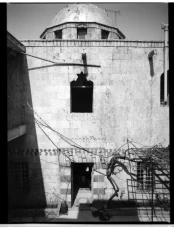
Bayt Wakil, facade of the reception hall (qaʿa)

Traditional houses, Ma'lula

Bab Antakiya, Haupttor

Palmyra / Tadmur, Blick auf den Baalshamin-Tempel
[Original: Baal-Schamin-Tempel, 60 - 150 n.Chr. Im Vordergrund Bad der Zenobia]

Raqqa - "East of Raqqa" site - Tall Aswad - finds
[1985/24/393] = [photo's name as: year/ film no./ photo no.] . ["s.a. Dias"]

Introducing the blue dye in boiling water to the silk threads. This process is repeated several times until the silk absorbs the blue dye effectively

Qalʿat al-Marqab, Fresco in ceiling of chapel sacristy, 12th C.

Burj as-Saʿa, general view

A side of Ibn Maʿn Castle

A photo of stairway with arches, Busra Citadel
HQ-k.K7 Aside from the Citadel, stairwell

Trinkende Schafherde nahe der Quelle des Barada

General view of the village of Shaykh Hilal
This part of the village is surrounded by domed houses, while flat-roofed houses are very few.

Madrasat al-Firdaws, Marmor-Gebetsnische (Mihrab) mit geometrischen Motiven

The mausoleum (turba) of Ibn Salama ar-Raqqi, topped by a dome

Takiyyat ash-Shaykh Abu Bakr, Minarett
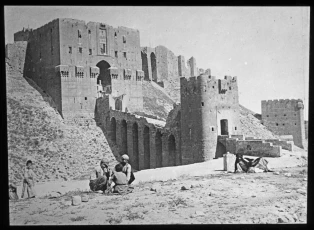
Citadel of Aleppo, entrance gateways and bridge
The Bavarian air force division 304b was based in Palestine from 25. October 1917 and was involved in the First World War until the division left the region, over Aleppo, in mid September 1918. During that period, over 3000 glas photographs, mostly aerial, have been made. Those early photographs were important for the archaeological research in the Middle East.
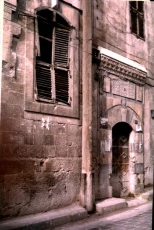
At-Takiyya al-Ikhlasiyya (az-Zawiya ar-Rifaʿiyya), general view from the outside
shap_import_65803

al-Burayj, General view of the Monastery of Saint Daniel, 6th c. AD

Baalshamin Temple - cella, 2nd c. AD
[ Description by author: Oberer Teil des Thalamos in der Cella, gesehen durch das Portal. ]

Bayt Dallal, iwan - wooden decorated canopy
![[Lanzenreiter] . [The date can be 1913 according to Oppenheim reference: Reisen 1911 – 1939, Bd. 9: Djebel Abd el Aziz 1913]](https://syrian-heritage.org/wp-content/plugins/justified-image-grid/timthumb.php?src=https%3A%2F%2Fsyrian-heritage.org%2Fwp-content%2Fuploads%2F2020%2F04%2Fshap_import_47044-1024x697.png&h=230&q=90&f=.png)
[Lanzenreiter] . [The date can be 1913 according to Oppenheim reference: Reisen 1911 – 1939, Bd. 9: Djebel Abd el Aziz 1913]

Jamiʿ at-Tawashi, east facade - one of the two columns which frame a window

Burj al-Ghanam, Gesamtansicht der Fassade

Saydnaya, Kirche St. Peter
[ Description by author: oder kleiner Tempel, Genaueres war nicht zu finden. Heute eine Kirche, Mar Butrus. Das Gebäude befindet sich in "100 yards" Entfernung vom Marienkloster, ich habe aber auf den Google-Karten nichts entdeckt und darum keinen GPS-Tag gesetzt. Eventuell steht es links an dem Kreisel südöstlich des Klosters, d.h. in der Nähe des Standortes von Bild 0419.- Zum Eingang links vgl. Bild 0422 ! ]

Khan Qurdbak, Süd-Arkade - mamlukisches Emblem (rank)

Sarkophage mit Skulpturen und Reliefs der Verstorbenen

Blick von Westen auf die Burg von Harim

Citadel of Aleppo, general view of the Throne Hall

Madrasat al-Firdaws, Arkadenhof mit Brunnenbecken

Khan al-Wazir, general view

Khan al-Hibal, the stairs leading to the upper floor

Burg (Qalʿat) al-Qadmus, Moschee Hasan Jalal ad-Din
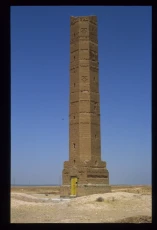
The minaret of Balis Mosque, rebuilt near Maskana

Krak des Chevaliers, the loggia

A courtyard of a domed house in the village of Shaykh Hilal
One of the village houses used to welcome tourists. In the middle of the courtyard there is a water fountain, also built with mud. The two domes in the picture are coated with lime to beautify and protect them.

Simeonskloster - Simeonsberg

Busra - Birkat (Becken) al-Hajj und Jamiʿ (Moschee) Abu al-Fidaʾ

Remains of some columns, the Great Colonnade

Waqf Ibshir Pasha, Innenraum des Kaffehauses
Das Kaffehaus besitzt einen rechteckigen Grundriss. Das quadratische Zentrum wird von einer Kuppel überspannt, die von vier Pfeilern und vier Säulen mit achteckigem Schaft und Muqarnaskapitellen getragen wird. Muqarnas-Pendentifs leiten vom quadratischen Mittelraum zum rund der Kuppel über. Die Kuppel selbst wird von einer Laterne bekrönt. Der zentrale Raum ist von Pfeilern umgeben. Der durchfensterte Eingangsbereich ist einschiffig, während die drei anderen Seiten zweischiffig gestaltet sind. Die Schiffe werden von Gewölben überdeckt.

Bayt Wakil (Aleppo-Zimmer), bemaltes Holzpaneel mit Maria und dem Jesuskind
Eine der berühmtesten christlichen Darstellungen im Empfangsraum des Wakil-Hauses ist ein Bild der Jungfrau Maria mit ihrem Kind, umgeben von Blatt- und Blütenornamenten.

Eine Beduinenfrau webt mit einem horizontalen Webstuhl

Bayt Dallal, decorated stone of the well

Raqqa-Ost, Westpalast, Grabungsfund

Al-Madrasa as-Sultaniyya, Außenansicht der Nordfassade - Eingang, Minarett und Garten

Khan Qurdbak, main entrance

Bewaldung im syrischen Küstengebirge kurz

Bel-Tempel, Peristyl-Balken mit Darstellung der Mondgottheit Aglibol
[ Description by author: Detail aus Bild 0637: Aglibol an seinem Altar, hinter ihm ein Adler mit einem Palmzweig. ]

Archäologische Funde (Münzen) aus Raqqa, ausgestellt im Damaszener National Museum

Bab Antakiya, main gate

Graves carved into the rocks, ʿAyn as-Sahib
[ Description by author (German): Links oben wohl entweder ein Felssaal ähnlich dem in ('Ain) Manîn (s. Bild 0397 und 0402) oder ein Grab mit zerstörter Fassade. In der Bildmitte ganz unten ein recht verwittertes Grab des Ädikula-Typs ähnlich dem von Bild 0411 - 0413. ]

The water of Khabur is near Raʾs al-ʿAyn strongly sulphurous

Wakil house, dome of the reception hall from the inside
The room drew light through a series of windows surrounding the dome's neck, as well as from the colored openings in the dome, which are shaped like circles and stars.

Palmyra / Tadmur, Museum, lion of goddess Al-Lat
[Original: Museum: Löwe als Beschützer einer Gazelle aus dem Heiligtum der Allat, ca. 50 v. Chr.]
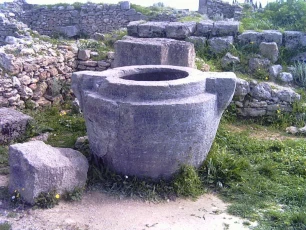
Big stone trough, Ugarit
shap_import_74031

Blick von Qalat al-Mudhiq auf die Unterstadt und den osmanischen Khan in der Orontes-Ebene

Raqqa, Grundriss der abbasidischen Großen Moschee

Hammam Yalbugha an-Nasiri, plan

Überreste der Pendentifs der Kuppel der Kirche in Qasr Ibn Wardan
[Original: Kirche (Kuppelbasilika mit Emporen)]

Qatna, Stadtareal innerhalb der Umfassungsmauer, Ausgrabung
. [Original: Al-Mishrifa / Qatnâ']

Khan Qurdbak, portico, section north-south
Size of plan 70 x 35. with ruler (no scale).

Maize field adjacent to the houses of Mishrifa village on top of the city wall of Qatna

Damascus, Glass Blowing Workshop near Bab Sharqi
[Original: LEAD Technologies Inc. V1.01]

As-Sabuniyya-Moschee, Fassade und Eingang mit Ablaq-Mauerwerk und Muqarnas-Kuppel

Khan Qurdbak, main entrance

al-Husn Church, Remains of the basilica after its demolition and turning the site into an agricultural field

Palmyra, Blick auf das Tetrapylon
[ Description by author: Gesehen von ~ Süden aus dem Gelände zwischen Agora und Tetrapylon. ]

Ebla (Tall Mardikh), Ostseite des Damaskus-Tores
~ Ostseite, äußerer Abschnitt, gesehen von der Westseite nach ~ Süden. [Original:Tall Mardîkh (Ebla)']

Husn Sulayman, Tempel des Zeus Baetocaece, Innenseite des Osttores in den Temenos
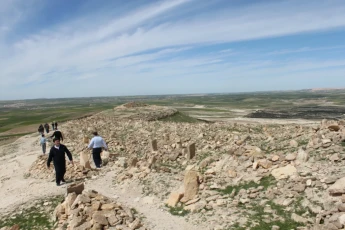
A view from Jabal ʿAruda toward the plain of Manbij

Palmyra, Diokletianslager, Tempel der Allat
[ Description by author: Rückseite, gesehen von ~ Westen. In Bildmitte hinten das Temenos-Tor, ganz hinten rechts der Bel-Tempel. ]

Eine Frau zeigt, wie man Wolle kämmt. Sie trägt ein seidenes Habari (Kopftuch)

Madrasat al-Firdaws, courtyard and arcades

The northern wall of the Damascus Citadel

Al-Madrasa az-Zahiriyya, courtyard - lobed angle fountain
shap_import_66077

Große Moschee, Minarett
Das Minarett der Großen Moschee wurde vom Qadi (Richter) von Aleppo während der Herrschaft der Seldschuken-Dynastie in Syrien in Auftrag gegeben. Der Baubeginn ist auf einer Inschrift an der Basis angegeben; das Fertigstellungsdatum befindet sich oben: 483 und 489 AH[11] / 1090 und 1096 AD. Sie bestand bis 2013. Das Minarett hat eine quadratische Form, sein Schaft ist ca. 45 m hoch und besteht aus Kalkstein. An seinem oberen Rand befindet sich ein Gesims, das aus zwei Reihen flacher, gewölbter Nischen besteht, die mit Blumenelementen verziert sind. Hinzu kommen eine offene Holzgalerie für den Muezzin (Gebetsrufer) und ein kurzer Turm mit Kappe. Zwischen der Basis und der Spitze ist das Minarett in vier Zonen unterschiedlicher Höhe unterteilt. Diese sind, mit Ausnahme des zweiten, mit Blindgewölben verziert, die aus profilierten Formteilen gebildet sind, die jeweils ununterbrochen um den Schaft des Minaretts verlaufen. Jede Zone ist durch Friese mit kalligraphischen, künstlerisch geschriebenen, arabischen Inschriften getrennt. Diese exquisit ausgearbeiteten Inschriften sind in floriertem Kufi - einem Schriftstil, der sich durch floral verzierte Buchstaben auszeichnet - und in der Naskhi-Schrift geschrieben. An der Basis des Minaretts befindet sich in einer Kartusche der Name des Architekten Hasan ibn Mufrih al-Sarmani. Die Inschrift auf der Basis des Minaretts zeigt, dass der örtliche Aleppiner Richter und der seldschukische Gouverneur die Macht in der Stadt teilten, da ihre Namen gemeinsam erwähnt werden: "Die Moscheen Gottes dürfen nur von denen erhalten werden, die an Gott und den Jüngsten Tag glauben, das Gebet verrichten und Zakat geben; Quran 9:18]. Der Bau wurde begonnen, vom Hohen Richter Ibn al-Khashshab Mohammed ibn Mohammed al-Khashshab begonnen, möge Gott ihm gnädig sein. In den Tagen von al-Amin al-ʿAjal al-Muzaffar Qasim al-Dawla wa-Nasir al-Mila Abi Saʿid Aqsunqur Bak, der Sklave des Kommandanten der Gläubigen, möge Gott seine Anhänger stärken". Die oberen Inschriften zeigen die Namen der damals herrschenden Seldschuken-Sultane Malikschah I. und Tutusch sowie von Barakat ibn Faris, Kommandant der städtischen Miliz.

Busra, cathedral. The remains of the 6th century basilica of the martyrs Sergios, Bacchos and Leontius
Sie wurde 512/13 den Märtyrern Sergios, Bacchus und Liontius geweiht. Hier gesehen von ~ Südwesten: Blick über den Zentral"raum" mit dem Tetrakonchos (vgl. Grundriss Bild 3781 !) auf die Ostwand mit Altarraum und Nebenräumen.

Große Moschee von Hama, Innenhof

Der Krak die Chevalier im Abendlicht

Bayt Dallal, decorated stone at the iwan stair
[Original: Steingitter d. Kellerfensters v.d. Liwan]

Afamyia, Säulenreste
shap_import_44109

Raqqa - finds discovered in the site "East of Raqqa", the Eastern Complex, clay decorations

Römisches Felsgrab hinter dem Kloster Unserer Lieben Frau von Saydnaya

Säulenstraße (Decumanus)
[ Description by author: Zum Standort s. Bild 0588 ! Zentralabschnitt: links, verdeckt, der Monumental-Bogen, rechts der Tetrapylon. Dahinter in der Mitte zwei Grabtürme, ganz hinten, an der Efqa-Quelle, das Hotel Palmyra Cham Palace. ['[Tetrapylon Hotel],'] ]

Krak des Chevaliers, Blick in den Hof

Al-Madrasa as-Sulaymaniyya (minor Takiyya), courtyard with fountain, arch arcades and mosque
[ Description by author: mit ähnlicher Grundstruktur, errichtet um 1570 unmittelbar östlich an der Takiya. Blick von ~ Norden über den Innenhof mit Becken auf die Moschee. Die Anlage dient heute für Werkstätten des klassischen Kunsthandwerks: man kauft hier teils Besseres und auf alle Fälle presigünstiger als im Sûq al-Hamadiya. ]

Suq az-Zarb, view towards west of the suq after the destruction

('Ain) Manîn, rechter Teil des Eingangs zu einem Heiligtum
[ Description by author: Der Zugang: rechter Teil eines Tores zum heiligen Bezirk.- Wenn hier und bei den folgenden Bilder "Römisch" angegeben ist, soll damit nur gesagt werden, dass die Anlage in heutiger Form zu dieser Zeit entstand und die Formensprache der "Reichskunst" benutzt wird. (The date of this photo was not sure as Peter Heiske did [(wohl) 08/05/1999)] ]

ʿAbd al-Qadir al-Jazaʿiri cenotaph, beside the Mausoleum of Shaykh Muhyi ad-Din Ibn ʿArabi
[ Description by author: Der Kenotaph für 'Abd al-Qâdir al-Jazâ'iri. ]

Damascus, an Arabic inscription on the gateway top of Khan Asʿad Basha al-ʿAzm

Bimaristan an-Nuri, view of the small Iwan

Palmyra, Qalʿat Ibn Maʿn, Fernsicht

Palmyra, View from hilltop towards the Valley of the tombs and the palm groves

Raqqa - excavations of the site "East of Raqqa" - Eastern Palace
Raqqa VII; Eastern East Palace

Jamiʿ Aslan Dada, marmorne Ecksäule der Gebetsnische mit korinthischem Kapitell

Hiraqla victory monument: reliefed fragments
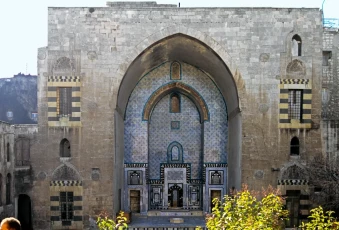
Bayt Junblat, southern iwan (the great iwan)
[Original:'Qasr Jumblât, Halab / Aleppo. Der Süd(?)flügel mit dem großen Iwân, gesehen von ~ Norden, wohl aus dem Iwân des Nordflügels. Das Gebäude stammt aus der 2. Hälfte des 16. Jhs.. Vgl. Bild 1302 - 1306 !].

General view of the hillside houses of Maʿlula town
[Original: Maalulla, Ländliche Siedlung]

Details of tent-construction, fastening of the side ropes of the Bedouin tent

Bauliche Überreste auf dem Friedhof bei der Burg Najm (Qalʿat Najm)

Sirjilla, two-storeyed andron
[Original: Andron mit doppelgeschossiger Vorhalle, von Konsolenkapitellen getragen, 6. Jh.]

Two-storey villa, Sirjilla

Blick auf den Khabur mit kleiner Noria (Wasserschöpfrad)

General view of ʿAyn as-Sahib
[ Description by author: Auf dem linken Hang. Zu dem links oben und in der Mitte s. Bild 0408 ! Ob sich unter dem Felsüberhang weiter nach unten und rechts auch ein Grab befindet ? Die Felswand gleich über den Bäumen links wirkt auffallen geglättet, in Petra würde ich sagen "vorbereitet" ....... ]

View of al-Kilaniyya Norias
Tele-Ausschnitt aus Bild 1007. (original date 03/03/2001 (?)) .['Original: Hamâ (Epiphania),']

Sarkophagrelief eines Kamelführers
[ Description by author: Kamel und sein Führer. Die Darstellung befindet sich vermutlich unter einer Kline.- Ob dieses Bild ebenfalls zum Sarkophag Bild 0873 - 0877 gehört, kann ich nicht mehr sagen. ['26/03/2002 (?)'] ]

Shops for buying traditional utensils in Raqqa

Hammam Bahram Basha, Waschplätze im inneren Bereich (juwwani)

Busra - Jamiʿ (Moschee) al-Mabrak, Innenhof

Al-Madrasa al-Ahmadiyya, prayer niche

Funerary sculpture of a Palmyrene couple
[Original: Museum: Grabrelief für ein Ehepaar]

Schwefelhaltige Karstquelle des Khabur bei Raʾs al-ʿAyn

Jamiʿ al-Utrush, general view of western facade and minaret

Jamiʿ al-ʿAdiliyya, prayer hall's entrance - muqarnas details

Entrance towers on the west side, Harim Castle

Jabal al-ʿArab, Photo of Bedouins in the 1930s
Note: these photos were taken between the year 1924 - 1939. The chosen date is to be average. (photographer unkown)

Busra - al-Jami‘ (mosque) al-ʿUmari - Islamic inscriptions

A photo of archaeological remains belonging to the castle of Shayzar

View of al-Marqab castle
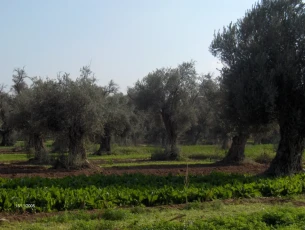
An olive and vegetable grove in the Ghouta of Damascus

Remains of the western basilica, Burj Haydar
[Original: Westliche Basilika, Säulenarkaden mit dorischen Kapitellen, 4. Jh.]

Bayt Ghazala, Iwan

Jamiʿ Aslan Dada, facade and entrance of the additional prayer hall (al-Hijaziyya)

Al-Madrasa as-Sultaniyya, marble prayer niche
The mihrab is another fine example of marble marquetry, with recessed panels bordered by a relief molding in the central half-cylinder, horizontal coursing in the niche head, and a well developed interlace occupying the spandrels. Columns, capitals, and bases are again contemporary. (Allen, Terry. "Madrasah al-Sultaniyah". In Ayyubid Architecture. Occidental, CA: Solipsist Press, 2003. http://www.sonic.net/~tallen/palmtree/ayyarch/ch8.htm#alep.msul)
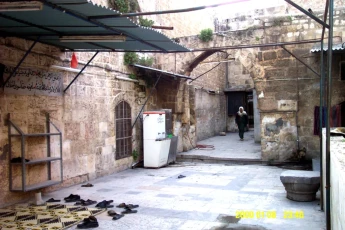
Al-Madrasa al-Muqaddamiyya, courtyard

Stuckpaneele an den Wänden eines abbasidischen Gebäudes in Kharab Sayyar

North-East Syria, Kurdish wedding celebration
[Original: Musikanten bei kurdischer Hochzeit]

Bayt Junblat, Süd-Iwan - Marmordekoration

Jamiʿ ar-Rumi, Innenhof mit West-Arkade
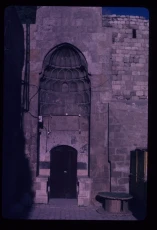
Al-Madrasa al-Kamiliyya, portal gate

Busra, remains of the Byzantine Cathedral

Qasr al-ʿAzm, Empfangshalle

The historic alley leading to al-ʿAzm Palace
[Original: Azem-Palast, von Asad-al-Azem 1740 begonnen, unter seinem Neffen Nasuh Pascha al-Azam Ende des 18. Jahrhunderts erweitert]

General view over al-Ghab Plain
[Original: Ostabfall des Ansariyengebirges u. Ghab-Niederung]

Burj al-Ghanam, general view of the tower's west-south corner
shap_import_63417

Bayt Junblat, Süd-Iwan, Schnitt Ost-West
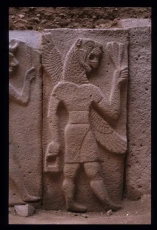
Citadel of Aleppo, Temple of the Storm God Hadad - Detail on platform wall
[Original: Grabung Kohlmeyer]
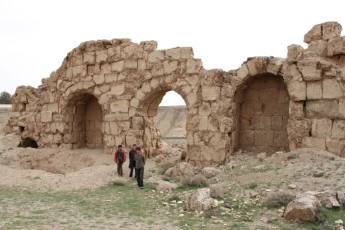
Remains of arches in Halabiyya-Zalabiyya

Eingang in die Burg von Harim

Qarqbiza, Langohrziegen in einer der byzantinischen Ruinen

The cella of Bel Temple, 1st c. AD

Decorated wooden panels of the Aleppo Room, Museum for Islamic Art, Berlin (1601-1603).

Khan Qurdbak, southern part of the khan - iwan of the Mamluk palace

Qanawat, Maʿbad Zeus, Westfassade des Serail-Komplexes

Bayt Dallal, ornamentiertes Steingitter an der Iwan-Stufe
[Original: Steingitter d. Kellerfensters v.d. Liwan]

Habuba Kabira, im Hof liegen Lehmziegel zum Trocknen aus

Bayt Junblat, Süd-Iwan - Bayt Junblat, Süd-Iwan, Wanddekoration mit Marmorplatten und Fayencefliesen
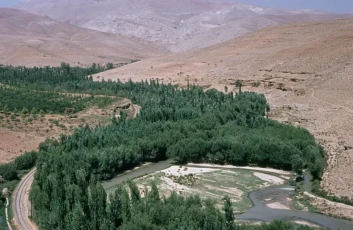
A view of the Barada valley showing the train rail

Qasr al-Hayr al-Sharqi, Baudekoration über dem Tor
[Original: Turm links]

Raqqa, Qasr al-Banat, Lehmziegelornamente

Relief showing an angel among fruits and pine cones, Temple of Baal
[ Description by author: Relief. In der Mitte ein geflügelter Genius, der mich irgendwie an die assyrischen erinnert. Links von ihm u.a. Pinienzapfen, ein Symbol der Fruchtbarkeit Die Früchte (?) rechts scheinen mir Granatäpfel zu sein, dagegen sprechen aber die Einkerbungen. Die Anordnung gemahnt irgendwie an die "Brüste" der Artemis von Ephesus ....... ]

Madrasat al-Firdaws, Innenhof mit östlicher Hofarkade

Qanawat, Blick auf das Nymphäum

Maintenance work in the course of the Barada River, Damascus

Raqqa-Ost, Ostpalast
Eastern East Palace, reconstruction

Shaykh Shibli shrine - al-Tar mountain, south -east of al-Mayadeen

Reverse side of the ceiling of Bayt Ḫazīna-Kātibī / Niẓām with ‘Ajami decoration
View from above on the construction of the šīša-ceiling

Old Damasccus, an artisan engraves on copper vessel

Turm der Burg (Qal'at) Yahmur

Bimaristan Arghun, view of the main courtyard and the portico

Jamiʿ al-Qayqan, main entrance

Waterwheels of Kilaniyya
Note: these photos were taken between the year 1924 - 1939. The chosen date is to be average. (photographer unkown)

Remains of the Byzantine church at Qarqbiza
[Original: einschiffige Kirche, Südseite]

Tal des großen nördlichen Flusses (Nahr al-Kabir al-Shamali)

Burj as-Saʿa, the entrance

Eine Bogenbrücke führt zur Burg Shayzar

shap_import_61326
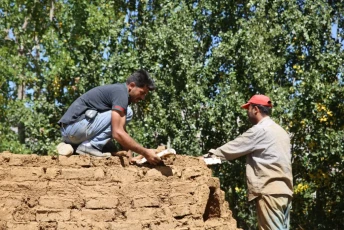
Ein Kuppelhaus in Taanayel: Der Bau der Kuppel
Ein Blick auf zwei Arbeiter, die flache Trittsteine zwischen die Ziegel einfügen. Diese erleichtern das Verputzen der Kuppel.

Bewässerungsfluren von ʿAyn at-Tina im Qalamun (Gebirgsregion in Südwestsyrien)
[Das Dorf selbst liegt im Mittelgrund über dem Niveau der bewässerten Feldterrassen: Im Hintergrund die Eozänkalk-Schichtstufe des Jebel Maaloula mit bis zu 1913 m ü. M.]

Wooden old door, Madinat Dimashq al-Qadima

Volcanic stones and behind it the Khubra lake, Jabal Says

Tomb of Jambliku in the Valley of the Tombs, 83 AD
[ Description by author: Fassade, gesehen von ~ Nordwesten. Das Grab stammt aus dem Jahre 83 n. Chr. ]

Arwad, Ayyubid fort, courtyard
[Original: al-Burj al-Ayyubi]

Blick über die Altstadt von Aleppo mit Großer Freitagsmoschee Jamiʿ Halab al-Kabir

Bayt Dallal, general view of the courtyard

Al-Madrasa al-Hallawiyya, wooden prayer niche in the iwan
shap_import_62569

Al-Madrasa al-Kamiliyya, Inneres der Gebetshalle

Jabla, Sultan-Ibrahim-Moschee, Eingangsportal

al-Lajat region, ancient cistern for storing water

Al-Madrasa as-Salimiyya, Innenhof mit Brunnenbecken und Arkaden
[ Description by author: Blick über den Innenhof mit dem Wasserbecken von der Moschee nach ~ Nordosten. Vgl. Bild 0128 und 0129 ! ]

Propylon des Jupiter-Tempels mit korinthischen Säulenkapitellen und Durchblick auf das Qaytbay-Minarett der Umayyaden-Moschee

The main facade of the Mosque of Sultan Ibrahim, Jabla

Turbat Khaʾirbak (mausoleum), section of southern iwan, courtyard and two chambers
size of plan 22 x 15 . scale 1:100 .

Qalb Lawza, Basilica of 5th c., South facade, decoration detail of the central doorway

Jamiʿ ad-Darwishiyya, Fenster mit Rahmenbordüre und Lünette
[ Description by author: mit Bordüre. ]

Jamiʿ Aslan Dada, hall dome - squinch and muqarnas

ʿAyn al-ʿArus, Blick in die Decke eines Lehmziegelhauses armenischer Besitzer

Agora-Annex, Blick von Nordosten auf die Südwest-Mauer
[ Description by author: der Agora, Blick von ~ Nordosten. Durch das Tor ganz rechts (es ist das selbe wie Bild 0704 links) sieht man in die Agora. Dieser Annex ist der eigentliche Handelsplatz von Palmyra und war wegen der Kamele auch nicht gepflastert. Hier wurde auch der berühmte (Zoll)Tarif vom April 137 n. Chr. gefunden. S. auch Bild 0707 ! ]

Afamiya, Säulen mit korinthischen Kapitellen auf der Kolonnadenstraße

Blick auf den Orontes in der Nähe von Darkush

Ein traditionell hergestellter Webteppich

Haupteingang in den Palast (Qasr) Ibn Wardan
mit reicher Verzierung und Inschrift, gesehen von ~ Süden. Noch steckt es etwa zur Hälfte im Sand .......

Muzayrib, Mahlstein in einer alten Mühle

Damaskus, Glasbläserei nahe Bab Sharqi
[Original: LEAD Technologies Inc. V1.01]

Blick auf den Ostpalast von ar-Raqqa

Jamiʿ (Moschee) al-Hanabila , Innenhof und Reinigungsbrunnen

Qasr Asʿad Basha al-ʿAzm, Innenhof nach Nordwesten

Details of Qashani tiles: floral and geometric designs, Mausoleum of Salah ad-Din al-Ayyubi
[ Description by author: Dekor der Eck-Pilaster, vgl. Bild 0228 ! (The year of the photo is not sure according to Peter Heiske ) ]

Habuba Kabira, Interior of the last existing deepened house (debabe), which was later used only as storage space

Qasr al-Hayr al-Sharqi, der obere Abschluß von einem der beiden Türme, die das Eingangstor flankieren
[Original: Turm links]

Agriculture on a mountain slope in Jabal al-ʿArab

Nahiyat Tall Tamir, Woman builds a silo for her supplies during the winter
The Assyrian villages on the Khabur with their domed houses were built by the French Mandate Government for Christian refugees from Turkey and Iraq.

A side of Palmyra Theater, 2nd c. AD

Alltägliche Straßenszene in ar-Raqqa

Burg (Qalʿat) Salah al-Din, Burgmauern auf dem gewachsenen Felsen aufsetzend

At-Takiyya al-Mawlawiyya, Westfassade, al-Midan

Archaeological objects, ar-Raqqa Museum

Maronite Cathedral, general view from the outside

Haus Junblat, Blick auf den Iwan, mit Marmor und Fliesen dekoriert
[Original:'Qasr Jumblât, Halab / Aleppo. Der große Iwân des Südflügels, gesehen aus dem Iwân des Nordflügels. Vgl. Bild 1303 - 1305 !].

Al-Madrasa as-Sultaniyya, entrance - stone carved Arabic inscriptions
The entrance contains inscriptions on three bays.

House in Bahsita, , bevelled wall corner with a Muqarnas console

Die Nordmauer der Zitadelle von Damaskus

Raqqa - "East of Raqqa" site - Western Palace - excavations
[ 87/ 59/ 1772] =[ photo's name as: year/ film no./ photo no,]. On the back of the photo: [87/59].. (Naming the area of the photo was done according to the list, although some they are similar but were done in different areas.)

Arch of Triumph (Qaws Hadrian) from the inside
[ Description by author: Blick zurück aus dem 2. Abschnitt der Säulenstraße nach ~ Südosten. Im Hintergrund der Bel-Tempel. ]

Raqqa-Ost, ausgegrabene Wandverkleidungen aus Stuck

Bayt Junblat, section drawing of the northern iwan
Small iwan in the north of the courtyard. Size of plan 50 x 20, with ruler (no scale).

Tall al-Biʿa, Gesamtansicht

Bogennische in der Burg al-Kahf, ash-Shaykh Badr, Tartus Region

Aleppo Great Mosque, Courtyard, 2018
Sorting stones especially the minaret rubble

Jamrin - The ancient bridge over Wadi az-Zaydi

Khan al-Jumruk, Innenhofansicht

Gesamtansicht des Tall Afis

Qalʿat ash-Shugr wa-Bakas, Ausblick

Arkaden, die einst zum Eingang des Jupiter-Tempels gehörten

Pavillion, Qasr al-Hayr al-Sharqi

Gesamtansicht der Burg (Qalʿat) Shumaymis
Teleausschnitt aus Bild 1038, gesehen entweder von dem dortigen Standort oder von dem hier angezeigten aus ~ Südosten. . [Original: Qal'at ash-Shamîmîs']

Qanawat, Rural house

Säulenstraße - Abschnitt B: südöstlicher Durchgang
[ Description by author: zur Rundstraße um das Theater im 2. Abschnitt der Säulenstraße, gesehen von ~ Norden. Der vordere Bogen ist der linke (> Tetrapylon) der Kolonnade, der hintere enspricht der Linie der Häuserfronten.. ]

Bel-Tempel, Cella - Süd-Thalamos, Monolith-Decke
[ Description by author: Cella, Süd-Thalamos: Decke. Sie besteht aus einem einzigen Monolithen. ]

Obstbäume und Mais in der Ghouta von Damaskus

Entrance of al-Imam Ismaʿil Mosque, as-Salamiyya
zum Gebetssaal - s. die Schuhe ! Er erinnert an mittelalterliche Kirchen - für eine gotische fehlt nur ein richtiger Tympanon ... Es ist mir aber nicht bekannt, dass die Moschee auf der Stelle einer Kirche errichtet worden wäre. Dennoch scheinen mit die "Kapitelle" rechts und links nicht islamische Kunst zu sein, der Türsturz, bei dem man gleich an eine Spolie denkt, trägt eine arabische Inschrift - er könnte aber gedreht worden sein .......- Da ich nicht mehr weiß, ob dieser Eingang sich auf der West-, Süd- oder Ostseite der Moschee befindet, habe ich keinen GPS-Tag gesetzt. Es gibt noch ein weiteres Problem: ich könnte mich irren, und dieses und das nächste Bild sind nicht von der Jâmi' al-Kabîr, sondern von der Masjid al-Imâm Ismâ'îl ! Dann wäre der Eingang im Norden oder Süden. [Original: 'Salamiya (Salamias)']

Befestigung eines horizontalen Webstuhl im Boden

Sarkophage im Hypogäum der drei Brüder
[ Description by author: Die Sarkophage, als Triclinium angeordnet. ]
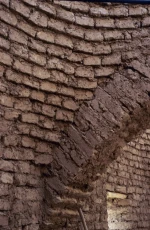
Habuba Kabira, Mud brick construction - connection of wall, belt arch and dome rounding

Busra, Jamiʿ (Moschee) al-Mabrak von außen

Raising camels in the western part of Badiyat ash-Sham

Al-Madrasa al-Kamiliyya, Detailansicht der Gebetsnische (Mihrab) in der Gebetshalle

Fresco on the apse, Roman Orthodox St. Elian Church, Homs
[ Description by author: Rechte Seitenwand: oben in den Medaiilons zwei Evangelisten, darunter Apostel. ]

Hanfhocken in der Ghouta von Damaskus in den 1970er Jahren

Khan al-Wazir, main entrance
On the photo was mentioned: date of creation between 1985-86

Minaret of al-Aqsab Mosque, Damascus
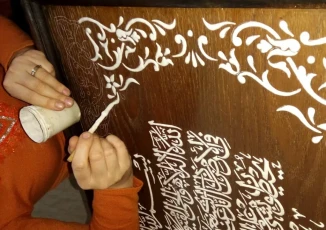
Aliya Alnuami is applying the relief paste on her ‘Ajami-work

Izraʿ, al-Jamiʿ (Mosque) al-ʿUmari - the courtyard

Capital in the Byzantine Cathedral, Qalʿat Burqush
[ Description by author: Ein anderer Typ der byzantinischen Kapitelle. Im Hintergrund Trommeln von Halbsäulen. ]

Bayt al-Haj Musa (Katasternummer VII 2060 und 2056)/ verkleinerter Grundriß

View of Qaws Hadrian (Arch of Triumph) and the Great Colonnade
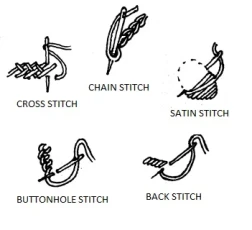
Examples of embroidery stitches
Drawings by Estibaliz Sienra Iracheta to illustrate processes of traditional textile manufacturing

Tall Shaykh Hamad (Dur Katlimmu) - Excavations
[Original:'TALL SAIH HAMAD']

Busra - Madrasat Abu al-Fidaʾ, prayer hall

al-Hayr al-Sharqi Palace, Inside of the early Umayyad desert castle with remains of vaulted rooms of the Western comlplex

Conservation of the Aleppo Room in the Museum for Islamic Art, Berlin (before)

Die Ruine der byzantinischen Kirche, die zur Anlage des Palastes von Qasr Ibn Wardan gehört
[Original: Kirche (Kuppelbasilika mit Emporen), Südseite (873-876)]

Monastry St. Sergius on the edge of the mountain plain overlooking Maʿlula

Blick aus der Ferne auf das Kloster Notre-Dame de Saydnaya

Jamiʿ al-ʿAdiliyya, prayer hall's entrance

Hand printed table cloth from Hama at Hassan's Shop, Old Damascus

Aleppo, view at street life in Quwwatli street in 1963

Khan as-Sabun, Bogenzwickel-Dekor des Tors in der nördlichen Hoffassade

Nahiyat Tall Tamir, Fladenbrote backen an der Tannurwandung (Tannur im Boden eingetieft)
Die assyrischen Dörfer am Khabur mit ihren Kuppelhäusern baute die französische Mandatsregierung für christliche Flüchtlinge aus der Türkei und dem Irak.

View into the courtyard of the Great Mosque of Hama

Busra, Hammam Manjak, Wasserleitungen

Raqqa, Qasr (Palace) al-Banat, an octagonal basin in the centre of the courtyard

Hama, general view of the "Four Norias", the two Bischriyyat and two Uthmaniyyat
View from southwest the Orontes/ al-ʿAsi up to the four water wheels. On the right side the terrace of an restaurant

Az-Zawiya al-Hilaliyya, wooden cells inside the prayer hall's iwan

Raqqa, Qasr al-Banat
[original: Raqqa, Qasr al-Banat']. [83/156/1772] =[ photo's name as: year/ film no./ photo no,]. on the back of the photos: [1983/156]

Madrasat al-Firdaws, Arkadenhof nach Südwesten
Courtyard, Fountain

Jisr ash-Shughur, Qalʿat ash-Shugr wa-Bakas, Kreuzritterburg, Arabische Inschrift

Al-Matbakh al-ʿAjami: Qaʿa, section north-south, view to west
Qaʿa of Matbakh al-ʿAjami, size of plan 55 x 45, with ruler (no scale).

Busra - Birkat (pool) al-Hajj and Jamiʿ (mosque) Abu al-Fidaʾ

Felder in der Gegend von ʿAfrin

Maronite Cathedral, the sanctuary

Great Mosque, prayer hall, minbar and mihrab
The unique wooden minbar, or pulpit, belongs to the Mamluk era as indicated by the inscribed name of the Sultan al-Nasir Muhammad, son of Qalawun (d. 741 AH / 1341 AD). The carpenter’s name is Muhammad ibn ʿAli al-Mawsili.

Eine kurdische Frau, die mit einer hängenden Spindel spinnt. Sie trägt ein traditionelles Übergewand

Al-Matbakh al-ʿAjami, facade of the east section of the great hall

Shaykh Shibli Schrein, Berg al-Tar, Süd-Ost al-Mayadeen, Innenansicht der zerstörten Kuppel

A view of a hill around ٍShahba

Jamiʿ al-Khayr, Haupteingang - dekorative Details

Archäologische Funde aus Raqqa, ausgestellt im Damaszener National Museum

Stone sarcophagi in the pyramidal mausoleum A, al-Bara

Mausoleum (Türbe) von Ibn Salama ar-Raqqi mit seiner auf zwei Tambouren sitzenden Kuppel

Bayt Wakil, iwan

Einfaches Muqarnas-Element in der Burg von Harim

Raqqa-Ost, Tall Aswad, Töpferei
Raqqa IV; Tall Aswad; Pottery garden probl. near excavation house in Tall Bi'a

Khan al-Hibal, the northern facade from inside

View to the east. The northern riwaq to the left, and the northern facade to the right. The burned eastern part is in the background. The space is 07 in general, according to the ground plan. Here in general F, Ft. Wc. Wd, and Wa. are seen.

Near Safira, upper opening in a dome , used to fill in straw or chaff

Al-Madrasa al-Ahmadiyya, Reinigungsbrunnen

Northeast Tower, Khan al-Hallabat
[ Description by author: (der rechte von Bild 0944) und Eingang, gesehen von Südosten. ]

A side of Qalʿat Ibn Maʿn

Blick nach Norden am Ufer des Assad-Stausees mit Pumpen, rechts: Tall Mumbaqa
Bewässerungspumpen am Stausee-Ufer

Burg (Qalʿat) al-Marqab, Deckenfresko in der Sakristei

Jamiʿ Aslan Dada, interior view of the prayer hall (qibliyya)

Ansicht einer Seite der Burg von Masyaf

Zitadelle von Aleppo - Tempel des Wettergottes Hadad, Orthostatenwand (Ausschnitt)
[Original: Grabung Kohlmeyer]

Busra, Hammam Manjak, Raum

Bayt Ghazala, ʿajami panels decorating the southern wing ceiling in the main reception hall (qaʿa)
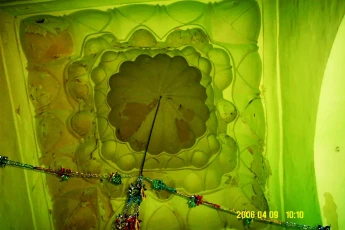
Al-Madrasa ash-Sharafiyya, interior view of lobed dome carried by muqarnas

Blick aus der Ferne auf die Burg (Qal'at) al-Qadmus

Am Westufer des Jabbul-Salzsees, Kuppelhäuser mit Belüftungsöffnungen am Wohnraum

Jamiʿ at-Tawashi, Ostfassade - vertikale Fensternische mit Muqarnas-Dekor
[Original:'Jâmi' at-Tawâshi, Halab / Aleppo. Erbaut 1348. Hier ein Fenster - wie es scheint, auf Straßenniveau. Vgl. Bild 1285, 1286 ! - Zum GPS-Tag: allgemein auf das Gebäude gesetzt, da ich nicht angeben kann, auf welcher Seite der Standort war.'].

A traditional house in Jabʿadin

Jabla, Mosque of Sultan Ibrahim, The courtyard with vaulted arcades

Jisr ash-Shughur, Qalʿat ash-Shugr wa-Bakas, Kreuzritterburgen, Höhlen

Bimaristan an-Nuri, Türzieher an der Holztür des Haupteingangs
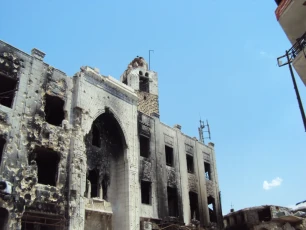
Damage of the outside westrn facade and the minaret. Here in general the west facade of space 02 and the minaret 03 are seen..

Busra, part of the citadel wall

A view from a high peak of the Anti-Lebanon Mountains
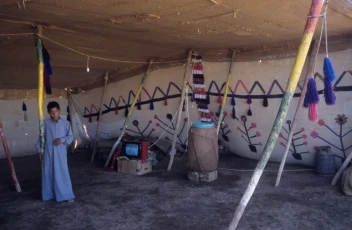
In the living compartment of the tent, which is embroidered in patchwork technique (the same tent is on photo #2850 and #2853.)

Khan al-Wazir, main entrance
[Original:'Khân al-Wazîr, Halab / Aleppo. Er stammt aus dem Jahre 1682. Hier die Außenfassade. Vgl. Bild 1250 ! Ob sie wirklich auf der Westseite der Anlage ist, ist mir nicht (mehr) ganz klar, aber die Beschreibung im Guide Bleu "Middle East" (Eingang an einem kleinen Platz mit Moschee am Ende) macht es wahrscheinlich.'].

Monastery of St Simeon Stylites, one of the church apses

Alt-Damaskus, Bick vom Hotel Burj al-Fardous über die Zitadelle
[ Description by author: Blick vom Hotel Burj al-Farâdîs nach ~ Osten: Al-Qal'a. ]
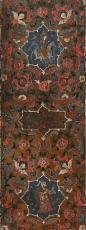
Motifs in Hatayi style, Aleppo Room wall frame, early 17th century

Making pickles

Remains of Harim Castle

Al-Madrasa as-Sultaniyya, interior view of southern facade - entrance and minaret
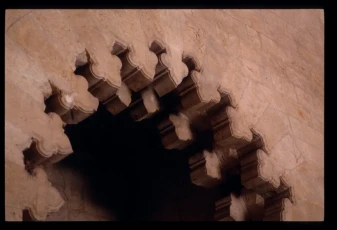
Al-Matbakh al-ʿAjami, small iwan - detail view of archway

Jamiʿ ash-Shuʿaybiyya, north Facade - a cornice with floral motifs and a Qur'anic text in Kufic script

Hiraqla victory monument - Decorative stone panel

Jisr ash-Shughur, Qalʿat ash-Shugr wa-Bakas, Kreuzritterburgen, die Ruinen der Burgen

Blick auf ein Dorf in den Bergausläufern, Oberes Euphrattal

General view of of Damascus city with the Umayyad Mosque

Waqf Ibshir Mustafa Pasha, Kaffeehaus, Halle
Die außergewöhnlich reich dekorierte Fassade der Halle des Kafeehauses sowie die erste Gewölbereihe wurden zerstört. Das Innere der Halle wurde nur teilweise beschädigt, während die Kuppel mit ihrer hohen Laterne zum Größtenteil zerstört wurde.
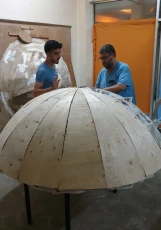
Abdelraouf Baydoun working with the craft of ‘Ajami: Preparation of a wooden dome

Mountains around Palmyra (parts of Palmyra Chains)

View from the palm groves to the south-eastern corner of Bel Temple

Archaeological finds from Raqqa, exhibited in the Damascus National Museum
Glass pig from ar-Raqqa; National Museum Damascus; Mus.Nr.16024; R.45

Part of a decorated wooden door with ‘Ajami decoration from the Damascus Room in the Dresden Museum for Ethnology
Painting on the large wall cupboard door (samandāra) of the Damascus Room in the Dresden Museum of Ethnology
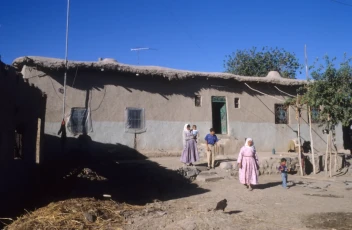
ʿAyn al-Khadra, residential house with a central hall plan of a Kurdish family in the Malkiyya-Region

View of the Orontes River with rapids

Informal (unplanned) settlements spread in the Ghouta, 1980s
Since the second half of the 20th century, more and more modern cement buildings have displaced the gardens and fields of the Ghuta - their orchards had to give way to urban expansion.

Monastery of St Simeon Stylites, Narthex of south basilica (south façade of church)

One of the entrances to Harim Castle

A central passage in the Castle of Harim

Baking of bread in tannur near to a field of maize in the outskirts of ar-Raqqa

Jamiʿ Sharaf, Mamluk rank

Al-Madrasa ash-Sharafiyya, the entrance from the interior

Shaykh Shibli shrine - al-Tar mountain, south -east of al-Mayadeen - the dome details from the inside
Near Qa'alat ar-Rahaba, Shrin Shaykh Shibliy. [Original:'Bei QAL'AT ar-RAHABA, Grabbau = SAIH SIBLI']

The window of cella, Baalshamin Temple, 2nd century AD
[ Description by author: Das Cella-Fenster von Bild 0786, gesehen von Nordosten. ]

View of the town of Halbun in the 1960s with gardens

View inside the courtyard of Manjak Mosque

Baalshamin-Tempel, 2. Jh. n. Chr., Ansicht von Nordwesten

Südlich vor Tall Abyad, Reste der Kirche aus Lehmziegeln

Raqqa-Ost, Tall Aswad, Ausgrabung im 1985
Tall Aswad, s.SW-Neg.85/735-6;738

Blick auf Halbun in den 1960er Jahren mit Gärten im Vordergrund

Muzayrib - Ancient mill

Conservation of the Grape Room made in 1835, house Nizam, Damascus

Obstbaumplantage in der Ghuta von Damaskus

Habuba Kabira, in the courtyard clay bricks are lying out to dry
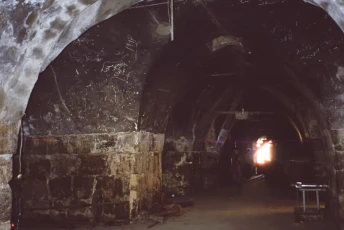
The Seljuk watermill ''Bab as-Salam watermill'' from the inside, Damascus

Jurn Kabir, Wandbord, auf dem Metallteller, -becher und Löffel präsentiert werden

Khan al-Jumruk, view of the mosque in the center of the Khan's courtyard

Khan Qurdbak, detail of a window in the iwan

'Ain as-Sâhib, Felsgräber
[ Beschreibung des Autors: Links oben wohl entweder ein Felssaal ähnlich dem in ('Ain) Manîn (s. Bild 0397 und 0402) oder ein Grab mit zerstörter Fassade. In der Bildmitte ganz unten ein recht verwittertes Grab des Ädikula-Typs ähnlich dem von Bild 0411 - 0413. ]

Engraving on copper in Suq Midhat Basha

Excavation work at Tall Afis

Husn Sulayman, Tempel des Zeus Baetocaece, Innenansicht des Nordtores

Al-Madrasa al-Hallawiyya, northern facade - marble plaque dated 1315 AH and sealed by the Sultan Abd al-Hamid Khan (Tughra)

A view from the courtyard of Khan Murad Basha (Museum of Maʿarrat an-Nuʿman)
shap_import_74303

Izraʿ, al-Jamiʿ (Mosque) al-ʿUmari - exterior view

Hama, Waterwheels of Kilaniyya, al-Tawafira and al-Jaʿbariyya

Al-Madrasa az-Zahiriyya, Fassadenansicht mit Kuppel und ihren zwei Tambouren

Luftfoto der Palmyra-Ketten

Jamrin - The ancient bridge over Wadi az-Zaydi

Ecke eines Beduinenzelts aus Ziegenhaar beim Wüstenfestival in Rusafa
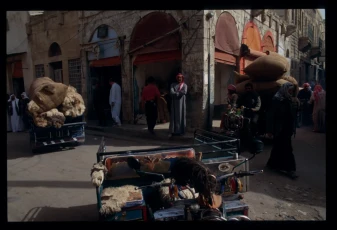
A street scene in one of the suqs of Dayr az-Zawr

Palmyra, Tal der Gräber, Blick auf eine Gruppe von Turmgräbern

East and south side of the cella of Bel Temple
[ Description by author: West- und Südseite, gesehen von ~ Südosten. Über dem Gebälk der Peristase "Assyrische Treppenzinnen" - typisch für derartige Gebäude im Nahen Osten in dieser Zeit, s. z.B. Petra ! ]

Jamiʿ al-Utrush, courtyard and eastern riwaq (portico)
Historical photograph with a view from Courtyard/ Sahn towards southeast, showing some rubble from collapsed parts of prayer hall [Original: Dscham'a el Utrusch]

Al-Madrasa al-Hallawiyya, die heutige Gebetshalle war Teil der byzantinischen Kathedrale von Aleppo
Die Beschädigung der al-Hallawiyya Gebetshalle, die eine Exedra der byzantinischen Kathedrale St. Helena (5. n. Chr.) enthält. Während des Krieges wurde das Denkmal beschädigt und geplündert.
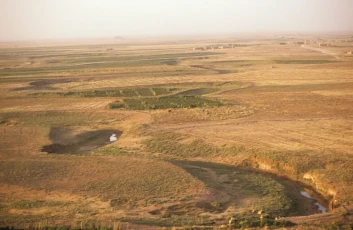
View from Tall Hamidiyya to the plain, Wadi Jaghjagh and fields, © Karin Pütt (CC-BY-NC-ND)

Burg (Qalʿat) al-Qadmus, Inschrift

Der Assad-Stausee mit Blick auf den Tabqa-Staudamm

As-Sisi alley: southern entrance with gate
View of the alley seen from the southern end, where the former gate, built in a narrow place, is clearly visible. Such gates were common until the beginning of the twentieth century in many old town streets, and were closed every evening.

Blick aus der Ferne auf die Burg (Qalʿat) Salah ad-Din
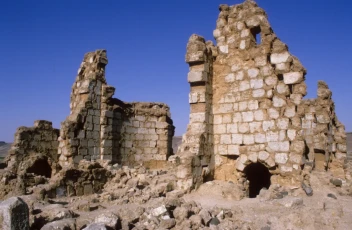
A side from the ruins of Halabiyya-Zalabiyya

At-Tabqa , Gesamtansicht der Burg Jaʿbar.

Monastery of St Simeon Stylites, the monastery complex

Tempel von ad-Dumayr (Thelsae), Inneres
[ Description by author: Blick von der Höhe der inneren ~ Ostwand nach ~ Westen. Unten die beiden "Kammern" und die Hofseite des Durchgangs, oben interessant die Verbindung des Giebels mit den beiden Ecktürmen. Vgl. Bild 0391 ! ]

Palast (Qasr) al-Hayr ash-Sharqi, Blick auf die Überreste der Bögen

Takiyyat ash-Shaykh Abu Bakr, interior view: courtyard and rooms from outside
Bahra mit Moscheefront 1917?

Bel-Tempel hinter Palmen

The entrance into the castle of al-Marqab is framed by a stepped portal

Izraʿ, Kanisat (Kirche) Mar Jirjis, Inneres
Kirche St. Georg

Dayr Zakka (monastery), mosaic in a destroyed part of the building, showing a palm, a fallow deer and birds
Raq19930002.tif

Busra, The East Gate "Nabataean Gate"
Nabatäisches Tor, Hauptstraße, am östlichen Ende der Hauptstraße, von Westen. Es soll im frühen 1. Jh. erbaut worden sein Westlich davon lag das römische, nach Osten das nabatäische Viertel der Stadt. Der Name ist weniger auf seine Erbauer, als auf die typisch nabatäischen Hörnerkapitelle der Säulen und Pilaster zurückzuführen. Vgl. Bild 3776 - 3779 !

Umayyaden-Moschee (al-Jamiʿ al-Umawi), Außenansicht des Braut(ʿArus)-Minaretts an der Nordfassade
Der untere Teil stammt aus dem 9. Jahrhundert und die obere Struktur wurde aus dem späten 12. Jahrhundert rekonstruiert.

Khan al-Wazir, interior facade of the khan's entrance

An irrigation canal on the edge of an orchard in the Ghouta of Damascus

Bab Antakiya, general view of the gate with the city's wall

Courtyard with fountain, Qasr As‘ad Basha al-'Azm
1929?

Engraving at the left of the portal of northern thalamos, cella of Bel Temple
[ Description by author: Cella, Nord-Thalamos, links vom Portal: Ädikula, darüber eine Art Obelisk (oder ein Altar ?). ]

Busra - Masjid Yaqut (mosque) - founding inscription

Khabur mit Weidenbäumen am Ufer in den 1960er Jahren

Khan al-Wazir, general view

Haus mit Lehmwulstdekoration im Dorf Qalʿat Najm, das vom Tishrin Stausee überflutet wurde
Das Haus verfügt im Innern über einen Doppelraum. Blick auf das Haus von Südosten.

Qalʿat Salah ad-Din

Bayt Ghazala, view of the bathhouse

Great Mosque of Aleppo, courtyard floor with geometrical designs

Bab Qinnasrin (city gate), inscription beside the gate from the outside
On the photo was mentioned: date of creation between 1985-86

Bimaristan Arghun, octagonal courtyard, doors to cells

Qalʿat Salah ad-Din located in the coastal mountain forests

Tall al-Mishrifa (ancient Qatna), view of the historic citywall, within which the village is located
City wall and village houses

General view of al-Qadmus Castle on a natural rocky hill

Busra, Jamiʿ (Moschee) al-Mabrak von außen

Busra, Hammam Manjak, Restaurierungsarbeiten

Maronitische Kathedrale St. Elias, Hauptfassadenansicht (West)

Jamiʿ al-Utrush, an original Mamluk column with its capital

Safita, der kreuzfahrerzeitliche Donjon mit einer Kapelle im Erdgeschoss

The upper part of the minaret of an-Nuri Mosque

Jamiʿ al-Utrush, bevelled wall corner with a Muqarnas console

A village on the foothills of the coastal mountains (al-Jibal as-Sahiliyya)

Laden im Suq al-Buzuriyya, Altstadt von Damaskus

Totentempel, ornamentierter Pfeiler mit korinthischem Kapitell
[Original: Tempelgrab Nr. 86 Weinrankenfries eines Eckpilasters]

Bayt Ghazala, courtyard - northern facade

Colossal basalt lion found in 1955 in ʿAyn Dara

Jurn Kabir, ein fahrender Händler mit Pferdekarren versorgte die Dörfer mit Gemüse und Obst

Horse harness manufacturer in the town of ar-Raqqa

Khan al-Jumruk, in the courtyard view to north showing the interior facade of the Khan's entrance

Marja-Platz mit der Telegrafensäule

Qasr al-Hayr al-Gharbi, Ruine des byzantinischen Turms bei dem umayyadischen Palastkomplex
[ Description by author: Gesehen von ~ Südwesten. ]

Afamiya, columns in the ruins
shap_import_44106

An irrigation canal in the Eastern Ghouta

Blick von der Burg von Harim in Richtung Stadt

Astrological relief panels on the ʿAyn Diwar bridge

Khan Murad Basha (Museum von Maʿarrat an-Nuʿman), Innenhof
shap_import_74305

ar-Rusafa, Kapitell der Innenfassade des Nordtors

Khan Qurdbak, Iwan des mamlukischen Palastes

Izraʿ - Kanisat (church) Mar Jirjis, exterior view

A mechanical loom in the textile factory of the Mezannar family in Damascus

The dome house in Taanayel: building the dome
A view of two workers inserting flat stepping stones between the bricks, an old technique to help plastering the dome houses.

Unweit von Tall Abyad, Rohbau des Hauses mit abgeflachten Kuppeln und Öffnung in einer Kuppel
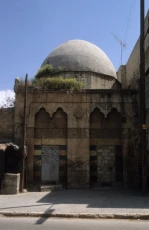
Turbat Khaʾirbak (mausoleum), western facade and dome
Chamber tomb with two chambers, Inscription from 1514

Part of a decorated wooden door with ‘Ajami decoration from the Damascus Room in the Dresden Museum for Ethnology

This view of al-Madrasa az-Zahiriyya shows the dome with two drums

Kaffeehaus Aslan Dada (nicht erhalten)
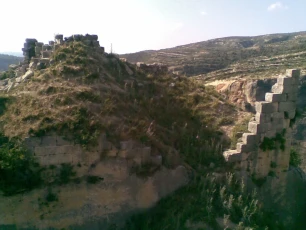
Jisr ash-Shughur, the ruins of Qalʿat ash-Shugr wa-Bakas, a twin crusader castle

Blick auf die Quelle des Barada und das Antilibanon-Gebirge

A side of archaeological remains in Khirbat as-Sarayij

Ansicht des Krak des Chevaliers in Westsyrien (Qal'at al-Husn)

50 pounds, 25 mm, 2018 (wartime)
50 Pfund, 25 mm, 2018 (Kriegszeit)

Qalb Lawza, Basilica of 5th c., Apse and south façade
[Original: Basilika, vor 469, SO-Seite]

Bouquet of flowers and fruits in bowls on the wooden panels of Bayt ad-Dahhan (Funduq Qasr al-Mansuriyya), 18th century

View from airplane to the upper reaches of the Sajur (mainly on Turkish territory, border strip of Syria visible at upper right)

Artificial irrigation, al-Ghab Plain

Dayr Zakka (monastery), floor mosaic in the sanctuary, 595 AD
Raq19920015.tif

Qasr al-ʿAzm, Qaʿa im Obergeschoss
Seitensaal des Kuppelsaales mit restaurierter Wandmalerei auf Holz.- Die Bilder 0998 - 1002 haben ein gemeinsames Problem: sie sind mit gepushten High-Speed- Filmen aufgenommen. Das Ergebnis ist beim Dia noch so gerade akzeptabel, führt bemi Scan aber zu starkem Rauschen (der Filmkörnung), zu unnatürlichen Farbverschiebungen oder, wenn man diese korrigieren will, zur Entfärbung. Ich jedenfalls kann's nicht besser .......!. ['Original: Hamâ (Epiphania),']

Cushions with a self-woven cover

Al-Madrasa ash-Sharafiyya, interior view of lobed dome carried by muqarnas

Shore zone of the Euphrates with tree vegetation of Lake Assad

Blick auf das Mar Taqla Kloster, Ma'lula, von oben
[Original: Maalulla- Thekla-Kloster]

Archäologische Funde aus Raqqa, ausgestellt im Damaszener National Museum

Raqqa, Qasr al-Banat
[original: Raqqa, Qasr al-Banat']. [83/156/1772] =[ photo's name as: year/ film no./ photo no,]. on the back of the photos: [1983/156]

General view of the monuments of Palmyra
[ Description by author: Der Hintergrund von Bild 0800. Links die Säulenstraße, 3. Abschnitt, dann der Tetrapylon, dahinter der Monumentalbogen. Rechts vom Tetrapylon das Theater, darüber die vier Säulen der Diokletiansthermen. Noch weiter rechts, nach der Kolonnade, die Agora mit ganz rechts dem Bankettsaal. Hinter all dem das Areal des Bel-Tempels, ganz im Hintergrund der Salzsee von Palmyra. ]

at-Tabqa, Jaʿbar Castle, Towers of western walls

ar-Rusafa, Basilica C, View towards the apse
[Original: k.K6/=HQ k.K5]
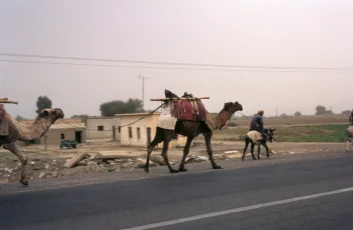
Kamele und Kamelhirte auf dem Heimweg nach dem Transport von Baumwollsäcken in den Feldern des Euphrattals

View of the Barada Valley in the 1960s

Befestigungsturm nördlich des Bab Antakiya. Inschriftlich erwähnt ist eine Restaurierung durch den mamlukischen Herrscher al-Malik al-Muʾayyad Shaykh zwischen 820/1417 und 823/1420

Aleppo, Große Moschee, Innenhof, 2018
Im Innenhof werden die Steine des zerstörten Minarets sortiert gelagert.

Al-Madrasa as-Sultaniyya, Hoffassade und Eingang der Gebetshalle

Suq al-ʿAttarin, Ansicht der zerstörten Marktgasse, Blick nach Osten

البارة، معصرة زيتون، القرن 5-6 م
كانت عملية عصر الزيتون المنتج محلياً تتم بواسطة معاصر الزيت. يُظهر المصنع المحفوظ جيداً، أقسام العمل المختلفة.

Bayt Wakil, qaʿa, front elevation of the hall's facade
Elevation drawing. No scale

Nahiyat Tall Tamir, The flattened dome roofs have just received new plastering.
The Assyrian villages on the Khabur with their domed houses were built by the French Mandate Government for Christian refugees from Turkey and Iraq.

Propylon des Jupiter-Temples und Qaytbay-Minarett der Umayyaden-Moschee
[ Description by author: der Umayaden-Moschee, gesehen durch zwei Säulen des Períbolos des ehemaligen Jupiter-Tempels. Die Bögen links sind arabisch unter Verwendung antiker Säulen und Kapitelle. Gesehen vom Ostende der Haupstraße vom Sûq nach ~ Südosten. ]

Theater, Cavea - Ostseite
[ Description by author: rechte Seite. Im Hintergrund ganz rechts der Monumentalbogen, in etwa Bildmitte die Säulen am Eingang der Diokletians-Thermen. Der Bogen und der Bogenansatz ganz links markieren den Südost-Durchgang in die Rundstraße ums Theater. Gesehen nach ~ Ost-Süd-Ost. ]

Ecological and botanical garden near Damascus citadel

Al-Matbakh al-ʿAjami: Ensemble von erhaltenen Teilen, allgemeiner Erdgeschossplan

Busra - Hammam Manjak - Restoration works

Khan Qurdbak, southern portico - Mamluk rank

A Bedouin woman is weaving with a horizontal loom

The Straight Street with Roman Arch and Minaret Al-'Umari
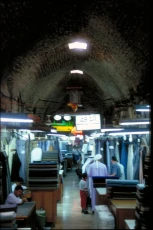
Suq ad-Diraʿ, general view of the suq

Khan al-Jumruk, exterior facade of the Khan's entrance

Exterior view of Hammam al-Qaramani, dome of frigidarium (barrani)
[ Description by author: Süd- oder West-Seite. Vgl. Bild 0139 ! ]

Remains of ancient buildings in Shahba, partly inhabited

Kamele bei as-Sabʿa Biyar in der Syrischen Wüste

Khan Qurtbak, Innenhof und westlicher Arkadentrakt

Jamiʿ Aslan Dada, Innenansicht der Gebetshalle (qibliyya)

Khan al-Hibal, südliche Innenhoffassade

Coffehouse Aslan Dada (vanished)

Mausoleum Ahmad Basha, general view of the facade
[ Description by author: Erbaut 1316. Zwei Kuppeln auf achteckigem Tambour, Eingangs-"Iwân". Die Nische rechts neben dem "Iwân" ist möglicherweise ein Brunnen. Gesehen wohl von ~ Nordwesten. ]

Machicolations on the wall of Damascus Citadel

Türzieher am Haupteingang der Madrasa az-Zahiriyya

Izraʿ, al-Jamiʿ (Moschee) al-ʿUmari, Gebetsnische

Spitzbogen in der Burg Najm (Qalʿat Najm)

Roman mosaic, National Museum of Damascus
[ Description by author: Die Bilder 0113 - 0116 sind eine durchgängige Folge links > rechts aus einem römischen Mosaik. Leider habe ich damals versäumt zu notieren, aus welcher Gegend Syriens es stammt. Hier: ein Bär attakiert Equiden. ]

Al-Madrasa as-Salimiyya, kleine Brunnenlöwen-Skulptur
[ Description by author: Der Löwe von Bild 0124 von der anderen Seite. ]

Afamiya, Blick von Norden auf die Kolonnadenstraße (Cardo Maximus)
shap_import_70676

Große Moschee, Innenhof, Fassade der Gebetshalle
Das Foto zeigt den Innenhof und die Südseite der Fassade der Gebetshalle, westlich des Portals

Qalʿat Salah ad-Din von innen

Izraʿ, Kanisat (Kirche) Mar Jirjis, Inneres
Bischofskirche
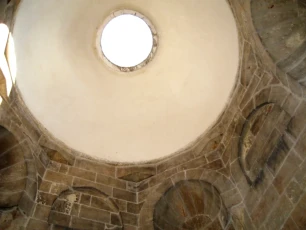
Bimaristan Arghun, northern courtyard - open dome
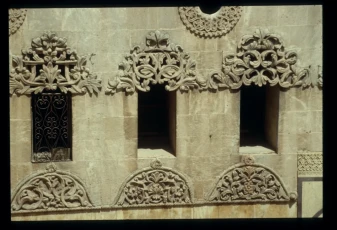
Bayt Ajiqbash, window stone decoration of the courtyard facade

A little boy from a resettlement village is drawing water from a tap embedded in the ground
The village was resettled in the 70s to Northeast Syria due to the construction of the Al-Furat dam of the Euphrates. Typically, these houses were covered with a corrugated iron roof and had their water source in the court instead of inside the house.

A distant view of the coastal mountains (al-Jibal as-Sahiliyya)

Decorated wooden door of the Damascus Room in the Dresden Museum for Ethnology

Qatna, Stadtareal innerhalb der Umfassungsmauer, Grabungsarbeiten
. [Original: Al-Mishrifa / Qatnâ']

Bel-Tempel von Nordosten
[ Description by author: Tele-Ausschnitt aus Bild 0586.. ['Hotel Villa Palmyra (Heliopolis ?)'] ]

Raqqa countryside, a traditional wedding ceremony in Suwaydiyya Kabira village

One of the inner part of Ibn Maʿn Castle

Qasr al-Hayr al-Gharbi, Bogenöffnung

Jamiʿ Aslan Dada, Halle - Inneres der Kuppel

Jabal ʿAruda, Blick auf den Euphrat

Bayt Jubran Afandi Shamiyya im Viertel Bab Tuma, Hofseite mit Arkaden
Tarma

Jabla, Entrance of the Mosque of Sultan Ibrahim

Bayt Jubran Afandi Shamiyya, heute die Privatschule Riʿaya im Viertel Bab Tuma
Tarma. Innen

Upper part of the western facade, Maʿbad ad-Dumayr (Temple)
[Orignal: Wasserheiligtum, Dreiecksgiebel über Schmalseite]

Männer in einem traditionellen Zelt in dem Dorf Suwaydiyya Kabira im Umland von ar-Raqqa

Große Moschee, oberer Bereich des Minaretts

Zawiyat Saʿd ad-Din al-Jibawi, Ansicht der Hauptfassade mit den beiden Kuppeln

Masbanat (soap factory) az-Zanabili, Aerial views of the courtyard and the domed first

Ar-Rusafa, Basilika A, Blick durch das Hauptschiff nach Westen
[Original: 1945 Geschenk Prof. Friedrich Sarre]

Blick auf die Burg (Qal'at) Marqab, über dem Mittelmeer thronend

Jamiʿ al-Qayqan, Außenansicht
[Original: Jâmi' al-Qîqân, Halab/ Aleppo, "Rabenmoschee" - etwa wegen der beiden wohl antiken / byzantinischen Basaltsäulen am Eingang? Eine weitere Merkwürdigkeit ist die Verwendung von Säulenstümpfen im Mauerwerk, was man sonst nur bei Festungsarchitektur sieht. Außerdem soll die Mosche "im Mauerwerk" - wo? - einen Stein mit hethitischer Inschrift bergen. 18/04/2001 (?)']
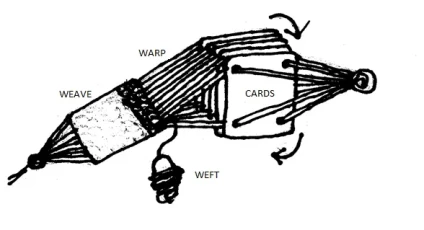
A tablet-loom
Drawings by Estibaliz Sienra Iracheta to illustrate processes of traditional textile manufacturing

al-Matbakh al-ʿAjami, ground plan and sectional drawings through the large hall
In the ground plan, the parts demolished in the fifties of the 20th century for a road extension were added. On the right, a north-south section through the large domed hall (above) and another from west to east. The plans have been redrawn as a CAD file by the BTU Cottbus, based on a draft by Jean-Claude David and Thierry Grandin.

Mit dem Zayzun-Wasserfall mündet ein kleiner Nebenfluss in den Grenzfluss Yarmuk (Grenze Syrien/Jordanien)

Al-Madrasa as-Sultaniyya, exterior view of northern facade - entrance and minaret

Remains of the mosque of the western enclosure, Qasr al-Hayr al-Sharqi
[Original: Pavillon]

An inscription on the wall of Damascus Citadel
[ Description by author: auf der Ostseite des Nordost-Turms (vgl. Bild 0143 !). Mit der Inschrift habe ich Probleme: nach dem Rahmen scheint sie mir aus späterer türkischer Zeit, ca. 19.Jh., zu stammen - aber der Text scheint mir Arabisch und nicht Osmanli zu sein. Auf jeden Fall steht sie unter einem älteren - mamlukischen ? - Relief(band). Zu erkennen sind zwei - gegenständige ? - Löwen, unter dem rechten ein junger Löwe. Darunter eine Art Muqarnas. ]

Offener Hof im Obergeschoss der Burg Najm (Qalʿat Najm)

One of the towers of Shayzar Castle

Waqf of Ibshir Mustafa Pasha, Coffeehouse, view of destroyed dome
The core of the hall was only partially damaged, while the section of the central dome with its high lantern was, for the most part, destroyed.

Große Moschee, Gebetshalle, Minbar und Mihrab
Die einzigartige hölzerne Kanzel (minbar) ist aus der Mamlukenzeit, wie die Inschrift mit dem Namen des Sultans al-Nasir Mohammed, Sohn von Qalawun (gest. 741 AH / 1341 AD), zeigt. Der Name des Künstlers ist Muhammad ibn ʿAli al-Mawsili.

At-Takiyya al-Mawlawiyya, minaret above the main entrance

Khan al-Wazir, innere Eingangsfassade
[Original:'Khân al-Wazîr,Halab / Aleppo. Innenseite des Tores von Bild 1248.'].

Bedouin girl with saddle bag, that was weaved by her mother

As-Sabuniyya Mosque, ornaments on the facade
[ Description by author: Dekor links bzw. rechts des Eingangs-"Iwâns". ]

Hama, The historic alley leading to al-ʿAzm Palace

Hammam Bahram Basha, the cold section (barrani)

Raqqa-Ost, Ostpalast, vegetabile Stuckdekorationen
Floral frieze decoration, Raqqa II; Eastern East-Palace

Az-Zawiya al-Hilaliyya, northern facade - al-Hijaziyya facade

Kharab Shams, Mittelschiff der Basilika
[Orignal: Säulenbasilika, 4. Jh. von weitem, Mittelschiffarkaden nach Osten]

Busra, Inneres der Kathedrale
HQ-k.9 Interior view, Arch,

Hochzeitsfest in einer Straße des Mukhayyam al-Yarmuk in Damaskus

Raqqa-Ost, Tall Aswad, Ausgrabung im 1985
Tall Aswad

Qasr Ibn Wardan, the church
[Original: Kirche (Kuppelbasilika mit Emporen), Südseite (873-876)]

Irrigation canal, al-Furat al-Aʿla (the Upper Euphrates Valley)

Exterior view of ad-Daydariyya cave
shap_import_44193

Al-Marqab Castle from the inside

Afamiya, Northern Roman baths
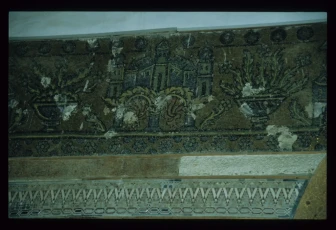
Mosaic in the mausoleum of az-Zahir Baybars
[Original: Zahiriya, Mausoleum des az-Zahir Baibars, 1277, Glasmosaiken]

The suspension bridge over the Euphrates in Dayr az-Zawr

Al-Madrasa al-Ahmadiyya, portico along the prayer hall

Khan Qurdbak, südlicher Arkadentrakt

Irrigation fields of ʿAyn at-Tina in Qalamun (mountainous region in southwest Syria)
The village itself lies in the middle ground above the level of the irrigated field terraces: In the background, the Eocene limestone layer of the Jebel Maaloula with up to 1913 m above sea level.

Die Kuppel des inneren Bereichs (juwwani) des Bahram Pasha-Bades
Die Kuppel des inneren Bereichs (juwwani) des Bahram Pasha-Bades wurde aus Lehmziegeln gebaut und liegt direkt auf den Iwan-Gewölben auf. Sie enthält eine große Anzahl von Buntglas-Öffnungen, die in verschiedenen geometrischen Formen – Sternen, Kreisen und Sechsecken – ausgebildet sind.

Khan al-Wazir, Innenhofansicht

Bayt (Haus) Quwatli, Tür in den neben dem Iwan liegenden Raum
Liwan. Seitentür

Blick auf die Burg von Masyaf, die die Stadt überragt

Fernsicht auf das Kloster Sankt Moses der Äthiopier
[ Description by author: und rechts die Unterkünfte für "Suchende". Gesehen von der Anhöhe ~ nördlich des Klosters. Im Vordergrund der "Aufweg" vom Parkplatz am Austritt des Wadi in die Ebene. ]

Qasr al-Hayr al-Gharbi, zugesetzte Toröffnung

Bayt Wakil, Hoffassade der Empfangshalle (Qaʿa)

Kharab Sayyar, Mauerreste
[Original: SW-Burg]

Landwirtschaft und Industriekomplex in der Nähe von Baniyas

Jamiʿ as-Saffahiyya, exterior windows

Teil einer verfallenen Wand in der Burg Najm (Qalʿat Najm)
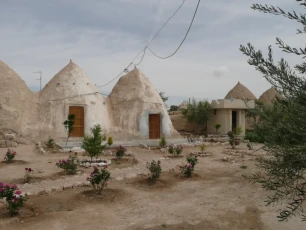
Domed house in the village of Shaykh Hilal
A view of one of the village houses, with a front porch and a small garden planted with flowers.

Jisr ash-Shughur, Qalʿat ash-Shugr wa-Bakas, a twin crusader castle, Arabic inscription

Damaskus, Glasbläserei nahe Bab Sharqi
[Original: LEAD Technologies Inc. V1.01]

Maronitische Kathedrale St. Elias, Hauptfassadenansicht (West)

Bel-Tempel, Temenos mit Cella von Nordwesten
[Original: Baal-Heiligtum, Cella, ca. 17 - 32 n.Chr.]
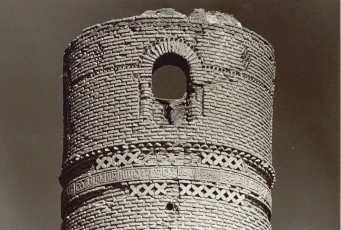
Jaʿbar Castle, Minaret of the mosque

Jurn Kabir, a hedgehog child

Khan Qurdbak, Khan Qurdbak, Haupteingangsportal - eisenbeschlagener Türflügel aus Holz

Bayt Wakil, courtyard and fountain

Inschrift auf einem Basaltstein in Jabal Says

Bayt Wakil, Kuppel der Qaʿa (Empfangshalle)
Blick auf die Kuppel auf dem Dach der repräsentativen Empfangshalle (Qaʿa). Sie steht auf einem polygonalen Tambour mit Fenstern für die Beleuchtung.

General view of Qalʿat Ibn Maʿn
[ Description by author: Stimmt die Standortangabe ? Dazu passt, dass der Standort etwas erhöht ist: das Zenobia Hotel liegt auf einem Hügel. Dagegen spricht das Gebäude unten links: wenn es das Tempel-Grab ist, müsste man links die Säulenfassade und keine Wand sehen. Jedenfalls: von ~ Südosten die Burg auf ihrem Bergkegel. ['Zenobia Hotel (?),'] ]

General view of Qalat Salah ad-Din

Südwest-Turm der Zitadelle von Damaskus
Blick auf den massiven südwestlichen Turm. Er weist zahlreiche Maschikulis auf und schließt mit einer Brüstung ab. Der Turm ist im Verbund mit der Zitadellenmauer gebaut., die ebenfalls von einer Brüstung abgeschlossen. wird.

Main entrance of the south facade of the church, Qarqbiza
[Original: "einschiffige Kirche, Haupttür der Südfassade (Villa des 3. Jhs. kurz vor 313 in Hauskirche umgewandelt - frühester datierbarer Sakralbau Syriens)"]

Al-Madrasa al-Hallawiyya, Eingang zur Gebetshalle

Khan Qurdbak, Grundriss Obergeschoss

Maronitische Kathedrale St. Elias, Kirchenschiff nach Osten
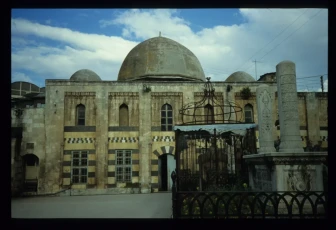
At-Takiyya al-Mawlawiyya, western facade - al-Midan

Tall al-Bi'a, Excavation at Dayr Zakka (monastery)
Raq19900043.tif

Khusrawiyya Complex, damage mapping (English)
The Khusrawiyya is severely destroyed. The northern arcade and parts of the western wing of the complex are damaged. There are parts which are still under rubble. The degree of damage is around 80%. The center of the explosion crater, produced in 2014, is located beneath the prayer room, i.e. in the domed hall of the Friday mosque, which doesn’t stand anymore. Most likely, the foundations are lost inside the inner area of the crater, while the rest of the area may contain remains of the building, perhaps sufficient for possible reconstruction. No action regarding the protection or management of the rubble has been done yet.

View of the remains of the Nabu Temple showing the podium
[ Description by author: Sein Podium mit dem Aufgang, gesehen von ~ Südosten. Im Hintergrund die Burg des Fakhru d-Dîn al-Ma'ni, links davon der Oberteil des Tetrapylon. In der Mitte hinter dem Tempel die Säulen der Diokletians-Thermen. ]

Tomb tower of Elahbel in the Valley of the Tombs

Madrasat al-Firdaws, the southern hall

Citadel of Aleppo, Entrance Gateway
shap_import_62333

Im Zelt einer halbnomadisch lebenden Familie aus der Maskana-Region - mit Vorratssäcken

Al-Madrasa as-Sultaniyya, facade and entrance of the prayer hall

Jamiʿ Manjak, Gebetshalle mit Mihrab

Khan Qurdbak, iwan, first floor plan
First floor with iwan [22], size of plan 60 x 40 . with ruler (no scale ).

At-Takiyya al-Mawlawiyya, the kitchen entrance
shap_import_65818

Dayr Zakka, Mosaik in einem zerstörten Gebäudeteil, auf dem eine Palme, ein Damhirsch und Vögel zu sehen sind
Raq19930002.tif

Jamiʿ Sharaf, Inschrift oberhalb des Grabes

Nahiyat Tall Tamir, Baking flat breads on the tannur wall (tannur deepened in the ground)

Bayt Dallal, ʿajami ceiling of a qaʿa (hall)

Al-Madrasa az-Zahiriyya, Ansicht des Eingangsportals

Khan Qurdbak, western portico

Bayt Wakil, Innenhof mit Springbrunnen

Landwirtschaft im syrischen Küstengebirge
[Original: Bewässerte Zitruspflanzung im Vorland d. Ansariyengebirges]

A truck transporting raw cotton bags stops at some bedouin tents in Raqqa-countryside

General view of Baalshamin Temple from the east

Afamiya, gedrehte Säulen der Kolonnadenstraße

View from afar to the Arch of Triumph (Qaws Hadrian)
[ Description by author: Exedra des 1. Abschnitts der Säulenstraße, Monumentalbogen und 2. Abschnitt, Burg, gesehen von ~ Südosten. Die sehr hohen Säulen der Exedra sind aus - vermutlich ägyptischem - Granit, nicht aus dem lokalen Kalkstein. Der Abstand der beiden Mittelsäulen ist etwas größer als der zwischen Mittel- und Außensäulen.- Im Plan in G. Degeorge "Palmyra" steht an etwa dieser Stelle "Nymphäum" - ? ]

Courtyard and Iwan of al-Quwatli House
Hof mit Bahra u. Liwan

Jamiʿ Aslan Dada, Gebetsnische in der Gebetshalle

Qalʿat Ibn Maʿn, Wehrgang

Bayt Dallal, courtyard and fountain

Bayt Ghazala, ʿajami wall panels decorating the main reception hall (qaʿa)

Jamiʿ Aslan Dada, the hall - octagonal neck of the dome

People near the historical city Wall of Raqqa

Baalshamin-Tempel - Cellafenster, 2. Jh. n. Chr.
[ Description by author: Das Cella-Fenster von Bild 0786, gesehen von Nordosten. ]

Palmyra, Remains of Allat Temple- Camp of Diocletian
[ Description by author: Rückseite, gesehen von ~ Westen. In Bildmitte hinten das Temenos-Tor, ganz hinten rechts der Bel-Tempel. ]

Computer modeling of the Mount Hermon
[Original: Hermon Computeraufn.]

Al-Madrasa as-Salimiyya, Innenhof nach Süden

Busra Citadel - tower

Modern painted panel with ‘Ajami decoration in Ziad Baydoun´s workshop in Malaysia

Bau der Wände eines beispielhaften Kuppelhauses in Taanayel (Libanon)
Das Bild zeigt die fertigen Lehmziegel und die erste Phase des Baus der Wände eines traditionellen syrischen Kuppelhauses in Taanayel
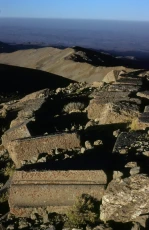
Remaining stones of ancient building on the Jabal Haramun (Mount Hermon)

Jabla, Pond in the courtyard of as-Sultan Ibrahim Mosque

A general view of Zawiyat Saʿd ad-Din al-Jibawi showing the two domes of the building

Habuba Kabira, inside the double-dome room with its relief arch

Bas-relief on an arch in the church of Qalb Lawza

Archäologische Funde aus Raqqa, ausgestellt im Damaszener National Museum

Izraʿ - Kanisat (chrurch) Mar Jirjis - plan
St. Georg

Raqqa - "East of Raqqa" site - Tall Aswad - finds
85-AS-loc. 03. [ 87/ 65/ 1938] =[ photo's name as: year/ film no./ photo no,]. on the back of the photos ['87/65']

Karten Aleppos: Funktionale Gliederung in der Altstadt, 1982
Thematische Karte von Aleppos historischer Altstadt: Funktionale Gliederung. Maßstab 1:2000, Maßstabsleiste und Legende.

Bad al-Hadid, detail of a rank decorating the gate's entrance from outside

Al-Hariqa-Viertel mit Blick auf den Südwest-Turm der Zitadelle von Damaskus
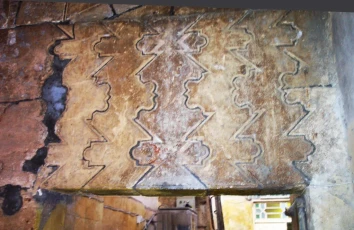
Jamiʿ ash-Shuʿaybiyya, zig-zag pattern

Afamiya, der osmanische Khan unterhalb der Zitadelle Qalʿat al-Mudiq

Suq al-ʿAttarin, Ansicht der zerstörten Marktgasse, Blick nach Osten

Aghabani table cloths with gold and silver threads

Qanawat, Gesamtansicht des Nymphäums

Bayt Wakil, floor tiles

The bronze Telegraph Column at al-Marja Square

Das Kuppelhaus in Taanayel: letzte Arbeiten
Ein Blick auf ein Kuppelhaus nach dem Verputzen mit Kalk. Auf dem Foto sehen wir den Eingang zu einem der Räume und ein kleines Fenster in einem anderen Raum.

Palmyra / Tadmur, Umgebung S, Nordost-Turm, Khan al-Hallâbât / Veriaraca
[ Description by author: (der rechte von Bild 0944) und Eingang, gesehen von Südosten. ]

The suspension bridge over the Euphrates in Dayr az-Zawr

Maronite Cathedral, one of the cathedral pointed towers

Jamiʿ Manjak, Teilansicht der Ost-Fassade

Khan al-Jumruk, doorway

A side of the Salah ad-Din Castle

Große Moschee von Hama, Innenhof, Blick auf Schatzhaus und Minarett
Schatzhaus und Minarett. Das Schatzhaus ruht, wie in der 'Umayyadenmoschee in Dimashq, auf antiken Säulen und Kapitellen. ['Original: Hamâ (Epiphania),']

Hammam an-Nahhasin, the warm section (wastani)
The middle part (wastani) in the public baths is a section of moderate temperatures, and consists, in an-Nahhasin bath, of chambers, iwans and niches. In this niche there are three stone basins for washing. The walls are covered with modern ceramics that change many of the features of the Ayyubid bath. The floor is paved with colored marble tiles in the middle that form simple geometric decorations.

Zitadelle von Aleppo - Große Moschee, Inschrift

Bayt Junblat, Süd-Iwan - Fayencefliesen-Dekoration

Fixation of a horizontal loom in the ground

A suq in Raqqa

Raqqa-Ost, Westpalast

Große Moschee von Aleppo, renovierungsarbeiten am Nordeingang in 2018
Zerstörte und bescchädigte Teile des Nordportals werden eingerüstet zur Restaurierung
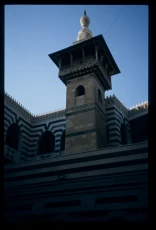
Mamluk square minaret, Jamiʿ Manjak

Takiyyat ash-Shaykh Abu Bakr, Hoffassade des Iwan und Wasserbecken

Jamiʿ (Moschee) al-Hanabila, Inschrift

Al-Madrasa al-Muqaddamiyya, the marble prayer niche

Bimaristan Arghun, octagonal courtyard - view of dome pendentives

General view of Palmyra city, Diocletian's Camp in foreground
View from Jabal Husainiyya, Diocletian's camp in foreground

Stone sarcophagi in the pyramidal mausoleum A, al-Bara

Winding of spools in the textile factory of the Mezannar family

Fassade und Kuppel des Empfangsraumes des Hauses der Familie Wakil
Ein Blick von außen auf die Fassade und Kuppel des Empfangsraums (qa'a), die Fenster des Tambours der Kuppel sind deutlich zu erkennen.

Raqqa, Qasr al-Banat, mudbrick decoration

Badefreuden im schwefelhaltigen Wasser der Afqa-Quelle
[Original: Efqa-Quelle in Palmyra, 2002 od. früher versiegt]

A mechanical loom in the textile factory of the Mezannar family

Burj as-Saʿa, general view
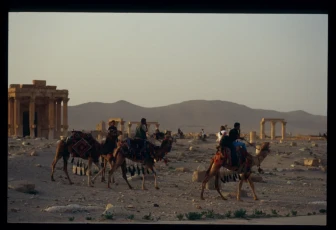
Tourist camels, Palmyra
[Original: Palmyra. Touristenkamele]

Töchter des Hauses backen Brot im eigenen Tannur am Stadtrand von Raqqa, Maisfeld im Hintergrund

Mari (Tall Hariri), a side of the architectural remains
[Original: Große Orientreise Nr.63 mit Rotel-Tours: Amman-Bagdad-Uruk-Babylon-Arbil-Mosul-Hatra-Samara-Mari-Dura Europos-Aleppo-Dayr Saman-Ugarit-Palmyra-Jarash]

Dayr Zakka (monastery), detail of a mosaic, showing the palm
Raq19930001.tif

Parts of Najm Castle (Qalʿat Najm), view on the Euphrates River

Tall al-Biʿa at the confluence of Euphrates and Balikh rivers

Coffehouse Aslan Dada (vanished)

The northern entrance of the historical city of Dura Europos (Qalʿat as-Salihiyya), end of 4th century BC
[Stadttor]

Izraʿ - Kanisat (church) Mar Jirjis from the inside

The dome hall in the upper floor of Qasr al-ʿAzm (Palace)
Der Kuppelsaal. ['Original: Hamâ (Epiphania),']

Khan as-Sabun, nördliche Innenhoffassade nach Verbreiterung der Straße

Tall Mumbaqa, Feast in a goat-hair tent during the excavation
Man dancing to the tunes of a flute at a party of the excavation

Diokletianslager

Jisr ash-Shughur, Qalʿat ash-Shugr wa-Bakas, a twin crusader castle, general view of the site

Shahba, Women in traditional dresses doing the laundry

al-Lajat region, Basalt stone into agricultural area

The historical sulfur Afqa Spring
[ Description by author: Gesehen von ~ Südwesten bei der Ankunft in Palmyra. Diese Quelle war die wichtigste des Ortes und bewässerte bis in die 1990er - seither ist sie versiegt - die Oase mit dem Palmenhain. Die Palmyrener legten an ihr unterirdische Bankettsäle an (Eingänge sichtbar auf den folgenden Bildern !) und stellten viel Altäre und Ex-Votos für die Gottheit der Quelle auf (ibidem). Das Wasser war leicht schwefelig. ]

Architekurreste aus umaiyadischer Zeit in Jabal Says

Ackerland südlich des Simeonsklosters in einem Polje (geolog.: allseits geschlossene Hohlform in Karstgebieten)
[Original: Polje südl. a. Simeonsklosters]

Afamiya, the colonnaded axis (Cardo Maximus)

Khan Qurdbak, Portikus, Aufriss Fassade des Nord-Portals und Querschnitt Ost-West

Im Krak des Chevaliers
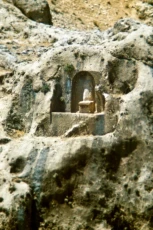
Tombe carved into the rock, ʿAyn as-Sahib
[ Description by author: Tele-Konverter-Ausschnitt, eindeutig auf das rechte Grab von Bild 0406 / 0408. ]

Bayt Junblat, southern iwan (the Great Iwan)

Naʿurat al-Muhammadiyya (waterwheel), the biggest noria in Hama

Baalshamin-Tempel, Gesamtsicht von Südosten, mit Blick zum Qalat Ibn Maan

Raqqa - "East of Raqqa" site - Western Palace - finds
Westpalace; Find Nr.12240

Baniyas, Bewässerungskanal
[Original: Bewäserungkanal im Küstengebiet des Raumes Banias]

Qalb Lawza, Basilika, 5. Jh., Blick auf die Hauptfacade von Südwesten
Hier sehen wir die Hauptfassade, deren mittlerer Teil, mit großem Rundbogen, eingestürzt ist, und die Sicht auf den Narthex (Vorhalle) freigibt. Die imposante Kirche besitzt ein erhöhtes Mittelschiff und weite Arkaden, die sich zu den Seitenschiffen öffnen. Während des Kriegs erlitt sie nur geringe Schäden.

As-Safira, alter mechanischer Dreschhäcksler (darrasa)

Habuba Kabira, entrance side of a room half deepened into the grown soil (in local dialect: debabe)

Remains of a building in the Hellenistic city of Afamiya

Jabla, Sultan-Ibrahim-Moschee, Kuppelinneres

Barada River in Old city of Damascus

Kharab Shams, view from south at church ruin, 4th/6th century CE
The columned basilica, which is very high in relation to its length, lacks the outer walls of the side aisles, which probably once fell victim to an earthquake. The rafters of the lower side roof can be seen above the round arches of the arcade.

Raqqa-Ost, Tall Aswad, Ausgrabung im 1985
[1985/25/435] = [photo's name as: year/ film no./ photo no.]

Blick auf einen Teilbereich der Burg (qalʿat) al-Qadmus
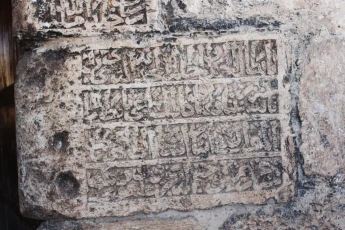
Qal‘at Shayzar ( Citadel), An Arabic inscription.

Palmyra / Tadmur, Tetrapylon, 3rd century AD
[Original: Tetrapylon mit Rosengranitsäulen aus Assuan (nur noch eine original)]

Busra, Hammam Manjak, exterior view

Ar-Rusafa, Gesamtsicht auf die Basilika A des Ruinengeländes
Basilica A

The wooden sarcophagus of Salah ad-Din al-Ayyubi
[ Description by author: Der ältere (alte ?) Holz-Sarkophag Salâhu d-Dîns. Ich glaube, es ist ebenfalls ein Kenotaph, somit bliebe unklar, wo der Leichnam heute ist. (The year of the photo is not sure according to Peter Heiske ) ]

Mushannaf, Kleine römische Tempel

Maronite Cathedral, the altar

Qasr al-Hayr al-Gharbi, Ruine des byzantinischen Turms bei dem umayyadischen Palastkomplex
[ Description by author: und rechts Eingang in den Innenhof, gesehen von ~ Südosten. Der "Balkon" am "Turm" ist eine Toilette - zumindest ist das so bei den Eremiten-Türmen des Kalksteinmassivs in Nordsyrien. Und bei den alten Dhaus in den Emiraten und 'Omân habe ich ganz ähnliches gesehen ....... ]

The Royal Palace G, Ebla (Tall Mardikh)
Mittlerer und oberer Teil. Gesehen nach ~ Südwesten [Original:Tall Mardîkh (Ebla)']

Siegesmonument von Hiraqla, ornamentierter Steinblock

Al-Jamiʿ an-Nuri, Innenhof

Damaskus, Khan Asʿad Basha al-ʿAzm, Blick in einen Arkadengang mit Ablaq-Mauerwerk

Hama, The minaret of an-Nuri Mosque
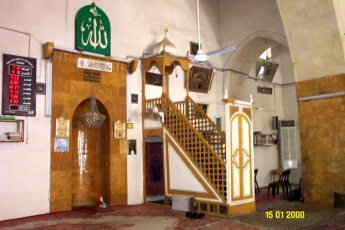
At-Takiyya al-Mawlawiyya, niche and minbar in the prayer hall (Samah Khana)

Sacrophagi decorated with sculptures of the dead

Wakil house, interior façade of the upper floor
A carried balcony is open to the courtyard with two adjacent arches, and on the right, there are several windows upstairs.

Apsis-Fresko in der Kirche, Kloster Sankt Moses der Äthiopier
[ Description by author: Triumphbogen über der Apsis, linker Teil und Mitte (Fortsetzung s. Bild 0488 !). Phase III. ]

Jisr ash-Shughur, Qalʿat Shugr wa Bekas from the inside.

Kühe inmitten eines Feldes in der Ghouta von Damaskus
Die Ghuta von Damaskus war auch durch die Zucht von reinrassigen Rindern bekannt (das Damaszener Rind), dies ist im Vergleich zum Rest der Levante einzigartig. Die reichen Weiden der Ghouta lieferten gutes Futter und so lieferten die Kühe die beste Milch.

Dar'a, al-Jamiʿ (Moschee) al-ʿUmari, Minarett von der Straße aus gesehen

Hammam Bahram Basha, Inneres der Kuppel im äußeren Bereich (barrani)

Al-Khusrawiyya, ground floor plan of 1998
shap_import_64425

Bayt Wakil, Gästehof - Iwan

Jurn Kabir, Brunnen auf der Uferterrrasse der dort breiten Flussaue des Euphrats, die vom Tishrin-Stausee geflutet wurde

In al-Hayat/Balikh valley: procedure of calcination of gypsum is finished and packed into sacks (3rd step): the natural gypsum stone was burned to produce gypsum as building material
(See also 1st and 2nd step of calcination of gypsum)

Große Moschee, Gebetssaal, Schrein des Propheten Zakariya, Keramikfliesen
shap_import_60397

Aramäische Inschrift des westlichen Altars, Palmyra / Tadmur - Umgebung, al-Karasi
[ Description by author: Detail aus Bild 0571: die aramäische Inschrift. ]

Al-Matbakh al-ʿAjami, kleiner Iwan - Detailansicht des Bogens

Citadel of Aleppo, exterior view of the domes of the Hammam

Suq ad-Diraʿ, a general view of the destruction of the Suq to the west

The prayer hall's arches of the Umayyad Mosque

Al-Madrasa al-Kamiliyya, Inneres der Kuppel der Gebetshalle
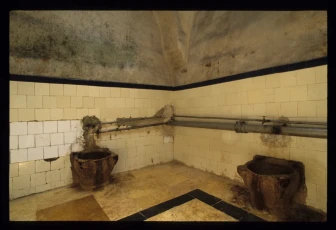
Hammam Bahram Basha, the hot section (juwwani)

Busra, Masjid Yaqut (Moschee), Grundriss

Aleppo, Blick auf das Straßenleben in der Quwwatli Straße, 1963

al-Malikiyya - ʿAyn al-Khadra, Basalt Tomb with arabic inscription

Khan al-ʿArus vor der Restaurierung, Blick von süd-west

Gold Dinar of the Kingdom of Syria, 21 mm, 1920

Jisr ash-Shughur, Qalʿat ash-Shugr wa-Bakas, Kreuzritterburgen, Steinbogen
![The eastern part of the building. This photos is of two ones, one of them is dated to 2011 and the other is taken from the net but not clear from where or when, therefore was put as no year. [Original photo name: as-i-محمع قصر الحسيني3_SYRHER]](https://syrian-heritage.org/wp-content/plugins/justified-image-grid/timthumb.php?src=https%3A%2F%2Fsyrian-heritage.org%2Fwp-content%2Fuploads%2F2020%2F04%2Fshap_import_75457-1024x386.png&h=230&q=90&f=.png)
The eastern part of the building. This photos is of two ones, one of them is dated to 2011 and the other is taken from the net but not clear from where or when, therefore was put as no year. [Original photo name: as-i-محمع قصر الحسيني3_SYRHER]

Busra - Jamiʿ (mosque) Fatima - the upper part of the minaret

Aleppo's Great Mosque, renovation of the north entrance in 2018
Destroyed and damaged parts of the north portal are scaffolded for restoration

Courtyard of the Great Mosque, Hama
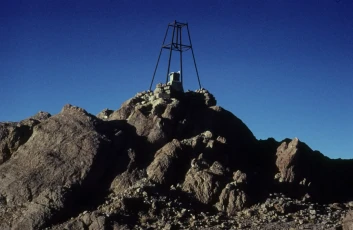
The peak of Mount Hermon (Jabal Haramun)

Großer Steintrog, Ugarit
shap_import_74031

Archaeological finds from Raqqa, exhibited in the Damascus National Museum
Capital from ar-Raqq, National Museum Damascus, Nr.13446

Jamiʿ (mosque) al-Hanabila

Zuckerrübentransport in der Ghab-Ebene
[Original: Zuckerrübentransport im Ghab]

Domes of as-Salamiyya historical bath from the outside
A picture from the outside of a group of domes and vaults belonging to the historical bath in as-Salamiyya. They contain small openings that are arranged within a pattern. In addition to their aesthetics, their main function is to lighten the various interior bathroom sections.

Khan Qurdbak, main entrance

Umayyaden-Moschee, bemalte und geschnitzte Holzdecke in der Gebetshalle
[ Description by author: Ein Stück Decke, vermutlich ijm Transept. ]

Euphrat-Ansicht an einem sehr flachen Uferabschnitt

Part of fortifications in Ebla (Tall Mardikh)
shap_import_48482

Raʾs al-ʿAyn, Blick vom Garten zum spätosmanischen Haus am Hang
Das Haus ist eine dreiflüglige Anlage, die sich zum südlich gelegenen Tal orientiert. Es öffnet sich auf ganzer Breite auf eine große Terrasse, in deren Mitte ein heute durch eine Tür zugesetzter Iwan liegt. Der Zugang zum Haus erfolgt von der westlichen Schmalseite - nicht sichtbar im Foto.

Innenhof der Burg von Arwad

Chinese cloud motifs on the top side of the panel, Aleppo Room wall frame, early 17th century

Raqqa, Qasr al-Banat, Lehmziegelornamente
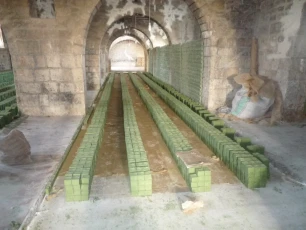
Masbanat al-Jubayli, soap preparation before the stage of arranging

Imam Ismaʿil-Moschee, Innenhof - Eingang zur Gebetshalle
zum Gebetssaal - s. die Schuhe ! Er erinnert an mittelalterliche Kirchen - für eine gotische fehlt nur ein richtiger Tympanon ... Es ist mir aber nicht bekannt, dass die Moschee auf der Stelle einer Kirche errichtet worden wäre. Dennoch scheinen mit die "Kapitelle" rechts und links nicht islamische Kunst zu sein, der Türsturz, bei dem man gleich an eine Spolie denkt, trägt eine arabische Inschrift - er könnte aber gedreht worden sein .......- Da ich nicht mehr weiß, ob dieser Eingang sich auf der West-, Süd- oder Ostseite der Moschee befindet, habe ich keinen GPS-Tag gesetzt. Es gibt noch ein weiteres Problem: ich könnte mich irren, und dieses und das nächste Bild sind nicht von der Jâmi' al-Kabîr, sondern von der Masjid al-Imâm Ismâ'îl ! Dann wäre der Eingang im Norden oder Süden. [Original: 'Salamiya (Salamias)']

Qanawat, Ruins of the Temple of Rabbos

Säulenstraße (Decumanus) mit Blickrichtung zum Hadrianstor

Great Mosque, courtyard and prayer hall facade
The Phot shows the courtyard and the southern side of the prayer hall facade, west of the porch.

Türme der Außenmauer des Qasr al-Hayr al-Sharqi
[Original: 1. Anlage]

Naʿurat al-Muhammadiyya, Hamas größte Noria (Wasserschöpfrad)

Imam Ismaʿil-Moschee, Außenansicht mit Mausoleums-Kuppel und Minarett

Bayt Ghazala, the iwan
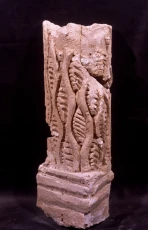
Archaeological finds from Raqqa, exhibited in the Damascus National Museum
Palace D, ar-Raqqa; Relief Decorated Stone; now in National Museum Damascus

The façade of the cathedral of Our Lady of Tortosa, the museum of Tartus today

Khan as-Sabun, window and decoration above the entrance
shap_import_61539

Zerstörungen im Stadtzentrum von Raqqa, 2018
Die moderne Stadt wurde im Jahr 2017 durch Bombenangriffe auf die „Hauptstadt“ des IS stark zerstört.

Jamiʿ at-Tawashi, interior view of the prayer hall
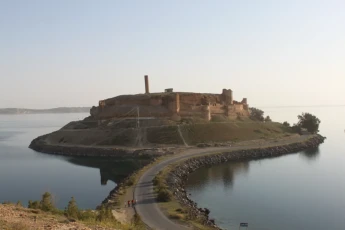
Jaʿbar Castle in at-Tabqa, General view

Monumental Arch and Colonnaded Street in Palmyra

Al-Madrasa al-Ahmadiyya, domes of the prayer niche from the outside

Busra, view of the Westgate of the Decumanus Maximus
Bâb al-Kandîl (Laternentor), Hauptstraße, von Süden aus der Straße zum Theater. Man erkennt gut die Sockel der ehemaligen Südfassade.

Qalʿat ash-Shugr wa-Bakas, Burgruinen auf einem Bergvorsprung

Al-Madrasa al-Hallawiyya, entrance - a stone base (spolia) which is the cathedral baptismal font

Turbat Khaʾirbak, Westfassade und Kuppel des Mausoleums

Jamiʿ al-Khayr, prayer hall - Minbar

Damascus, Khan Asʿad Basha al-ʿAzm, internal view of the portal

Busra, Hammam Manjak vor der Restaurierung

Ruinen des Theaters von Afamiya

Archaeological finds from Raqqa, exhibited in the Damascus National Museum
Floral frieze decoration; Palace D, ar-Raqqa; National Museum Damascus

Jamiʿ al-ʿAdiliyya, interior view of the prayer hall dome
shap_import_64443

Suq Aslan Dada, view of the Mamluk coat of arms (rank) at the north entrance after completion of the rebuilding work

Mnin, Traditional village houses at the foot of the Qalamun Mountains

Turbat Khaʾirbak (mausoleum), western facade - tomb chamber

Shahba, zwei traditionell gekleidete Menschen mit einem Lastenkamel

A Jacquard-loom in the textile factory of the Mezannar family in Damascus

Blick auf die Hanghäuser von Ma'lula
[Original: Maalulla, Ländliche Siedlung]

Jamiʿ al-Qayqan, Haupteingang

Qasr Asʿad Basha al-ʿAzm, Innenhof mit Brunnen und Iwan
Liwan und Bahra

Khan al-Jumruk, decorations and windows on the internal facade of the Khan's entrance

Jamiʿ al-Maydani, windows with stone lattice screen (Transenna)

Habuba Kabira, Lehmziegelkonstruktion - Verbindung von Wand, Gurtbogen und Kuppelrundung

Excavation work inside ad-Daydariyya cave

Hubert Mezannar, son of Antoine Elias Mezannar. In the background is the certificate of a gold medal, the family won in 1936 on an international fair
At the beginning of the 20th century, Antoine Mezannar brought mechanical looms from Lyon with electric motors to Damascus and became one of the first consumers of electricity in Damascus.

('Ain) Manîn, Türsturz des Eingangs zu einem römischen, religiösen Gebäudekomplexes
[ Description by author: Detail aus dem Türsturz der kleinen Halle. ]

Remains of wall foundations, Kharab Sayyar
[Original: SW-Burg]

Raqqa, hypothetische Rekonstruktion der Gebetshalle der abbasisdischen Großen Moschee
Isometric view drawing. Scale ruler

Bel-Tempel, Cella von Osten
Exterior view from east

Qalʿat Ibn Maʿn, Blick nach Südwesten auf das Tal der Gräber (Westnekropole)
[ Description by author: Blick nach ~ Südwesten. Der hohe Turm rechts der Bildmitte ist der des Elahbel. ]

Jamiʿ Sharaf, inscription above ad-Darih
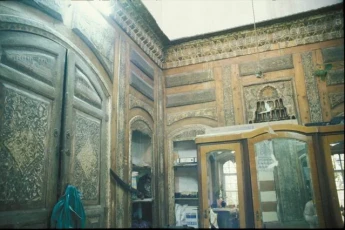
‘Ajami decoration in Bayt Nabulusi in Damascus
shap_import_97590

Jamiʿ at-Tawashi, general view of the entrance gate and the minaret room

Aleppo: Citadel, entrance 12th – 16th c.

Aliya Alnuami is finalising her ‘Ajami work

Jamiʿ al-Qayqan, Main entrance

Al-Madrasa al-Hallawiyya, entrance - a stone base (spolia) which is the cathedral baptismal font
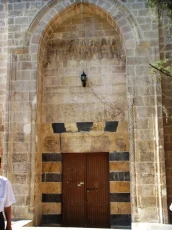
Jamiʿ al-Utrush, northern entrance

Raqqa-Ost, Tall Aswad, Ausgrabung im 1985
Tall Aswad

Wandnische mit Kielbogen in der Burg von Harim

Burj Alaʾ, general view of the southern facade of the tower with its machicolations and parapets

Jurn Kabir, Girls from Habuba Kabira are preparing the lime milk from local chalk

A view from the west to Harim Castle
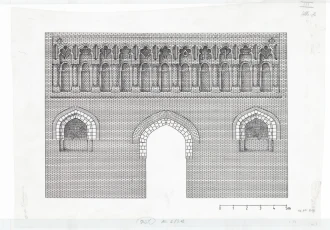
Raqqa, Bagdad Gate, Drawing of total reconstruction
Drawing of total reconstruction [on original: III, Abb. 2, S. 12]

Ghouta of Damascus, A grove of vegetables and fruit trees

Qanawat, view of the nymphaeum

Luxury summer houses in Bludan

Moderne bemalte Wandpaneele mit ‘Ajami-Dekoration in Ziad Baydouns Werkstatt in Malaysia

Hama, general view of the Jisriyya (waterwheel)
Note: these photos were taken between the year 1924 - 1939. The chosen date is to be average. (photographer unkown)

At-Takiyya al-Mawlawiyya, prayer hall (old Midan)

Al-Marja Square with the Column of Telegraph, Damascus

Excavation work at Tall Afis

At-Takiyya al-Ikhlasiyya (az-Zawiya ar-Rifaʿiyya), general view of the northern facade

Jabal al-ʿArab, a view of volcanic area
[Original: Vulkanit-Aufschluß sü. d. Leja, ö.d. Straße]

Wasserfall von Zayzun im Jarmuktal, 1918
[Original: 'Wasserfall von Zezun im Jarmuktal']. Die bayerische Luftwaffenabteilung 304b war ab dem 25. Oktober 1917 in Palästina stationiert und am Ersten Weltkrieg beteiligt, bis die Division Mitte September 1918 über Aleppo die Region verließ. In dieser Zeit wurden über 3000 Glasfotografien, meist Luftaufnahmen, gemacht. Diese frühen Fotos waren wichtig für die archäologische Forschung im Nahen Osten.

Busra - Südliches Römisches Bad von außen (al-Hammam ar-Rumani al-Janubi)
Vorhof vor der Restaurierung, Blick nach Süden

Bei Safira, hochgelegene Öffnung in einer Kuppel, um Stroh oder Häcksel einzufüllen

Archäologische Funde aus Raqqa, ausgestellt im Damaszener National Museum

Qal‘at Shayzar ( Zitadelle), Eine arabische Inschrift

Salt production in extraction, possibly in as-Sabkha in the Euphrates Valley
[Original: Salzgewinnung im Euphrattal]

Chinese cloud motifs on the top side of the panel, Aleppo Room wall frame, early 17th century
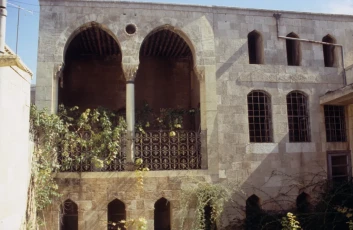
Bayt Wakil, interior facade of the upper floor

Zayzun waterfalls of a tributary into Yarmuk river (border Syria/Jordan)

An artificial irrigation canal, al-Furat al-Aʿla (the Upper Euphrates Valley)

Mosaiken der westlichen Arkade der Umaiyaden-Moschee
[ Description by author: Decke des mittleren Schiffs, gesehen nach ~ Südwesten. ]

As-Sinaniyya-Moschee, bunte Blumenmuster auf den Bogenfeldern mit Damaskus-Fliesen im Ablaq-Mauerwerk

Blick aus Flugzeug auf Oberlauf des Sajur (hauptsächlich auf türkischem Gebiet, rechts Grenzstreifen von Syrien sichtbar)

Ein Junge präsentiert eine gewebte Decke (Kelim) seiner Mutter

Salah ad-Din statue situated in front of the western facade of Damascus citadel

Busra - Birkat (Becken) al-Hajj

As-Sabuniyya Mosque, the upper part of the minaret

Hand carved wood block used for printing fabrics

Plastic tools shop in ar-Raqqa
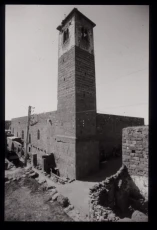
Busra, al-Jami‘ (mosque) al-ʿUmari - minaret, northern-eastern corner
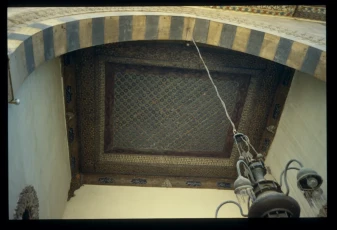
Bayt Ajiqbash, wooden decorated (ʿajami) ceiling in the iwan

Blick auf die Burg (Qalʿat) Arwad

Inner courtyard, Jamiʿ as-Sinaniyya

Kharab Shams, Blick von Westen auf die Kirche
[Original: Säulenbasilika, 4. Jh. von weitem, von W]

Busra, Hammam Manjak, iwan im Ruhebereich (Barrani)

Blick auf Ma'lula in den 30er Jahren
Hinweis: Dieses Foto wurde zwischen den Jahren 1924 - 1939 aufgenommen. Das gewählte Datum soll ein Durchschnittswert sein. (Fotograf unbekannt)
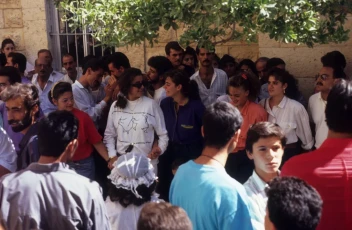
Dancing on a terrace in the St. Thekla Monastery on the Holy Cross Day in Maʿlula

Bayt Ghazala, courtyard - northern facade
View of courtyard and courtyard facade [Original: Privathaus, Innenhof] Pl. Nr. Aufnahme Enderlein, Foto-Verz. Nr. 11030 A 18

Al-Madrasa az-Zahiriyya, general view of the main facade and the entrance

Pavilion, Qasr al-Hayr al-Sharqi

Rapid Condition/Damage Assessment File
al-Matbakh al-ʿAjami, Rapid Damage Assessment File, suggesting a recommendation class "RC" (acc. to European Norm EN 16096), including a condition assessment and proposed interventions

Hiraqla victory monument
Hiraqla (near ar-Raqqa), (MM: DAI 93/158)

Aerial photograph of Barada valley in Jibal Lubnan ash-Sharqiyya (Anti Lebanon mountains)

Überreste der Stadtmauer und Qalʿat Ibn Maʿn
[ Description by author: In der Mitte das Tempelgrab, ganz rechts ein Turm der Mauer, dahinter Säulen vom 3. Abschnitt der Säulenstraße, links oben die Burg. Blick nach ~ Norden. ]

Maronite Cathedral, upper pointed part of one of the cathedral towers

Monastery of St Simeon Stylites, apse of east basilica

Front view of a Hummus shop

Afamiya, Ruined building

Jurn Kabir, die beiden einzigen Klassenräume für die Kinder des Dorfes

Umaiyaden-Moschee, die Fassade des Gebetssaales mit ihrem mehrfarbigen Mosaik auf goldenem Grund
Ursprünglich war die gesamte Hoffassade mit Mosaiken verkleidet. Sie zeigen phantastische Landschaften, die als Darstellung des Paradieses gedeutet werden.

The tower tombs, Valley of the Tombs
[ Description by author: Der hohe hinten ist der des Maliku (vgl. Bild 0820, der ganz rechts der des Jambliqu (vgl. Bild 0823 - 0830 !). Gesehen von ~ Nordwesten. ]

Landwirtschaft am Fuß des Anti-Libanon

Al-Madrasa as-Sultaniyya, entrance of the prayer hall

Jamiʿ Aslan Dada, iwan of hall entrance

Garbage and dirt accumulation in a canal, the Ghouta of Damascus

A view of Arwad citadel

A view of the main facade, the Convent of Our Lady of Saydnaya

Qalb Lawza, Basilica of 5th c., view from nave, facing east to apse

Busra - Hammam Manjak - the fountain of the cold section (barrani)

Lintel of the main entrance of the Church, Ibn Wardan Palace
[Original: Kirche (Kuppelbasilika mit Emporen), Tympanon der südlichen Tür]

Waqf of Ibshir Mustafa Pasha, Coffeehouse, the hall
The core of the hall was only partially damaged, while the section of the central dome with its high lantern was, for the most part, destroyed.

At-Takiyya al-Mawlawiyya, Gebetshalle (alter Midan)

Qasr al-Hayr al-Gharbi, Eingangsbogen

Warp threads of silk in the textile factory of the Mezannar family in Damascus

A herd of sheep is drinking from a pool of water in al-Hawl area near Iraqian border

Jamiʿ al-Maydani, general view

Burj Alaʾ, general view of the tower's western facade
shap_import_63412

Tiles of blue Qashani, Mausoleum of Salah ad-Din al-Ayyubi
[ Description by author: Die Inschrift über die Restaurationsarbeiten von Wilhelm II. Eine ähnliche Inschrift befindet sich im Bacchus-Tempel von Ba'labak. (The year of the photo is not sure according to Peter Heiske ) ]

Exterior view from the south of the North Gate in ar-Rusafa.

Nordwestecke des Tempel von Mushannaf mit dem Wasserbecken im Vordergrund

Westsyrien: Zugang zur Saladinsburg durch zwei in den Fels gehauene Spalten, 12. Jh.

A Bedouin woman is weaving with a horizontal loom

Bayt Jubran Afandi Shamiyya im Viertel Bab Tuma, Iwan
Hof mit Liwan und Seitenliwan

View of the dam of the Assad reservoir of the Euphrates with its park

Khan al-Wazir, Haupteingangsportal
[Original:'Khân al-Wazîr, Halab / Aleppo. Er stammt aus dem Jahre 1682. Hier die Außenfassade. Vgl. Bild 1250 ! Ob sie wirklich auf der Westseite der Anlage ist, ist mir nicht (mehr) ganz klar, aber die Beschreibung im Guide Bleu "Middle East" (Eingang an einem kleinen Platz mit Moschee am Ende) macht es wahrscheinlich.'].

Jisr ash-Shughur, Qalʿat ash-Shugr wa-Bakas, eine Gesamtansicht der Brücke zwischen den beiden Burgen

As-Sa'a-Kreisverkehr in Raqqa

At-Takiyya al-Ikhlasiyya (az-Zawiya ar-Rifaʿiyya), entrance of the prayer hall
shap_import_65805

Baalshamin-Tempel aus östlicher Richtung

al-Malikiyya - ʿAyn al-Khadra, Basaltgrab mit arabischer Inschrift

Details of decoration on the Qaws Hadrian (Arch of Triumph)
[ Description by author: - wo genau ? ['Monumentalbogen, ??/??/2002'] ]

Mushabbak, byzantinische Basilika, Kirchenschiff nach Westen

Jamiʿ at-Tawashi, east facade - one of the two columns which frame a window
[Original:'Jâmi' at-Tawâshi, Halab / Aleppo. Detail aus Bild 1284: die rechte Säule des Fensters.'].
General view of Abu al-Fidaʾ Mosque on the Orontes river
Jami' al-Haiyaya, [Original: 'Jâmi' al-Haiya']. Gesehen von Südosten über den 'Âsi. Unter der rechten, kleineren Kuppel ist der Politiker, Historiker und Geograph Abû l-Fidâ' begraben. ['Original: Hamâ (Epiphania),']

Der Nord-West-Turm der Zitadelle von Damaskus

Remains of Afamiya Theater

An inscription on the wall of Damascus Citadel

Citadel of Aleppo, general view of the south bastion facade

al-Lajat region, Roman road

Jamiʿ Aslan Dada, prayer hall (qibliyya), window above the prayer niche

The dome house in Taanayel: final touches
A view of the dome house after the process of plastering with lime. In the photo we can see the entrance to one of the rooms and a small window in the other room.

Burj as-Saʿa, qastal window

Homs, Western entrance, Jamiʿ an-Nuri
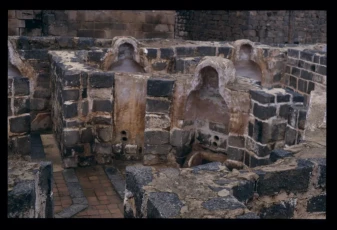
Busra, Hammam Manjak, niches in the hot section (juwwani)
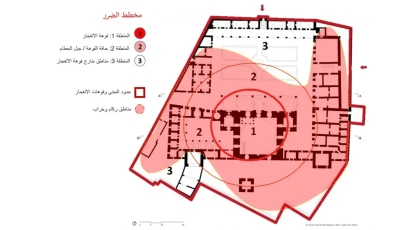
Khusrawiyya-Komplex: Schadenskartierung (Arabisch)
Die Khusrawiyya ist stark zerstört. Die Nordarkade und Teile des Westflügels des Komplexes sind beschädigt. Es gibt Teile, die noch unter Schutt liegen. Der Schadensgrad liegt bei ca. 80%. Das Zentrum des Explosionskraters, der 2014 entstanden ist, befindet sich unterhalb des Gebetsraums, d.h. in der Kuppelhalle der Freitagsmoschee, die nicht mehr steht. Wahrscheinlich sind die Fundamente im Inneren des Kraters verloren, während der übrige Teil des Geländes Reste des Gebäudes enthalten kann, die vielleicht für eine mögliche Rekonstruktion ausreichen. Es wurden noch keine Maßnahmen zum Schutz oder zur Behandlung der Trümmer ergriffen.

مشهد طبيعي في سهل حوران

Tote Städte, Kirkbiza: Zuggespann aus Muli und Ochse, die einen Metallpflug ziehen.

Khan Qurdbak, dome of the entrance

Al-Khusrawiyya: Explosion crater where the mosque once stood, 2016
The first Ottoman mosque in the city was designed by the famous architect Sinan. An explosion in 2014 destroyed the mosque completely, nothing but a huge crater is left.

Al-Madrasa as-Sultaniyya, entrance - stone carved Arabic inscriptions

South wall of the central shrine (cella), Temple of Bel
[ Description by author: Gesehen von Süden. Zu sehen die Schmalseite der Cella, dekoriert mit zwei Halbsäulen mit jonischen Kapitellen (vgl. Bild 0615 !) und gerahmt von Pilastern mit Kapitellen (vgl. Bild 0616 !) zwischen der West-Peristase mit dem Monumental-Tor und den Säulen der Ost-Peristase. ]

A group of camels near as-Sabʿa Biyar, Syrian Desert

Busra, Teilbereich der Zitadellenmauer

Tall Dahab, Woman carrying firewood

Waqf Ibshir Mustafa Pasha, Gesamtplan der Gebäudeteile (Englisch)
Der waqf (Stiftungs-Komplex) von Ibshir Mustafa Pasha hat in mehreren Bereichen schwere Schäden erlitten. Dazu gehören der Khan auf der Nordseite und die östliche und westliche Qaysariyya. Ohne vorherige Trümmerbeseitigung kann keine abschließende Aussage über das Ausmaß des Schadens getroffen werden. Höchstwahrscheinlich kam es in den von der Tunnelbombenexplosion vom April 2015 betroffenen Gebieten zu einem Totalschaden. Der westliche Teil des waqf-Komplexes, einschließlich seiner Vorderfront, steht noch, ist aber deutlich beschädigt. Zwei der wichtigsten Gebäude des Waqf-Komplexes von Ibshir Mustafa Pasha sind in Teilen erhalten geblieben: die Moschee und das Kaffeehaus im Süden. Die einzigartig dekorierte Fassade der Halle des Kaffeehauses sowie die erste Gewölbezeile wurden zerstört. Der Kern der Halle wurde nur teilweise beschädigt, während der Abschnitt der zentralen Kuppel mit ihrer hohen Laterne größtenteils zerstört wurde.

At-Takiyya al-Mawlawiyya, Gebetsnische und Kanzel des Samah Khana

Jamiʿ Aslan Dada, Eingang der zusätzlichen Gebetshalle (al-Hijaziyya) vom Hof aus

An old man from Al-Bab demonstrates how felt carpets were traditionally manufactured by using one´s own foot
Photographs of a manufacturing facility for felt carpets in Al Bab as part of the "Aleppo Stadtarchivprojekt" of GIZ (German Corporation for International Cooperation) in 2008

Monumentalbogen und Große Kolonnade im Abschnitt B

Jamiʿ as-Saffahiyya, Muqarnas-Gewölbe der Portalnische

Jamiʿ al-Khayr, Inneres der Gebetshalle, Eingangs-Empore (Sudda) mit Holzbrüstung

Qalʿat Ibn Maʿn, Blick vom höchsten Punkt der Burg auf das Tal der Gräber (Westnekropole)
[ Description by author: Blick vom höchsten Teil der Burg genau nach Süden. Ganz links im "Fenster" das Hotel Cham Palace, rechts daneben der Turm des Maliku, der am weitesten rechts in dieser Reihe ist der des Jambliqu. ]

Dar'a, al-Jamiʿ (mosque) al-ʿUmari - The minaret and the courtyard

Hauptfassade des Bimaristan an-Nuri in Damaskus
Haupteingang mit Muqarnas und Wandrelief

Afamiya, remains of colossal columns
shap_import_44109

Palmyra / Tadmur - Umgebung NW, Jazil, Eingang des Höhlenklosters - Felsbalkon
[ Description by author: Blick etwa vom Klostereingang. Zu sehen ein Wasserkanal und hinten rechts davon ein Becken, vgl. Bild 0896 ! ]

reiterstandbild von Salah ad-Din, vor der Westfassade der Zitadelel von Damaskus

Al-Madrasa al-Kamiliyya, Innenhof und Iwan

Al-Madrasa al-Muqaddamiyya, the entrance

Eingang des ʿAbd al-Basit Bades
Der Eingang, der zum Kaltbadebereich (barrani) führt, ist einer der schönsten Eingänge der islamischen Badarchitektur. Das Mauerwerk wurde in der Ablaq-Technik gebaut, wobei die Steinreihen zwischen den Farben Weiß, Grau und Blau wechseln. Der Eingang selbst ist in der Fassade zurückgesetzt und wird von, einem, mit einem Zick-Zack-Ornament verzierten, Bogen abgeschlossen. Über dem Eingang ist auf diesem Foto der Tambour der Kuppel des Barrani-Bereichs mit seinen vielen Fenstern zu sehen,.Dieses Gebäude existiert heute nicht mehr!

The courtyard with fountain and Iwan, Bayt Jubran Afandi Shamiyya, Bab Tuma
Bahra mit Liwan

Al-Madrasa as-Sultaniyya, general view from the Citadel

reconstruction al-Husn Church

Palmyra, Blick über das Ruinengelände
[ Description by author: Der Hintergrund von Bild 0800. Links die Säulenstraße, 3. Abschnitt, dann der Tetrapylon, dahinter der Monumentalbogen. Rechts vom Tetrapylon das Theater, darüber die vier Säulen der Diokletiansthermen. Noch weiter rechts, nach der Kolonnade, die Agora mit ganz rechts dem Bankettsaal. Hinter all dem das Areal des Bel-Tempels, ganz im Hintergrund der Salzsee von Palmyra. ]

Tartus, Qalʿat al-Marqab, Crusader castle, general view from the Castle.

Traditionelle Häuser in Ma'lula

Maronite Cathedral, a cross shaped window
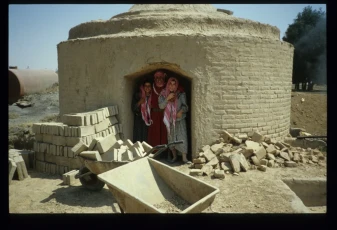
A photo of villagers at the entrance of traditional building under construction, Raqqa

Archaeological finds from Raqqa, exhibited in the Damascus National Museum
Pottery from ar-Raqqa; National Museum Damascus

Khan Qurdbak, Iwan, Grundriss Erdgeschoss

Zelt aus Jutesäcken der halbnomadisch lebenden Familie aus der Maskana region

Karte der Bewässerungsoase von Damaskus - Versuch einer Überblicksdarstellung, 1969
[Die Bewässerungsoase von Damaskus - Versuch einer Überblicksdarstellung. Legende und Maßstab]

Qalʿat al-Marqab (Castle), General view - eastern and southeastern side

Takiyyat ash-Shaykh Abu Bakr, general view from outside
Note: these photos were taken between the year 1924 - 1939. The chosen date is to be average. (photographer unkown)

Al-Madrasa al-Ahmadiyya, the prayer hall's facade

Remain of City Wall, Palmyra
[ Description by author: Blick nach ~ Nordwesten. Vor der Mauer ganz rechts der Annex, zwischen den beiden Mauern liegt die Agora, bei der Säule ist der Eingang zum Bankettsaal, darüber die Burg. Im Verlauf der Mauer erkennt man ganz hinten das Diokletians-Lager.- Die Mauer wird bald als Diokletianisch, bald als Justinianisch bezeichnet: vermutlich unter Diokletian (rund 300 n. Chr.) erbaut und unter Justinian (ca. 550. n. Chr.) erneuert / verstärkt. ]

Kleiner Fluss in Baniyas

Afamiya, Kolonnadenstraße

Remains of a courtyard at Ibn Mʿan Castle

Masbanat aj-Jubayli, the stage of arranging the soap to dry
In the picture, the arched corridors appear on the top floor of the soap manufactory, where the soap bars are arranged in the areas between the arches to dry them out.

Al-Madrasa as-Sulaymaniyya, courtyard with fountain, arch arcades and mosque
[ Description by author: Blick über den Innenhof mit dem Wasserbecken von der Moschee nach ~ Nordosten. Vgl. Bild 0128 und 0129 ! ]

Khan al-Wazir, interior facade of the khan's entrance

A picture of workers doing restorations in the Umayyad Mosque
Corridor, column

Euphrat-Ebene nahe der Einmündung des Sajur mit Kalksteinmassiv auf Südseite (vor der Flutung des Tishrin-Stausees)

Luftbild des Dorfes Shaykh Hilal
Das Bild zeigt die Verteilung der Gebäude nach dem Schachbrettmuster. Es lassen sich viele Kuppelhäuser und Häuser mit Flachdächern identifizieren, zu denen auch Gärten und Terrassen gehören.

Islamic coloured shard, ar-Raqqa museum

Raqqa, Qasr al-Banat, courtyard with northern Iwan

Ansicht des Krak des Chevaliers in der Umgebung des an-Nasara Tals

Dura Europos (Qalʿat as-Salihiyya), Grabungsarbeiten
Side of the Excavation

A herd of sheep drinks near the Barada spring

The main mihrab of the mosque with mosaic decoration. The space is 02 in general, according to the ground plan. Here the mihrab in secondary space 07 is seen.

Grundrisse verschiedener Mausoleen (Turba) in Damaskus
Grundrisse von Grabmalen in Damaskus: 105 Shibliyya, 106 Rayhan [Handschriftlich: Nr. 84 Kataster II/5 1380 (?)], 107 Takritiyya, 108 Zahiriyya, 109 Khatuniyya

Al-Matbakh al-ʿAjami: ensemble of parts, general ground floor plan
Ensemble of conserved parts of palais, size of plan 55 x 45, with ruler (no scale).
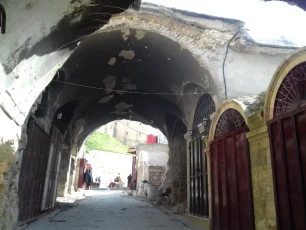
Suq az-Zarb, general view of the suq after the destruction, view towards east
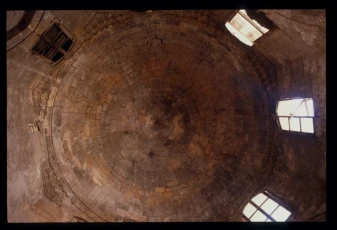
Jamiʿ Aslan Dada, interior view of the hall dome

Busra - al-Jami‘ (mosque) al-ʿUmari - the eastern side facing Hammam Manjak

Madrasat al-Firdaws, west wall of iwan opposite the prayer hall

Bimaristan Arghun, inscription

Jamiʿ al-ʿAdiliyya, prayer hall - interior view of the dome

Das Minarett der Moschee des Shaykh ʿAqil al-ʿUmari al-Manbiji

Qanawat, Blick auf die in die zweite Basilka führende Tür aus severischer Zeit, von Norden

Bayt Shaykh Qatana, Innenhofansicht vor dem Abriss
Bl.aus dem Liwan ü.d. Bahra

In the storage and living area of the Bedouin tent in ad-Duwaym
The old woman is wearing a belt of tablet weaving.

Tall Abyad, Historical watermil of ʿAyn al ʿArus

Turmgrab des Elahbel - Inneres, Tal der Gräber (Westnekropole)
[ Description by author: Bei den Bildern 0838 - 0840 gibt es ein Problem: gehören sie zum Turm des Elahbel oder zu dem des Jambliqu ? Da aber auf allen meinen Bildern der Eingang zum Turm des Jambliqu mit einer Gittertür verschlossen ist, auf der anderen Seite alle meine Führer schreiben, dass man den Turm des Elahbel besteigen könne und wegen der Aussicht auch solle, dürfte es sich um diesen handeln. Jedenfalls befinden wir uns hier in einer höheren Etage mit Blick auf den Eingang ins Treppenhaus. Das Relief unten rechts zeigt einen typischen Palmyrener auf eine Kline - wie er an der Außenseite bzw. an der Rückwand im Erdgeschoss "fehlt" ....... ]
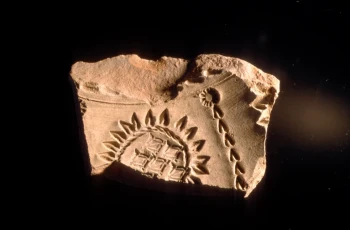
Raqqa - "East of Raqqa" site - Tall Aswad - finds
Tall Aswad; relief decorated pottery

A Bedouin woman is weaving with a horizontal loom

Jamiʿ al-Khayr, western facade

Aleppo, Khusrawiyya-Komplex: Lageplan der Bauten (Englisch)
Die Khusrawiyya ist stark zerstört. Die Nordarkade und Teile des Westflügels des Komplexes sind beschädigt. Es gibt Teile, die noch unter Schutt liegen. Der Schadensgrad liegt bei ca. 80%. Das Zentrum des Explosionskraters, der 2014 entstanden ist, befindet sich unterhalb des Gebetsraums, d.h. in der Kuppelhalle der Freitagsmoschee, die nicht mehr steht. Wahrscheinlich sind die Fundamente im Inneren des Kraters verloren, während der übrige Teil des Geländes Reste des Gebäudes enthalten kann, die vielleicht für eine mögliche Rekonstruktion ausreichen. Es wurden noch keine Maßnahmen zum Schutz oder zur Behandlung der Trümmer ergriffen.

Blick auf das Dorf nördlich des Jabal ʿAruda, im Vordergrund: Gräber

(Dome) Qubbat as-Sayyar on Qasyun mountain
Photos of Qubbat as-Sayyar ['Saiyer'], No. 96[B]

View of the Khabur River with willow-trees in the 1960s

Qal‘at Shayzar ( Zitadelle), Eine arabische Inschrift auf dem Zitadelle Eingang

('Ain) Manîn ,Heiligtümer in die Felsen gehauhen
[ Description by author: Blick auf die Anlage von (wohl) ~ Südwesten. Ganz rechts das Tor, links daneben die große Halle mit monumentaler Freitreppe zu einer Plattform davor. Links hinter ihrer Balustrade die kleine Halle mit reich dekoriertem Eingang: danach (vgl. Bild 0401 !) wird die Anlage ins 3. Jh. n. Chr. datiert. Irgendwie macht das Ganze einen "nabatäischen" Eindruck, der durch weitere Details auf den folgenden Bildern (insbesondere Bild 0401) verstärkt wird. ]

Damaskus, Khan Asʿad Basha al-ʿAzm, Blick auf die zentrale kreisförmige Dachöffnung und den Brunnen

Qanawat, Reliefierter Basaltstein

Khan Qurdbak, Innenhof mit östlichem Arkadentrakt

Eingangstor in die Burg al-Kahf in ash-Shaykh Badr, Tartus Region

Aleppo Citadel, entrance gateways and bridge

Jamiʿ at-Tawashi, Eingangsportal - Details der Dekoration

Vaulted entrance, Qalʿat Harim from the interior

Ein modernes Gebäude und ein traditioneller Lehmzaun in einem der Ghuta-Felder von Damaskus

Ausgabrung in Tall al-Biʿa, der altorientalischen Stadt Tuttul

Empfangsraum im Haus der Familie Wakil

Uferzone des Assad-Stausees mit Baumbewuchs

Main entrance of Qasr al-Hayr ash-Sharqi

Khan Dannun - Courtyard

Khan Sulayman Basha, view into the courtyard
[ Description by author: Erbaut 1732. Die beiden Kuppeln existieren nicht mehr, aber auch die Bögen mit den riesigen Trompen sind eindrucksvoll. ]

Courtyard and Iwan, Qasr As‘ad Basha al-'Azm
Liwan und Bahra

Bayt Dallal, the basin and the iwan
[Original:'Judaida-Viertel, Halab / Aleppo. Sofern Bild 1296 tatsächlich die Decke des Iwâns von Bait Sâyigh darstellt, könnte dies hier der Iwân sein.].

Application of the relief paste of a contemporary ‘Ajami decoration
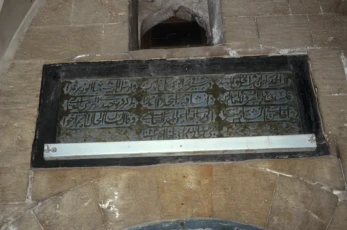
At-Takiyya al-Ikhlasiyya (az-Zawiya ar-Rifaʿiyya), inscription above the prayer hall entrance
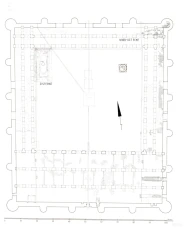
Raqqa, Grand Abbasid Mosque - Plan
Ground plan drawing. Scale ruler

Khan Qurtbak, Innenhof mit Iwan

Takiyyat ash-Shaykh Abu Bakr, al-Midan entrance

General view of the houses of the village of Shaykh Hilal
The domed houses are of near proximity to each other and interspersed with shrubs that are often planted in the houses’ courtyards.

Grazing sheep on the edge of al-Ghab Plain
[Original: KLeintierherde am Rand d. Ghab]

Sulphurous karst spring of the Khabur at Raʾs al-ʿAyn

al-Husn Church, remains of basilica's wall, which constitue the boundary of an agricultural field

Remains of the Praetorium, Balis (Barbalassos)

Raqqa - the excavations of the site "East of Raqqa" - Eastern Palace
Eastern East Palace, reconstruction

Izraʿ, al-Jamiʿ (Mosque) al-ʿUmari - the prayer niche

General view of Bel Temple among the palm trees
[ Description by author: Morgendlicher Fernblick aus einem der beiden Hotels, also von ~ Nordosten.. ['Hotel Villa Palmyra (Heliopolis ?)'] ]

View of as-Sajur river

Courtyard on the upper floor, Najm Castle (Qalʿat Najm)

Piece in the courtyard, terrace of the northern riwaq.

Remains of the portal frame, Byzantine Cathedral in Qalʿat Burqush
[ Description by author: Sie wurde weitgehend aus Materialien des Tempels errichtet. Dieses Bruchstück hier scheint mir römisch zu sein: Einfassung eines bzw. des Portals. Interessant: sofern die Kirche den Linien der byzantinischen Substrukturen folgte - nach den Plänen ist das der Fall - ist sie nicht richtig geostet, sondern nach ~ Südosten ausgerichtet. Wollte man sparen und die Tempelmauern benutzen ? ]

Jamiʿ al-Khayr, upper part of the main entrance - foundation inscription

Jamiʿ ad-Darwishiyya, framed window with a decorative strip, topped by an ornamental arch
[ Description by author: mit Bordüre. ]

Habuba Kabira, preparation of the clay mass for the production of clay bricks

Excavation work, Madinat al-Far

Remains of Diocletian Baths
[ Description by author: Links das Peristyl des Beckens (dass es ein Becken ist, erkennt man auf Bild 0693, 0694 !), ganz rechts das Propylon, hinten die Innenseite des Monumentalbogens. Gesehen von ~ Nordwesten. ]

Kuppelhaus im Dorf Shaykh Hilal
Ein Blick auf eines der Dorfhäuser mit einer Vorhalle und einem kleinen, mit Blumen bepflanzten Garten.

Al-Matbakh al-ʿAjami, southern part, ground floor plan before demolition
Before destruction of southern part in 1950, copy. Size of plan 42 x 30. no scale. [Original on plan: الجبهة بحالتها الراهنة]

Bayt Ghazala, eastern facade - red hall (qaʿa)

Busra, Westwand und Apsis als Ruinen der byzantinischen Kathedrale aus dem 6.Jahrhundert

Shaykh Anas shrine - al-Tar mountain south-east of al-Mayadeen
Near Qa'alt ar-Rahaba, grave Shikh Anis. [Original:'bei Qal'at ar-Rahba, Grabbau = Saih Anis']

Western facade of the Saraya complex (Maʿbad Zeus), Qanawat

Tall Abyad, die historische Wassermühle in 'Ayn al-'Arus

Vorbereitung von Lehm zum Bauen in einem Dorf im Gouvernement ar-Raqqa

Die Kuppeln des historischen Bades von as-Salamiyya von außen
Außenansicht der Kuppel und Gewölbe des historischen Bades in as-Salamiyya. Die kleinen Öffnungen sind zu dekorativen Mustern angeordnet. Ihre Hauptfunktion besteht darin, Licht in die verschiedenen Bereiche des Bades zu bringen.

General view of Masyaf city

Remains of the main entrance of Nabu Temple, Palmyra
[ Description by author: Gesehen von ~ Süd-Süd-Ost. Im Tor sieht man hinten die Säulen der Diokletians-Thermen, hinter der rechten Türrahmung den Altar und dahinter die Treppe zum Podium des Tempels. Der Altar hat die Form eines Naiskos (vgl. Bild 0680 !), wie z.B. in Qal'at Faqra im Libanon. ]
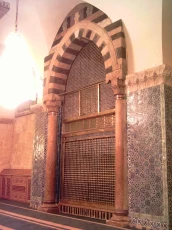
Great Mosque, prayer hall, Shrine of the Prophet Zakariya
The shrine room of the Prophet Zakariya – the father of the Prophet Yahya, or, in the Christian tradition, John the Baptist – lies to the left (east) of the main niche forming the front of the centrally positioned nave of the prayer hall. It is shielded by a copper screen and topped by a small dome. The shrine room of the Prophet Zakariya was renovated and decorated according to the long inscription above it dated 1120 AH / 1708 AD. The shrine room of Zakariya shows a characteristic Ottoman feature. It is covered by several types of ceramic tiles. First, there is a unique type of hexagonal tiles, based on an early Iznik blue and white prototype from the 16th century with plump peony motifs. A second group of tiles are of the ‘Dome of the Rock’ type. Also, there are two types of rectangular border tiles decorated with cruciform ogival medallions amongst scrolling arabesques and foliage and two different colour schemes: one in black on a turquoise ground, the other in apple green outlined in brown on a white ground.

Burj as-Saʿa, mechanical clock

Salinenbecken zur Salzgewinnung westlich des Jabal Jabisa

A photo of Masyaf Castle overlooking the city

Bab al-Maqam, general view

Al-Matbakh al-ʿAjami, muqarnas squinches of the iwan dome

In al-Hayat/Balikh valley, procedure for calcination of gypsum (1st step), fuel is placed on a natural gypsum layer
(See also 2nd and 3rd step of calcination of gypsum)

Qalʿat al-Marqab (Castle), Inscription framed with decorations

Madrasat al-Firdaws, Innenhof nach Norden mit achteckigem Brunnenbecken und Iwan

View from east to the cella of Bel Temple
Exterior view from east

Zitadelle von Aleppo - Torturm und Eingangstorbau, Gesamtansicht der Eingangsanlage
[Original: Zitadelle, v.a. vom Ayyubiden-Sultan Zahir Ghazi (reg. 1193 - 1215) umgestaltet. Haupttor mit achtbogiger Brücke]

Arch of Triumph (Qaws Hadrian) behind palm trees
[ Description by author: am Knick der Säulenstraße, und ein Stück der Kolonnade Richtung Tetrapylon. Morgendlicher Fernblick von einem der beiden Hotels, also von ~ Nordosten. ['Hotel Villa Palmyra (Heliopolis ?)'] ]

Monumentalbogen ("Hadriansbogen"), 3. Jh. n. Chr., Blick von Südosten

Luftfoto der Burg Ibn Maʿn auf einem der höchsten Berge der Umgebung

Säulenstraße - Abschnitt B, Durchgang mit Bogenöffnungen
[ Description by author: in der Säulenstraße beim südöstlichen Abgang der Rundstraße ums Theater. Der hintere Bogen gehört zur Kolonnade, der vordere entspricht der Linie der Häuserfronten. Gesehen von ~ Südwesten. ]

Habuba Kabira, maintenance of the house by a further exterior plastering

Busra - Masjid Yaqut (mosque) - the exterior facade and the entrance

At-Takiyya al-Mawlawiyya, Kücheneingang
shap_import_65818

Forests in the Syrian Coastal mountains (al-Jibal as-Sahiliyya)
[Original: Ansariyengebirge]

Al-Madrasa al-Ahmadiyya, inscription and decoration above the entrance of the prayer hall

Qal‘at Shayzar (Zitadelle), überwölbte Straße

Busra, Blick in die Kathedrale, 6. Jh. n.Chr.

Umaiyaden-Moschee, Innenhof, Blick nach Osten
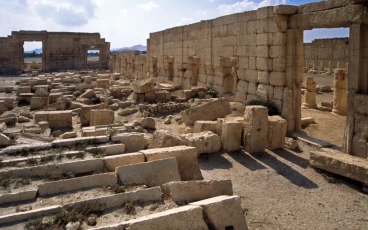
View from northeast, Agora and commercial center
[ Description by author: der Agora, Blick von ~ Nordosten. Durch das Tor ganz rechts (es ist das selbe wie Bild 0704 links) sieht man in die Agora. Dieser Annex ist der eigentliche Handelsplatz von Palmyra und war wegen der Kamele auch nicht gepflastert. Hier wurde auch der berühmte (Zoll)Tarif vom April 137 n. Chr. gefunden. S. auch Bild 0707 ! ]

Al-Madrasa as-Sultaniyya, general view of al-Malik az-Zahir Ghazi tomb
Tomb of Az-Zahir Ghazi and his family.

Euphrat-Staudamm und Assad-See in at-Tabqa

Al-Madrasa as-Sultaniyya, Marmor-Gebetsnische

Blick aus der Ferne auf die Burg (Qal'at) al-Mudiq

Raqqa, Madinat ar-Rafiqa, Stadtmauer, Ausgrabung

Waqf of Ibshir Mustafa Pasha, Coffeehouse, the hall
The uniquely decorated facade of the hall of the coffeehouse, as well as its first row of vaults, were destroyed. The core of the hall was only partially damaged, while the section of the central dome with its high lantern was, for the most part, destroyed.

Bayt Junblat, Süd-Iwan, Marmor-Dekoration

Bab Antakiya, inscription above the city gate

Aghabani table cloth with gold and silver threads

Palmyra, Damaskus-Tor, Stadtmauer, Die linke Volute des Türsturzes
[ Description by author: Die linke Volute des Türsturzes, gesehen von ~ Südwesten. ]
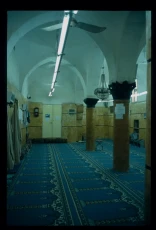
Jamiʿ ash-Shuʿaybiyya, prayer hall

Jamiʿ al-Utrush, western facade - decorated window
The lower window is decorated with black and yellow masonry (ablaq) and joggled voussoirs. Two slim spiral columns flank the ablaq-masonry to each side. The window niche above has a rectangular shape and is surrounded bycarved palmette leaves and a zig-zag frieze. The small upper window is topped by a double row of muqarnas.

Great Mosque of Aleppo, courtyard, vertical declining sundial
shap_import_60568
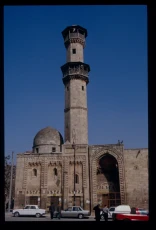
Jamiʿ al-Utrush, general view of western facade and minaret

Auf dem Khabur bei Raʾs al-ʿAyn, einfache Seilfähre aus leeren Fässern

Römisches Tor (Peribolos) an der Geraden Straße, Altstadt von Damaskus
[ Description by author: Gesehen von ~ Südwesten, mittlerer Durchgang. Die "Bürgersteige" der Geraden Straße wurden im Mittelalter zu Straßen, der alte Fahrdamm überbaut. Aber ab diesem Bogen für einige hundert Meter nach Osten besteht noch die alte Struktur: der Fahrdamm wurde ein offener Sûq, die "Bürgersteige" auch hier Straßen. Vgl. Bild 0322 ! ]

Innenhofansicht, Umaiyaden-Moschee
[ Description by author: Blick aus der Nordost-Ecke nach Südwesten. Vorn links der Uhren-Pavillon, dahinter die Fassade des Transepts und seine Kuppel, rechts daneben das Minarett von Qait Bay. Weiter rechts im Hof der Bau mit dem Becken für die Waschungen, ganz rechts das Schatzhaus. ]

Khan Qurdbak, östlicher Arkadentrakt

Turmgrab des Elahbel im Tal der Gräber (Westnekropole)
[Original: Große Orientreise Nr.63 mit Rotel-Tours: Amman-Bagdad-Uruk-Babylon-Arbil-Mosul-Hatra-Samara-Mari-Dura Europos-Aleppo-Dayr Saman-Ugarit-Palmyra-Jarash]

Qalb Lawza, Basilica, 5th c., view of main facade from south-west
Here we can see the main façade, the central part of which, with its large round arch, has collapsed, giving a view of the narthex (vestibule). The imposing church has a raised central nave and wide arcades that open onto the side aisles. This basilica suffered relatively little damage.

Panel with flower bouquet, from an unknown house near Bab Saghir, Damascus, presumably first half 18th century

Jupiter-Tempel, Ruinen des Westtores

View towards Qalʿat al-Qadmus (al-Qadmus Citadel)

Az-Zawiya al-Hilaliyya, one of the pendentives carrying the dome

Jarada, tower

Ruinen historischer Gebäude, die teilweise bewohnt sind, in Shahba

Alte Wassermühle in ʿAyn al-ʿArus

Bimaristan Arghun, octagonal courtyard - view of dome pendentives
shap_import_60896

Busra Citadel - The ditch of the citadel and the bridge leading to the entrance

General view of the Mediterranean coast near Baniyas

al-Matbakh al-ʿAjami, northwest corner of the large hall

Tall Tamir, Stallung eines großen Gehöfts

Simeonskloster, korinthische Kapitelle mit "windbewegten" Akanthusblättern
Kapitelle des Simeonklosters sind, als nordsyrische Eigenheit, häufig mit wehenden Akanthusblättern geschmückt.

Remains of walls and pillars, Mari (Tall al-Hariri)

Bayt Junblat, southern iwan - decoration of marble and faience tiles

Raqqa, Große Moschee, Luftbild

A mechanical loom in the textile factory of the Mezannar family

A Bedouin woman is weaving with a horizontal loom

Busra - Masjid Yaqut (mosque) - founding inscription

Khan as-Sabun, mamluk ranks decorating the northern facade's gate

Bayt Junblat, Süd-Iwan (großer Iwan)

Raqqa - "East of Raqqa" site - Western Palace - painted glass
Westpalace; Find Nr.14747, painted glass

Al-Madrasa as-Sultaniyya, Gesamtansicht, Blick vom Saray

The barrani (frigidarium) section of Hammam Manjak, Busra
Domed room of the reception wing, view from east

View from the Hotel Burj al-Fardous towards Old Damascus showing the Citadel
[ Description by author: Blick vom Hotel Burj al-Farâdîs nach ~ Osten: Al-Qal'a. ]

A coffee house and waiting service taxi in the center of the small frontier town

Telegrafensäule, auf ihrer Spitze befindet sich ein Miniaturmodell einer Moschee

Jamrin - The ancient bridge over Wadi az-Zaydi

Aliya Alnuami is experimenting with new ways of painting and decorating ‘Ajami work

Im Zelt von Beduinen in der syrischen Wüste: Trennung von Wohn- und Aufbewahrungsbereich durch eine Stabmatte (arab. zarb)
Große Patchwork-Vorhänge bedecken die Bettzeugstapel und - so wie hier - die Trennwand, die die beiden Zeltbereíche separiert. Die Mädchen der Familie nähen die riesigen Patchworkdecken zusammen. Der Wohnbereich desselben Zeltes ist auf Foto #2852 und #2853 zu sehen.

Bimaristan an-Nuri, courtyard

General view of Ibn Maʿn Castle
[Original: Burg oberh. v. Palmyra]

Village houses with courtyards in Mishrifa (ancient Qatna)

The main palace of the Caliph Harun ar-Rashid, ar-Raqqa
[Original: Palastareal]

Ruins of the wall of Qalʿat Shumaymis (castle)

Bayt Junblat, Nord-Iwan

Hammam Bahram Basha, the dome of the inner part (juwwani)
The dome of the inner part (juwwani) of Bahram Pasha bath was built from clay-brick and is resting directly on the iwan vaults. The dome contains a large number of stained-glass openings, which are formed in various geometric shapes of stars, circles and hexagons.

Umaiyaden Moschee, Ausschnitt des Goldgrundmosaiks an der Transeptfassade der Gebetshalle
[ Description by author: Von Norden: Mosaiken am großen Bogen, linker Teil. ]

Al-Khusrawiyya, Freitagsmoschee, Eingangsportal
Nahaufnahme der Nische des Eingangsportals mit seiner Muqarnas-Dekoration und einer Tafel mit seiner Gründungsinschrift. Dieses Element ist heute verloren (zerstört seit 2015)!

Krak des Chevaliers, Gothic vaults in the loggia

Bayt Junblat, southern iwan (the great iwan)

Al-Madrasa al-Ahmadiyya, inscription and decoration above the entrance of the prayer hall

Raqqa - the excavations of the site "East of Raqqa" - Eastern Palace, stucco decorations
Floral frieze decoration, Raqqa II; Eastern East-Palace

Burj as-Saʿa, general view
Drawings by Estibaliz Sienra Iracheta to illustrate processes of traditional textile manufacturing

Überreste des Eingangs in den Palast von al-Walid (Qasr Says) in Jabal Says

An arch topped a niche in the mausoleum of az-Zahir Baybars
[Original: Zahiriya, Mausoleum des az-Zahir Baibars, 1277. Mihrab-Nische mit Marmorinkrustationen]

Umayyaden-Moschee, Ausschnit des Fassadenmosaiks
[ Description by author: Mittelgang, Südwand, Westende.- Die Bilder 0179 - 0192 wurden mit einem High-Speed-Film gemacht, daher die mäßige Qualität ! (The date of this photo was not sure as Peter Heiske did [(wohl) 18/04/2004] ]

Bimaristan Arghun, passageway

The southern tower of Qal‘at Shayzar

Afamiya, columns of colonnaded axis (Cardo Maximus)
[Original. "Säulenstraße, 1,8 km lang und 37,5 m breit, nördlicher Abschnitt (glatte Säulenschäfte mit korinthischen Kapitellen) nach 115 n.Chr."]

Bayt Wakil, iwan

Damascus citadel, the prison courtyard in the north-east part

Zentraler Durchgang in der Burg von Harim

Raqqa - "East of Raqqa" site - Tall Aswad, excavation in 1985
[1985/25/435] = [photo's name as: year/ film no./ photo no.]

Conservation of the Grape Room made in 1835, house Nizam, Damascus

Armenische Kirche in ar-Raqqa

Preparation of spools in the textile factory of the Mezannar family

warp threads of dyed silk in the textile factory of the Mezannar family in Damascus

Khan al-Jumruk, dekorierte Fensternische an der inneren Eingangsfassade

Shaykh Shibli Schrein, Berg al-Tar, Süd-Ost al-Mayadeen

Bayt Junblat, door in the centre of southern iwan

Unteres Sammelbecken der Wasserfälle von Tall Shihab

A photo taken from the southern side towards Ibn Mʿan's castle

Bogenöffnung in der Arkade der Großen Moschee von ar-Raqqa/ar-Rafiqa, 8./12. Jh. AD


Jamiʿ as-Saffahiyya, Portalnische und Minarett
shap_import_64337

Jamiʿ ash-Shuʿaybiyya, the upper part - a cornice with floral motifs and a Qur'anic text in Kufic script
Decoration in Jami al-Tuta or Jami ash-Shu'aybiyya. [Original: Jâmi' at-Tûta, Halab / Aleppo. "Maulbeerbaum-Moschee": Detail aus dem ayyubidischen Dekor an den Resten des Gebälks, vgl. Bild 1216 !']
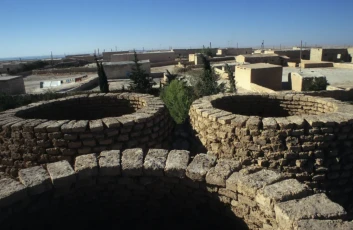
Habuba Kabira, view over cantilever domes during construction

Gothische Kreuzrippengewölbe in der Loggia des Krak de Chevaliers

A popular market in Raqqa

Temporary title for Image 75588
[ Description by author: Fresken der Kalotte. Sie sollen aus dem 12. Jh. stammen. In der Mitte ein thronender Christus, flankiert links von Maria und Maria Magdalena, rechts von Johannes dem Täufer und dem Evangelisten Johannes . Darunter rechts und links in den Medaillons die vier Evangelisten. ]

Tempel von Ithriya, Blick von Südosten
Auf der linken Seite ist gut das Podium zu erkennen. Gesehen von ~ Südosten. [Original:'Ithriya (Seriana),']

Blick von einem Boot auf das Jabal ʿAruda-Massif

The Buwayda pond at the foot of the Ayyubid citadel in Salkhad
Note: these photos were taken between the year 1924 - 1939. The chosen date is to be average. (photographer unkown)

Raqqa, Qasr al-Banat, Northern Iwan
[G 88/ 24/ 293] =[ photo's name as: year/ film no./ photo no,].

Prayer hall "sanctuary", Jamiʿ Manjak (mosque)

Habuba Kabira, plastering of the domes after completion of the shell

Damascus, Sinâniya-mosque, fassade, built 1518
[ Description by author: Erbaut 1590. Eingangs-"Iwan", Minarett und Kuppel. ]

Dome houses in a village in Aleppo countryside

ʿAyn al ʿArus, Arkadenbögen

Madinat al-Far, Grabung

Citadel of Aleppo, Entrance Gateway
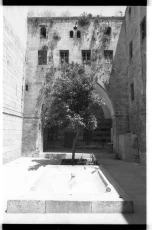
Jamiʿ Aslan Dada, view of the courtyard and the hall iwan
[Original: B63 Film-VI]

Blick auf das Koster Mar Taqla in Maʿlula

Khusrawiyya, view of complex from the citadel, Khan ash-Shuna in foreground, in 2000

Blick vom Jabal ʿAruda auf die südlich gelegenen Ausläufer

In the southern part of Tall Abyad, remains of the church made of mud bricks

Khan Qurdbak, stone ornamentaion
Detailed view of a magnificent stone ornamentation: in the window niche flanked by plaited decorative columns there is a flat relief (overlay) arch above the lintel, with joggled voussoirs in a ablaq (multicoulored) pattern. Above it, at the level of the column capitals, there is a bas-relief of geometric ribbonwork. In addition, the frame around the niche is extended by a double muqarnas band, framed by a dentil frieze

Tourists with a local resident at the Peak of Mount Hermon (Jabal Haramun)

Afqa-Quelle - historisches Bad
[ Description by author: Gesehen von ~ Südwesten bei der Ankunft in Palmyra. Diese Quelle war die wichtigste des Ortes und bewässerte bis in die 1990er - seither ist sie versiegt - die Oase mit dem Palmenhain. Die Palmyrener legten an ihr unterirdische Bankettsäle an (Eingänge sichtbar auf den folgenden Bildern !) und stellten viel Altäre und Ex-Votos für die Gottheit der Quelle auf (ibidem). Das Wasser war leicht schwefelig. ]

Archaeological find in the Eastern Palace, ar-Raqqa

View of the city of Saydnaya with its monastery

Afamiya, kannelierte Säulen auf der Kolonnadenstraße

Blick auf Saydnaya und sein Kloster

Jurn Kabir, ein ländliches Haus, wo jeder Raum eine Tür zum Hof hat
Das Haus besteht aus einem Wohnraum (linke Tür) und einem Familienraum (rechte Tür), wo aller Besitz, alles Inventar aufbewahrt wird.
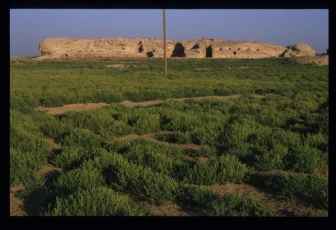
General view of Hiraqla victory monument, near Raqqa

A view of the Orontes river near Darkush

Aleppo, Stadttor Bab al-Maqam, Gesamtansicht von Süden, ca. 1932 während der französischen Mandatszeit
Hinweis: Dieses Foto wurde zwischen den Jahren 1924 - 1939 aufgenommen. Das gewählte Datum soll ein Durchschnittswert sein. (Fotograf unbekannt)

Al-Madrasa al-Hallawiyya, entrance - Zengid inscription in Naskhi script

The nord thalamos in the cella, Temple of Bel
[ Description by author: Cella: Nord-Thalamos für die Götter-Triade Aglibol (Mondgott) - Bel (oberster Himmelsgott) - Yarhibol (Sonnengott). ]

Raqqa, Der Torbogen des Statores (Bab) Baghdad

Madrasat al-Firdaws, a view of the courtyard and the southern arcade
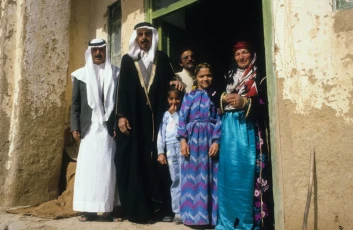
A Sheikh with his family in traditional clothes. The man is wearing a black Abbaya

Raqqa, Palace D, stucco decorations
Palace D; Inst.Neg. 86/1428 Floral frieze decoration

Jurn Kabir, ein typisches Haus des Euphrat-Tales bei Qalʿat Najm mit starkem Rundholz (Weide) quer zur Längsachse des Raums
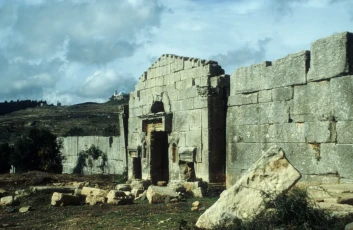
Husn Sulayman, Temple of Zeus Baetocaece, inner face of the North Gate

Busra - Jamiʿ (Moschee) Fatima - Gebetshalle

Khan al-Wazir, main entrance

Basalt sphinx at the main entrance of ʿAyn Dara Temple

A part of the ground and upper floor, Khan Asʿad Basha al-ʿAzm

Qalʿat al-Marqab, Fresco on the ceiling of chapel sacristy, 12th C.

A boy in a metal workshop in Raqqa

Kuppel des Empfgangsraumes (qa'a) im Haus der Familie Wakil
Der Raum wurde durch eine Reihe von Fenstern in der Tambourzone der Kuppel belichtet sowie durch die kreis- und sternförmigen Öffnungen in der Kuppel selbst.

Blick auf Saydnaya mit seinem Kloster

Madrasat al-Firdaws, inner courtyard with eastern arcade

Burj al-Ghanam, Gesamtansicht von Südwesten
shap_import_63417

Excavation of mosaic floor, ʿAyn al-ʿArus
Mosaic floor panel in hexagonal shape

Busra - Madrasat Abu al-Fidaʾ - prayer hall

Al-Madrasa as-Sultaniyya, view of eastern window of al-Malik az-Zahir Ghazi tomb
The window topped by an inscription panel

View of the Euphrates River, Raqqa

Khan al-Hibal, the upper part of the entrance with foundation inscription

ar-Rusafa, Nordtor, Blick in den Innenraum

Monolith ceiling of the south thalamos in the cella, Temple of Bel
[ Description by author: Cella, Süd-Thalamos: Decke. Sie besteht aus einem einzigen Monolithen. ]

Suq al-ʿAttarin, view to east showing the destruction

Remains of Islamic Jaʿbar castle
Note: these photos were taken between the year 1924 - 1939. The chosen date is to be average. (photographer unkown)

Al-Matbakh al-ʿAjami, östliche Stirnwand der großen Halle

A woman showing how to card wool. She is wearing a silk Habari (head scarf)

Monumentalbogen und Säulenstraße (Decumanus) in Palmyra

Qasr al-Hayr al-Sharqi, Remains of Ayyubid arch in the western enclosure

Brücke über den Euphrat in ar-Raqqa
[Original: Euphratbrücke]
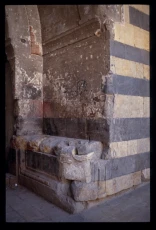
Khan Qurdbak, entrance- stone bench

Suq ad-Diraʿ, general view of the suq

Part of archaeological remains, Tall Mardikh (Ebla)
shap_import_48483

Izraʿ, al-Jamiʿ (Mosque) al-ʿUmari - the courtyard

Qanawat, Ruinen des Rabbos-Tempels

Takiyyat ash-Shaykh Abu Bakr, Maqarnas-Gewölbe der Gebetsnische

Palmyra / Tadmur, Tetrapylon, 3. Jh. n. Chr.
[Original: Tetrapylon mit Rosengranitsäulen aus Assuan (nur noch eine original)]

10 piastres (silver), 17 mm, 1929 (French Mandate)
shap_import_130398

General view of the Great Colonnade (Shariʿ al-Aʿmida)
[ Description by author: 3. Abschnitt. Ganz links das Tempelgrab, ganz rechts der Tetrapylon und dahinter der Monumentalbogen. Unterhalb des Tempelgrabes ein Stück der Stadtmauer. Gesehen nach ~ Südosten. ]

Shahba, View to the historic center of the town

Al-Bara, Pyramid Tomb A, 6th century
The Mausoleum A with its pyramid-shaped roof lies in the middle of oil plantations. The wealth of the region was based on the production of olives.

Künstliche Feldbewässerung und Trinkwasserverteilung in der Ghab-Ebene

Al-Farnathiyya mausoleum, the dome from the inside
at destrict Damaskus-as-Salihiyya, Ceiling of dome

Al-Madrasa al-Hallawiyya, Säulen und Pilaster

Agriculture at the foot of Jibal Lubnan ash-Sharqiyya (Anti-Lebanon Mountains)

Jamiʿ al-Utrush, Westfassade - nördlicher Teil mit Hauptportal

Excavation work, Madinat al-Far
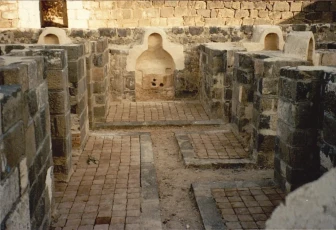
Busra, Hammam Manjak, hot section (juwwani)
Rooms of the proper bath after restoration

An arch in Qasr al-Hayr ash-Sharqi
[Original: Arch-k.K6/=HQ k.K 60,]

Turmgräber, Tal der Gräber (Westnekropole)
[ Description by author: Der hohe hinten ist der des Maliku (vgl. Bild 0820, der ganz rechts der des Jambliqu (vgl. Bild 0823 - 0830 !). Gesehen von ~ Nordwesten. ]

The historical sulfur spring of Afqa
[ Description by author: Nach Südwesten. Ich vermute, dieser Kanal, an dessen Eingang man hier steht, ist der Zugang zur eigentlichen Quelle. ]

Ländliche Häuser im Marj-Gebietöstlich der Ghuta

At-Takiyya as-Sulaymaniyya, Innenhof mit Moschee
[ Description by author: und Innenhof mit Wasserbecken, gesehen von ~ Nodwesten. Links ein Ausstellungsstücke der Armee: irgendeine MIG ....... ]

Church of the monk Buhayra, Busra
[Original: Bahira-Basilika, paganer Profanbau des 3. Jhs. n.Chr., der später christianisiert wurde -Außenansicht]

Khan Qurdbak, Haupteingangsportal

Jaʿbar castle, southern side of the castle

Several peaks in the Costal mountains (Jibal as-Sahiliyya)

Khan Qurdbak, southern portico

Izraʿ, al-Jamiʿ (Moschee) al-ʿUmari, Innenhof

Archäologische Funde aus Raqqa, ausgestellt im Damaszener National Museum

The Great Colonnade behind the palm trees
[ Description by author: Zum Standort s. Bild 0588 ! Zentralabschnitt: links, verdeckt, der Monumental-Bogen, rechts der Tetrapylon. Dahinter in der Mitte zwei Grabtürme, ganz hinten, an der Efqa-Quelle, das Hotel Palmyra Cham Palace. ['[Tetrapylon Hotel],'] ]

Qanawat -Roman nympheum

Damaskus, Khan Asʿad Basha al-ʿAzm, Pendentif-Kuppel

Raqqa, Qasr al-Banat, Hof mit Südiwan

Habuba Kabira, Blick über Kragkuppeln während der Bauphase

Blick in einen überwölbten Raum in der Burg Najm (Qalʿat Najm)
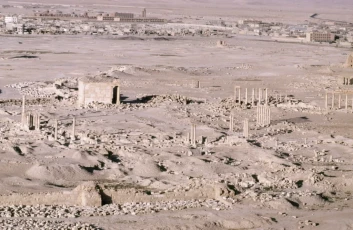
View from Jabal Husainiyya towards Diocletian's camp and Allat-temple
View from above towards north

Palmyra, view from afar of Qalʿat Ibn Mʿan (castle)
seen from the south

Khan Qurdbak, general view of the courtyard and the porticos

Jamiʿ Aslan Dada, hall dome - squinch and muqarnas

Metallwerkstatt in Raqqa

Capital of column, courtyard of Bel Temple
[ Description by author: Kapitell. Auch von der Höhe her der ideale Gartentisch ....... ]

Raqqa, Qasr al-Banat, Capital with plant motifs

Khan Qurdbak, Steindekor oberhalb eines Fensters des Iwans

Ein Dorf mit schilfgedeckten Häusern in der Ghab-Ebene
[Original: Dorf mit z.T. traditionellen schilfgedeckten Häusern im Ghab-Gebiet]

The tower tombs, Valley of the Tombs
[ Description by author: Starkes Tele, vielleicht sogar Tele + Konverter. Zum Standort s. Bild 0592, der Blick wäre dann von ~ Ost-Nord-Ost.. ['Zenobia Hotel (?),'] ]

Gesamtansicht der Burg (Qalʿat) Salah ad-Din

Waqf of Ibshir Mustafa Pasha, Coffeehouse, interior
The hall has a rectangular ground plan. Based on a square middle room, it is divided by 12 pillars, all spanned by pointed arches, into 20 compartments of two different forms: two narrow oblong ones each on three sides of the central area (see picture 5) and two smaller square ones each in the adjacent corner areas. The central area is covered by a high dome. Supported by four massive pillars, it rests on muqarnas pendentives – triangular-shaped with tiered rows of geometric cells –, and is topped by a round lantern with small columns plus pointed cupola. The other parts are covered with elongated, flattened vaults and small domes according the respective compartment form.

Jamiʿ al-Mihmandar, interior of the prayer hall

Häuser entlang des Barada in der Altstadt von Damaskus

Tall Tamir, Mews of a huge farmstead

Al-Bimaristan an-Nuri, Baudekoration über dem Türsturz
Über dem Türstürz des Bimaristans ist ein antiker Giebel wieder verwendet worden (Spolie). Darüber befindet sich eine Blendnischendekration die typisch für die islamische Zeit ist.

Madrasa al-Hallawiyya: Innenansicht auf eine ehemalige byzantinische Apsis
Teile der byzantinischen Kathedrale (5. Jh.) wurden im 12. Jh. in eine religiöse Hochschule (Medrese) integriert. Während des Krieges wurde das Gebäude beschädigt und geplündert. [Original:'Al-Madrasa al-Halâwiya, Halab / Aleppo. Inneres. Diese Nische ist Teil eines Tri- (Tetra-) Konchos, der zur verschwundenen St.-Helena-Kathedrale aus dem 5. Jh. gehörte, die ihrerseits die Stelle eines antiken Tempels einnahm. Sie ist die einzige völlig erhaltene Nische. Vgl. Bild 1241 - 1247 !'].

Qasr Asʿad Basha al-ʿAzm, Brunnen in der nördlichen Hofarkade

Bel-Tempel, Peribolos-Ecke NW
[ Description by author: Aber welche ? Die Form des Mauerwerks und des Porikus sprechen für die Nordwest-Ecke und nachmittags / abends wäre eine derartige Beleuchtung möglich.- Wenn diese Überlegung stimmt, gesehen von ~ Nordwesten. ]

Excavation work at Tall Afis
![Tall Brak (Nagar), ruins of Naram-Sin Palace, 3rd millennuim BC. [Original photo name: naram sin palace2]](https://syrian-heritage.org/wp-content/plugins/justified-image-grid/timthumb.php?src=https%3A%2F%2Fsyrian-heritage.org%2Fwp-content%2Fuploads%2F2020%2F06%2Fshap_import_44759.webp&h=230&q=90&f=.webp)
Tall Brak (Nagar), ruins of Naram-Sin Palace, 3rd millennuim BC. [Original photo name: naram sin palace2]
shap_import_44759

General view of ʿAyn Dara temple

A farmer in the Badiyya shows the traditional pillows woven by his wife

Propylaea of Jupiter Temple, Damascus

Raqqa countyside, shepherd with traditional woolen coat in the village Suwaydiyya Kabira

Khan al-Jumruk, Ansicht der Moschee im Zentrum des Innenhofes

A view of the walls and the castle, Halabiyya-Zalabiyya

Jamiʿ al-Mihmandar, minaret
The minaret is of the Anatolian style, with a square base, octagonal drum, and cylindrical shaft ornamented with zig-zags and blind arches. It dates to later in the 14th/8th century and was not constructed as part of the original mosque. the minaret reconstrued in 1946.(archnet.org) The minaret had suffered severe damage during the conflict in Aleppo (2012-2016) and eventually collapsed.

Busra, Zitadelle
[Originalbeschriftung: HQ-k.K7]

Jamiʿ (mosque) al-Hanabila - plan
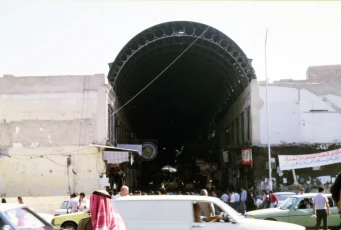
Entrance of Suq al-Hamidiyya in the eighties of the 20th century, Damascus

Corner pilaster topped by Corinthian capital, Funerary Temple
[Original: Tempelgrab Nr. 86 Weinrankenfries eines Eckpilasters]

General view of Tall Afis
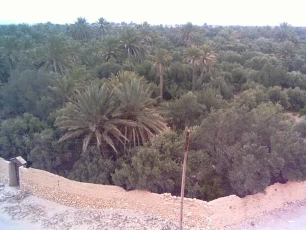
Palm groves

Afamiya, a side of ruins
shap_import_44111

Turmgrab des Elahbel im Tal der Gräber (Westnekropole)
[Original: Grabturm in Palmyra]

A circular skylight opening of Khan Asʿad Basha al-ʿAzm's courtyard (collapsed central dome)

Bayt Wakil, dome of the reception hall from the inside

Dayr Zakka, Fußbodenmosaik aus der Vorhalle der Klosterkirche

Afamiya, Remains of Great Colonnade (Cardo Maximus)
shap_import_70674

An irrigation canal in the Ghouta of Damascus

Tartus, museum in the former cathedral, view at western facade

Qalb Lawza, Basilica of 5th c., south aisle

Traditionelle Hochzeitsfeier in dem Dorf Suwaydiyya Kabira im Umland von ar-Raqqa

The Great Colonnade at Afamiya

Ansicht der Burg Jaʿbar am linken Ufer des Euphrats

Main facade of Jamiʿ at-Tawashi mosque (stitched panorama)
Photograph of mosque's main, southeastern, facade during ongoing works of refurbishment and partly recovery work. Several pictures have been put together to a panorama.

Qasr al-ʿAzm, Obergeschoss, Eingangsfassade der Qaʿa mit Kuppel

Two workshops for the manufacture and sale of iron tools in Raqqa

Der Süd-West-Turm der Zitadelle von Damaskus

Adult son of the semi-nomadic family in their tent from the Maskana region

Maronite Cathedral, general view of the main entrance

General view of the Shumaymis Castle
auf ihrem Vulkankegel (oben als Fels und im Mauerwerk Basalt !). Gesehen von entweder Südwesten (so der GPS-Tag) oder von Südosten, von der Straße Hamâ - Salamiya. [Original: Qal'at ash-Shamîmîs']

East of the Ghuta, rural houses in the Marj area

Stadtor (Bab) as-Salam, Portal mit Ablaq-Dekoration (verschiedenenfarbige Steinlagen)

An olive grove in the Ghouta of Damascus
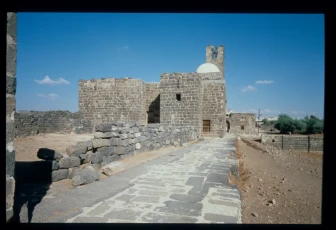
Busra - Madrasat Abu al-Fidaʾ, view from west

Ar-Raqqa - Islamic coins discovered in the site of al-Jamiʿ al-ʿAtiq
Numairidian Coin; approx. 450 h.; Ra91-GrMo-8146 (B)

al-Malikiyya - ʿAyn al-Khadra, Basaltgrab mit arabischer Inschrift

Teilansicht der Ruinen von Ugarit
shap_import_74034

Ghouta of Damascus, collecting of hemp in 1970s

Khan Qurdbak, western portico from the inside

Ansicht der Ost- und Süsostseite der Burg (Qal'at) al-Marqab

In der Pilgerkirche des hl. Simeon Stylites, 5. Jh. n. Chr.

Habuba Kabira, construction of a relieving arch using piled bricks, which are later removed

Khan Murad Basha (Museum von Maʿarrat an-Nuʿman), Innenhof
shap_import_74303

Junblat house, the southern iwan decorated with marble and tiles
The summer iwan belongs to a residential large house with several courtyards and opens to one of them. It is lined with ceramic tiles. Parts of the complex were damaged during the war.

Busra, Masjid Yaqut (Moschee), Eingangsportal

Afamiya, die gedrehten Säulen der Kolonnadenstraße

Vicinity of Tall Abyad, shell of the house with flattened domes and opening in one dome

ʿAyn al-Khadra, Im hinter dem Haus gelegenen Wirtschaftshof mit Stallungen aus Basaltsteinen

The southern end of the Great Colonnade at Afamiya

The Roman Theatre and the Ayyubid Citadel, Busra
[Original: Theater, Bühnengebäude (wahrsch. spätes 2. Jh.)]

Monastery of St Simeon Stylites, Corinthian capital

Bayt Ghazala, ʿAjami-Wandvertäfelung in der Hauptempfangshalle (Qaʿa)

Muzayrib, Reste einer alten Brücke

Blick auf die Nuri-Moschee und die Kilaniyya Norias (Wasserschöpfräder) in Hama
Blick von der Kilaniyya Brücke in Richtung der Nuri Moschee. Die Gruppe der drei Norias gehört zur Gruppe der sog. Kilaniyat (Kilaniyya, Tawafira und Jaʿbariyya).

Madrasat al-Firdaws, Innenhof nach Nordosten mit Iwan (Nord) und Ostarkade
[Original:'Madrasa al-Firdaus, Halab / Aleppo. Fertiggestellt 1235/36. Hier der Innenhof mit dem großen Iwân.].

Khan at-Tutun, courtyard

General view of the Mediterranean sea in Baniyas

Lower part of Temple colomns, Harran al-ʿAwamid
[ Description by author: Wie an der linken Säule erkenntlich, wurde offensichtlich ein Basaltkern mit anderem Material (Kalkstein ?) umkleidet. Ich habe irgendwo auch etwas von nabatäischem Einfluss gelesen: diese Säulen-Umkleidung erinnert u.a. sehr stark an die im Löwen-Greifen-Tempel in Petra. Vgl. Bild 0373 ! ]

Bel-Tempel, Säulenkapitel der Portikus
[ Description by author: Ein Kapitell des Portikus, vielleicht aus dem Nordost-Bereich. ]

Al-Jamiʿ an-Nuri, Minarett
1172 erging der Erlass zum Bau dieser Moschee.- Gesehen von ~ West-Nord-West. ['Original: Hamâ (Epiphania),']

Ein Teil der Mauern von Qalʿat Harim

Busra - Hammam Manjak - Restoration works
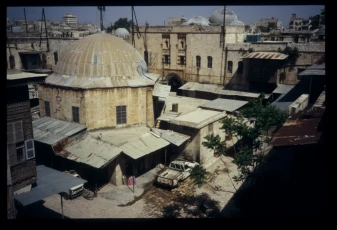
Khan al-Jumruk, general view of the mosque in the center of the Khan's courtyard

Zwei große Wasserreservoire in den Ruinen von Kharab Sayyar

Seitenansicht der Burg Najm (Qalʿat Najm)

Stadtmauer von ar-Raqqa nach der Restaurierung
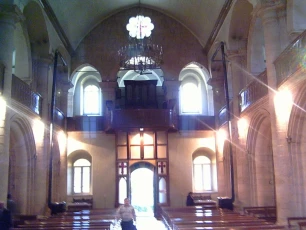
Maronite Cathedral, the nave

Stucco panels on the walls of an Abbasid building in Kharab Sayyar

Damaskus, Khan Asʿad Basha al-ʿAzm, Arkade mit Kreuzgewölbe

Al-Madrasa al-Hallawiyya, Innenhof mit Wasserbecken

Carved giant footprints at the threshold of the entrance of ʿAyn Dara temple

Eine Gasse in der Innenstadt von Halbun

Khusrawiyya-complex, view of the Mosque in 2010

Hama, General view of al-Madiq castle from the southern side

At the peak of Mount Hermon (Jabal Haramun)
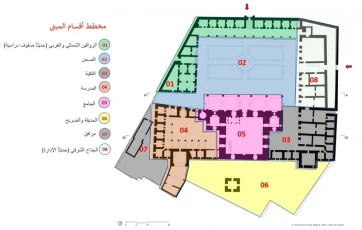
Khusrawiyya-Komplex: Lageplan der Bauten (Arabisch)
Die Khusrawiyya ist stark zerstört. Die Nordarkade und Teile des Westflügels des Komplexes sind beschädigt. Es gibt Teile, die noch unter Schutt liegen. Der Schadensgrad liegt bei ca. 80%. Das Zentrum des Explosionskraters, der 2014 entstanden ist, befindet sich unterhalb des Gebetsraums, d.h. in der Kuppelhalle der Freitagsmoschee, die nicht mehr steht. Wahrscheinlich sind die Fundamente im Inneren des Kraters verloren, während der übrige Teil des Geländes Reste des Gebäudes enthalten kann, die vielleicht für eine mögliche Rekonstruktion ausreichen. Es wurden noch keine Maßnahmen zum Schutz oder zur Behandlung der Trümmer ergriffen.

Temporary title for Image 75590
[ Description by author: Rechte Seitenwand: oben in den Medaiilons zwei Evangelisten, darunter Apostel. ]

Al-Madrasa al-Hallawiyya, Eingang zur Gebetshalle

Bayt Junblat, southern iwan (the great iwan)

A traditionally crafted tapestry weave
Appliqué for the decoration of textiles
Drawings by Estibaliz Sienra Iracheta to illustrate processes of traditional textile manufacturing

Krak des Chevaliers, courtyards

Gesamtsicht auf al-Jamiʿ an-Nuri und Kilaniyya-Wasserradgruppe am Orontes in Hama
Gesehen nach ~ Südwesten vom Dach des "Afamia Cham Palace", rechts etwa anschließend an Bild 0978. Vor der Moschee zwei Nawâ'îr, eine weitere links unten. . ['Original: Hamâ (Epiphania),']

Hypogeum of the Three Brothers from the inside - mural paintings
Nekropole - Grab der drei Brüder - 160 nChr {Foto}

Nische mit Muqarnas-Gewölbe am Haupteingang Bimaristan an-Nuri

Bayt Ajiqbash, view of the courtyard interior

The Great Colonnade towards the Monumental Arch
View to the south east

Arch of Triumph (Qaws Hadrian) from the outside
[ Description by author: Der Bogen kaschiert einen Straßenknick von ca. 25° nach links von ~ Nord-Nord-West nach ~ Nordwest. Er besteht aus zwei "Scheiben", jede rechtwinklig zum entsprechenden Straßenabschnitt. Der Grundriss bildet also ein "V" mit der Spitze links. Jede "Scheibe" hat drei Durchgänge, aber nur bei der hinteren ist der höhere mittlere Bogen erhalten. Zwischen den "Scheiben" vertrittt Mauerwerk die Säulen, links (hier verdeckt) mit einer Öffnung, rechts mit zweien. Auf dem Bild sieht man den Knick von außen: die Säulenbasen links vorn gehören zum 1., die Säulen links hinten zum 2. Abschnitt der Säulenstraße. Um die vordere "Scheibe zu rekonstruieren, muss man eine Linie vom Bogen links zum Bogen rechts ziehen und sich darüber den zweiten hohen Mittelbogen vorstellen. Vgl. Bild 0663a ! ]

Burj as-Saʿa, general view

Al-Madrasa al-Muqaddamiyya, the entrance

Khan Qurdbak, southern part of the Khan - iwan of the Mamluk Palace

Hypogäum der drei Brüder, Innenansicht mit Wand- und Deckenfresken

Raqqa, Planentwurf der Stadt ar-Rafiqa mit Stadtmauer
Überlagerungszeichnung mit verbliebener Straßenstruktur und modernen Stadtteilen. 84-87% > ca. Maßstab 1:10.000

Blick über die monumentalen Ruinen von Theater, Agora und Annex
[ Description by author: Hinten Mitte das Theater und die Rundstraße um die Cavea. Davor links die Agora mit ganz links dem Bankettsaal. Rechts der Agora der Annex. Blick nach ~ Nordosten. ]

Bimaristan Arghun, view of main courtyard
shap_import_60864

Agricultural fields and industrial complex near Baniyas

Manbij, Bäckerei von dünnem Fladenbrot, mit Blick in den Ofen

Busra - Birkat (pool) al-Hajj

Bayt (Haus) Quwatli, Ansicht des Innenhofes mit Iwan
Hof mit Bahra u. Liwan

al-Malikiyya - ʿAyn al-Khadra, Basalt Tomb with arabic inscription

Al-Matbakh al-ʿAjami: Qaʿa, Schnitt Ost-West, Blick nach Norden

Khan Qurdbak, Khan Qurdbak, Haupteingangsportal - eisenbeschlagener Türflügel aus Holz

Arched window of perforated stucco, al-Bimaristan an-Nuri
[ Description by author: zum Innenhof. ]

Threshing in Sahl Hawran (Hawran Plain): farmers are separating wheat from chaff

Raqqa, Qasr al-Banat, courtyard with northern Iwan
[ G 88/ 19/ 236] =[ photo's name as: year/ film no./ photo no,].(ref. http://www.esyria.sy/eraqqa/index.php?p=stories&category=todayimg&filename=201003152100042)

Küchenzelt mit Feuerstelle der halbnomadisch lebenden Familie aus der Maskana region

Homs, Khalid ibn al-Walid Mosque, an old photo from the 1920/30s
Note: these photos were taken between the year 1924 - 1939. The chosen date is to be average. (photographer unkown)

Raqqa, Haupteinkaufsstraße mit traditionellen Verkaufsstellen

Afamiya, Ruinen der Kolonnadenstraße (Cardo Maximus)
shap_import_70671

Tower north of Bab Antakiya, a side of the defensive tower after the removal of infringements

Orpheus-Mosaik - Gesamtaufnahme

The northern-eastern tower of Damascus Citadel
One of the most beautiful towers of Damascus Citadel with its carefully carved stone rows. This upper part of the tower contains a machicolation, and the tower ends with parapets interspersed with arrow slits.

Al-Madrasa al-Kamiliyya, courtyard and iwan

Al-Matbakh al-ʿAjami, muqarnas squinches of the iwan dome

Damascus, Glass Blowing Workshop near Bab Sharqi
[Original: LEAD Technologies Inc. V1.01]

Yabrud: making Burghul, in background a wall in a special pisé-technique
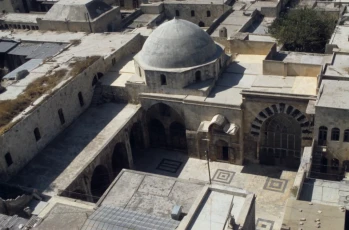
Al-Madrasa al-Hallawiyya, general view of the madrasa from the Great Mosque minaret

Raqqa - "East of Raqqa" site - aerial photo of the West Palace

Busra, Hammam Manjak, Restaurierungsarbeiten

A view shows monasteries and residential buildings, Saydnaya

The semi-circular towers of ar-Raqqa Wall

Museum of Arwad - Arwad citadel

Bayt Wakil (Aleppo-Room Berlin), details of the painted wooden panel
The painted wood panel belongs to Wakil house in Aleppo. It represents floral patterns of multiple colours.

The Citadel of Damascus from the inside, 2003

Diokletians-Thermen
[ Description by author: - aber was sollen dann die Säulen vorn ? Im Hintergrund der mittlere Abschnitt der Säulenstraße, die Bögen markieren den südlichen Eingang in die Rundstraße ums Theater. Die Außenseite von dessen Scaenae Frons erkennt man rechts hinter den Säulen. Gesehen von ~ Nordosten. ]

Palmyra, Baal Temple - Temenos wall with propylaeum and view towards the oasis

Qasr al-Hayr al-Gharbi, seen towards the south
[Original: Mo. Nach S.]

Raqqa, Außenansicht des ar-Raqqa-Museums

Simeonskloster (Qalʿat Samʿan), korinthisches Kapitell mit "windbewegten" Akanthusblättern
[Original: k.K6/=HQ k.K25]

Excavation work, Qasr al-Hayr al-Sharqi

Fresko im Nordschiff der Kirche, Kloster Sankt Moses der Äthiopier
[ Description by author: Nördliches Seitenschiff, erster Pfeiler: Engel. ]

Raqqa/Rafiqa, alte Fotografie der Ruinen des Qasr al-Banat vor der Restaurierung
[Original: Palast. Aufnahme von Westen/ 1945 Geschenk Prof. Friedrich Sarre]

General view of Husn Sulayman

Damascus, part of the city wall and the eastern tower

Raqqa, Luftbild des Palastes von Hiraqla

Blick auf den Krak des Chevaliers
[Original: 1150 - 1250 vom Johanniterorden erbaut, Außenansicht]
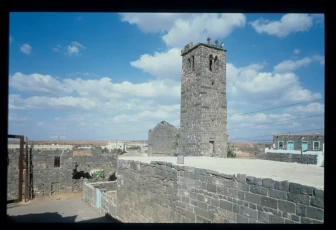
Busra - Jamiʿ (mosque) Fatima, exterior view

Qasr al-ʿAzm, view of the ground floor courtyard

Jamiʿ Aslan Dada, the hall - octagonal neck of the dome

Remains of an entrance, Diocletian Baths
[ Description by author: in oder bei den Thermen. Da nur die Türrahmen in sehr verwittertem Zustand (Kalkstein !) übrigblieben, erinnert das Bild an Dolmen ....... Im Hintergrund der Monumentalbogen von innen. Der GPS-Tag ist approximativ ! Gesehen von ~ Nordwesten. ]

People gathering near a government office, Raqqa

Raqqa, Nordostkomplex

Madrasat al-Firdaws, courtyard, iwan and western arcade

Remains of the Byzantine tower incorporated into the Umayyad complex at Qasr al-Hayr al-Gharbi (Palace)
[ Description by author: Gesehen von ~ Südwesten. ]

Wakil house, dome of the reception hall
A view of the hall’s dome from the outside, where the rectangular windows appear clearly on the neck of the dome.

Archaeological finds from Raqqa, exhibited in the Damascus National Museum
Glass cup and drinking glass from ar-Raqqa ; National Museum Damscus

Al-Madrasa al-Hallawiyya, dome of the prayer hall

Qalʿat Ibn Maʿn, Treppe im Innern der Burg
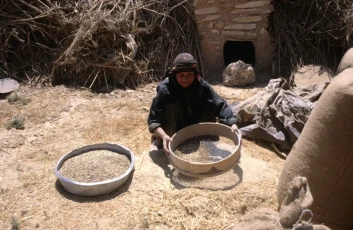
Habuba Kabira, screening of barley as seed by the grandmother
Jamiʿ ar-Rumi, general view of the minaret

A general scene showing some of the ruins of Palmyra and the Castle Ibn Maʿn

Nahiyat at-Tabqa, Euphrates Dam

Transporting sugar beets in al-Ghab Plain
[Original: Zuckerrübentransport im Ghab]
Coffehouse Aslan Dada (vanished)

Bayt Wakil, iwan

Raqqa, Qasr al-Banat, Wandgliederung mit Lehmziegelornamenten
Neg. Nr. 83/5-31A/32

Remains of 'Ayn Dara temple built of basalt stones

Eingang in die Burg (Qalʿat) Salah ad-Din

A side from historical Qalʿat Masyaf

Frühlingslandschaft, Raʾs al-ʿAyn

Künstliche Feldbewässerung und Trinkwasserverteilung in der Ghab-Ebene

Citadel of Aleppo, entrance gateways and bridge

Reste der Brücke bei ʿAyn Diwar

The church of St Peter?, Saydnaya
[ Description by author: oder kleiner Tempel, Genaueres war nicht zu finden. Heute eine Kirche, Mar Butrus. Das Gebäude befindet sich in "100 yards" Entfernung vom Marienkloster, ich habe aber auf den Google-Karten nichts entdeckt und darum keinen GPS-Tag gesetzt. Eventuell steht es links an dem Kreisel südöstlich des Klosters, d.h. in der Nähe des Standortes von Bild 0419.- Zum Eingang links vgl. Bild 0422 ! ]

Bayt Wakil, reception hall - western wing

Raqqa, Qasr al-Banat, Säulenkapitell mit vegetabilen Motiven

ar-Rusafa, Nordtor, Blick in den Innenraum

Einer der Türme der Burg von Shayzar

Damascus, Khan Asʿad Basha al-ʿAzm, a circular aperture in the roof of courtyard
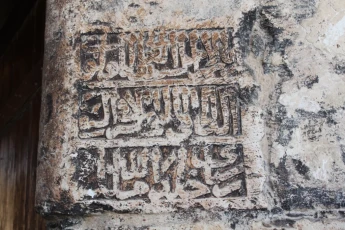
Qal‘at Shayzar ( Citadel), An Arabic inscription.


Al-Madrasa al-Kamiliyya, Innenhof

Tomb tower of Elahbel in the Valley of the Tombs
[Original: Südwestnekropole, Hypogäum der „Drei Brüder“, Mitte 2. Jh. erbaut, bis 259 belegt]

Archaeological excavation in Kharab Sayyar

Part of Damascus city wall topped by a house balcony
[ Description by author: aus ayyubidischer Zeit mit neuerer Überbauung. Im Hintergrund das Minarett des Bâb Sharqi. ]

Schafherde an einem Wasserbecken in der Region al-Hawl nahe der irakischen Grenze

Damascus Gate on the south eastern side of the City Wall, Ebla (Tall Mardikh)
~ Ostseite, Abschnitt zur Stadt. Gesehen von der ~ Westseite nach ~ Osten. [Original:Tall Mardîkh (Ebla)']

Khusrawiyya, Detail der ornamentalen Verkleidung der Moschee im Jahr 2008

Jamiʿ as-Saffahiyya, Fenster in der Außenfassade

Jamiʿ al-Maydani, the minaret

Tall Dahab, Mittelhallenhaus - die Breite der Halle entspricht dem Rücksprung in der Fassade, die Loggia wird zum Aufenthalt benutzt

Jabla, Mosque of Sultan Ibrahim, Quranic calligraphy

Al Madrasa al-Kamiliyya, courtyard and prayer hall facade

Left volute of the lintel, Damascus Gate, Palmyra
[ Description by author: Die linke Volute des Türsturzes, gesehen von ~ Südwesten. ]

Aleppo, Khan as-Sabun, Blick auf den Innenhof nach Westen

A part of at-Takiyya as-Sulaymaniyya, showing a vaulted arcade and the two minarets of the mosque

Khan Ujkhan, Eingangsfassade

Rural life in Qalamun mountains (Antilibanon): peasants returning home from grape harvest

Ar-Raqqa: Hersteller von Pferdegeschirr

Qasr al-ʿAzm, Wandmalerei im Iwan
Malerei auf der Rückseite des Iwans. ['Original: Hamâ (Epiphania),']

North-East Syria: Weaving in a tent

Imam Ismaʿil-Moschee, Mausoleums-Kuppel von innen - Muqarnas-Zwickel
Zwickel an der Kuppel. Irgendwo habe ich gelesen, dass diese kleinen Nischen die erste Stufe der Entwicklung der Muqarnas darstellen und dass darin die künstlerische Bedeutung der Moschee bestehe.- S. Beschreibung Bild 1052 gegen Ende ! [Original: 'Salamiya (Salamias)']

Jamiʿ al-ʿAdiliyya, general view of the prayer hall

Khan al-Jumruk, general view

Bayt Ghazala, 17th c. ground floor plan
The only private house that includes a private bath (hammam) and six courtyards. It suffered structural damages and the loss of unique interior decorations (ʿajami).

Qalʿat ash-Shugr wa-Bakas, Burgruinen auf einem Bergvorsprung

A group of doves in the old city of Aleppo
Some of the residents of the old city used to raise pigeons for fun and to enjoy them. Here we see a number of doves resting on the roof of an old building.

Damaskus, Glasbläserei nahe Bab Sharqi
[Original: LEAD Technologies Inc. V1.01]

Remains of Harim Castle
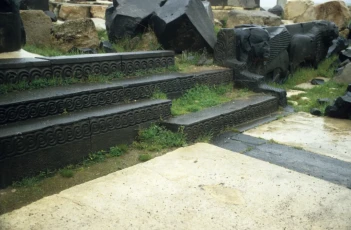
ʿAyn Dara, Bas-relief motif decorating some steps of the main entrance, southern façade of Ishtar Temple
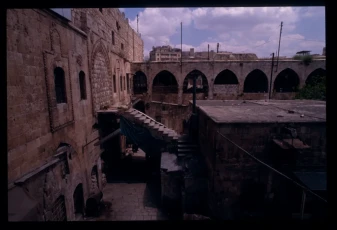
Khan as-Sabun, view of eastern gallery, northern inner facade and building part inside of courtyard

Temporary title for Image 75591
[ Description by author: Zumindest Rückwand des Raumes rechts der Apsis: Fresko eines Heiligen, Ich wäre geneigt, die Buchstaben als "Abraham" zu lesen - aber wird der so recht jugendlich mit Heiligenschein dargestellt ? ]

Altstadt von Damaskus, Kupferstecher arbeitet an der Ornamentierung eines Gefässes

Ceiling ornament, Asʿad Basha al-ʿAzm Palace

Blicküber Husn Sulayman

The Great Colonnade

Tall Dahab, Cement-fixed area where rinsing or washing is carried out, body washing may take place there too

Große Moschee von Aleppo (Umayyaden-Moschee), Boden des Innenhofes mit geometrischen Musterfeldern

Turbat Khaʾirbak, Westfassade und Kuppel des Mausoleums

Qasr Asʿad Basha al-ʿAzm, Blick in den Innenhof des Familienwohnbereiches

Maronitische Kathedrale St. Elias, Altarbaldachin

View over the roof of the south-western Madrasat Ismaʿil Basha al-ʿAzm to the Umayyad Mosque with its high transept of the prayer hall with a central dome and its three minarets

Busra - Jamiʿ (Moschee) al-Mabrak

Sculpture of a camel and two persons with Parthian costume
[ Description by author: aus Palmyra in parthischer (Hosen !) Tracht. ]

Habuba Kabira, offene Brunnenkammer für Feldbewässerung, im Hintergrund Motorpumpe des Brunnens

A female Kurdish tribe leader wearing a screen-printed headscarf called Habari

Khan al-Jumruk, drawing of the interior facade of the Khan's entrance

Qatna, Stadtareal innerhalb der Umfassungsmauer, Grabungsarbeiten
. [Original: Al-Mishrifa / Qatnâ']

Izraʿ, al-Jamiʿ (Moschee) al-ʿUmari, Innenhof

View of plastics and metal waste, at-Tabqa

A partially demolished historic building in the historic Midan district

Jamiʿ al-Qayqan, verbaute Spolie mit hieroglyphischen Steingravuren

Tartus, cathedral, interior view of the ruinous nave of the church
Interior view of the cathedral of Tortosa with shepherds in the ruinous nave. Reproduction of an engraving by W. H. Bartlett. Assumed date of origin around 1830. [Original: Christian Church at Tortosa]

Jamiʿ Aslan Dada, interior view of the hall dome


Capital and remains of the Byzantine cathedral, Qalʿat Burqush
[ Description by author: Es soll bei der Kathedrale fünf Kapitell-Typen geben, hier einer davon, auf Bild 0086 ein anderer. Ich vermute, dass das Kapitell nicht wiederverwendet römisch, sondern original byzantinisch ist. Ist der Stein im Hintergrund Teil einer Türschwelle (Tür zum Betrachter hin öffnend) ? ]

Bimaristan Arghun, Inschrift

Remains of the Cathedral, Qalʿat Burqush
[ Description by author: Auch dieses Halbsäulen scheinen mir ursprünglich römisch zu sein: Dekor der inneren (äußeren ?) Cella-Wand. Vgl. Bild 0084 ! ]

Palmyra, Remains of Allat Temple- Camp of Diocletian
[ Description by author: Gesehen von ~ Nord-Nord-Ost: rechte Seite und Rückwand. Ganz links das Temenos-Tor. ]

Bab Antakiya, Gesamtansicht des Tores mit Stadtmauer

Bayt Ghazala, courtyard - northern facade

View from Qalʿat ash-Shugr wa-Bakas

Damascus, Khan Asʿad Basha al-ʿAzm, a view of the circular aperture in the roof and the fountain in the middle courtyard

Tall Bdiri, House consisting of a large living room with a small attached kitchen

Al-Madrasa ar-Rukniyya al-Barraniyya, Ansicht von Süden

Al-Madrasa al-Hallawiyya, iwan

Suq ad-Dahsha, Ansicht der Marktgasse

Fassade der Kirche, Qasr Ibn Wardan
[Original: Kirche (Kuppelbasilika mit Emporen, Innenraum)]

Ein Taubenschwarm in der Altstadt von Damaskus
Eine Szene eines Taubenschwarms, der sich über den Dächern versammelt

In the Orontes valley below the village of Qalʿat al-Mudiq is situated a 16th c Khan, which has become a Museum

View of the Orontes valley at low water

Qalʿat Ibn Maʿn, Zugangsbrücke über dem Burggraben

Damascus, Khan Asʿad Basha al-ʿAzm, general view of the vaults and pendentive
Cross vaults carrying domes, Khan Asʿad Basha al-ʿAzm

Khan Qurdbak, Blick über den Innenhof

Hammam al-Bayyada, Gesamtgrundriss

Khan Qurdbak, iwan of the Mamluk palace

View of a hill in the upper Euphrates valley (al-Furat al-Aʿla)

ِAleppo, Khan as-Sabun, Teilansicht der östlichen Arkade des ersten Stockwerks

The northern entrance of the historical city of Dura Europos (Qalʿat as-Salihiyya), end of 4th century BC

Madrasat al-Firdaws, the marble prayer niche (mihrab) decorated with floral and geometric motifs

Die Zayzun-Wasserfälle entstehen durch einen Nebenfluss des Yarmuk, der dort die Grenze zwischen Syria und Jordanien bildet

A woman showing a woven saddle bag with embroidery

Turbat Khaʾirbak (mausoleum), cross section of the facade

Al-Umma Park (Hadiqat al-Umma) in Damaskus

Stamping machine for punch cards for the Jacquard looms in the textile factory Mezannar in Damascus

Ein Turm der Zitadelle von Damaskus
Blick auf einen Turm an der Ostfassade der Zitadelle Damaskus. Im oberen Bereich des rechteckigen Turms befindet sich eine Reihe von Maschikulis.

Tall Bdiri, Eine einfache Wandöffnung in einer Lehmziegelmauer mit Lehmputz - vermutlich an einem Stall

Simeonskloster (Qalʿat Samʿan), korinthisches Kapitell mit "windbewegten" Akanthusblättern
[Original: -k.K6/=HQ k.K24]

Afamiya, Ruinen der Kolonnadenstraße (Cardo Maximus)
shap_import_70674

Erweiterung des Hafens von Tartus
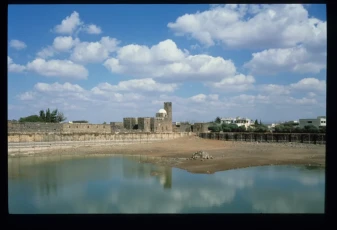
Busra, Birkat (pond) al-Hajj and Abu al-FidaʾMosque
During the rainy saison the pool is filled until today with water.

Application of the relief paste of a ‘Ajami decoration
Ziad Baydoun in his workshop in Malaysia

Busra, the western wall and the apse are the remains of the Byzantine Cathedral built in the 6th century
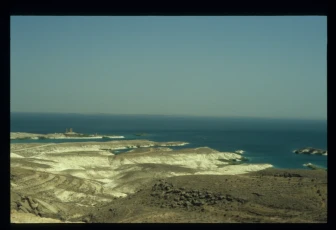
General view of Balis on the Euphrates river

Interior view towards the entrance, Agora
[ Description by author: Ostecke. Das Tor ist das von Bild 0704, aber jetzt von innen. Im Torrahmen sieht man den Mittelteil der Scaenae Frons des Theaters. ]

Bayt Junblat, courtyard and northern iwan

Müll neben einer Obstplantage in der Ghouta von Damaskus

Haus Wakil, Innenhof mit Wasserbecken

Angelegte Höhlen im Kalksteinmassiv (Südseite) an der Mündung des Sajur in den Euphrat, nahe al-Awshariyya

A warping machine in the textile factory of the Mezannar family in Damascus

Traditional production of animal glue

Bridge over the Euphrates, ar-Raqqa
[Original: Euphratbrücke]

Houses of stone and concrete in Mnin

Entrance of Khan al-Hallabat
[ Description by author: und Eingang, gesehen von der ~ Südmauer nach ~ Nordosten über den Innenhof. ]

Villages and the fertile floodplain of the Euphrates valley, that were flooded by the Tishrin-Lake

Eating breakfast in the shop

Notre Dame de Saidnaya, Sayyidnâyâ, Gesamtsicht
[ Description by author: von ~ Südosten. In dem Felssockel rechts befindet sich das Grab mit den Figuren von Bild 0420.- Trotz obiger Zuordnung (nach den wichtigsten Ausbau-Stufen): die Ursprünge der Anlage gehen in byzantinische Zeit zurück und sollen in Zusammenhang mit einem Erlebnis des Kaisers Justinian stehen: eine von ihm verfolgte Gazelle verwandelte sich in ein Marienbild (des Lukas ...), das die Erbauung einer Kirche an dieser Stelle verlangte und seither Wunder tat. ]

Excavation work inside ad-Daydariyya cave

Jurn Kabir, a typical old house of the Euphrates valley near Qalʿat Najm with a large log (willow) transverse to the longitudinal axis.

Qasr Asʿad Basha al-ʿAzm, Innenhof mit Brunnen
1929?

Natural landscape and agriculture in Sahl Hawran (Hawran plain)

Hubert Mezannar, son of Antoine Elias Mezannar. In the background is the certificate of a gold medal, the family won in 1936 on Damascus International Fair.
At the beginning of the 20th century, Antoine Mezannar brought mechanical looms from Lyon with electric motors to Damascus and became one of the first consumers of electricity in Damascus.

Kharbaqa-Staudamm: Er wurde gebaut, um die saisonalen Überflutungen in der Wüstensteppe (Badiyya) einzudämmen

Madrasat al-Firdaws, courtyard and western arcade

Burj al-Ghanam, general view of the tower's southern facade

The tower of Qalʿat Yahmur (Yahmur Castle)
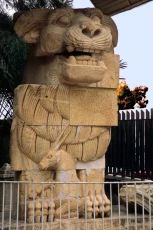
Lion of goddess Al-Lat, 1st c. AD
The lion was embedded in the outer wall of the Al-Lat temple. As a protector of an antelope it is a symbol of peacefullness. The stone statue was severely damaged by ISIS.

Jamiʿ Aslan Dada, courtyard with a rectangular basin

Eine kurdische Stammesführerin mit einer siebgedruckten Kopfbedeckung namens Habari

A photo of a residential quarter in the city of Tartus

Jisr ash-Shughur, Qalʿat ash-Shugr wa-Bakas, a twin crusader castle, Arabic inscription

Tall Bdiri, A simple opening in a clay brick wall with clay plaster - probably in a stable

Raqqa, Reste der Südarkade der Großen Moschee (al-Jamiʿ al-ʿAtiq)

Bewaldete Bergrücken im syrischen Küstengebirge

Architectural remains of the graveyard near Najm Castle (Qalʿat Najm)

Damascus, Minaret al-Qalʿi, 15 C.
One of the most important minarets from the Mamluk era in Damascus due to its rich ornamental elements of Muqarnas cells, geometrical panels.

Jabʿadin, the rock wall at Sinnir mountain

Takiyyat ash-Shaykh Abu Bakr, Gebetsnische (Mihrab)
shap_import_65912

Damaskus, Teilbereich der Stadtmauer und des Ostturmes

At-Takiyya al-Mawlawiyya, entrance and courtyard of the kitchen

Takiyyat ash-Shaykh Abu Bakr, north facade - arcade and courtyard

Altar of Nabu Temple from the northeast corner, Palmyra
[ Description by author: Gebälk-Dekor von der ~ Nordost-Ecke. ]

The Cave Monastery, northwest of Palmyra, Jazil
[ Description by author: Trotz der völlig anderen Landschaft musste ich an das Höhlenkloster Dair Mâr Marûn am 'Assi in der Nähe von Hirmil im Libanon denken (Bilder dort !). ]

Jamiʿ al-Khayr, western facade from the inside

shap_import_3226

Der Euphrat bei Raqqa

Salkhad, Archaeological remains in a vineyard

Maintenance work in the course of the Barada River, Damascus

Hand printed table cloth from Hama at Hassan's Shop, Old Damascus

Raqqa, Great Mosque; Aerial view

Busra, Zitadelle, Ansicht mit den Schienen der Hedschaz-Bahn im Vordergrund

Blick aus einem Obstgarten in die ar-Ruj-Ebene

Qasr al-Hayr al-Sharqi, Ausgrabungsarbeiten

Great Mosque of Aleppo, prayer hall interior and Shrine of the Prophet Zechariah

Maronitische Kathedrale St. Elias, einer der beiden Spitztürme

Bayt Junblat, Süd-Iwan - Fayencefliesen-Dekoration

Harvest of cotton in ar-Ruj plain

Citadel of Aleppo, main entrance gateway, hawker in foreground

Bayt Junblat, Süd-Iwan (großer Iwan)

Jamiʿ al-Utrush, Westfassade - dekorierte Fensternische, Detailansicht
Der obere Teil des mittleren Fensters der westlichen Außenfassade.

Große Moschee, Gebetshalle, Hauptportal, 2006
Haupteingang in den Gebetssaal mit Spitzbogen und Flechtwerk aus farbigen Inkrustationen und einer Restaurierungsinschrift über dem Türbogen.

A door of room beside the Iwan of Quwatli House
Liwan. Seitentür

Archäologische Funde aus Raqqa, ausgestellt im Damaszener National Museum

Erwachsener Sohn der halbnomadisch lebenden Familie in deren Zelt (aus der Maskana-Region)

Raqqa-Ost, Tall Aswad, Grabungsfund

Blick vom Hof des Klosters Sankt Moses der Äthiopier nach Nordosten auf die gegenüberliegende Talseite
[ Description by author: Blick vom Innenhof auf die ~ nordöstliche Talseite mit modernen Bauten für Leute "auf der Suche". Die teil-vermauerten Höhlen könnten die der ursprünglichen Mönche sein. ]

Tomb carved into the rock, ʿAyn as-Sahib
[ Description by author: Ädikula-Typ. Eigenartig der unsymmetrische Bogen: war der Platz links für eine Statue vorgesehen ? Vgl. Bild 0412, 0413 ! ]

Artificial field irrigation and drinking water supplies, al-Ghab Plain

Part of golden and coloured mosaic, Umayyad Mosque
[ Description by author: Mittelgang, Südwand, Westende.- Die Bilder 0179 - 0192 wurden mit einem High-Speed-Film gemacht, daher die mäßige Qualität ! (The date of this photo was not sure as Peter Heiske did [(wohl) 18/04/2004] ]

Remains of Zengid bridge in ʿAyn Diwar

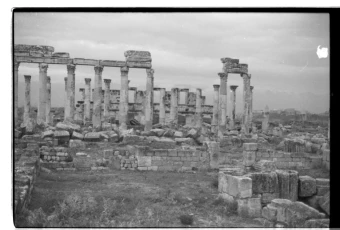

Al-Madrasa al-Ahmadiyya, column with its capital

Parking spaces infront of the textile factory of the Mezannar family in Damascus

Temple of Mushannaf, southwest corner, pilaster capital

Qanawat - Roman nympheum

As-Sabuniyya-Moschee, Ornamentfeld an der Fassade
[ Description by author: Dekor links bzw. rechts des Eingangs-"Iwâns". ]

Part of a decorated wooden door with ‘Ajami decoration from the Damascus Room in the Dresden Museum for Ethnology
Frame of the large wall cupboard door (samandāra) of the Damascus Room in the Dresden Museum of Ethnology, with a flat, white-ground strip for fixing the hinge

Tall al-Biʿa, der altorientalischen Stadt Tuttul

Noria (waterwheel) in Hama
The fine details of the norias are clearly visible. In the background the vaults of the water channel can be seen.

Khan al-Jumruk, general view of the khan with the internal facade of the Khan's entrance

Ruins of Qalʿat Maʿarrat an-Nuʿman

Al-Madrasa al-Hallawiyya, entrance - a stone base (spolia) which is the cathedral baptismal font.

Palmyra, a photo of some tower tombs

Städtische Bebauung auf dem Bergrücken in Rastan

Turbat Khaʾirbak (mausoleum), western facade - inscription band

Jabla, Ruine des Römischen Theaters
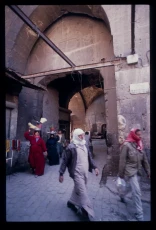
Bab Antakiya, main gate

Khan al-Wazir, Eingang in den Khan, Innenfassade

Blick auf die auf einem Berg liegende Burg Marqab

Qatna, Stadtareal innerhalb der Umfassungsmauer, Ausgrabung
. [Original: Al-Mishrifa / Qatnâ']

Sancturies graved into the rocks, Roman period, Mnin
[ Description by author: Blick auf die Anlage von (wohl) ~ Südwesten. Ganz rechts das Tor, links daneben die große Halle mit monumentaler Freitreppe zu einer Plattform davor. Links hinter ihrer Balustrade die kleine Halle mit reich dekoriertem Eingang: danach (vgl. Bild 0401 !) wird die Anlage ins 3. Jh. n. Chr. datiert. Irgendwie macht das Ganze einen "nabatäischen" Eindruck, der durch weitere Details auf den folgenden Bildern (insbesondere Bild 0401) verstärkt wird. ]

Raqqa, The ruins of Qasr al-Banat

A side of archaeological remains in Khirbat as-Sarayij

Bab al-Maqam, Gesamtansicht

Sirjilla, andron, 5th c.
In some places, buildings were found, that consist only of a huge room and a multifunctional ground-floor space. They were likely community houses (Andron).

Ash-Shaykh mountain, distant view of 'Arna village
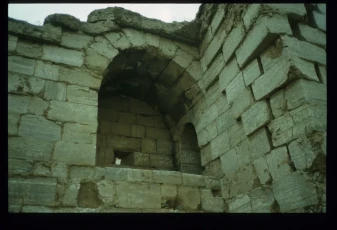
Fortification of Halabiyya

Der Gebirgszug Jabal al-Shaykh mit dem Dorf 'Arna in der Ferne

Palmyra, view from the south, valley of tombs in foreground, Qalʿat Ibn Maʿn in background

View to the east, courtyard of Jamiʿ an-Nuri (mosque), Homs
The courtyard of the mosque: to the left is the riwaq (arcade hall), opened to the north, and to the right the northern facade of the courtyard.

Traditional house in neighborhood "al-Almaji"
Traditional two-storey house from the late Ottoman period (19th century?): the main stonework façade on the upper floor is symmetrically accentuated by a leap forward wooden oriel, the "Kishk".

Ausschnitt der Stadtmauer der Burg (Qalʿat) Salah ad-Din

A view into the main road of Raʾs al-ʿAyn

Baalshamin Temple (2nd c AD), view from north west

Tall Bdiri, Abondened house with buttresses in the wall and at the door

General view of Shumaymis Castle
Teleausschnitt aus Bild 1038, gesehen entweder von dem dortigen Standort oder von dem hier angezeigten aus ~ Südosten. . [Original: Qal'at ash-Shamîmîs']

Bayt Wakil, Qaʿa, Aufriss Hoffassade der Empfangshalle

A side from the courtyard of Bayt Jubran Afandi Shamiyya, Bab Tuma

Al-Matbakh al-ʿAjami, the great iwan dome

Citadel of Aleppo, Temple of the Weather God, early 1st millennium BC
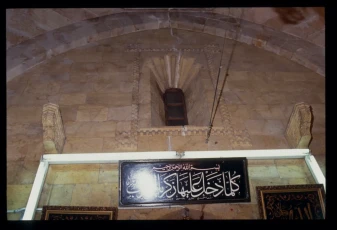
Jamiʿ Aslan Dada, prayer hall (qibliyya), window above the prayer niche

Busra, Blick in die Kathedrale, 6. Jh.
[Original: Kathedrale (den Märtyrern Sergios und Bacchios und dem Leontios geweiht), 512/13]

Al-Khusrawiyya, Friday Mosque, 1547

Raqqa - "East of Raqqa" site - Western Palace, finds
Eastern West Palace; Arch above Frieze J-i, s.SW-Neg.85/267

The minaret of Great Mosque of ar-Raqqa/ar-Rafiqa, 8th/12th c.

Jamiʿ / Turbat at-Taynabiyya, Teilansicht der Nordfassade mit Eingangsportal
[ Description by author: mit dem Ersatz-"Minarett". ]

Jabʿadin, Blick auf die traditionellen Dorfhäuser

shap_import_11878

Safita, view from the Qal'a on at-Tall quarter

Gewölbe in der Altstadt von Tartus

Qasr al-ʿAzm, terrace with portico in the upper floor
Terrasse mit Portikus vor dem Kuppelsaal. ['Original: Hamâ (Epiphania),']

Raqqa, Qasr al-Banat, mudbrick decoration

Jamiʿ Manjak, mamlukisches Minarett mit quadratischem Grundriss

Raqqa - "East of Raqqa" site - Tall Aswad, excavation in 1985
[1985/72/988] = [photo's name as: year/ film no./ photo no.]

Raqqa, Qasr al-Banat, documentation sheet of courtyard with northern Iwan
The palace called "Girls' Castle" has a courtyard surrounded by four open halls (Iwan). This type of groundplan is known above all from Iran.

Bimaristan an-Nuri, Innenhof

A side of the city remains, Ugarit
shap_import_74034

Fresco above the apse of the church, Monastery of Mar Musa al-Habashi
[ Description by author: Triumphbogen über der Apsis, linker Teil und Mitte (Fortsetzung s. Bild 0488 !). Phase III. ]

Amrit, Melqart Tempel (Eshmoun), zentraler Schrein
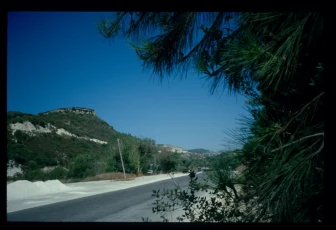
A road in a village in the Syrian coastal mountains (al-Jibal as-Sahiliyya)

The facade of the church, Ibn Wardan Palace
[Original: Kirche (Kuppelbasilika mit Emporen)]

Livestock in a byzantine building, Qarqbiza

Sirjilla, Ruinenfassade

A couple a day after their wedding
The woman is wearing a Habari (screen-printed head-scarf) over which she has laid an Abaya (coat)

Al-Bimaristan an-Nuri, Innenhofansicht und Spitze der seljukischen Muqarnas-Kuppel

Raqqa-Ost, Nordkomplex, Ausgrabung
[ 87/ 59/ 1789] =[ photo's name as: year/ film no./ photo no,]. On the back of the photo: [87/59].. (Naming the area of the photo was done according to the list, although some they are similar but were done in different areas.)

Stadtmauer von Damaskus, östliche Seite nahe Bab Kisan
Bis heute sind Teile der historischen Stadtmauer, mit integrierter Wohnbebauung, erhalten. Der Legende nach ist der Apostel Paulus von hier, dem Stadttor Bab Kisan im Hintergrund rechts, geflohen, um die christliche Lehre zu verbreiten.

The minaret of Great Mosque of Raqqa-Rafiqa, 8th/12th C.

Al-Madrasa as-Sultaniyya, Marmor-Gebetsnische

Tomb tower of Elahbel in the Valley of the Tombs
[Original: Grabturm in Palmyra]

Jamiʿ al-ʿAdiliyya, column details in the double arcade

Palmyra, Grave in Diocletian's Camp
[ Description by author: Inneres des Grabes von Bild 0759. ]

Top view of a group of traditional houses in Saydnaya

Baniyas, Blick auf das Mittelmeer

Traditionelles Wohnhaus im Viertel "al-Almaji"
Traditionelles zweigeschossiges Wohnhaus aus der spätosmanischen Periode (19. Jh.?): die steinerne Hauptfassade wird im Obergeschoss in voller Breite von einem vorspringenden hölzernen Erker, dem "Kishk", symmetrisch betont.
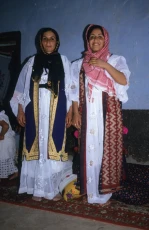
Two Kurdish women. The woman on the right is wearing a traditional woven overgarment

Madrasat al-Firdaws, a grave on the east of prayer hall

Outlining and shadowing of motifs of a contemporary ‘Ajami decoration
Abdelraouf Baydoun in his workshop in Malaysia

Nabu-Tempel, Nordwest-Ecke
[ Description by author: ~ Nordwest-Ecke. In der Mitte das Podium des Tempels, vorn zwei Säulen und viele Basen der ~ West-Kolonnade des Tempelhofes. Hinten rechts die Propyläen, ganz hinten links die arabische Bastion des Bel-Tempels. ]

Jamiʿ Sharaf, Inschrift oberhalb des Grabes

Raqqa, main shopping road with salesman of vegetables

A side of Damascus Citadel during the restoration works

Im Umkreis eines Ortes am Hang eines hoch aufragenden Felsens, vielleicht in der Afrinregion
Frage: Weiß jemand, wo sich der auf dem Foto abgebildete Ort befindet? Das Foto wurde 1984 in West- oder Nordsyrien aufgenommen. Zu sehen ist ein kleiner Fluss, eine weite Ebene mit Feldern und Bäumen, und ein sich aus der Ebene erhebender Felsen mit einem kleinen Gebäude auf der Kuppe. Am Abhang dieses Felsens liegt ein Ort. Da im Hintergrund niedrige Berge zu sehen sind, könnte das Foto in der Afrin-Region aufgenommen worden sein.

Ruinen des Theaters von Afamiya

Bayt Ghazala, ʿajami wall panels decorating the red hall (qaʿa)

View to the south from ad-dalati street.

At-Takiyya al-Ikhlasiyya (az-Zawiya ar-Rifaʿiyya), Ansicht der nördlichen Innenhoffassade
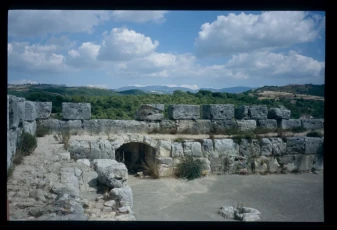
A view from the top of Salah ad-Din Castle overlooking the coastal mountains

Habuba Kabira, to make burghul (wheat grits) the wheat is cooked in a huge pot and then carried to a drying place

General view of as-Sabuniyya Mosque
[ Description by author: mit Minarett und Eingangs-"Iwân". Die Madrasa stammt aus dem Jahre 1458 (1464 ?). Gesehen (wohl) von ~ Osten. ]

The general structure of the example dome house in Taanayel (Libanon) before the end of the construction process
The mud bricks composing the walls and the two domes of the house, which are still under construction, are shown. We also see the stone foundations below, and the flat stone blocks integrated in the mud bricks in the domes, that serve for plastering work.

Google earth- al-Husn Church 2017

Bauarbeiten zur Kanalisierung des Barada in Damasus

Columns belong to the Great Colonnade
[ Description by author: bis zum Monumentalbogen, linke Seite. Gesehen von ~ Südwesten. Alle Zuordnungen sind hypothetisch ! ]

Ruine des byzantinischen Prätoriums von Barbalissos/Balis, Blick von Osten

ar-Raqqa - Qasr al-Banat, der von vier Iwanen umgebene Innenhof

Khan Qurdbak, ein Fenster des Iwans

The Mount Hermon covered by snow
[Original:'Hermon-Gipfel, mit Schnee bedeckt, rechts im Hintergrund der Antilibanon']. The Bavarian air force division 304b was based in Palestine from 25. October 1917 and was involved in the First World War until the division left the region, over Aleppo, in mid September 1918. During that period, over 3000 glas photographs, mostly aerial, have been made. Those early photographs were important for the archaeological research in the Middle East.

View into a vaulted room of Najm Castle (Qalʿat Najm)

Raqqa/Rafiqa, Wall decoration in the Iwan of Qasr al-Banat
[Original: Detail vom Palast Iwan/ nach Sarre-Herzfeld]

ar-Rusafa, North-Gate, view into the interior.

Terrace of Ishtar or Lions Terrace, Ebla (Tall Mardikh)
Davor ein Teil des Gebäudes PS. Im Hintergrund links das Fort V (vgl. Bild 1194 - 1199 !) und rechts das Gebäude (Palast ?) Z (vgl. Bild 1193 !). Der Blick geht von ~ der Akropolis nach ~ West-Nord-West. [Original:Tall Mardîkh (Ebla)']

Manmade caves in the Euphrates valley near embouchure of Sajur-river close to al-Awshariyya

At-Takiyya al-Ikhlasiyya (az-Zawiya ar-Rifaʿiyya), inscription above the main entrance

Al-Mishrifa (die historische Stadt Qatna) mit ihren dörflichen Innenhofhäusern
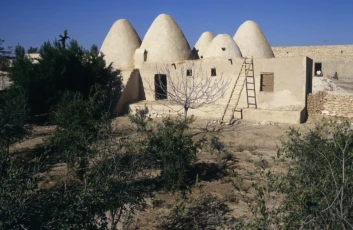
Habuba Kabira, the plastered new dome house and its garden

Die Region des Lajat, Basalt- und Ackerbauflächen

The upper part of the minaret, Qashani tiles, as-Sinaniyya Mosque
[ Description by author: Der "Korb" für den Mu'azzin. ]

Brücke über den Euphrat in Raqqa

Al-Matbakh al-ʿAjami, Stirnwand des südlichen Teils der großen Halle

Courtyard looking north, Qalʿat Samʿan (Monastery of St Simeon Stylites)
[Original: Oktogon von Süden]

Al-Madrasa al-Hallawiyya, Gebetsnische aus Holz im Iwan

Al-Madrasa al-ʿUmariyya al-Kubra - southern arcade

Bimaristan an-Nuri, der Haupteingang wird von einer Muqarnas-Dekoration bekrönt

Izraʿ, al-Jamiʿ (Moschee) al-ʿUmari, Innenhof

Habuba Kabira, Rückseite eines halb in den gewachsenen Boden eingetieften Raums (im lokalen Dialekt: debaba)

Suq ad-Diraʿ, Ansicht der Suq-Gasse

Große Moschee, Gebetshalle, hözerner Minbar (Kanzel)
Die einzigartige hölzerne Kanzel (minbar) ist aus der Mamlukenzeit, wie die Inschrift mit dem Namen des Sultans al-Nasir Mohammed, Sohn von Qalawun (gest. 741 AH / 1341 AD), zeigt. Der Name des Künstlers ist Muhammad ibn ʿAli al-Mawsili.

at-Takiyya al-Mawlawiyya, Eingangsfassade der Küche

Archäologische Überreste in Khirbat as-Sarayij


Al-Matbakh al-ʿAjami: Qaʿa, Schnitt Nord-Süd, Blick nach Westen

Terrace with portico in the upper floor, Qasr al-ʿAzm

Raqqa, Grundriss der abbasidischen Großen Moschee
Ground plan drawing. Scale ruler

Hayy al-Farafira, Quartiersplan des südlichen Bereich der Suwayqat Ali
Plan des südlichen Bereichs von Suwayqat Ali im Farafira Viertel, Katasterbezirk VII-3-1, inkl. Matbakh al-Ajami vor dem Teilabriß durch Straßenerweiterung [27]. Maße des Plans 55 x 45. Maßstabsleite (55 x 45).

Busra, Hammam Manjak, the fountain of the cold section (barrani)

Jamiʿ at-Tawashi, Eingangsportal

Mushabbak, Byzantine basilica, view from south

Die schneebedeckten Hänge des Anti-Libanon

Suq al-ʿAttarin, view to east showing the destruction

Covered small alley in Halbun with traditional houses

A view of the fortification, Halabiyya-Zalabiyya

Pre-drawn pattern of a contemporary ‘Ajami decoration
Abdelraouf Baydoun is working on the underdrawing of a ‘Ajami-Decoration
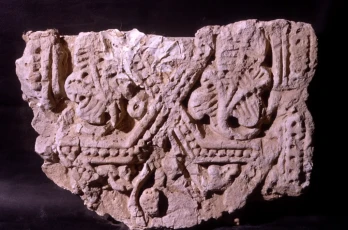
Archaeological finds from Raqqa, exhibited in the Damascus National Museum
Floral frieze decoration; National Museum Damascus, from ar-Raqqa

Turmgräber, Tal der Gräber (Westnekropole)
[ Description by author: Starkes Tele, vielleicht sogar Tele + Konverter. Zum Standort s. Bild 0592, der Blick wäre dann von ~ Ost-Nord-Ost.. ['Zenobia Hotel (?),'] ]

Raqqa-Ost, Tall Aswad, Ausgrabung im 1985
[1985/24/405] = [photo's name as: year/ film no./ photo no.]. ["s.a. Dias"]

Bab al-Hadid, general view of the entrance
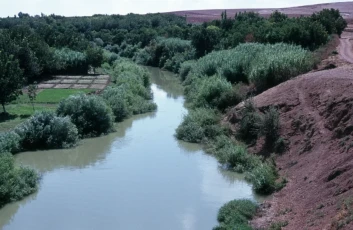
View of the Orontes River with forested river banks

Eine Frau präsentiert ihre Spindel

A view in Wadi Barada

ʿAyn al-Khadra, Village school from mud bricks, not used any more

Topographical map collection "UAR North (Syrian) region, district El Furāt" of 1960
Photographic reproduction of a topographic map of ar-Raqqa area, scale 1:25.000 (Partley corrected by hand into scale 1:20.000). Based on combined contour/ stereo-topographic survey of 1959. Clarke's ellipsoid of 1880. Lambert's coordinates system (Levant's zone). Mediterranean height system (Beirut's)
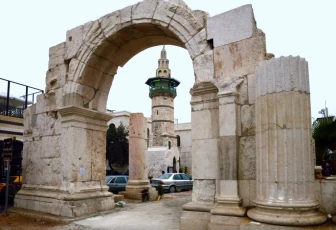
Roman Gate (Peribolos) at the Straight Street, Old City of Damsacus
[ Description by author: Gesehen von ~ Südwesten, mittlerer Durchgang. Die "Bürgersteige" der Geraden Straße wurden im Mittelalter zu Straßen, der alte Fahrdamm überbaut. Aber ab diesem Bogen für einige hundert Meter nach Osten besteht noch die alte Struktur: der Fahrdamm wurde ein offener Sûq, die "Bürgersteige" auch hier Straßen. Vgl. Bild 0322 ! ]

Palmyra / Tadmur, Blick auf den Baalshamin-Tempel
[Original: Baal-Schamin-Tempel, 130 - 150 n. Chr.]

Simeonskloster - Pilgerkirche des hl. Simeon Stylites, Blick über das Zentraloktogon nach Westen
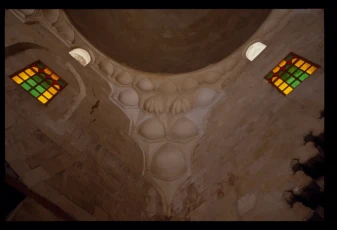
Al-Matbakh al-ʿAjami, muqarnas squinches of the iwan dome

Raqqa, Die Innenseite des Stadttores (Bab) Baghdad
Raq19830039.tif

In the light of the missing central dome of Khan Asʿad Basha al-ʿAzm

Säulenstraße - Abschnitt B, Blick auf den Monumentalbogen
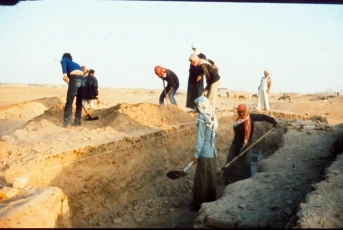
Raqqa - excavations at the site "East Raqqa" - the northern complex
Eastern North Complex; Middle Trench

Jamiʿ at-Tawashi, prayer hall - minbar (pulpit)

Ecological and botanical garden near Damascus citadel

Eine Szene mit Pfau auf den Holzpaneelen des Hauses der Familie Wakil (Aleppo-Zimmer)
Es werden viele Vögel auf den Holzpaneelen des Aleppo-Zimmers gezeigt, so auch Pfauen mit ihren langen Federn unter den Zweigen blühender Bäume.

½ piastre, 21 mm, 1921 (French Mandate)

Busra - Jamiʿ (Moschee) Fatima, Außenansicht des Minaretts

Gesamtansicht des kleinen Palastes von Qasr al-Hayr al-Sharqi
[Original: 1. Anlage]

Busra, Jamiʿ Fatima, Eingang
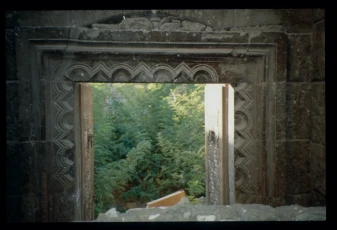
Bimaristan an-Nuri, frame of the entrance door
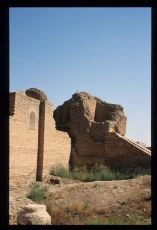
Raqqa, A side of Qasr al-Banat

Dimashq, Maqâm as-Sayyida Zainab, Innenhof, Nordseite
[ Description by author: Sayyida Zainab ist eine Tochter von 'Ali und Fatima, somit Schwester von Husain und Hasan und Enkelin des Propheten, außerdem Tante der Sayyida Raqîya, einer Tochter Husains, die ebenfalls in Damaskus begraben ist (vgl. Bild 0251 - 0253 !). laut sunnitischer Tradition ist Sayyida Zainab allerdings in Kairo begraben ....... Die Anlage wurde ab 1990 errichtet, vermutlich weitgend mit Geld aus Iran.- Gesehen von ~ Norden. ]

Spools in the textile factory of the Mezannar family

Bel-Tempel, Temenos mit Cella, von Westen
[Original: Baal-Heiligtum, Cella, ca. 17 - 32 n.Chr.]

Eine Zusammenkunft von Leuten um einen ausgerollten Kelim-Webteppich
Der Teppich besteht aus mehreren Streifen, die zusammengenäht werden

Jurn Kabir, wooden door bar lock, seen from the interior side

Southwest wall of the Agora
[ Description by author: Südwestwand der Anlage, gesehen von ~ Südosten, von der Außenseite. Im Hintergrund die Säulenstraße. Vgl. Bild 0709 ! ]

Bimaristan Arghun, southern courtyard - view the dome pendantives and the iwan

A side of Salah ad-Din castle

Saydnaya, Blick über die Stadt mit ihren Klöstern und Wohnhäusern

Jurn Kabir, a swift that was found on the ground

Al-Jisriyya norias (water wheel), Hama
This set of norias is called aj-Jisriyya, and is considered the largest and one of the most famous and beautiful norias of Hama city.

Bergrücken längs des Flusstales in der Oberen Euphratregion

Front facade of famous Hotel Zenobia in the ruins of Palmyra

Raqqa, Qasr al-Banat, Hof mit Nordiwan
[ G 88/ 19/ 240] =[ photo's name as: year/ film no./ photo no,].(ref. http://www.esyria.sy/eraqqa/index.php?p=stories&category=todayimg&filename=201003152100042)

Bayt Ghazala, courtyard and western facade - main hall's (qaʿa) facade
[Original: B86 /Film XV]

Bayt Ghazala, ʿajami wall panels decorating the main hall (qaʿa)

Remains of the Jupiter temple in Damascus

Dayr az-Zawr, Hängebrücke über den Euphrat

A Kurdish woman with a prayer rug made of wool with embroidery

Jamiʿ al-Utrush, general view of the western facade and the entrance

Madrasat al-Firdaws, inner iwan and courtyard with lobed octagonal basin

Bayt Jubran Afandi Shamiyy im Viertel Bab Tuma, Hofseite mit Arkaden
Hof gegen Tarma

Khan al-Jumruk, main door

Kommode mit traditioneller Einlegetechnik mit Permutt in einem alten Haus in Maʿlula

© SMB, Museum for Islamic Art, image: G. Niedermeiser

Ladengasse (suq) in Raqqa

Waqf Ibshir Mustafa Pasha, Kaffeehaus, eingestürzte Kuppel der Halle
Die außergewöhnlich reich dekorierte Fassade der Halle des Kafeehauses sowie die erste Gewölbereihe wurden zerstört. Das Innere der Halle wurde nur teilweise beschädigt, während die Kuppel mit ihrer hohen Laterne zum Größtenteil zerstört wurde.

Große Moschee, Kanzel (minbar) in der Gebetshalle
Der hölzerne Minbar stammt aus mamlukischer Zeit wie eine Inschrift mit dem Namen des Sultans al-Nasir Muhammad, Sohn von Qalawun (gest. 741 AH / 1341 n.Chr). belegt.

Busra - Hammam Manjak - Restoration works

Palmyra, Nabu-Tempel, Altar
[ Description by author: in Form eines Naiskos und Propyläen von der Hofseite, gesehen von ~ Norden. ]

Agricultural terraces in The Anti-Lebanon Mountains


Gesamtansicht der Burg (Qalʿat) al-Qadmus, auf einem natürlichen Felsen gelegen

Remains of an ancient minaret in Khirbat as-Sarayij

Khusrawiyya Complex, siteplan of the building parts (Arabic)
The Khusrawiyya is severely destroyed. The northern arcade and parts of the western wing of the complex are damaged. There are parts which are still under rubble. The degree of damage is around 80%. The center of the explosion crater, produced in 2014, is located beneath the prayer room, i.e. in the domed hall of the Friday mosque, which doesn’t stand anymore. Most likely, the foundations are lost inside the inner area of the crater, while the rest of the area may contain remains of the building, perhaps sufficient for possible reconstruction. No action regarding the protection or management of the rubble has been done yet.

Jamiʿ al-Utrush, Westportal
Das Tor befindet sich in einer dekorierten Nische.

Maʿlula, Der Prozessionszug zum Heiligkreuzfest geht auch durch die schmalen Gassen der Altstadt

Part of Damascus City Wall to the east of the city

Vaulted room in the Citadel of Damascus
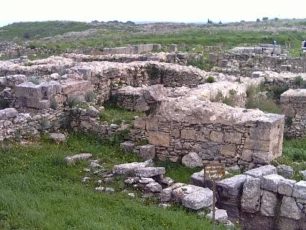
A side of architectural remains, Ugarit
shap_import_74018

Khusrawiyya-Komplex: Schadenskartierung (Englisch)
Die Khusrawiyya ist stark zerstört. Die Nordarkade und Teile des Westflügels des Komplexes sind beschädigt. Es gibt Teile, die noch unter Schutt liegen. Der Schadensgrad liegt bei ca. 80%. Das Zentrum des Explosionskraters, der 2014 entstanden ist, befindet sich unterhalb des Gebetsraums, d.h. in der Kuppelhalle der Freitagsmoschee, die nicht mehr steht. Wahrscheinlich sind die Fundamente im Inneren des Kraters verloren, während der übrige Teil des Geländes Reste des Gebäudes enthalten kann, die vielleicht für eine mögliche Rekonstruktion ausreichen. Es wurden noch keine Maßnahmen zum Schutz oder zur Behandlung der Trümmer ergriffen.
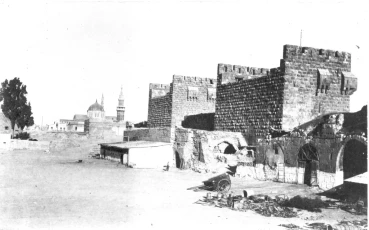
Im Innenbereich der Zitadelle von Damaskus, um 1930
Dieses historische Foto im Innern der Zitadelle von Damaskus zeigt zwei Verteidigungstürme, die die Südseite zum Suq al-Hamidiyya hin schützen. Hinweis: Dieses Foto wurde zwischen den Jahren 1924 - 1939 aufgenommen. (Fotograf unbekannt)

Bayt Ghazala, Haupteingang

Palmyra, Kamele in der Säulenstraße
[Original: Kamele in der Säulenstraße]

Palmyra, arch of Triumph (Qaws Hadrian), entrance to the Great Colonnade
View towards north west

The Dome of the Clock, courtyard of the Umayyad Mosque
[Original: Omayyaden-Moschee (705 - 725), Pavillon mit byzant. Kapitellen, im 18./19. Jh. zum „Glockenbaldachin“ zusammengesetzt]

Dar'a, al-Jamiʿ (Moschee) al-ʿUmari, Haupteingang von außen gesehen

Bayt Wakil, Kuppel der Empfangshalle von Innen

Busra - Jamiʿ (mosque) Fatima - the prayer hall

Außenmauern der Burg Najm (Qalʿat Najm)

Tall al-Biʿa, Blick aus der Ferne
[Original: Blick auf Tall al-Biʿa]

Suq Aslan Dada, view of the Mamluk coat of arms (rank) at the north entrance after completion of the rebuilding work

Die Stadt Darat ʿAzza liegt an der Straße zum Simeonskloster

Straßenverkäufer von Gemüse, ar-Raqqa

Bimaristan Arghun, Ansicht des Hauptinnenhofs

Ebla (Tall Mardikh), Roter Tempel / Ishtar-Tempel D(?)
Im Vordergrund die Treppe von Bild 1185 hinten. Nach dem Gesamtplan Bild 1162 müsste sie zum Roten Tempel / Ishtar-Tempel D führen. Gesehen nach ~ Nordosten. [Original:Tall Mardîkh (Ebla)']

Diokletians-Thermen, Grundriss
[ Description by author: Extremer Ausschnitt aus einem Stadtplan. ]

At-Takkiyya al-Mawlawiyya, Kücheneingang
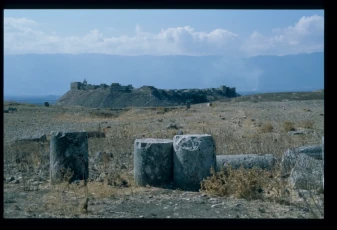
View from afar to al-Mudiq Citadel

A shell of a new house with flattened domes in a village south of Tall Abyad

Waqf of Ibshir Mustafa Pasha, Coffeehouse, interior, dome and muqarnas squinches

Palmyra, Hadrian’s Arch, , 3rd century A.D., view from south at the entrance to colonnaded street
The triumphal arc was constructed in honour of the Roman emperor Hadrian and linked the colonnaded street to the Temple of Baal. In 2015, ISIS destroyed the arch.

Jurn Kabir, a rural house, where each room has its own door opening on the courtyard
The house is consisting of a living room (left door) and a family room (right door), where all assets are stored.

Raqqa - remains of the southern arcade of the Jamiʿ al-ʿAtiq

Bayt Wakil, Gästehof - Iwan

Bayt Junblat, courtyard and northern iwan

Habuba Kabira, im Inneren des Doppelkuppelraums mit seinem Entlastungsbogen

At-Takiyya al-Mawlawiyya, carved decoration on the exterior facade
![Tall Brak, one of the earliest and largest cities in northern Mesopotamia during the 4th millennium BC [Original photo name:eye temple4]](https://syrian-heritage.org/wp-content/plugins/justified-image-grid/timthumb.php?src=https%3A%2F%2Fsyrian-heritage.org%2Fwp-content%2Fuploads%2F2020%2F06%2Fshap_import_44758.png&h=230&q=90&f=.png)
Tall Brak, one of the earliest and largest cities in northern Mesopotamia during the 4th millennium BC [Original photo name:eye temple4]
shap_import_44758

Blick auf das Siegesmonument von Hiraqla bei Raqqa

The stage of Roman Theatre and the Ayyubid Citadel, Busra
[Original: Theater, Bühnengebäude (wahrsch. spätes 2. Jh.)]

Raqqa - "East of Raqqa" site - Tall Aswad, excavation in 1985
Raqqa IV; Tall Aswad

Suq al-ʿAttarin, view to west showing the destruction
This lane of the Great Bazar was specialized in spices, herbs, and essential oils. It burnt down in December 2012.

Khan al-Wazir, northern facade and the internal facade of the khan's entrance

Palmyra, Valley of the tombs

Jamiʿ as-Saffahiyya, Eingangsportal

View from the top towards the oasis and the ruins of Palmyra
[ Description by author: Ganz vorn unten ein Stück der Stadtmauer. Hinten das Areal des Bel-Tempels, vgl. Bild 0811 ! Ganz rechts, hinter der Mauer, ein Teil des Hotels Sham Palace. Blick nach ~ Osten. ]

Theater, Portal auf der Rückseite der Scaenae Frons - ornamentierter Türsturz
[ Description by author: Rückseite des Tores Bild 0721. Gesehen von ~ Nord-Nord-West. ]

Arches in a house, the Ghouta of Damascus

Ebla (Tall Mardikh), Löwenterasse der Ishtar
Davor ein Teil des Gebäudes PS. Im Hintergrund links das Fort V (vgl. Bild 1194 - 1199 !) und rechts das Gebäude (Palast ?) Z (vgl. Bild 1193 !). Der Blick geht von ~ der Akropolis nach ~ West-Nord-West. [Original:Tall Mardîkh (Ebla)']

Blick auf das Dorf al-Awshariyya auf dem Nordufer des Sajur nahe der Mündung in den Euphrat
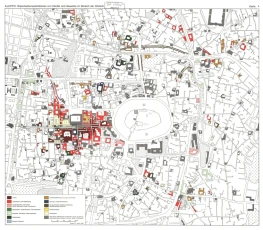
Maps of Aleppo: Sectoral concentration of trade and craft, 1982
Thematic map of Aleppo ancient city-center: Sectoral concentration of trade and craft in the area of ancient city. Scale 1:2000, ruler and legend. [Original in German: Aleppo: Branchenkonzentration von Handel und Gewerbe im Bereich Altstadt | Karte 4] Inventory no. stamp: Museum für Islamische Kunst Isl 85/31 /2 Berlin-Dahlem. Part of TAVO Reihe B Nr. 58
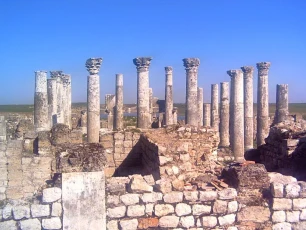
Afamiyam Blick über Säulen im Ruinengelände
shap_import_44106

Al-Matbakh al-ʿAjami, facade of the west section of the great hall

Bel-Tempel, Akroterion im Temenos
[ Description by author: "Assyrische Eck-Treppenzinne", von einem der Türme des Tempels (vgl.Bild 0629 !) . Die Struktur ist orientalisch, der Dekor römisch. ]

An abandoned rural noria on the Orontes river
In the rural area of an-Nasiriyya, north of Hama, there are remnants of a noira on the Orontes River, where its stone base and remnants of the aqueduct with its pillars appear.

Tall al-Biʿa, Ancient city of Tuttul

Blick auf die Ruinen der Burg Shayzar, auf einem Felsen gelegen

Kleiner gewölbter Durchgang, Qalʿat Harim

Habuba Kabira, back side of a room half deepened into the grown soil (in local dialect: debabe)

Feld am Dorfrand nahe Safira im Regierungsbezirk Aleppo

Müll- und Schmutzansammlungen in einem Kanal in der Ghouta von Damaskus

al-Madrasa al-Jaqmaqiyya, Detail der Ostfassade
[ Description by author: und Schriftband an der Ostwand der Madrasa, vgl. Bild 0235 ! ]

On the western shore of Jabbul salt lake, triangle door of a kitchen as a domed room


Inside the Hummus shop of Ra’oof al-Tatari

Remains of the city wall of Halabiyya fortress on the bank of the Euphrates
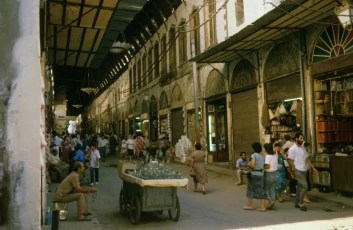
Im Suq al-Buzuriyya mit seinen vielen kleinen Gewürz- und Heilmittelläden

Western and eastern altars which are fully preserved, al-Karasi
[ Description by author: "Die Sitze". Es sind vier Altäre, die in Form einer Raute aufgestellt sind - der vierte stand hinter zwischen den beiden voll erhaltenen. Die längere Achse - hier vom rechten zwischen den beiden anderen nach links - velief S > N, die voll erhaltenen sind also der westliche und der östliche Altar. Sie tragen Inschriften in Griechisch und Aramäisch (vgl. Bild 0571, 0572 und 0574, 0575 !), die besagen, dass die Altäre im Jahre 144 n. Chr. auf Kosten des Staatsschatzes errichtet wurden. Man vermutet, dass sie dem Schutz einer neuen Obstpflanzung dienten - noch heute, wenn auch auf den Fotos nicht zu sehen, wachsen viele Bäume in der Gegend, weswegen man die Altäre auch nur schwer findet ....... - Der GPS-Tag für diese sieben Bilder ist sehr approximativ ! ]

View on the Euphrates river from Dura Europos

Reconstruction of Assyrian town Dur Katlimmu
Reconstruction of Assyrian town Dur Katlimmu in the modern village Tall Shaykh Hamad. Taken on: Exhibition stand "Umwelt und Technik vor 3500 Jahren" on Hannover Messe 1983

Traditional production of animal glue

Inside the city wall, excavation work, Qatna
. [Original: Al-Mishrifa / Qatnâ']

Umayyad Mosque (al-Jamiʿ al-Umawi), an exterior view of the ʿArus minaret at the northern facade
The lower part dates to the 9th century, and the upper structure is reconstructed from the late 12th century.

Bimaristan Arghun, general view of the southern courtyard

Excavation work at Tall Afis

Ein Schäferjunge und seine Herde am Rand der Ghab-Ebene
[Original: Junge mit Schafe am Rand des Ghab]

Khan Qurdbak, entrance
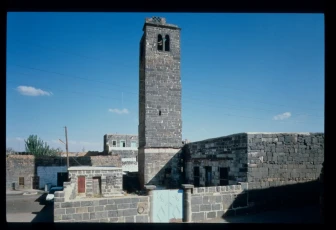
Busra - Jamiʿ (mosque) Fatima - exterior view of the minaret

View of the Mediterranean Sea, Tartus

Maʿlula, Gesamtsicht
[ Description by author: Gesehen bei der Anfahrt von ~ Süden. Auf dem Berg hinten links Kirche und Kloster der Heiligen Sergios (Mâr Sarkîs) und Bacchos.- Ma'lûlâ und eine Nachbargemeinde sind die einzigen Orte, in denen noch bis ins 20. Jh. Aramäisch gesprochen wurde, heute ist es praktisch ausgestorben.- Der GPS-Tag ist approximativ. ]

Burj Alaʾ, general view of the tower

Busra, Interior view of the Roman Theatre and Ayyubid Citadel
Orchestra und Scenae Frons, gesehen von ~ Süden. Das Theater stammt aus dem 2. Jh. und ist eines der größten und besterhaltenen der römischen Welt. Es fasste ca. 15000 Zuschauer. Vgl. Bild 3802 !
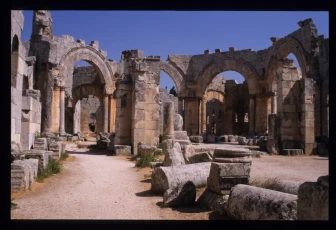
Monastery of St Simeon Stylites, Church of Saint Simeon Stylites

Kirche von Qasr Ibn Wardan, von Süden gesehen

Conservation of the Grape Room made in 1835, house Nizam, Damascus

Busra, Hammam Manjak, niche in the hot section (juwwani)

An old photo showing the main western entrance of Jamiʿ an-Nuri (mosque), Homs
The main western entrance to the courtyard.

Tall al-Biʿa - Aerial photograph

Landmarke in der Syrischen Wüste

Jamiʿ as-Saffahiyya, Gebetsnische

Hammam Bahram Basha, dome of the cold section (barrani)

A decorated inscription in Masayaf Castle

Jamiʿ al-ʿAdiliyya, prayer hall's entrance - inscription documenting the date of building accomplishment

Tall Mardikh (Ebla), Steinsarkphage im Südpalast
shap_import_48464

Ädikula am Turmgrab des Iamblik, Tal der Gräber (Westnekropole)
[ Description by author: Der Türsturz, ebenfalls mit zweisprachiger Inschrift. ]

Jamiʿ al-ʿAdiliyya, prayer hall's entrance
Entrance with muqarnas of jami al-'Adiliyya mosque. It was built 1555 in the time of the ottoman time.[Original:' Jâmi' al-'Âdiliya, Halab / Aleppo. Erbaut 1555 unter dem osmanischen Gouverneur Mehmet Pascha. Eingang mit "muqarnas". Vgl. Bild 1222 !'].

Tartus, museum in former cathedral, view at western facade

Raqqa - "East of Raqqa" site - Western Palace - Pottery
Raqqa VIII; Eastern West Palace, SW-Neg.89/658-699

Bayt Junblat, Innenhof mit Nord-Iwan

Wakil House, decorated windows
Decorations of window openings of Wakil house, which are stone panels carved with geometric and vegetal forms that crown the window on top.

Bayt Junblat, Süd-Iwan - eines der seitlichen Fenster

Busra, Hammam Manjak, Restaurierungsarbeiten
Fresco on the apse, Roman Orthodox St. Elian Church, Homs
[ Description by author: Zumindest Rückwand des Raumes rechts der Apsis: Fresko eines Heiligen, Ich wäre geneigt, die Buchstaben als "Abraham" zu lesen - aber wird der so recht jugendlich mit Heiligenschein dargestellt ? ]

Khan Qurdbak, ground plan, first floor, reduced copy
First floor, Hotel Balit, iwan (mamluk.) Uzdemir [15]. size of plan 60 x 40. with ruler (no scale) .

As-Sinaniyya-Moschee, Eingang, oberer Bereich der Portalnische
[ Description by author: Oberer Teil mit Stalaktiten-Halb"kuppel" und Bilder-Kacheln. ]

Face sculpture, Zenobia Hotel
[ Description by author: Eingelassen in einer Wand des Hotels. Vermutlich handelt es sich um ein Stück der Verschlussplatte eines Loculus, vgl. Bild 0857 ! ]

Courtyard on the upper floor, Najm Castle (Qalʿat Najm)

Khan al-Jumruk, interior facade of the Khan's entrance
Windows of a facade in the courtyard. [Original: Khân al-Jumruk,Halab / Aleppo. Fenster im Innenhof des Gebäudes. Es stammt aus dem 17. Jh.. Vgl. Bild 1220 !. 18/04/2001 (?)']

Fresco paintings on the ceiling of tomb tower of Elahbel
Dar'a, al-Jamiʿ (mosque) al-ʿUmari - The minaret seen from the street

Damage of the minaret. Here in general the minaret 03 is seen..

Khan Qurdbak, Portikus, Schnitt Nord-Süd

Inside the city wall, excavation work, Qatna
. [Original: Al-Mishrifa / Qatnâ']

A view of an-Nuri mosque and the Kilaniyya norias (water wheels), Hama
[Original: Nuri-Moschee am Orontes (unter Nur ad-Din 1162/63 errichtet) und Norias]

Khusrawiyya, northern arcade, 2018
The northern arcade is the only survived part of Khusrawiyya complex.

Palm trees in Palmyra oasis
[Original: Palmen in Palmyra]

Az-Zawiya al-Hilaliyya, wooden prayer niche
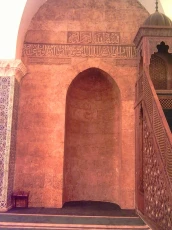
The prayer niche and the pulpit in the middle of the south wall in the prayer hall of the Great Umayyad Mosque of Aleppo
In the 7th century AH / 13th century AD, after the Mongols under Hulagu Khan had attacked Aleppo and damaged the Great Mosque, the Mamluks extensively rebuilt it, replacing the wooden ceiling of the prayer hall by stone vaults on pillars. The mihrab was replaced by the Mamluk sultan Qalawun; his name is indicated above the present one, together with that of his governor, the Mamluk prince Qarasunqur al-Jukandar, and the date 684 AH / 1285 AD: “In the name of God, the Entirely Merciful, the Especially Merciful. It was commanded to be built after it was burned by Our Master the greatest Sultan, al-Malik al-Mansur Sayf al-Dunya wa l-Din Qalawun, may God enhance his victory. By the high advice of the master, al-Amir Shams al-Din Qarasunqur al-Jukandar al-Maliki al-Mansuri. The governor of the guarded principality of Aleppo, may God reward and guard him, in the month of Rajab of the year six hundred and eighty-four [September 1285 AD]”.

Citadel of Aleppo, exterior view of the domes of the Hammam

Baalshamin-Tempel, 2. Jh. n. Chr.
[ Description by author: und nördlicher Säulenhof, gesehen von ~ Ost-Nord-Ost. Die Anlage umfasste auch einen südlichen Säulenhof und erstreckte sich im Nordosten bis unter das heutige Hotel Zenobia. Der Tempel datiert aus der Mitte des 2. Jhs. n. Chr. ]

Maronitische Kathedrale St. Elias, Ansicht des Haupteingangs (West)

Khan al-Wazir, Innenhofansicht

Al-Madrasa al-Kamiliyya, Eingangsportal

Al-Matbakh al-ʿAjami, kleiner Iwan - Detailansicht des Bogens

Ansicht der tieferen Teil des Jabal Haramun (Hermon-Gebirge)

Büste von Harun al-Rashid in Raqqa

Jamiʿ Aslan Dada, inscription above the entrance of additional prayer hall (al-Hijaziyya)
B63 Film-VI Jamiʿ Aslan Dada, entrance of the additional prayer hall (Hijaziyya)

Jabal ʿAruda, Blick zum Euphrat

Bab Qinnasrin, Ansicht der Außenfassade mit Gusserker

Blick auf den Jabal ʿAruda am rechten Ufer des Euphrats

Yabrud, irrigated market gardening near the caves of Wadi Iskafta

Bayt Wakil, iwan

Punch cards for jacquard looms with woven sample for silk fabric in the Mezannar textile factory in Damascus

Busra, Hammam Manjak, Islamic Museum

Southwest Tower, Khan al-Hallabat
[ Description by author: (der linke von Bild 0944), gesehen von Südosten. ]

Terraced grain fields on the western slope of the coastal mountain range (Jabal Ansariyya)

General view of the Convent of Our Lady of Saydnaya

A warping machine in the textile factory of the Mezannar family in Damascus

Raqqa, Grand Abbasid Mosque - Plan
[original:' Raqqa, Große Moschee']. [84/27/322 a] =[ photo's name as: year/ film no./ photo no,].

View of the Tetrapylon at the sunset
[ Description by author: Abendstimmung. Gesehen von ~ Nordosten - der GPS-Tag ist approximativ ! ]

Tall Mardikh (Ebla), Blick über das Ruinengelände
shap_import_48455
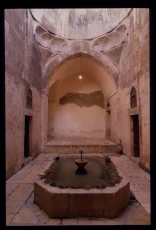
Bimaristan Arghun, general view of the southern courtyard - fountain and iwan

Spools in the textile factory of the Mezannar family

Euphrates dam and Assad lake, Nahiyat at-Tabqa

A hall in the upper floor, Qasr al-ʿAzm (Palace)
Seitensaal des Kuppelsaales mit restaurierter Wandmalerei auf Holz.- Die Bilder 0998 - 1002 haben ein gemeinsames Problem: sie sind mit gepushten High-Speed- Filmen aufgenommen. Das Ergebnis ist beim Dia noch so gerade akzeptabel, führt bemi Scan aber zu starkem Rauschen (der Filmkörnung), zu unnatürlichen Farbverschiebungen oder, wenn man diese korrigieren will, zur Entfärbung. Ich jedenfalls kann's nicht besser .......!. ['Original: Hamâ (Epiphania),']

Bab Qinnasrin, Inschrift auf der Torseite der äußeren Fassade
On the photo was mentioned: date of creation between 1985-86

When milking a flock of sheep in the Syrian Jazira

Mosaic Aphrodite and Ares, Shahba Museum

Habuba Kabira, Lehmziegel liegen zum Trocknen aus -am Dorfrand, weil dort Platz vorhanden ist

View of Masyaf Castle
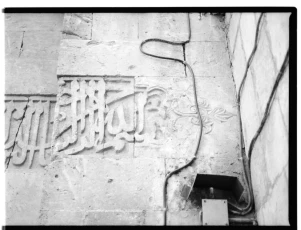
Turbat Khaʾirbak (mausoleum), western facade - inscription band

Bayt Wakil (Aleppo-Zimmer), the middle part of the room
A view of Aleppo room, whose magnificent woodwork was transferred from Wakil House in Aleppo to be re-installed at the Museum of Islamic Art in Berlin. The drawings for this room are the oldest collection from a Syrian house in the Ottoman era. They represent various subjects, including the formations of Islamic art portrayed by various plant and geometric drawings, Christian themes and images of the Virgin Mary with her child, as well as scenes from the court with the ruler on his throne, and mass hunting trips.

At-Taynabiyya-Moschee, Eingang, oberer Bereich der Portalnische mit geometrischem Musterfeld und Muqarnas-Halbkuppel
[ Description by author: Dekor. ]

Simeonskloster - Pilgerkirche des hl. Simeon Stylites, Südfassade der Ostbasilika

Temporary title for Image 120244

Grabturm aus römischer Zeit in Sarrin
Nicht genauer lokalisierbarer Grabturm, der durch seine Inschriften ins Jahr 74 n. Ch. datiert. Zu beachten die hoch angesetzten kannelierte Halbsäulen [Original: 'SIRRIN, Grabturm (74 n. Ch.)']

The Great Colonnade: southeastern passage
[ Description by author: zur Rundstraße um das Theater im 2. Abschnitt der Säulenstraße, gesehen von ~ Norden. Der vordere Bogen ist der linke (> Tetrapylon) der Kolonnade, der hintere enspricht der Linie der Häuserfronten.. ]

Raqqa - Qasr al-Banat, Innenhof

Kafr Halab, Lehmkuppelhäuser des Dorfes

Mausoleum az-Zahir Baybars, mosaics covering the southern wall

Der Barada fließt durch die Altstadt von Damaskus

Nordostsyrien, Obere Euphratregion

Burj as-Saʿa, general view

Blick über die Mittelmeerküste bei Baniyas

Qalʿat al-Marqab (Castle), Central courtyard and chapel

Hängebrücke über den Euphrat in Dayr az-Zawr - Aufnahme aus der 1. Hälfte des 20. Jh.
Hinweis: Dieses Foto wurde zwischen den Jahren 1924 - 1939 aufgenommen. Das gewählte Datum soll ein Durchschnittswert sein. (Fotograf unbekannt)

Waqf Ibshir Mustafa Pasha, Gesamtplan der Gebäudeteile (Arabisch)
Der waqf (Stiftungs-Komplex) von Ibshir Mustafa Pasha hat in mehreren Bereichen schwere Schäden erlitten. Dazu gehören der Khan auf der Nordseite und die östliche und westliche Qaysariyya. Ohne vorherige Trümmerbeseitigung kann keine abschließende Aussage über das Ausmaß des Schadens getroffen werden. Höchstwahrscheinlich kam es in den von der Tunnelbombenexplosion vom April 2015 betroffenen Gebieten zu einem Totalschaden. Der westliche Teil des waqf-Komplexes, einschließlich seiner Vorderfront, steht noch, ist aber deutlich beschädigt. Zwei der wichtigsten Gebäude des Waqf-Komplexes von Ibshir Mustafa Pasha sind in Teilen erhalten geblieben: die Moschee und das Kaffeehaus im Süden. Die einzigartig dekorierte Fassade der Halle des Kaffeehauses sowie die erste Gewölbezeile wurden zerstört. Der Kern der Halle wurde nur teilweise beschädigt, während der Abschnitt der zentralen Kuppel mit ihrer hohen Laterne größtenteils zerstört wurde.
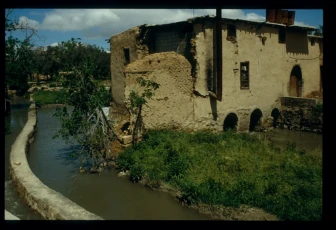
Exterior view of ʿArbin watermill in Rif Dimashq

Luftfoto des Bel-Tempels mit alten Dorfhäusern im Vordergrund

A side from the courtyard of Bayt Shaykh Qatana before demolition
Tür zum Hof

Feast of the excavation with musicians playing the local music with mizmar (local oboe) and big drum

Raqqa, Qasr al-Banat, decorative niches on the wall of a room
Neg. Nr. 83/5-33A/34

Burg von Harim, Blick in einen Eingang

Ruinen der Burg von Harim

The courtyard of an-Nuri Mosque

Waterfalls of Tal Shihab (during summer time)

Turmgräber im Tal der Gräber (Westnekropole)
[ Description by author: Blick nach Süden auf Grabtürme: links hinten der des Maliku, rechts der des Jambliqu. ]

Busra - Madrasat Abu al-Fidaʾ, inscription

Busra, general view of the old city.

Monastery of St. Simeon Stylites, late 5th-early 6th c., Exterior of sanctuary of east basilica (apse from exterior)

Qalʿat Burqush, Reste einer Kirche
[ Description by author: Auch dieses Halbsäulen scheinen mir ursprünglich römisch zu sein: Dekor der inneren (äußeren ?) Cella-Wand. Vgl. Bild 0084 ! ]

Columns with Corinthian capitals, remnants of the Jupiter Temple
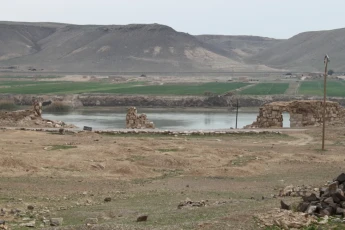
Remains of fortifications along the Euphrates River, Halabiyya

Burj Alaʾ, general view of the tower's southern facade
shap_import_63415

Ar-Raqqa, view of a side of city wall

Raqqa, Tall Aswad, Grabungsfunde

Church of Saint Simeon Stylites is composed of four churches forming a cross

View the northeast corner of the Agora
[ Description by author: Blick von ~ Osten auf die Nordost-Ecke der Agora (Forum) und in den ihren Innenhof mit Resten von Säulen der Portikus. Links geht es zum Annex, zum hohen Portal rechts vgl. Bild 0705 ! ]


Zitadelle von Aleppo - Tempel des Wettergottes Hadad, Orthostatenwand (Ausschnitt)
[Original: Ausgrabung Kai Kohlmeyer]

View of Eastern Palace, ar-Raqqa

Al-Madrasa as-Sultaniyya, Eingang, umlaufende arabische Inschriften in Stein gemeißelt

Palmyra, Qalʿat Ibn Maʿn, Gesamtsicht mit Zugangsbrücke

Waqf Ibshir Mustafa Pasha, Moschee, Bauornamentik
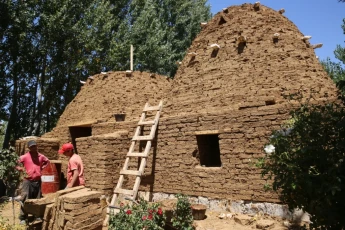
Struktur des beispielhaften Kuppelhauses in Taanayel (Libanon) kurz vor dem Ende des Bauprozesses
Auf diesem Bild sind die Lehmziegel zu sehen, aus denen die Wände und die beiden Kuppeln des Hauses bestehen, das sich noch im Bau befindet. Wir sehen auch die Steinfundamente und die flachen Steine, die zwischen den Lehmziegeln der Kuppeln eingesetzt sind. Auf diesen stehend kann der Außenputz aufgebracht werden.

Raqqa - the excavations of the site "East of Raqqa", Palace D, stucco decorations

A side of Kharbaqa Dam, spring

At-Tabqa , Minaret of the Mosque at Jaʿbar Castle.
Note: these photos were taken between the year 1924 - 1939. The chosen date is to be average. (photographer unkown)

Inside the city wall, excavation work, Qatna
. [Original: Al-Mishrifa / Qatnâ']

A robust 4 cm thick felt carpet made of wool in the manufacturing facility in Al-Bab
Photographs of a manufacturing facility for felt carpets in Al Bab as part of the "Aleppo Stadtarchivprojekt" of GIZ (German Corporation for International Cooperation) in 2008

Shops in Suq al-Hamidiyya, Old Damascus

Ackerbau an einem Berghang im Jabal al-ʿArab

Preparation of spools in the textile factory of the Mezannar family

View of a village on the slopes of mountainous hill, al-Furat al-Aʿla (Upper Euphrates Valley)

At that time the Bedouin tent was in the village ad-Duwaym in Nahyat al-Yarabiyya
The family belongs to the famous old Tayy-tribe.

Blick auf die Burg von Masyaf

Zitadelle von Aleppo - Maqam Ibrahim, Gründungsinschrift rechts neben dem Eingang zur Gebetshalle

Al-Muhammadiyya waterwheel (noria)

Bayt Wakil, Empfangshalle - westlicher Sitzraum

Wasserschöpfrad (Noria) und Aquädukt, circa 1930
Hinweis: Dieses Foto wurde zwischen den Jahren 1924 - 1939 aufgenommen. Das gewählte Datum soll ein Durchschnittswert sein. (Fotograf unbekannt)

Qasr al-Hayr al-Sharqi, Innenansicht der westlichen Einfriedung

Takiyyat ash-Shaykh Abu Bakr, Innenhof - Nordfassade mit Portikusarkaden

Busra, The cold section (Barrani) of Hammam Manjak
Interior View, Arch, Fountain,_Separaiting Sheet 86/XV

Al-Khusrawiyya, view at the Madrasa courtyard in 2007

As-Sabuniyya-Moschee, Minarett, oberer Bereich

Frühjahsweide von Schafen in der Syrischen Wüstensteppe bei Sabʿ Biyar
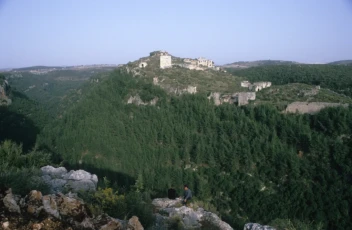
View from afar, Qalʿat Salah ad-Din (castle)
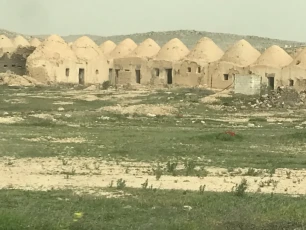
Verlassene Häuser im Jabal al-Hus südlich von Aleppo
Ansicht einer Gruppe von verlassenen Lehmkuppelhäusern. Sie sind in einem schlechten Zustand.

Raqqa - remains of the southern arcade of al-Jamiʿ al-ʿAtiq (Great Mosque)

Khan Qurdbak, Ground floor plan, reduced copy with ruler
Ground floor, [14]. size of plan 60 x 40 .with ruler (no scale) .

Jamiʿ al-Qayqan, Stone engraving - hieroglyphic pictorial writing

Khan Qurdbak, Süd-Arkade, mamlukisches Emblem (Rank)

Al-Madrasa al-Hallawiyya, Corinthian capital
[Original:'Al-Madrasa al-Halâwiya, Halab / Aleppo. Kapitell von der äußersten Säule rechts des Konchos.'].

Qasr Ibn Wardan seen from the south

Raqqa, Palace D, stucco decorations
Palace D; Inst.Neg. 86/1426 Floral frieze decoration

The western entrance of Maʿbad (temple) ad-Dumayr
[ Description by author: ~ Westseite. Sehr schön ist der in islamischer Zeit zugemauerte und mit einer Schießscharte versehene Eingang zu erkennen. Vgl. Bild 0380 ! ]

Bayt Ajiqbash, view of the courtyard interior

Al-Madrasa al-Hallawiyya, detail of the prayer niche (mihrab)

Maronitische Kathedrale St. Elias, einer der beiden Spitztürme - oberer Teil

Bayt Wakil, Bodenfeld aus Marmorplatten

Boats trip on the Euphrates River, near Jabal ʿAruda

Busra - Südliches Römisches Bad (al-Hammam ar-Rumani al-Janubi)
Außenansicht von Osten

Hama, Gesamtbild der "Vier Norias", die zwei "Bischriyyat" und die zwei "Uthmaniyyat"
Blick von Südosten auf die vier Wasserräder. . ['Original: Hamâ (Epiphania),']

Jamiʿ Aslan Dada, hall dome - squinch and muqarnas

Burg (Qalʿat) Yahmur, Haupteingang in einen Turm der Befestigungsanlage

Al-Matbakh al-ʿAjami, östliche Qaʿa, Schnitt Nord-Süd, Blick nach Osten

Sirjilla, Türfassade einer Gebäuderuine

A side of al-Mudiq castle shows some of its towers

Khan Ujkhan، Haupteingang

Siegesmonument von Hiraqla, Grabungsfunde

Palmyra / Tadmur - Umgebung, al-Karasi, West- und Ostaltar in jeweils gutem Erhaltungszustand
[ Description by author: "Die Sitze". Es sind vier Altäre, die in Form einer Raute aufgestellt sind - der vierte stand hinter zwischen den beiden voll erhaltenen. Die längere Achse - hier vom rechten zwischen den beiden anderen nach links - velief S > N, die voll erhaltenen sind also der westliche und der östliche Altar. Sie tragen Inschriften in Griechisch und Aramäisch (vgl. Bild 0571, 0572 und 0574, 0575 !), die besagen, dass die Altäre im Jahre 144 n. Chr. auf Kosten des Staatsschatzes errichtet wurden. Man vermutet, dass sie dem Schutz einer neuen Obstpflanzung dienten - noch heute, wenn auch auf den Fotos nicht zu sehen, wachsen viele Bäume in der Gegend, weswegen man die Altäre auch nur schwer findet ....... - Der GPS-Tag für diese sieben Bilder ist sehr approximativ ! ]

Busra, Hammam Manjak, Kaltbad (Barrani)
Domed room of the reception wing, view from east

Part of colored and golden mosaic on the courtyard facade, Umayyad Mosque
[ Description by author: Von Norden: Mosaiken am großen Bogen, linker Teil. ]

Raqqa, Great Mosque (al-Jamiʿ al-ʿAtiq), the courtyard

Al-Madrasa as-Sultaniyya, Eingang, umlaufende arabische Inschriften in Stein gemeißelt
The entrance contains inscriptions on three bays.

Ansicht von Säulenstraße, Monumentalbogen und Qa'at Ibn Ma'n

Lateral iwan in the Dada House
Seitenliwan

Al-Matbakh al-ʿAjami, renoviertes bzw. restauriertes Portal

Waqf of Ibshir Mustafa Pasha, Coffeehouse, interior
The hall has a rectangular ground plan. Based on a square middle room, it is divided by 12 pillars, all spanned by pointed arches, into 20 compartments of two different forms: two narrow oblong ones each on three sides of the central area (see picture 5) and two smaller square ones each in the adjacent corner areas. Between the pillar pairs that frame an oblong compartment stands a column each with octagonal shaft and multifaceted capital, which is formed by small geometric cells (muqarnas). Towards the side of the windowed entrance wall, the hall is only one bay deep. The courtyard side with its second row of pillars functioned as a kind of entrance portico, being once opened by four high pointed arches within the outside wall. The central area is covered by a high dome. Supported by four massive pillars, it rests on muqarnas pendentives – triangular-shaped with tiered rows of geometric cells –, and is topped by a round lantern with small columns plus pointed cupola. The other parts are covered with elongated, flattened vaults and small domes according the respective compartment form

View from boat to Jabal ʿAruda-massif

Ar-Rusafa, Decoration details on the inner facade of the North Gate

Turmgräber im Tal der Gräber (Westnekropole)
[ Description by author: in der rechten Bildhälfte. Ich habe den GPS-Tag nach der Angabe auf der Karteilkarte "vom Südwest-Hügel" (damit könnte der Hang des Jabal al-Mantâr gemeint sein) gesetzt. Eine andere Möglichkeit wäre: aus der Gegend des Turms des Jambliqu, denn auch dieser Hügel (und ist eher ein "Hügel" !) liegt südwestlich in Bezug auf die Stadt. Die Blickrichtung jedenfalls muss nach Nordwesten oder Westen sein. ]

Ruins of Qalʿat ash-Shugr wa-Bakas on the edge of a mountain slope

Propylon im Westen des Jupiter-Tempels, Teilansicht
[ Description by author: vom Westportal des Períbolos, Detail aus Bild 0150. ]

Restoration of a part of a decorated wooden panel with ‘Ajami decoration of the Damascus Room in the Dresden Museum for Ethnology

al-Husn Church, Remains of the basilica after its demolition and turning the site into an agricultural field

Cross vaults in the prayer room of an-Nuri Mosque

Remains of the Praetorium from east, Balis (Barbalassos)

Jamiʿ Sharaf, inscription above the Sabil

Raqqa - "East of Raqqa" site - Tall Aswad, excavation in 1985
[1985/24/395] = [photo's name as: year/ film no./ photo no.]. ["s.a. Dias"]

Traditional houses near as-Sajur river
Doppelraumgrundriss

The courtyard of at-Takiyya as-Sulaymaniyya with a water fountain

Near Tall Tamir, an Assyrian village, courtyard of a house with two later flattened domes of the original building
The Assyrian villages on the Khabur with their domed houses were built by the French Mandate Government for Christian refugees from Turkey and Iraq.

An aerial view of Ibn Maʿn's castle located on one of the highest mountains of Palmyra

Jamiʿ Aslan Dada, Kuppel der Halle - Ecktrompe mit Muqarnas als Überleitung zum achteckigen Tambour

Qalʿat Salah ad-Din

Qanawat, Ruinen des Rabbos-Tempels
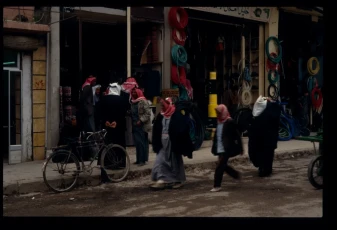
Daily scene in front of some shops in Raqqa

An agricultural field and poplar trees in Yabrud

General view of Qalʿat Ibn Maʿn (castle)
[Original: mittelalterliche arabische Burg]

Jamiʿ ash-Shuʿaybiyya, minaret

View of the artificial pool and the Temple of Mushannaf

Facade of the turbine house of Assad dam of the Euphrates, whose supplies large parts of Northern Syria with electricity

As-Sabuniyya-Moschee, Minarett-Schaft mit reichem Dekor
[ Description by author: Fenster-Etage oberhalb des Sockels. ]

Busra, Römisches Theater
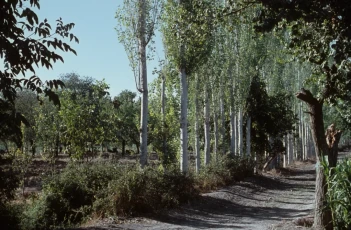
An orchard in the Ghuta of Damascus

Madrasat al-Firdaws, Hofarkaden - Untersicht auf ein Säulenkapitell

Innenhof, Blick nach Osten, al-Jamiʿ an-Nuri, Homs
Innenhof der Moschee: links der nach Norden hin offene Riwaq (Arkadenhalle), rechts die nördliche Hoffassade.

Syriac tombs in Jabal ʿAruda

Habuba Kabira, shell of a dome house made of clay bricks

Madrasat al-Firdaws, back iwan
Courtyard,

Menschen vor der historischen Stadtmauer von ar-Raqqa

Jamiʿ al-Utrush, western facade- decoration on the top part of a window niche
A top part of a window niche framed by double muqarnas plates and carved serrated border

Tall Mardikh (Ebla), Blick über einen Teil des Ruinengeländes
shap_import_48483

Kharijat ad-Drisiyat, guest house

Ras Shamra, Ruinen des Stadtstaates und Königreiches Ugarit

Remains of mills at the waterfalls of Tall Shihab

Izraʿ, Kanisat (Kirche) Mar Jirjis, Inneres
[Original: Kirche St. Georg]

Bayt Wakil, detail of windows and courtyard decoration

Muqarnas-Dekoration in der Burg Kahf in ash-Shaykh, Tartus Region Badr, Tartus

View over city, Jamiʿ Halab al-Kabir

View on the Euphrates River from the site of Dura Europos (Qalʿat as-Salihiyya)

Engraving of a group of women, Temple of Bel
[ Description by author: LInke Seite oben des Balken Bild 0642, 0643: noch einmal verschleierte Frauen. ]

Aleppo: cadastral plots plan of northern quarters of ancient city
Draft plan of cadastral plots of northern quarters of old city: Hayy al-Judayda, Hayy Qastal al-Musht, Hayy al-Almaji and Hayy al-Hazzaza

Aleppo countryside, Dome houses
Trulli house

Locally produced perfumes displayed for sale in Suq al-Buzuriyya

Bei einem Dorf im syrischen Küstengebirge

Raqqa, Qasr al-Banat, im Innenhof befindet sich ein sternförmiger Brunnen

Afqa spring, sulfuric water of the historic bath
[Original: Efqa-Quelle]

A self-manufactured fulling machine at work producing a felt carpet
Photographs of a manufacturing facility for felt carpets in Al Bab as part of the "Aleppo Stadtarchivprojekt" of GIZ (German Corporation for International Cooperation) in 2008

General view of Suq al-Buzuriyya

View to the village al-Awshariyya on the northern shore of the Sajur near the junction with the Euphrates river

Mausoleum of az-Zahir Baybars, decorations with colorful marble

View of Mar Taqla Monastery, Maʿlula
[Original: Maalulla- Thekla-Kloster]

Khan al-Wazir, Fenster und Dekoration im oberen Teil der inneren Eingangsfassade

Ausflugslokal an den Ufern des Barada

Siegesmonument von Hiraqla
Foto (MM: DAI 93/156)

Soap of Aleppo: fresh soap to dry
Interior view from the soap production: a stack of freshly produced soap, arranged with columns in between. So they will stay for several months to dry.

Al-Madrasa ash-Sharafiyya, Portalnische - oberer Abschluss mit Halbkuppel über Muqarnas
Al-Madrasa al-Kamiliyya, prayer hall - the muqarnas squinch of the dome

Damascus, copper workshop in the Straight Street, where "damascening", an old Inlay-technique is still practised

Conservation of the Aleppo Room in the Museum for Islamic Art, Berlin (after)

Archäologische Grabung in Kharab Sayyar

Habuba Kabira, Konstruktion eines Entlastungsbogens mithilfe von aufgetürmten Ziegeln, die später entfernt werden

General view showing the remains of city wall
[ Description by author: Blick vom Gipfel, etwa hinter dem Fahnenheiligtum, nach ~ Südosten. Vorn unten das Fahnenheiligtum, davor das Prätorium und die Treppe. Dann schaut man durch die Via Praetoria nach hinten. Links das Allât-Heiligtum. Zu den Gebäuden im Hintergrund s. Bild 0801 ! ]

Bayt Wakil (Aleppo-Zimmer), a scene of a peacock from Wakil house’s wooden panels
Birds occupy the bulk of the woodwork of Wakil house, headed by peacocks with their feathers under the branches of blooming trees.

Nahiyat Tall Tamir, Kleine kuppelartige Kükenunterstände, die bei Nacht mit Steinen verschlossen werden.

Al-Madrasa as-Sultaniyya, marble prayer niche

Fortification tower north of the Bab Antakiya, view during the removal of historical annexes

Bewässerungskanal in der Oberen Euphratregion

Busra - Jamiʿ (mosque) al-Mabrak

Hama, Gesamtbild der "Vier Norias", die zwei "Bischriyyat" und die zwei "Uthmaniyyat"
Blick von Südwesten den Orontes/ al-ʿAsi-aufwärts auf die vier Wasserräder. Rechts die Uferterrasse eines Ausfluglokals.

Busra, Hammam Manjak, Restaurierungsarbeiten

Making pickles
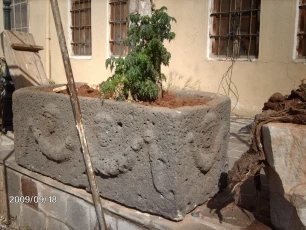

Blick von Westen auf das historische Quartier al-Kilaniyya und al-Baz Noria (Wasserschöpfrad)
Seltener Blick auf das heute nicht mehr existente Viertel (1982 zerstört) am rechten Orontesufer. [Originale Beschreibung: Hama quartier Kaylani] Hinweis: Dieses Foto wurde zwischen den Jahren 1924 - 1939 aufgenommen. Das gewählte Datum soll ein Durchschnittswert sein. (Fotograf unbekannt)

Destruction of the northern part of the western entrance. The space is 23 according to the ground plan.

Al-Madrasa al-Hallawiyya, courtyard - southern facade

Überreste von Spitzbögen in der Burg Najm (Qalʿat Najm)

Überwölbte Gasse in der Altstadt von Damaskus

Arches carry the bridge over the Orontes River, which leads to the Shayzar Castle
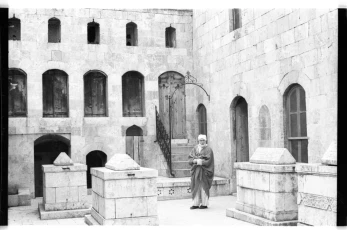
Az-Zawiya al-Hilaliyya, western facade

Suq ad-Diraʿ, Ansicht der Suq-Gasse

Bimaristan Arghun, muqarnas vault behind entrance portal

Khan Qurdbak, courtyard and iwan

Umayyaden-Moschee, Handwerker führen Restaurierungsarbeiten aus
Corridor, column
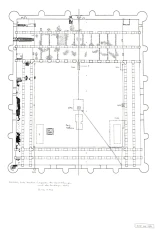
Raqqa, Grand Abbasid Mosque - Plan

Damascus, Khan Asʿad Basha al-ʿAzm, vaulted arcade
Bagdad-Tor von Raqqa-Rafiqa, frühestens 10. Jh.
Das Tor aus gebrannten Ziegeln war der südöstlichen Ecke der Stadtmauer von Raqqa-Rafiqa vorgelagert.

Jamiʿ al-Khayr, Grundriss

Raqqa, Baghdad Gate, Façade decorations: three-lobed niches and arched frames resting on colonnette

Turmgrab des Iamblik, 83 n. Chr., Tal der Gräber (Westnekropole)
[ Description by author: Fassade, gesehen von ~ Nordwesten. Das Grab stammt aus dem Jahre 83 n. Chr. ]

A craftsman working on a Jacquard loom in the textile factory of the Mezannar family, Damascus

Habuba Kabira, Bootsausflug einer Familie zu ihrem Dorf, das 1973 vom Tabqa-Stausee überflutet wurde

Frauen mit einer siebgedruckten Kopfbedeckung (Habari)

Palmyra, Bel-Tempel, Cella
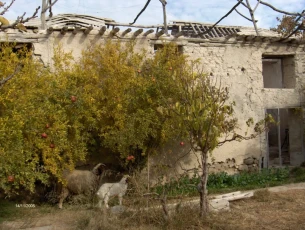
Courtyard of a rural house in the Ghouta of Damascus

Ghuta of Damascus, an old irrigation canal, 1963
The farmers of the Ghuta were able to benefit from the Barada and al-'Awaj rivers in the most possible way, through a water distribution system. The Barada River was divided into seven branches, as well as a subnet of canals covering all the lands of the Ghuta. The inhabitants of the Ghuta did not rely only on the water coming from these two rivers for the irrigation of their orchards, but rather they dug dozens of wells to benefit from the groundwater as well.

The Valley of Tombs - sculptures of the deads who are buried in a tower tomb
[ Description by author: Detail der Fassade. Im Bogen der Tote auf einer Kline, dahinter seine Familie. Unter der Kline Reste der Inschrift. ]

Jamiʿ at-Tawashi, minaret
[Original:'Jâmi' at-Tawâshi, Halab / Aleppo. Oberer Teil des Minaretts.'].

Khusrawiyya,detail of the ornamental paneling of the Mosque in 2008

Archaeological finds from Raqqa, exhibited in the Damascus National Museum
From Balis and now in Damascus Museum. [Original:'DAMASKUS, Mus. <---
Balis']

Brocade in the textile factory of the Mezannar family in Damascus

Qanawat, Westfassade des Seraya-Komplexes (Maʿbad Zeus)
[Original: Zweigeschossige Fassade mit drei rechteckigen Portalen (prostyler Tempel aus der 2. Hälfte des 2. Jhs, im 5. Jh. christlich überarbeitet)]
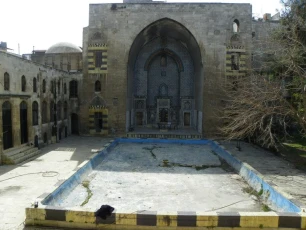
Das Junblat-Haus in Aleppo mit seinem großen Innenhof und Iwan
Blick auf den Innenhof des Junblat Hauses. In der Mitte befindet sich ein großes Wasserbecken, das in dem für Aleppo typischen Wechsel aus gelben und schwarzen Steinen (Ablaq) gefertigt ist. Der Iwan auf dem Bild ist einer der größten der traditionellen Häuser in Aleppo. Die Wände des Iwans sind mit blau und weiß glasierten Keramikfliesen verkleidet.

Kupferstecher im Suq Midhat Basha

Al-Madrasa as-Sultaniyya, exterior view of northern facade - entrance, minaret and garden

Bel-Tempel, Cella - Süd-Fassade, ionisches Säulenkapitell
[ Description by author: Tele-Aussschnitt aus Bild 0614: das jonische Kapitell der linken Halbsäule der Cella-Südwand. ]
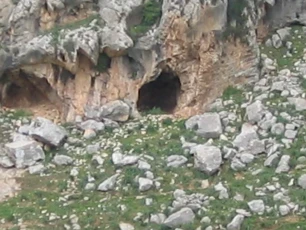
Die Daydariyya-Höhle von außen
shap_import_44193

Afamiya, Blick auf die nördlichen römischen Bäder

Habuba Kabira, Im Innenraum des letzten eingetieften Hauses, der nur noch als Stauraum benutzt wurde
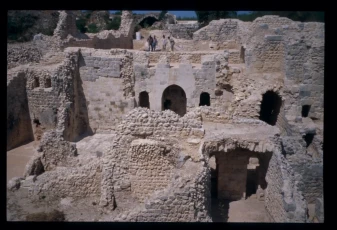
Some of inner parts, Qalʿat Salah ad-Din

Bel-Tempel, Cella von Südosten

Part of the remains of Shayzar Castle

Dome from the outside, Jamiʿ al-Imam Ismaʿil

Citadel od Aleppo, Temple of the Storm God Hadad - Detail on platform wall
[Original: Grabung Kohlmeyer]

Busra - Hammam Manjak - Restoration works

Suq az-Zarb, general view of the suq, after the destruction, near the Sabil Suq az-Zarb, view towards west

An alley in one of Damascus's old neighborhoods

Hammam Bahram Basha, Teil der nach Norden ausgerichteten Hauptfassade
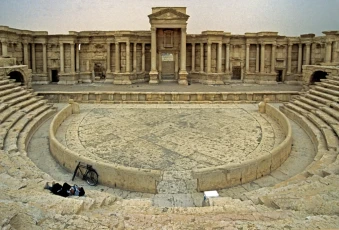
Roman Theater, 2nd c. AD
The theatre had been renovated before the war. It was used by ISIS for executions.

Khan Qurdbak, entrance - wooden door covered with iron
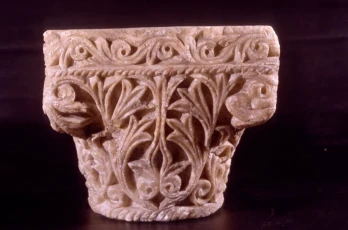
Archaeological finds from Raqqa, exhibited in the Damascus National Museum
Capital; National Museum Damascus; Mus.Nr.1866 from ar-Raqqa

Al-Madrasa as-Sultaniyya, südliches Fenster des Mausoleums von al-Malik az-Zahir Ghazi
The window topped by an inscription panel

A shop in Suq al-Buzuriyya, Old City of Damascus

Informelle (ungeplante) Siedlungen breiten sich in der Ghuta Oase aus, 1980er
Seit der zweiten Hälfte des 20. Jahrhunderts verdrängen immer mehr moderne Zementgebäude die Gärten und Felder der Ghuta - ihre Obstgärten müssen den Stadterweiterungen weichen.

Great Mosque, prayer hall, wooden pulpit (minbar)
The unique wooden minbar, or pulpit, belongs to the Mamluk era as indicated by the inscribed name of the Sultan al-Nasir Muhammad, son of Qalawun (d. 741 AH / 1341 AD). The carpenter’s name is Muhammad ibn ʿAli al-Mawsili.

Jurn Kabir: ein Mauersegler, der auf dem Boden gefunden wurde

Gipfel des Hermon-Gebirges (Jabal Haramun)

General view Hama city, showing al-Muhamadiyya waterwheel (noria)
[Original: Blick auf die Stadt und ein Noria (Schöpfrad) am Stadtpark]

Temple of Bel, 1st c. AD
This center of religious life was dedicated to the Mesopotamian weather god Baal. ISIS bombed he temple in 2015 .

Al-Madrasa al-Muqaddamiyya, the prayer niche
Typical mihrab of a mosque. Maybe the mosque is near Jami al-Tuta. [Original: Mihrâb, Halab / Aleppo. Typischer Mihrâb einer Moschee (vermutlich in der Nähe der Jâmi' at-Tûta)'].

Bridge over the Euphrates, ar-Raqqa
[Original: Euphratbrücke]

Mari (Tall al-Hariri), The Archive Hall in the Palace of Zimri lim

Habuba Kabira, Blick in eine verputzte Kragkuppel mit Öffnungen und Zierschicht

Nomad tents on the outskirts of the Ghuta of Damascus

ʿAyn al-ʿArus, Ausgrabung eines Bodenmosaiks

Bayt Junblat, southern iwan - decoration of faience tiles

Der äußere Bereich (barrani) des historischen Bades von as-Salamiyya
Das Bild dieses Kaltbadebereichs, „barrani“ genannt, zeigt einen Iwan mit gewölbter Decke. In der Mitte befindet sich ein Springbrunnen. Im Iwan, den großen Nischen und unter den Sitzplattformen (sing. mastaba), befinden sich kleine Nischen zur Aufbewahrung der Kleider und Schuhe.

Maʿlula, traditional hillside houses with galleries during the 1960s

Qanawat -Roman nympheum

As-Sabuniyya-Moschee, Gesamtansicht
[ Description by author: mit Minarett und Eingangs-"Iwân". Die Madrasa stammt aus dem Jahre 1458 (1464 ?). Gesehen (wohl) von ~ Osten. ]

Bayt Dallal, decorated stone above a gate

Qarqbiza, Hausruine

A grove in the Ghouta of Damascus

A traditionally crafted tapestry weave

Siegesmonument von Hiraqla, Glasvase

The stairs of the Hananiya Church in Bab Tuma quarter
The church of Hananiya can be reached by a narrow staircase with small stone steps.

Khan Qurdbak, iwan with basement of neighbouring qaʿa
Khan Qurdbak. ground floor plan of iwan with basement of Qaa in Bayt Haj Musa al-Amiri. GW 688, originally part of Khan Hajj Mussa al-Amiri, also on plan: iwan of Khan Qurdbak ([26a] / for description: see book Suwayaqt Ali, p. 33. size of plan 42 x 30. Ruler.

A side of the courtyard arches, an-Nuri Mosque
Antike Säule im Innenhof. ['Original: Hamâ (Epiphania),']

Jamiʿ al-Khayr, westliche Fassade der Innenhofseite

Einer der quadratischen Türme der Burg von Masyaf

Takiyyat ash-Shaykh Abu Bakr, Gesamtansicht von außen
Hinweis: Dieses Foto wurde zwischen den Jahren 1924 - 1939 aufgenommen. Das gewählte Datum soll ein Durchschnittswert sein. (Fotograf unbekannt)

Jamiʿ ash-Shuʿaybiyya, west facade - entrance blocked by a wall with a door opening surmounted by an arch
On the photo was mentioned: creation date between 1985-86]
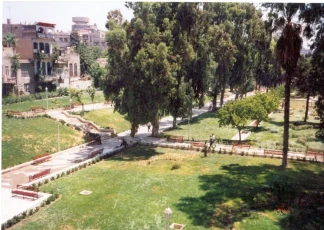
Hadiqat al-Umma (al-Umma Park) in Damascus

Ausgrabungen in Tall Afis

Qalʿat Ibn Maʿn, Teilsicht

A niche with ogee arch, Harim Castle

A side of Agora
[ Description by author: Gesehen nach West-Süd-West. Ist das hier der Altar, und der Mauerdurchbruch die Nische für das Götterbild / den Betyl ? ]

A woman presenting her spindle

Außenseite des Siegesmonuments von Hiraqla, erbaut durch Harun ar-Rashid, bei Raqqa

Al-Kilaniyya neighborhood in Hama
A general view that shows the historic an-Nuri Mosque and in front of it the set of al-Kilaniyya norias on the left bank of Orontes River.

East and south side of the cella of Bel Temple

Raqqa, Northeast Complex

Qarqbiza, Ruine der frühbyzantinischen Hauskirche
[Original: einschiffige Kirche, Südseite]

Die Nordmauer der Zitadelle von Damaskus
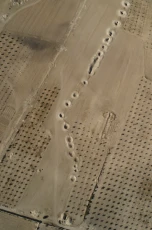
Luftbild von einem Wasserkanal im Dorf Shaykh Hilal
Dieses Bild zeigt deutlich den Weg einer alten Wasserstraße. Um die Kanäle zu reinigen, graben die Bewohner Löcher, die an der Oberfläche sichtbar sind. In der Nähe des Kanals wachsen Olivenbäume.

Jamiʿ Aslan Dada, Eingangstür der Gebetshalle von innen

Burg (Qalʿat) al-Marqab, Seitenansicht

The city of Raqqa - remains of the southern arcade of al-Jamiʿ al-ʿAtiq
[ G 88/ 07/ 075] =[ photo's name as: year/ film no./ photo no,].. On the back of the photos:[everything is Raqqa without 073] ['Alles Raqqa, ausser 073']

Scheitelbogen der Apsis, Basilika von Qalb Lawza

Minarett der Moschee des Shaykh ʿAqil al-ʿUmari al-Manbiji

Monastery of St Simeon Stylites, the baptistery

Ar-Raqqa, city wall, showing an arched gate and two towers

Jamiʿ at-Tawashi, Gebetsnische

Jamiʿ al-Utrush, Westfassade - nördlicher Teil mit Hauptportal

Busra, General view of Busra citadel
On the photo it was mentioned: date of creation between 1985-86

Aghabani table cloth

Jamiʿ Aslan Dada, Gebetshalle (Qibliyya), Fenster oberhalb der Gebetsnische
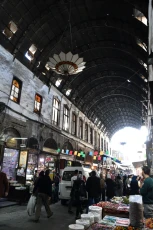
General view Suq al-Buzuriyya

Tall Shaykh Hamad (Dur Katlimmu) - Excavations
[Original:'TALL SAIH HAMAD']

Khusrawiyya, Innenansicht der Sudda (empore) in der Freitagsmoschee 2008

Mnin, Blick auf den Qalamun-Berg und die Häuser an seinen Hängen
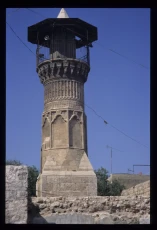
Jamiʿ al-Maydani, the minaret

Khan Ujkhan، main entrance

Al-Madrasa al-Kamiliyya, prayer hall

Busra - Jamiʿ (mosque) al-Mabrak from the outside


Zitadelle von Aleppo - vorgelagerter Südturm, Hauptfassade

Corner of a Bedouin tent from goat hair during the desert festival in ar-Rusafa

Madrasat al-Firdaws, view to south - courtyard and arcades

Raqqa, Aerial photo of Hiraqla vicotry monument

Alltägliche Straßenszene in Raqqa

Habuba Kabira, mixture of sifted raw loam, chaff and water to produce clay bricks therefrom

Al-Matbakh al-ʿAjami, modern and re-used portal (spolia)

Al-Madrasa al-Kamiliyya, courtyard

Hypogäum der drei Brüder, Eingang

Al-Matbakh al-ʿAjami, Stirnwand des westlichen Teils der großen Halle

Al-Matbakh al-ʿAjami, facade of the east section of the great hall

Bel-Tempel, Cella, 1. Jh. n. Chr.
البكرات في مصنع الغزل والنسيج لعائلة مزنر

Hiraqla victory monument
Photo (MM: DAI 93/156)

Ghuta of Damascus, an alley in one of the villages

Port expansion in Tartus
Extension of port, working with cranes

Kopfskulptur eines Mannes (Bruchstück eines palmyrenischen Grabreliefs), Hotel Zenobia
[ Description by author: Eingelassen in einer Wand des Hotels. Vermutlich handelt es sich um ein Stück der Verschlussplatte eines Loculus, vgl. Bild 0857 ! ]

Burg (Qalʿat) al-Marqab, Westeingang in die Kapelle

Raqqa, Große Moschee (al-Jamiʿ al-ʿAtiq)

Jamiʿ ash-Shuʿaybiyya, public fountain (sabil) beside the main entrance
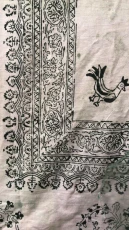
Hand printed fabric combining plant and animal motifs

Citadel of Aleppo, general view of the Gate Tower

Decorated door lintel, Valley of the Tombs
[ Description by author: Der Türsturz der Anlage.- Die Farbe ganz rechts ist nachträglich eingesetzt: diese rechte Seite war grellweiß überstrahlt ! ]

Monumentales Tor (Valva Regia) der Theaterrückwand (Scenae Frons) des Theaters in Palmyra

Al-Madrasa as-Sultaniyya, view of southern window of al-Malik az-Zahir Ghazi tomb
The window topped by an inscription panel

al-Husn Church, Remains of the basilica after its demolition and turning the site into an agricultural field

Sahat (Square) al-Marja in the early 20th century
[Original:'Damaskus: Telegrafendenkmal']. The Bavarian air force division 304b was based in Palestine from 25. October 1917 and was involved in the First World War until the division left the region, over Aleppo, in mid September 1918. During that period, over 3000 glas photographs, mostly aerial, have been made. Those early photographs were important for the archaeological research in the Middle East.

Ruin of a double room house in the village Qalʿat Najm

Tempel von ad-Dumayr, im Volksmund "die Burg" genannt
[Orignal: Wasserheiligtum, Dreiecksgiebel über Schmalseite]

Luftbild des Barada-Tals zwischen den Bergketten des Anti-Libanon

Qalʿat Jaʿbar, vaulted loophole

Burg (Qalʿat) al-Marqab, Inschrift mit ornametiertem Rand

Qanawat, Theatron and Orchestra

Stadtmauer von ar-Raqqa, gebaut aus Lehmziegeln

Blick über die monumentalen Bauwerke
[ Description by author: dahinter das Areal des Bel-Tempels. Vorn links die Säulenstraße, 3. Abschnitt, dann der Tetrapylon, dahinter die Säulen der Diokletians-Thermen und dann der Monumentalbogen. Man sieht deutlich, dass die Säulentraße auch im Tetrapylon einen Knick aufweist. Rechts vom Tetrapylon das Theater, ganz rechts die Agora mit Annex und Bankettsaal. Gesehen nach ~ Südosten. ]

An open sky passage in the Castle of Harim

Stadttor von Ugarit
[Original: Ausfalltor in Ugarit]

Der Khubra See in Jabal Says
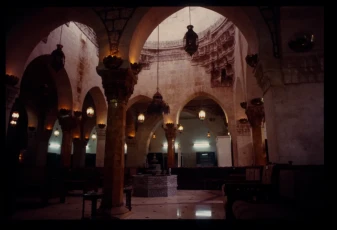
Waqf of Ibshir Mustafa Pasha, Coffeehouse, interior
The hall has a rectangular ground plan. Based on a square middle room, it is divided by 12 pillars, all spanned by pointed arches, into 20 compartments of two different forms: two narrow oblong ones each on three sides of the central area (see picture 5) and two smaller square ones each in the adjacent corner areas. Between the pillar pairs that frame an oblong compartment stands a column each with octagonal shaft and multifaceted capital, which is formed by small geometric cells (muqarnas). Towards the side of the windowed entrance wall, the hall is only one bay deep. The courtyard side with its second row of pillars functioned as a kind of entrance portico, being once opened by four high pointed arches within the outside wall. The central area is covered by a high dome. Supported by four massive pillars, it rests on muqarnas pendentives – triangular-shaped with tiered rows of geometric cells –, and is topped by a round lantern with small columns plus pointed cupola. The other parts are covered with elongated, flattened vaults and small domes according the respective compartment form

Shaykh Anas shrine - al-Tar mountain south-east of al-Mayadeen - the dome from the inside

Busra, Hammam Manjak, Islamisches Museum

Busra - Madrasat Abu al-Fidaʾ and (pool) Birkat al-Hajj, view from south

Raqqa-Ost, Westpalast, Grabungsfund

Excavation of mosaic floor, ʿAyn al-ʿArus

Mausoleum (Türbe) und Madrasa von Amat al-Latif, Tochter von an-Nasih al-Hanbali
[Original: ( mm 84 )]

Nahiyat Tall Tamir, Eingangskorridor vor dem eingestürzten Kuppelhaus
Die assyrischen Dörfer am Khabur mit ihren Kuppelhäusern baute die französische Mandatsregierung für christliche Flüchtlinge aus der Türkei und dem Irak.

A shop in al-Qaymariyya, the old city of Damascus, selling salted lupini beans 'termos'

Al-Madrasa al-Hallawiyya, detail of Corinthian capital

Damaskus, Khan Asʿad Basha al-ʿAzm, Muqarnas-Halbkuppel über dem Tor

Dayr Zakka, Detail des Mosaiks mi Palmenkrone
Raq19930001.tif

Bimaristan Arghun, südlicher Innenhof - Inneres der Pendentifkuppel und des Iwans

Valley of Nahr Al-Kabir al-Shamali River

Plan of The Baths of Diocletian
[ Description by author: Extremer Ausschnitt aus einem Stadtplan. ]

A view from the Castle toward Harim city

Dar'a, al-Jamiʿ (mosque) al-ʿUmari - the main entrance from the outside
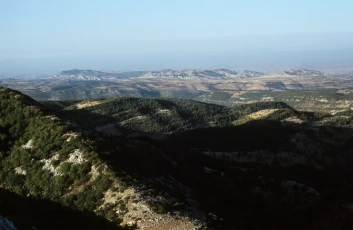
General view of al-Jibal as-Sahiliyya (the coastal mountains) covered by forests

Grabung in der Zitadelle von Damaskus

Dorfkinder vor dem Hintergrund des Krak de Chevaliers

Afqa-Quelle - historisches Bad
[ Description by author: Wie Bild 0581, leicht geänderter Blick: Altar, Säule, "Treppe", Altar. ]

Jisr ash-Shughur, Qalʿat ash-Shugr wa-Bakas, a general view of bridge between the two castles

Mosaic in the mausoleum of az-Zahir Baybars
[Original: Zahiriya, Mausoleum des az-Zahir Baibars, 1277, Glasmosaiken]

Damaged buildings in Qunaytra

Eine Hälfte der Cavea, Römisches Theater von Busra
[Original: Theater, Cavea für 15.000 Zuschauer (Halbkreis von 102 m) und Bühnengebäude]

Jabal ʿAruda southern foothills

Burg (Qalʿat) al-Marqab, Deckenfresko in der Sakristei

Habuba Kabira, das neue Kuppelhaus hat seine erste Verputzschicht erhalten

Brücke über den Euphrat in ar-Raqqa
[Original: Euphratbrücke]

At-Takkiyya al-Mawlawiyya, Kücheneingang

A local bakery in the old city of Aleppo
A picture of croissants pieces in a local bakery in the historic neighborhood of al-Jallum.

Raqqa, Baghdad gate

The sanctuary (cella) of Bel Temple
[Original: Baal-Heiligtum, Cella, ca. 17 - 32 n.Chr.]

Busra, Hammam Manjak, Heißbadebereich (Juwwani)

General view of the city of Harim, Muhafazat Idlib
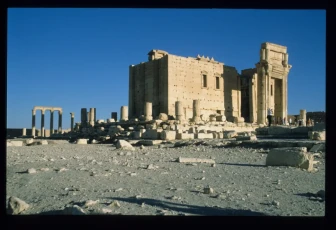
The sanctuary (cella) of Bel Temple
[Original: Baal-Heiligtum, Cella, ca. 17 - 32 n.Chr.]

Raqqa, Qasr al-Banat, courtyard with northern Iwan
[ G 88/ 19/ 240] =[ photo's name as: year/ film no./ photo no,].(ref. http://www.esyria.sy/eraqqa/index.php?p=stories&category=todayimg&filename=201003152100042)

A woman in a rural area with traditional clothes

The region of Limestone Massif, where Qal'at Sam'an (monastery of St. Simeon) is situated

Damascus citadel from the inside, round 1930
An old picture of Damascus Citadel from the inside showing two defensive towers protecting the southern side, where Suq al-Hamidiyya is situated. Note: these photos were taken between the year 1924 - 1939. (photographer unkown)

Al-Madrasa as-Sultaniyya, Inschrift auf einem Fenstersturz des Mausoleums von al-Malik az-Zahir Ghazi

Entrance of a house, Qarqabiza
[Original: Tor eines Hauses]

Khan Qurdbak, courtyard and eastern portico

Jamiʿ al-Mihmandar, Minarett - Basis und Übergangszone

Remains of the Byzantine tower incorporated into the Umayyad complex at Qasr al-Hayr al-Gharbi (Palace)
[ Description by author: und rechts Eingang in den Innenhof, gesehen von ~ Südosten. Der "Balkon" am "Turm" ist eine Toilette - zumindest ist das so bei den Eremiten-Türmen des Kalksteinmassivs in Nordsyrien. Und bei den alten Dhaus in den Emiraten und 'Omân habe ich ganz ähnliches gesehen ....... ]

Busra - Masjid Yaqut (mosque) - plan

Corner pilaster topped by Corinthian capital, Ithriya Temple
und sein Kapitell, vermutlich an der ~ Nordwest-Ecke (?). [Original:'Ithriya (Seriana),']

Habuba Kabira, Rohbau eines Kuppelhauses aus Lehmziegeln

The Theater of Palmyra, upper part of the gateway
[ Description by author: Rückseite des Tores Bild 0721. Gesehen von ~ Nord-Nord-West. ]
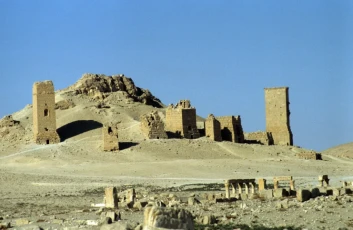
Palmyra, scenery in the valley of the tombs, showing a group of tower tombs

The northern entrance of the historical city of Dura Europos (Qalʿat as-Salihiyya), end of 4th century BC
[Stadttor]

Hadrian’s Arch, 3rd century AD, view from south at the entrance to colonnaded street

A part of family wing (so called haramlik oder juwwani) in Asʿad Basha al-ʿAzm Palace

Dayr Zakka, Fussbodenmosaik aus der Vorhalle der Klosterkirche (in situ)
Mosaik aus dem Kloster Dayr Zakka, auf dem Tall Bi'a; 70:16, Raq19900048.tif

Monumentalbogen und Säulenstraße
[ Description by author: vom Bel-Tempel, also von ~ Südosten, her. Rechts der Monumentalbogen, von ihm ausgehend nach hinten links der 2. Abschnitt der Säulenstraße bis zum Tetrapylon. Von dort zweigt eine weitere Säulenstraße nach links ab. Im Hintergrund die Burg des Fakhru d-Dîn al-Ma'ni. Die hohen Säulen vorn gehören zur Exedra des 1. Abschnitts der Säulenstraße (vgl. Bild 0657 - 0660 !). ]

Khan Sulayman Basha al-ʿAzm, Ornament an einem Fensterbogen
[ Description by author: Dekor über dem linken Fenster von Bild 0313. ]
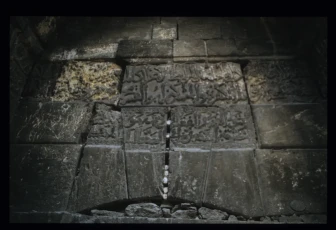
Bimaristan an-Nuri, inscription above the entrance

Aerial view of the desert in Badiyat ash-Sham

Bayt Ghazala, courtyard and northern facade

Raqqa countryside, Men in a traditional tent in Suwaydiyya Kabira village

East and south side of the cella of Bel Temple

General view of Ithriya Temple
Gesehen von ~ Osten (sofern ich das Satellitenfoto richtig gedeutet habe !).- Zur genaueren Information s. das PDF Nr 1087 ! Die Verzierung links und rechts des Tores erinnert an Nîha im Libanon. Der Tempel soll ein Prostylos gewesen sein und aus dem 3. Jh. stammen. [Original:'Ithriya (Seriana),']

Entrance of the Ayyubid Mosque of Fatima, Busra

Jurn Kabir, whitewashing with chalk milk

Qalʿat ash-Shugr wa-Bakas, Burgruinen auf einem Bergvorsprung

Khusrawiyya, interiour view at sudda (tribune) in Friday Mosque in 2008

Lower village of Afamiya with the museum in an Ottoman khan and village houses

al-Matbakh al-ʿAjami, Grundrisszeichnung vor dem Teilabriss
Rekonstruktionszeichnung des intakten Palastes vor dem Teilabriss im südlichen Teil (Grundstück VII-3-1 2057 in heutigen Grenzen), mit zusätzlich eingezeichneter Katasterebene, zu dessen Ausdehnung auf verschiedenen Grundstücken. Basierend auf einem Teilaufmaß der Antikenverwaltung (DGAM).

Reste des umaiyadischen Palastes in Jabal Says

ʿIsa-Minarett an der Südost-Ecke der Umayyaden-Moschee
[ Description by author: gesehen von ~ Norden und römische Reste an der Ostseite der Moschee. Die Tür Bild 0161 befindet sich, wenn ich mich richtig erinnere, hinter dem Betrachter in der rechten Mauer. ]

Sheep grazing on the ruins of Halabiyya-Zalabiyya
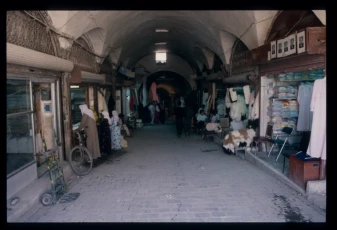
Suq az-Zarb, general view of the suq

A view of al-Marqab castle located on a high hill

Jebrud: Außenwand der griechisch-orthodoxen Kirche "Konstantin und Helena", die einst zu einem Tempel gehörte

Jamiʿ al-Qayqan, stone engraving - hieroglyphic pictorial writing
[Original: Moschee um Bab Antakiya}, on the photo was mentioned: creation date between 1985-86]

Umayyaden-Moschee von Damaskus - Minarett der Braut (al-ʿArus)
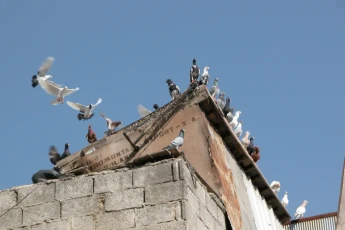

Upper Barada valley in Jibal Lubnan ash-Sharqiyya (Anti-Lebanon Mountains)

Dayr Zakka (monastery), floor mosaic of the narthex (in situ)
Mosaic from monastery Dayr Zakka, upon Tall Bi'a; 70:16, Raq19900048.tif

Krak des chevaliers (Qalʿat al-Husn), Gothic vaults

Khan al-Wazir, the window on top of the khan's entrance facade

Porticus post scaenam, Römisches Theater - Bosra
[Original: Theater, Bühnengebäude (wahrsch. spätes 2. Jh.)]

Waqf of Ibshir Mustafa Pasha, Coffeehouse, view on the roof
Large central dome, surrounded by small domes and cloister vaults.

Khan al-Jumruk, interior facade of the khan's entrance

Muzayrib, alte Mühle

A passageway in Najm Castle (Qalʿat Najm)

Great Mosque, Minaret
The minaret of the Great Mosque was commissioned by the judge (qadi) of Aleppo during the rule of the Seljuk dynasty in Syria. The beginning of its construction is indicated in the inscription at the base and the completion date is found at the top: 483 and 489 AH / 1090 and 1096 AD. It existed until 2013. The minaret is a square shape, its shaft is approximately 45 m high and made of limestone. On its upper edge, there is a cornice formed by two rows of flat arched niches lavishly adorned by floral elements. This is topped by an open wooden gallery for the muezzin (prayer caller) and a short tower with cupola. Between the base and the top, the minaret is divided into four zones of varying height. Those are, except for the second one, decorated with blind arches formed by profiled mouldings each running uninterruptedly around the minaret’s shaft. Each zone is separated by friezes with calligraphic, artistically written, Arabic inscriptions. These exquisitely carved inscriptions are written in floriated Kufi – a script style distinguished by bold letters adorned with floral motifs – and in Naskhi script. At the base of the minaret is the signature of the architect Hasan ibn Mufrih al-Sarmani written inside a cartouche. The inscription from the minaret’s base shows that the local Aleppine judge and the Seljuk governor shared power in the city, as their names are mentioned together: “The mosques of God are only to be maintained by those who believe in God and the Last Day and establish prayer and give zakat [(alm-tax); Quran 9:18]. It was started to be built by the High Judge Ibn al-Khashshab Muhammad ibn Muhammad al-Khashshab, may God have mercy on him. In the days of al-Amin al-ʿAjal al-Muzaffar Qasim al-Dawla wa-Nasir al-Mila Abi Saʿid Aqsunqur Bak, the slave of the Commander of the Faithful, may God enhance his supporters”. The upper inscriptions indicate the names of the then ruling Seljuk sultans Malikshah I and Tutush, and of Barakat ibn Faris, commander of the urban militia.

Qalʿat (castle) Yahmur, Main entrance of the fortified tower
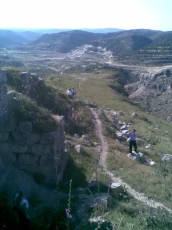
Jisr ash-Shughur, Qalʿat ash-Shugr wa-Bakas, the trail around the two castles
Naturlandschaft mit LAndwirtschaft in der Hawran-Ebene

Yabrud, Stadtansicht mit angrenzenden Ackerflächen

Al-Bara, Pyramid Tomb A, 6th century
[Original: Größeres Grabmal (im Grundriß quadratischer Raumkubus mit pyramidalem Dach), sp. 6. Jh.]
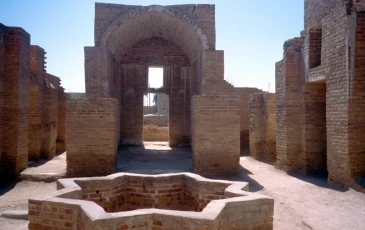
Raqqa, Qasr al-Banat, courtyard with southern Iwan

Bel-Tempel, Nordost-Ecke des Temenos - Portikus
[ Description by author: Portikus der Nordostecke, Standort zwischen den Säulen und dem Mauereck, Blick nach Südwesten. Nord- und Ostportikus haben die selbe Höhe. Zwischen den Säulen erkennt man links / Mitte den Tempel, rechts die Propyläen. ]

Große Moschee von Hama, Eingang zur Gebetshalle mit Ablaq-Dekor

Assyrian Corner Stairway Trough, Temple of Bel
[ Description by author: "Assyrische Eck-Treppenzinne", von einem der Türme des Tempels (vgl.Bild 0629 !) . Die Struktur ist orientalisch, der Dekor römisch. ]

Jurn Kabir, the only two school classrooms for children of the village

al-Matbakh al-ʿAjami, Grundriss und Schnitte der großen Halle
Im Grundriss wurden die in den fünziger Jahren des 20. Jh., für eine Straßenerweiterung abgerissenen Teile angefügt. Rechts davon ein Nord-Süd Schnitt durch die große überkuppelte Halle (oben) und ein weiterer von West nach Ost (unten). Die Pläne sind als CAD-Datei, nach Vorlage von Jean-Claude David und Thierry Grandin, von der BTU Cottbus nachgezeichnet worden.

Terrassierte Getreidefelder an der Westabdachung des Küstengebirges (Jabal Ansariyya)

VW-Käfer auf einer Straße inmitten der Ghab-Ebene

Jamiʿ al-Utrush, general view of the western facade and the entrance
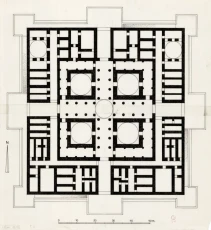
Hiraqla victory monument - plan of ground level
Reconstruction drawing of gound level. Plan showing walls. (with ruler)

View to the pole, Badiyat ash-Sham

Ornamentierte Fenstergitter im Haus der Familie Wakil
Fensteröffnungen des Wakil-Hauses. Die Fenster werden im oberen Bereich durch geometrische und pflanzliche Steingitter abgeschlossen.

Jurn Kabir, a woman offering her dowry (carpets and sacks for storage)

The historical sulfur spring of Afqa
[ Description by author: ~ Nordwestliche Seite mit einem Altar und Zugängen zu den unterirdischen Bankettsälen. Gesehen von ~ Osten. ]

Khan al-Wazir, main entrance and the northern wall after widening the street

A crowd in the 'Afrin, at the time of the cotton harvest


Khan al-Hibal, the northern facade, upper floor

Old rural house, Harran al-ʿAwamid
[ Description by author: mit Dekor, irgendwo im Ort (der GPS-Tag soll nur den Ort angeben). ]

Yabrud: Straßenleben mit Läden und Wohnhäusern, Städtern und Bauern
Straßenansicht mit Häusern und einer dörflichen Szene eines Bauerns mit Wagen und Zugtier. Diese straßenbegleitende Bebauung zeigt eine lokale Architektur (des Qalamun Gebirges): ein bis zweigeschossige Steinfassaden mit Drillingsöffnungen in den Obergeschossen. Mittlere Tür und seitliche Fenster, alle mit Rundbögen und davor ein Balkon. Steinerne symetrisch angelegte Fassade aus sauber gehauenen Kalksteinen und schlanken Bogenfenstern. Die Entstehungszeit dieser Häuser wird wohl im ersten Quartal des zwanzigsten Jahrhundert sein.

Jabla, Mosque of Sultan Ibrahim, Arched entrance built according to the ablaq system

Gebirgslandschaft nahe des Dorfes 'Arna am Jabal ash-Shaykh

Ansicht von Maʿlula
[Original: Große Orientreise Nr.63 mit Rotel-Tours: Amman-Bagdad-Uruk-Babylon-Arbil-Mosul-Hatra-Samara-Mari-Dura Europos-Aleppo-Dayr Saman-Ugarit-Palmyra-Jarash]

Hain und Bewässerungskanal in der Ghouta von Damaskus

Ansicht der Burg (Qalʿat) Shumaymis vom nordwestlichen Bereich des Burggrabens
Der innere Teil, gesehen nach ~ Südosten vom äußeren Nordwest-Rand des Grabens. . [Original: Qal'at ash-Shamîmîs']

Raqqa, Qasr al-Banat, Capital with plant motifs
Neg. Nr. 83/5-36A/37

Spools in the textile factory of the Mezannar family

Das Goldgrundmosaik an der Transept-Fassade der Gebetshalle der Umaiyaden-Moschee

The courtyard of an-Nuri Mosque

Jurn Kabir, Brotfladen werden mit einem Stock ausgerollt, damit sie hauchdünn werden und auf dem Blech über dem Feuer backen können

Remains of the Halabiyya fortifications, 8th-9th century BC

Turbat ash-Shaykh Hasan / Turbat Mukhtar / Turbat Ahmad Basha

The inner harbor, Jabla

ar-Raqqa - Qasr al-Banat, the courtyard surrounded by four iwans

Raʾs al-ʿAyn, view from the garden to the late Ottoman house, situated on a slope
The house consists of three wings with an Iwan in the middle (now reduced to a door) and is generally oriented to the valley in the south. The house opens to a large terrace with an Iwan in the middle and is accesible from the street on the western narrow side - not visible on the photo.

A small pathway in the Ghuta of Damascus
The Ghuta consisted of a large number of groves separated from each other by walls or mud fences. There was often a small road between a grove and another, where it was accessed through a gate. The walls were built of rammed earth, an old tradition of rural architecture in the region.

Halabiyya, entrance to the Praetorium, which is integrated into the city wall and dates from the time of Justinian.

Palmyra, Qalʿat Ibn Maʿn, Fernsicht mit Grabtürmen, Blick von Süden

Palmyra, Nabu-Tempel, Altar, Gebälk-Dekor von der Nordost-Ecke
[ Description by author: Gebälk-Dekor von der ~ Nordost-Ecke. ]

Al-Madrasa al-Ahmadiyya, southern portico

Ar-Raqqa, Waren werden mit einem von einem jungen Pferd gezogenen Karren transportiert

Drawing of Maria and Jesus on the decorated wooden panels of the Aleppo Room, Museum for Islamic Art, Berlin (1601-1603)

Archäologische Überreste in Khirbat as-Sarayij

Mar Taqla Kloster, Maʿlula, Blick in das Innere

Busra - Jamiʿ (mosque) al-Mabrak from the outside

Madrasat al-Firdaws, Blick in die südliche Halle

Jamiʿ al-Utrush, general view of the minaret
The only minaret in Aleppo with two galleries.

Turmgrab des Elahbel im Tal der Gräber (Westnekropole)

Busra - Hammam Manjak - Restoration works

Jamiʿ al-Khayr, the main entrance from the outside

Traditionelles Haus mit Laubhütte ("sibat", arab.) im Euphrattal an der Nationalstraße 4/Kreuzung von ar-Raqqa

View to the proscenium and scaenae frons of Palmyra Theater
[Original: Theater, 2. Jh. n.Chr.]

al-Burayj, a side of Saint Daniel Monastery

Qashani-Fliesen (Ausschnitt) mit floralen und geometrischen Mustern, Mausoleum von Salah ad-Din al-Ayyubi
[ Description by author: Dekor der Eck-Pilaster, vgl. Bild 0228 ! (The year of the photo is not sure according to Peter Heiske ) ]

Berg in der Gegend von Shahba

Ein Paar am Tag nach der Hochzeit
Die Frau trägt ein Habari (siebgedrucktes Kopftuch), über die sie eine Abaya (Mantel) gelegt hat.

Al-Madrasa al-Kamiliyya, portal gate

Jamiʿ at-Tawashi, exterior view - eastern facade and domes

Al-Madrasa az-Zahiriyya, Ansicht der Hauptfassade mit Eingangsportal

Nationalmuseum: Fresko aus Dura Europos, 3. Jh.

Habuba Kabira, how three cantilever domes are connected (two cantilever domes are posed on a relieving arch)

Waqf of Ibshir Mustafa Pasha, Coffeehouse, exterior facade
The street facade of the coffeehouse is unique for this kind of building regarding its openness, size and large-surface decoration.

Jamiʿ al-Utrush, general view of western facade and minaret
The most decorated facade of the mosque which can be seen from afar.
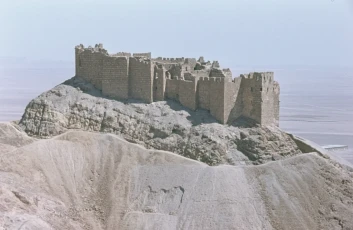
Aerial view of Qalʿat Ibn Maʿn (castle) from the west

Mushabbak, Byzantine basilica, a side of the church
[Original: Dreischiffige Säulenbasilika, 2. H. 5. Jh., 18,5 x 13,8 m]

Homs, West-Portal, al-Jamiʿ an-Nuri

Bimaristan an-Nuri, water reservoir made of basalt

Scaenae Frons, Theatre of Palmyra
[ Description by author: Die Porta Regia mit dem Durchgang zur Säulenstraße, vgl. Bild 0721 ! Gesehen von ~ Südwesten. ]

Raqqa, Qasr (Palace) al-Banat

Al-Matbakh al-ʿAjami: Qaʿa, section east-west, view to south
Qaʿa of Matbakh al-ʿAjami, size of plan 55 x 45, with ruler (no scale).

The inner façade of Baghdad Gate, Raqqa

Jamiʿ ar-Rumi, Gesamtüberblick vom Minarett

Raqqa, Reste der Südarkade der Großen Moschee (al-Jamiʿ al-ʿAtiq)

Überlebensgroße Basaltstatue eines Löwen im Tempel von ʿAyn Dara

(Bath) Hammam ʿAbd al-Basit - plan

Nahiyat Tall Tamir, Heute leerstehende Kuppelhäuser in einem assyrischen Dorf von der Straßenseite aus gesehen
Die assyrischen Dörfer am Khabur mit ihren Kuppelhäusern baute die französische Mandatsregierung für christliche Flüchtlinge aus der Türkei und dem Irak.

Kharab Shams, central nave of the basilica
[Orignal: Säulenbasilika, 4. Jh. von weitem, Mittelschiffarkaden nach Osten]

Säulenstraße, Überreste von Säulenreihen

Arwad, Eingang in die aiyubidische Festung

Bab Qinnasrin (city gate), general view from the outside

Gewölbter Eingang - Innenseite, Qalʿat Harim

Jamiʿ Manjak, Blick in den Innenhof

Al-Madrasa al-Ahmadiyya, Gebetsnische

Fluted column- The Great Colonnade at Afamiya

Hammam Bahram Basha, the main northern facade

Jamiʿ at-Tawashi, eastern facade - window within a rectangular niche decorated with muqarnas

Palmyra Theater, central part (valva regia) of scaenae frons

Blick auf die Burg (Qal'at) Marqab

Jamiʿ(mosque) al-Hanabila - north-south section with the prayer hall, courtyard, and the minaret

al-Madrasa al-Jaqmaqiyya, Decorative details in the eastern facade
[ Description by author: und Schriftband an der Ostwand der Madrasa, vgl. Bild 0235 ! ]

reiterstandbild von Salah ad-Din, vor der Westfassade der Zitadelel von Damaskus

Blick auf die Häuser des Dorfes Shaykh Hilal
Die Kuppelhäuser liegen in unmittelbarer Nähe zueinander. In den Innenhöfen werden häufig Sträucher gepflanzt.

Säulenstraße - Abschnitt B

Blick auf das Wasserbecken und den Tempel von Mushannaf

Waqf of Ibshir Mustafa Pasha, Coffeehouse, interior, dome and muqarnas squinches

At-Takkiyya al Mawlawiyya, Gebetshalle (alter Midan)

Jisr ash-Shughur, Qalʿat ash-Shugr wa-Bakas, a twin crusader castle, stone arch

Tall Dahab, Back of the guest house with surrounding scultural ornamentation

Stadttor von Ugarit

Qanawat, Blick auf Theatron und Orchestra

Afqa-Quelle
[ Description by author: Nach Südwesten. Ich vermute, dieser Kanal, an dessen Eingang man hier steht, ist der Zugang zur eigentlichen Quelle. ]

Jamiʿ al-ʿAdiliyya, general view of the prayer hall showing the minbar

The south-western tower of Damascus Citadel
A general view of the massive southern-western tower that protected the citadel from that angle, this tower features many machicolations and ends at the top with parapets. The tower is connected to the citadel walls, which consist of a very thick wall, also topped by parapets.

Ädikula am Turmgrab des Iamblik, Tal der Gräber (Westnekropole)
[ Description by author: Linke Volute vom Türsturz, gesehen von ~ Osten. ]

Teil Stadtmauer von Damaskus mit Balkon-Überbauungen
[ Description by author: aus ayyubidischer Zeit mit neuerer Überbauung. Im Hintergrund das Minarett des Bâb Sharqi. ]

Busra, Zitadelle, Turm

Suq az-Zarb, view towards east of the suq after the destruction

Im Dorf al-Hayat/Balikh-Tal, Prozess der Gipsherstellung (2. Schritt), das Brennmaterial wurde angezündet
(Siehe auch den 1. und 3. Schritt der Gipsherstellung)

Hanging dyed silk to dry after washing it in cold water

Bayt Junblat, door in the centre of southern iwan
[Original:'Qasr Jumblât, Halab / Aleppo. Iwân des Süd(?)flügels: die mittlere Tür.].

Hypogeum of the Three Brothers from the inside - mural paintings
[ Description by author: Linke Wand, Rückwand und Decke der freskierten Halle. In der Lünette Achill auf Skyros, in der Decke die Entführung des Ganymed. ]

At-Takiyya al-Mawlawiyya, western facade - al-Midan

Jamiʿ Sharaf, the old mihrab

ʿIsa minaret in the south-eastern corner of the Umayyad Mosque
[ Description by author: gesehen von ~ Norden und römische Reste an der Ostseite der Moschee. Die Tür Bild 0161 befindet sich, wenn ich mich richtig erinnere, hinter dem Betrachter in der rechten Mauer. ]

A stand selling sandwiches in Damascus

Jamiʿ al-Khayr, Portikusarkaden der Gebetshalle

Habuba Kabira, construction of a mud brick house before the circular of the domes is started

Afqa-Quelle - historisches Bad
[ Description by author: ~ Nordwestliche Seite mit einem Altar und Zugängen zu den unterirdischen Bankettsälen. Gesehen von ~ Osten. ]

Traditionelle Patchwork-Wandbehänge, in denen teilweise kleine Dinge aufbewahrt werden

Jamiʿ at-Tawashi, Minbar (Kanzel) - Inschrift

Palmen in der Oase von Palmyra
[Original: Palmen in Palmyra]

Remains of a water canal in the village of Shaykh Hilal
The village inhabitants believe this type of water canals to be Roman, although the oldest of them dates back to the Byzantine era.

Krak de Chevaliers (Qal'at al-Husn), die Loggia

Jamiʿ (Moschee) al-Hanabila

Bel-Tempel, Cella von Süden
[ Description by author: Gesehen von Süden. Zu sehen die Schmalseite der Cella, dekoriert mit zwei Halbsäulen mit jonischen Kapitellen (vgl. Bild 0615 !) und gerahmt von Pilastern mit Kapitellen (vgl. Bild 0616 !) zwischen der West-Peristase mit dem Monumental-Tor und den Säulen der Ost-Peristase. ]

Umayyaden-Moschee, Innenhof, das Schatzhaus (Qubbat al-Khazna) mit Mosaikdekor

View to the excavation in Tall Shaykh Hamad in 1984
[Original:'TALL SAIH HAMAD']

Tall Aswad near Raqqa, view to an outbuilding of a farmstead

Al-Madrasa al-Hallawiyya, Eingang - verbaute Spolie an der Basis, ehemals Taufstein in der früheren Kathedrale

Obstplantage in der Ghuta von Damaskus

Exterior northern facade and the entrance of at-Taynabiyya Mausoleum-Mosque
[ Description by author: mit dem Ersatz-"Minarett". ]

Imam Ismaʿil-Moschee, Minarett
Gesehen von der Sâhat al-Hurriya nach ~ Südosten. Im Vordergrund zwei byzantinische Säulen mit Kapitellen, vermutlich aus einer Kirche. [Original: 'Salamiya (Salamias)']

Al-Madrasa al-Hallawiyya, entrance - Zengid inscription in Naskhi script

Busra - Birkat (pool) al-Hajj

Bayt Wakil, Gästehof - Detailansicht einer Fensterfassade

Busra - Jamiʿ (msoque) al-Mabrak, the courtyard

Sirjilla, two-storeyed andron
[Original: Andron mit doppelgeschossiger Vorhalle, von Konsolenkapitellen getragen, 6. Jh.]

Afamiya, Remains of Great Colonnade (Cardo Maximus)
shap_import_70673

A photo from the beginning of 20th century in Badiyat ash-Sham

Sahl Hawran (Hawran Plain), agricultral area
[Original: Südsyr. Ackerebene im Hauran mit Hermon]

Al-Madrasa ash-Sharafiyya, prayer niche decorated with geometric patterns

Izraʿ, al-Jamiʿ (Mosque) al-ʿUmari - the courtyard

Jurn Kabir, Mädchen aus Habuba Kabira bereiten die Kreidemilch aus lokaler Kreide vor

Monastery of St Simeon Stylites, the baptistery
[Original: Baptisterium mit oktogonalem Zentralraum]

Mushabbak, byzantinische Basilika, Ansicht von Süden

Palmyra / Tadmur - Umgebung NW, Jazil, Inneres des Höhlenklosters
[ Description by author: Blick durch die Flucht der Räume. ]

Jamiʿ Aslan Dada, the dome of prayer hall (qibliyya)

Ansicht einer Seite der Stadmauer von ar-Raqqa

Archäologische Funde aus Raqqa, ausgestellt im Damaszener National Museum

Vegetation with rocks in the coastal mountains

General view of Jaʿbar castle
Note: these photos were taken between the year 1924 - 1939. The chosen date is to be average. (photographer unkown)

Olivenhaine bei Harim

Jamiʿ Aslan Dada, entrance of the prayer hall

Exterior view of ad-Daydariyya cave
shap_import_44213
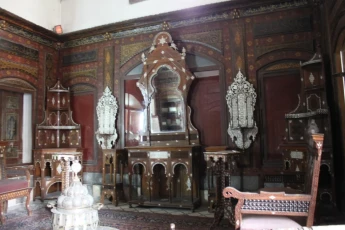
A room in the family wing (haramlik or juwwani), Asʿad Basha al-ʿAzm Palace

Al-Matbakh al-ʿAjami, Muqarnas-Zwickel der Iwan-Kuppel
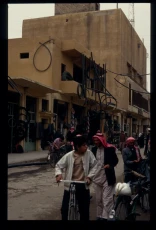
Daily life scene in the city of Raqqa

Yabrud: traditionelle Wohnhäuser mit Mittelhallengrundrissen
Straßenansicht mit Mittelhallenhaus. Diese straßenbegleitende Bebauung zeigt eine lokale Variation (des Qalamun Gebirges) der seit der Mitte des 19. Jh aus dem Libanon bekannten Hausform: beschattete Eingangshalle mit einer Eingangsarkade aus drei Bögen auf Rundsäulen im Erdgeschoß, darüber im Obergeschoß die Wiederholung als offene Sitzfläche mit vorgesetzten Balkon. Steinerne symetrisch angelegte Fassade aus sauber gehauenen Kalksteinen und schlanken Bogenfenstern. Die Entstehungszeit dieser Häuser wird wohl im ersten Quartal des zwanzigsten Jahrhundert sein.

Ar-Raqqa, Ansicht der Stadtmauer mit halbrunden Türmen

Jabal ʿAruda am rechten Ufer des Euphrats

Part the western gate of the Jupiter Temple and Minaret of Qaytbay
[ Description by author: der Umayaden-Moschee, gesehen durch zwei Säulen des Períbolos des ehemaligen Jupiter-Tempels. Die Bögen links sind arabisch unter Verwendung antiker Säulen und Kapitelle. Gesehen vom Ostende der Haupstraße vom Sûq nach ~ Südosten. ]

Durchgang in der Burg von Harim

Busra, Hammam Manjak

Das Dorf Al-ʿAmarna mit seinem altorientalischen Siedlungshügel (links) und der weiten Ebene des Euphrat

The door of the qaʿa (guest room), Dada House
Tür v. Liwan zur Qa'a

Jamiʿ Sharaf, Qastal - Fassade

Busra, Hammam Manjak, niche in the hot section

General view of the complex constisting of a church and a palace of Qasr Ibn Wardan
[Original: sakraler Zentralbau und Palast, Palast, 564]

Inside the city wall, excavation work, Qatna
Das alte Qatnâ war in der ersten Hälfte des 2. Jts v. Chr. eine Stadt von einiger Bedeutung und geriet dann in das Spannungsfeld zwischen Ägyptern und Hethitern. Von den letzteren wurde es um 1340 zerstört. . [Original: Al-Mishrifa / Qatnâ']

Raʾs al-ʿAyn, Blick in die Hauptstraße
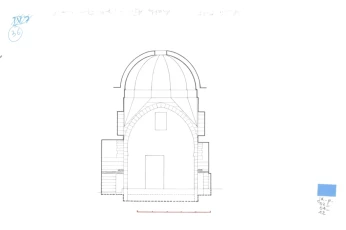
Al-Matbakh al-ʿAjami: eastern Qaʿa (mamluke), section north-south, view to west
Size of plan 22 x 32, with ruler (no scale).

Al-Madrasa as-Sultaniyya, entrance - stone carved Arabic inscriptions

Remains of Resheph Temple, Ebla (Tall Mardikh)
So nach dem unteren Bild der Schautafel. Hier nach ~ Südosten / Süd-Süd-Ost gesehen. [Original:Tall Mardîkh (Ebla)']

Raqqa, Beduinenfamilie in ihrem Zelt
Die Beduinenfamilie wohnte in ihrem Zelt direkt neben der Grabung des Deutschen Archäologischen Instituts, für die sie die offiziellen Wächter waren.

A capital decorated with wavy acanthus leaves, Monastery of Saint Simeon Stylites
[Original: k.K6/=HQ k.K25]

Busra, Hammam Manjak, waterpipes

Part of the propylaea, Jupiter Temple
[ Description by author: am Tympanon des Westportals des Períbolos. Vgl. Bild 0150 und 0151 ! ]

Nabu-Tempel, Podium, Blick von Südosten
[ Description by author: Sein Podium mit dem Aufgang, gesehen von ~ Südosten. Im Hintergrund die Burg des Fakhru d-Dîn al-Ma'ni, links davon der Oberteil des Tetrapylon. In der Mitte hinter dem Tempel die Säulen der Diokletians-Thermen. ]

Part of the city wall of ar-Raqqa after the restoration

Terrassenfeldbau im syrischen Küstengebirge

Bel-Tempel, Cella - Nord-Thalamos, Ädikula
[ Description by author: Cella, Nord-Thalamos, links vom Portal: Ädikula, darüber eine Art Obelisk (oder ein Altar ?). ]

Überreste eine Wasserkanals im Dorf Shaykh Hilal
Die Dorfbewohner halten diese Art von Wasserkanälen für römisch, der älteste von ihnen stammt jedoch erst aus byzantinischer Zeit.

Muzayrib, alte Mühle
Khan

Hammam Yalbugha an-Nasiri, Gesamtansicht von der Zitadelle

Jurn Kabir: hölzernes Türriegelschloss, von der Innenraumseite her gesehen

al-Bara, Ansicht des Klosters Dayr Subat

Hanghäuser mit überdeckten Terrassen von Bludan am Fuß Antilibanongebirges

Busra - Südliches Römisches Bad (al-Hammam ar-Rumani al-Janubi)
Palaestra des südlichen Bades, Außenansicht von Norden

Jamiʿ al-ʿAdiliyya, western entrance gate

Al-Madrasa as-Sultaniyya, Eingang, umlaufende arabische Inschriften in Stein gemeißelt

Das Dorf Jurn Kabir vor seiner Flutung durch den Tishrin-Staudamm

Raqqa - the excavations of the site "East of Raqqa" - Eastern Palace, pottery
Eastern East Palace, SW.Neg. 84/500-501

Bayt Junblat, courtyard and southern iwan (the great iwan)

Qanawat, Nymphäum

Hammam al-Qaramani, Außenansicht mit Kuppel des Kaltbads (Barrani)
[ Description by author: Süd- oder West-Seite. Vgl. Bild 0139 ! ]

Römisches Mosaik, Nationalmuseum
[ Description by author: Die Bilder 0113 - 0116 sind eine durchgängige Folge links > rechts aus einem römischen Mosaik. Leider habe ich damals versäumt zu notieren, aus welcher Gegend Syriens es stammt. Hier: ein Bär attakiert Equiden. ]

Überreste der Umfassungsmauer der Festung Halabiyya am Euphrat-Ufer
![Tall Brak (Nagar), ruins of Naram-Sin Palace, 3rd millennuim BC. [Original photo name: naram sin palace2]](https://syrian-heritage.org/wp-content/plugins/justified-image-grid/timthumb.php?src=https%3A%2F%2Fsyrian-heritage.org%2Fwp-content%2Fuploads%2F2020%2F06%2Fshap_import_44760.webp&h=230&q=90&f=.webp)
Tall Brak (Nagar), ruins of Naram-Sin Palace, 3rd millennuim BC. [Original photo name: naram sin palace2]
shap_import_44760

Bayt Wakil, courtyard and fountain (restaurant)
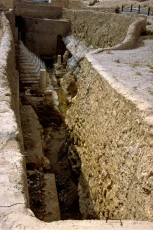
The historical sulfur Afqa Spring
[ Description by author: Wieder die Quelle, aber diesmal von ~ Nordosten. Links und hinten rechts sind zwei Altäre zu erkennen. Wenn das Gestufte hinter der Säule die alte Zugangstreppe zur Quelle ist, war sie verdammt steil ....... ]
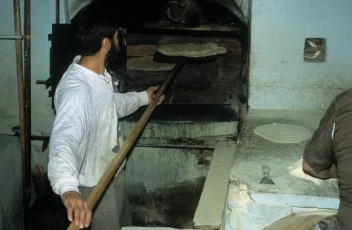
Manbij, Bakery of flat bread with oven

Aerial photograph of Jibal Lubnan ash-Sharqiyya (Anti-Lebanon Mountains) with Barada valley

The entrance of al-Madrasa az-Zahiriyya is richly decorated with ablaq masonry, a muqarnas vault and inscriptions

Hammam Bahram Basha, the main facade after the destruction
1

Im Wohnbereich der halbnomadisch lebenden Familie aus der Maskana region

A side of the walls of Qalʿat Salah ad-Din

Jisr ash-Shughur, Qalʿat ash-Shugr wa-Bakas, a twin crusader castle, cave

Siegesmonument von Hiraqla, Grundriss Erdgeschoss
Rekonstruktionszeichnung des Erdgeschosses, Zeichnung zeigt das Konstruktionssystem (mit Maßstab)

Traditionelle Häuser in Halbun

View on the Euphrates river from Dura Europos
[Original: Ruinen von Dura Europos]

Jisr ash-Shughur, Qalʿat Shugr wa Bekas, Innenraum.

Turmgräber im Tal der Gräber (Westnekropole)
[ Description by author: Links der Turm des Maliku (vvgl. Bild 0576, 0815, 0822 !), rechts der des Jambliqu. Davor in der Mitte das Tempelgrab, links davon der untere Teil eines Turmes der Justinianischen Stadtmauer (Nordseite). Gesehen von ~ Nordosten. ]

Al-Madrasa as-Sultaniyya, inscription band above the window of al-Malik az-Zahir Ghazi tomb

Jamiʿ Aslan Dada, Halle - oktogonaler Tambour der Kuppel

Gebetshalle der Umaiyaden-Moschee
[ Description by author: Blick aus der Nordostecke durch die Osthalle nach ~ Südwesten. Hinter den Säulen der Pavillon mit dem Kopf Johannes' des Täufers. ]

Ruinen des Jupiter-Tempels in Damaskus, eingebaut in das Stadtgefüge

Muzayrib - Ancient mill
Khan

Hama, Wasserschöpfräder Kilaniyya, al-Tawafira und al-Jaʿbariyya

Madrasat al-Firdaws, lobed octagonal basin in the centre of courtyard

Afamiya, Architectural component with showing ionic elements

Tall Mardikh (Ebla), Blick in den rekonstruierten Palast G
shap_import_48448

Al-Madrasa al-Hallawiyya, entrance - Zengid inscription in Naskhi script

Damaskus, Hammam al-Qaramani
[ Description by author: Eine Tür - ursprünglich ein hochliegendes Fenster (s. Beschreibung Bild 0139) ? ]

Muzayrib, alte Mühle

Camel and its guide on sacrophagus
[ Description by author: Kamel und sein Führer. Die Darstellung befindet sich vermutlich unter einer Kline.- Ob dieses Bild ebenfalls zum Sarkophag Bild 0873 - 0877 gehört, kann ich nicht mehr sagen. ['26/03/2002 (?)'] ]

Ar-Raqqa, Ansicht eines Teilbereichs der Stadtmauer

Noria (water wheel) axis
The wooden axis of the noria is called the heart. It stands on wooden bases that are placed on steady stable stone foundations at the bottom of the river.

View from Harim Castle towards the nearby plains

General view of al-Jibal as-Sahiliyya (the coastal mountains) covered by forests

Steinmetzdekoration in der Zitadelle von Damaskus
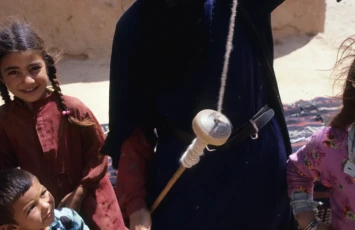
Eine Frau, die mit einer hängenden Spindel spinnt

River section of Barada

Jabla, Sultan-Ibrahim-Moschee, Hauptfassade

At-Taynabiyya Mosque, the upper part of the entrance is decorated with muqarnas and geometrical decorations
[ Description by author: Dekor. ]

Turbat Khaʾirbak (mausoleum), section from the interior (the courtyard)
size of plan 21 x 15 . scale 1:100 .

New buildings still empty for agricultural purposes in the Ghab-plain

Exterior view of the dome of Salah ad-Din al-Ayyubi Mausoleum, Damascus
[Ooriginal: Damaskus. Hinter d. Omajadenmoschee]

Die Daydariyya-Höhle von außen
shap_import_44213

Khan Qurdbak, iwan of the Mamluk palace

Aleppo: multi-colored facade of Mamluk-Ottoman Hammam Yalbugha an-Nasiri
A view of the exterior façade of Yalbugha bath decorated with alternating black and yellow rows. The entrance is high with beautiful ranks on top and many windows on the sides. The large, high dome contains windows for the light to enter inside.
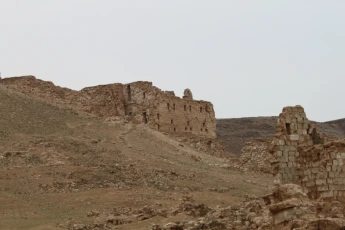
Halabiyya, remains of fortifications and the praetorium

ar-Rusafa, Goat hair tent erected for a funeral service

An olive grove in the Ghouta of Damascus

Suq al-ʿAttarin, view to east showing the destruction

Die Pilgerkirche des hl. Simeon Stylites: vier Basiliken bilden einen kreuzförmigen Grundriss

Khan al-Hibal, Treppe ins Obergeschoss

Khan Murad Basha (Museum von Maʿarrat an-Nuʿman), Mosaik
[Original: Khan Murad Pascha, Bodenmosaik (4. - 7. Jh., aus den Toten Städten)]

Qalʿat ash-Shugr wa-Bakas, Burgruinen auf einem Bergvorsprung

Ausgrabungen in Tall Afis

As-Sinaniyya-Moschee, Innenhof

Interior view of the tomb tower of Elahbel

View of an orchard in the Ghuta of Damascus

Karten Aleppos: historische Altstadt und Außenbezirke. 1969 mit Revisionen in 1979 und 1982
Thematische Karte Aleppos: innenstadt und Außenbezirke: Bemerkenswerte Gebäude und Grundzüge der Flächennutzung in den Neustadtquartieren | Karte 5. Maßstab 1:5000, Maßstabsleiste und Legende, Inventurnr. /Stempel: 4° 629 192-Ktn / Bibliothek Preussischer Kulturbesitz. Teil von TAVO Reihe B Nr. 58

A fountain rich in geometric decorations in the northern arcade of the courtyard, Asʿad Basha al-ʿAzm Palace

Al-Mudiq Castle sits on a large hill
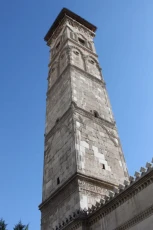
Great Mosque, Minaret
The minaret of the Great Mosque was commissioned by the judge (qadi) of Aleppo during the rule of the Seljuk dynasty in Syria. The beginning of its construction is indicated in the inscription at the base and the completion date is found at the top: 483 and 489 AH / 1090 and 1096 AD. It existed until 2013. The minaret is a square shape, its shaft is approximately 45 m high and made of limestone. On its upper edge, there is a cornice formed by two rows of flat arched niches lavishly adorned by floral elements. This is topped by an open wooden gallery for the muezzin (prayer caller) and a short tower with cupola. Between the base and the top, the minaret is divided into four zones of varying height. Those are, except for the second one, decorated with blind arches formed by profiled mouldings each running uninterruptedly around the minaret’s shaft. Each zone is separated by friezes with calligraphic, artistically written, Arabic inscriptions. These exquisitely carved inscriptions are written in floriated Kufi – a script style distinguished by bold letters adorned with floral motifs – and in Naskhi script. At the base of the minaret is the signature of the architect Hasan ibn Mufrih al-Sarmani written inside a cartouche. The inscription from the minaret’s base shows that the local Aleppine judge and the Seljuk governor shared power in the city, as their names are mentioned together: “The mosques of God are only to be maintained by those who believe in God and the Last Day and establish prayer and give zakat [(alm-tax); Quran 9:18]. It was started to be built by the High Judge Ibn al-Khashshab Muhammad ibn Muhammad al-Khashshab, may God have mercy on him. In the days of al-Amin al-ʿAjal al-Muzaffar Qasim al-Dawla wa-Nasir al-Mila Abi Saʿid Aqsunqur Bak, the slave of the Commander of the Faithful, may God enhance his supporters”. The upper inscriptions indicate the names of the then ruling Seljuk sultans Malikshah I and Tutush, and of Barakat ibn Faris, commander of the urban militia.

Stone coffins in the Southern Palace, Ebla (Tall Mardikh)
Wie Bild 1175, diesmal nach ~ Osten gesehen. Man beachte die "Becken" (Särge ?) zwischen den Orthostaten. [Original:Tall Mardîkh (Ebla)']

Busra, Hammam Manjak, Restoration works

Archäologische Funde aus Raqqa, ausgestellt im Damaszener National Museum

ar-Rusafa, Beduinenfrauen kochen Schaffleisch auf offenen Feuerstellen aus Anlass des Wüstenfestivals

Northwest corner of Nabu Temple
[ Description by author: ~ Nordwest-Ecke. In der Mitte das Podium des Tempels, vorn zwei Säulen und viele Basen der ~ West-Kolonnade des Tempelhofes. Hinten rechts die Propyläen, ganz hinten links die arabische Bastion des Bel-Tempels. ]

The northern entrance of the historical city of Dura Europos (Qalʿat as-Salihiyya), end of 4th century BC
[Original: Große Orientreise Nr.63 mit Rotel-Tours: Amman-Bagdad-Uruk-Babylon-Arbil-Mosul-Hatra-Samara-Mari-Dura Europos-Aleppo-Dayr Saman-Ugarit-Palmyra-Jarash]

A woman spinning with a suspended spindle

Busra, Hammam Manjak, Heißbadetrakt (Juwwani)

Qalʿat Jaʿbar, Minarett
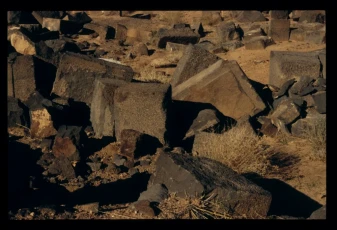
Remains of a ruined building in Jabal Says

Dorfbewohner beim Bau eines traditionellen Wohngebäudes im Gouvernement ar-Raqqa

In the living compartment of the semi-nomadic family's tent (from Maskana region)
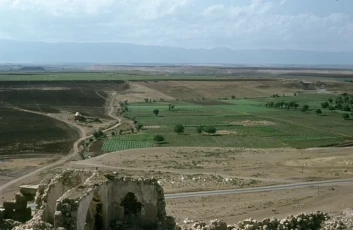
A view from Qalʿat Shayzar towards the Orontes plains

An der Westseite des Jabbul-Salzsees, trapezförmige Türöffnung zu einer kleinen Küche in einem Kuppelbau

Blick über Oase und Ruinen
[ Description by author: Ganz vorn unten ein Stück der Stadtmauer. Hinten das Areal des Bel-Tempels, vgl. Bild 0811 ! Ganz rechts, hinter der Mauer, ein Teil des Hotels Sham Palace. Blick nach ~ Osten. ]

Madrasat al-Firdaws, Innenhof nach Nordosten mit Iwan (Nord) und Ostarkade

Darat ʿAzza, city located along the St. Simeon Monastery road

Minaret of the Great Mosque of Hama

Maronite Cathedral, the altar

Ein Laden der traditionelle Gebrauchsgegenstände verkauft in Raqqa

ʿAyn al-ʿArus, Interior of a village mud bricks house, armenian owners
Window niche with a built-in sink made from concrete
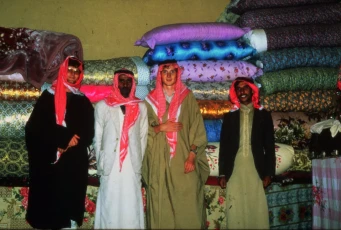
Traditional dress for men in the villages of at-Tabqa
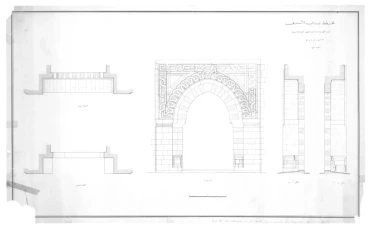
Detail drawing of the relocated portal in al-Matbakh al-ʿAjami
Reusing a portal for the new facade of al-Matbakh al-ʿAjami after demolishing a part during enlargement of the street: detail plan drawings of the relocated portal from a demolished palace/ mansion, registered under 157A, 22A in Syrian monuments list, and originally located in cad. no. VII-1-1 3777. Scale 1:20.

Aramaic inscription on the western altar, al-Karasi
[ Description by author: Detail aus Bild 0571: die aramäische Inschrift. ]

A sample of the handprinted fabric prepared for the women of Douma.
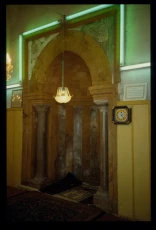
Al-Madrasa al-Muqaddamiyya, the prayer niche

Holztür in der Altstadt von Damaskus

Bimaristan Arghun, inscription

Burg (Qalʿat) al-Qadmus, Inschrift

Vulkanlandschaft im Jabal al-ʿArab
[Original: Vulkanit-Aufschluß sü. d. Leja, ö.d. Straße]

ʿAyn al-ʿArus, Ausgrabung eines Bodenmosaiks
Mosaic floor panel in hexagonal shape

Römisches Tor (Peribolos) an der Geraden Straße, Altstadt von Damaskus
[ Description by author: von Bild 0321, gesehen von ~ Osten. Der alte Fahrdamm ist heute ein "Park". ]

Telegraph column, topped with a miniature of a mosque, Sahat (square) al-Marja

Al-Madrasa ash-Sharafiyya, the dome from outside
shap_import_66021

Al-Madrasa al-Hallawiyya, the current prayer hall was part of ِAleppo's Byzantine cathedral
The damage of al-Hallawiyya prayer hall that contain an exedra of the Byzantine cathedral of St. Helena (5th CE.). During the war, the monument was damaged and plundered.

Aleppo, Bab al-Maqam city gate, general view from south, ca. 1932 during French mandate
Note: these photos were taken between the year 1924 - 1939. The chosen date is to be average. (photographer unkown)

Detail of a decorated wooden panel of the Damascus Room in the Dresden Museum for Ethnology

Remains of the facade of an building, Sirjilla

View to the northeast, Monastery of Mar Musa al-Habashi
[ Description by author: in seiner Landschaft. Etwas anderer Standort als Bild 0493, Blick nach ~ Nordosten. ]

Blick von der Burg (Qalʿat) von Shumaymis in das Umland
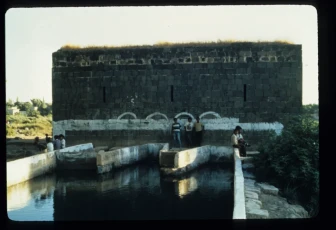
Muzayrib - Ancient mill

Jisr ash-Shughur, Qalʿat ash-Shugr wa-Bakas, a twin crusader castle, caves

Blick von der Burg (Qalʿat) Shumaymis in die Ebene
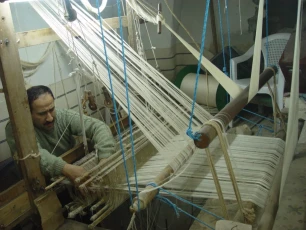
A man weaving textiles with a pit-loom in Hama
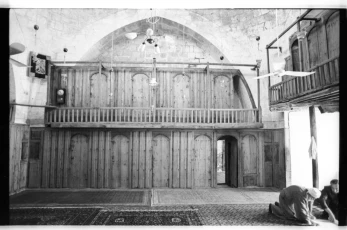
Az-Zawiya al-Hilaliyya, wooden cells inside the prayer hall's iwan

Al-Madrasa al-Hallawiyya, korinthisches Säulenkapitell
[Original:'Al-Madrasa al-Halâwiya, Halab / Aleppo. Kapitell von der äußersten Säule rechts des Konchos.'].

Bayt Dallal, Iwan - ornamentiertes Holz-Vordach

Jamiʿ ash-Shuʿaybiyya, view of the rectangular minarett above the main entrance

Raqqa, Baghdad-Tor, von außen gesehen
Raq19820005.tif

Al-Madrasa al-Ahmadiyya, entrance of the tomb

In the vicinity of a small town/village on the slope of a natural rock, possibly in the Afrin region
Question: Does anyone know where the place shown in the photo is located? The photo was taken in 1984 somewhere in West or North Syria. On the photo one can see a small river, a wide plain with fields and trees, and a rock rising from the plain with a small building on top. On the slope of this rock is situated a small town. Since there are low mountains in the background, the photo may have been taken in the Afrin region.

Auf dem Tall Aswad bei Raqqa, Blick auf Nebengebäude eines Gehöfts

Nordpalmyrenische Kreidehöhen, einsame atlantische Pistazie im Flussbett eines ausgetrockneten Wadis

Byzantine decorated basalt stone reused in the construction of Qal‘at Shayzar

Preparation of the design of a felt carpet
Photographs of a manufacturing facility for felt carpets in Al Bab as part of the "Aleppo Stadtarchivprojekt" of GIZ (German Corporation for International Cooperation) in 2008

General view of the town of Maʿlula
[ Description by author: Gesehen vom linken Berg - GPS-Tag approximativ - nach ~ Nordosten auf den Ortskern. Unten links die Masjid Ma'lûlâ, oben links das Kloster Mâr Takla und links davon der Eingang zum Fajj Mâr Takla. Hinter dem Ganzen der "rechte" Berg und das Plateau. ]

Al-Madrasa ash-Sharafiyya, Potalnische - Muqarnas-Ecküberleitung

Busra, al-Jami‘ (mosque) al-ʿUmari - minaret, northern-eastern corner

Gesamtsicht auf die Altstadt von Hama mit dem al-Muhamadiyya Wasserschöpfrad (Noria)
[Original: Blick auf die Stadt und ein Noria (Schöpfrad) am Stadtpark]

Bayt Junblat, southern iwan - decoration of faience tiles
[Original:'Qasr Jumblât, Halab / Aleppo. Dekor in der Wand oberhalb der Tür von Bild 1303.].

Jamiʿ (mosque) al-Hanabila, courtyard and ablution fountain

Jamiʿ Aslan Dada, interior view of the prayer hall (qibliyya) showing the niche (mihrab)

Pre-drawn patterns of a contemporary ‘Ajami decoration

Al-Madrasa ash-Sharafiyya, interior view of lobed dome carried by muqarnas

View of the courtyard of Khan al-Wazir

Al-Madrasa az-Zahiriyya, äußere Gesamtansicht

Al-Madrasa as-Sultaniyya, facade and entrance of the prayer hall
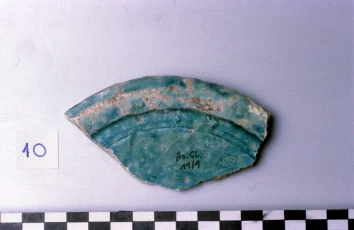
Raqqa - "East of Raqqa" site - Tall Aswad - glazed pottery
Tall Aswad; Glazed Pottery; ROM 10

Northern Palmyrenean chalk heights, lonely Atlantic pistachio in the riverbed of a dried-up wadi

Jamiʿ al-Khayr, Hauptportal Innenhofseite - dekorative Details

A side from the Citadel of Busra
[Originalbeschriftung: HQ-k.K7]
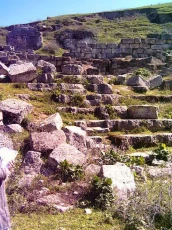
Afamiya Theater, remains of Cavea
shap_import_70740

Ansicht des Jabal Haramun (Hermon-Gebirge)

Jamiʿ al-Mihmandar, prayer hall - minbar (pulpit)

Weekly market in Maskana, at the end of a sales day

Colorful ornamental motifs on ablaq wall, Jamiʿ as-Sinaniyya

Bayt Ghazala, courtyard and western facade - the main hall facade

Qanawat, Frauen in traditioneller Kleidung an einem Brunnen

Bayt Wakil, fountain of the reception hall

The southern tower of Qal‘at Shayzar

Stadttor von Ugarit

Archäologische Funde aus Raqqa, ausgestellt im Damaszener National Museum

Raqqa, Raqqa, Bedouin family in their tent
The Bedouin family lived in their tent next to the excavation of the German Archaeological Institute, as they were initially the official guards.

Bayt Ghazala, Innenhof nach Nordwesten mit Fassade der Hauptempfangshalle (Qaʿa)
Hof mit Bahra und Qa'a-Front
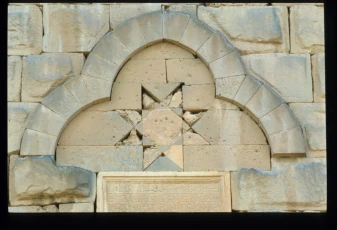
Busra Citadel - Stone decorations at the entrance

Al-Madrasa al-Kamiliyya, gate portal

Khan as-Sabun, Fenster und Dekoration über dem Eingangsportal

al-Bara, Dayr (monastery) Subat, 6th c.- General view

Aleppo Great Mosque, minaret, foundation inscriptions on the base
The minaret of the Great Mosque was commissioned by the judge (qadi) of Aleppo during the rule of the Seljuk dynasty in Syria. The beginning of its construction is indicated in the inscription at the base and the completion date is found at the top: 483 and 489 AH / 1090 and 1096 AD. It existed until 2013. The minaret is a square shape, its shaft is approximately 45 m high and made of limestone. On its upper edge, there is a cornice formed by two rows of flat arched niches lavishly adorned by floral elements. This is topped by an open wooden gallery for the muezzin (prayer caller) and a short tower with cupola. Between the base and the top, the minaret is divided into four zones of varying height. Those are, except for the second one, decorated with blind arches formed by profiled mouldings each running uninterruptedly around the minaret’s shaft. Each zone is separated by friezes with calligraphic, artistically written, Arabic inscriptions. These exquisitely carved inscriptions are written in floriated Kufi – a script style distinguished by bold letters adorned with floral motifs – and in Naskhi script. At the base of the minaret is the signature of the architect Hasan ibn Mufrih al-Sarmani written inside a cartouche. The inscription from the minaret’s base shows that the local Aleppine judge and the Seljuk governor shared power in the city, as their names are mentioned together: “The mosques of God are only to be maintained by those who believe in God and the Last Day and establish prayer and give zakat [(alm-tax); Quran 9:18]. It was started to be built by the High Judge Ibn al-Khashshab Muhammad ibn Muhammad al-Khashshab, may God have mercy on him. In the days of al-Amin al-ʿAjal al-Muzaffar Qasim al-Dawla wa-Nasir al-Mila Abi Saʿid Aqsunqur Bak, the slave of the Commander of the Faithful, may God enhance his supporters”. The upper inscriptions indicate the names of the then ruling Seljuk sultans Malikshah I and Tutush, and of Barakat ibn Faris, commander of the urban militia.

Jamiʿ (Moschee) al-Hanabila, Nord-Südschnitt mit Gebetshalle, Innenhof und Minarett

Vor einem Regierungsgebäude wartende Menschen in Raqqa
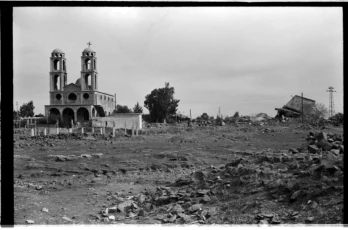
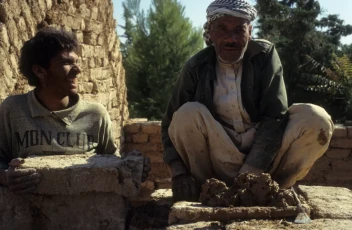
Habuba Kabira, master builder and his helper constructing the walls of a mud brick house

Fassade des berühmten Hotels Zenobia in den Ruinen von Palmyra

Große Moschee von Hama, Innenhof
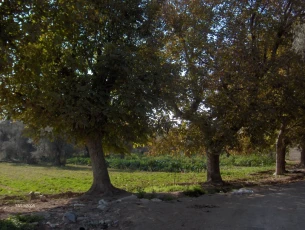
A grove in the Ghouta of Damascus

Colossal basalt lion, ʿAyn Dara Temple

al-Bara, Pyramidal roofed tomb known locally as As-Sawma‘a,
![Tall Brak (Nagar), ruins of Naram-Sin Palace, 3rd millennuim BC. [Original photo name: naram sin palace2]](https://syrian-heritage.org/wp-content/plugins/justified-image-grid/timthumb.php?src=https%3A%2F%2Fsyrian-heritage.org%2Fwp-content%2Fuploads%2F2020%2F06%2Fshap_import_44762.webp&h=230&q=90&f=.webp)
Tall Brak (Nagar), ruins of Naram-Sin Palace, 3rd millennuim BC. [Original photo name: naram sin palace2]
shap_import_44762

Al-Madrasa al-ʿUmariyya al-Kubra, Süd-Arkade

Jamiʿ al-Mihmandar, courtyard - inscription on the northern facade

Das Stadttor Bab Qinnasrin, Außenansicht von Südwest
Das äußere Tor wird von einem Spitzbogen abgeschlossen, der in abwechselnd hell-dunkel gestreiften Mauerwerk (Ablaq) ausgeführt wurde.

ar-Rusafa, Capital on the interior façade of the North Gate,

Excavation of mosaic floor, ʿAyn al-ʿArus
Mosaic floor panel in hexagonal shape

Busra - Masjid Yaqut (mosque) - the exterior facade and the entrance

Burj al-Ghanam, Deatailansicht der Südfassade mit Gusserker
shap_import_63418

View to northeast, Qalʿat Ibn Maʿn
[ Description by author: Blick nach ~ Nordosten. ]

General view of Masyaf Castle

Al-Madrasa al-Ahmadiyya, dome of the prayer hall

Khan Dannun - Courtyard

Al-Madrasa az-Zahiriyya, general view of the courtyard and the colonnaded portico

Bayt Ghazala, courtyard, windows of the northern facade

Vorbereiten des Abendessens im Hof eines Lehmziegelhauses am Stadtrand Raqqas

Zwei kurdische Frauen. Die Frau auf der rechten Seite trägt ein traditionell gewebtes Überkleid

Busra - Southern Roman Bath (al-Hammam ar-Rumani al-Janubi)
South-Thermae, view from the colonnade

Jamiʿ ash-Shuʿaybiyya, prayer hall
shap_import_66115

Palmyra, Diokletianslager, Grab
[ Description by author: Eingang zu einem Grab in der Nähe des Fahnenheiligtums. Vgl. Bild 0760 ! ['~ kein Datum !] ]

Sakophagrelief mit Figurenpaar
[ Description by author: Bei Bild 0873 - 0877 handelt es sich um den selben Sarkophag, vielleicht gehört auch Bild 0872 dazu.- Diese Sarkophage bestehen aus zwei Teilen: dem Kasten, der in der Form einer Kline mit Polster gearbeitet ist, und dem Deckel, der den liegenden Toten darstellt. Bei der Kline sind bis in feinste Details Holzschnitzereien nachgeahmt, bei dem Polster und insbesondere bei den Gewändern die feinsten bestickten Stoffe. Unter der Kline sind Szenen dargestellt, hier wohl Diener, die für ein (Toten)Mahl oder (Toten)Opfer rüsten. Auch die Szene von Bild 0872 "spielt" unter einer Kline: aus dem Alltag des Toten, wohl eines Handelherrn. ]

Al-Khabur region, a potter in the workshop, probably in al-Busayri

Waqf Ibshir Mustafa Pasha, Kaffeehaus, Halle
Die außergewöhnlich reich dekorierte Fassade der Halle des Kafeehauses sowie die erste Gewölbereihe wurden zerstört. Das Innere der Halle wurde nur teilweise beschädigt, während die Kuppel mit ihrer hohen Laterne zum Größtenteil zerstört wurde.

A view of al-Marqab castle from the bottom of the hill

Oberes Barada-Tal im Anti-Libanon

View from west at al-Kilaniyya historic quarter and al-Baz noria (waterwheel)
Rare view of the now vanished quarter (destroyed in 1982) on the right bank of the Orontes. [Original description: Hama quartier Kaylani] Note: these photos were taken between the year 1924 - 1939. The chosen date is to be average. (photographer unkown)

Kitbugha mausoleum on the foot of Qasyun mountain

Ansicht der Wassermühle von ʿArbin im Rif Dimashq

Manbij, cemetry and new buildings in the background, view from the south

Public street life in Raqqa

Der "Byzantinische Turm" in Qasr al-Hayr al-Gharbi
[Original: "Heir al-Garbi"]

Khan Murad Basha (Museum von Maʿarrat an-Nuʿman), Innenhof
[Original: Khan Murad Pascha, osman. (heute Mosaiken-Museum)]

Afamiya, a side of ruins

Wandbild aus Mari (Tall al-Hariri), das als "Ordinator des Opfers" bekannt ist." (ca. 1780 v: Chr.) und im Louvre hängt.
Teil eines Wandbildes, auf dem eine große Figur (hier nicht abgebildet) den König darstellt, der einer rituellen Opferdarstellung vorsteht. [Original: Malerei aus Mari]
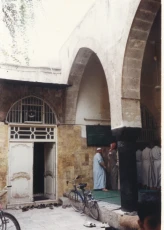
Jamiʿ ash-Shuʿaybiyya, arcade and the prayer hall entrance
shap_import_66113

Burj al-Ghanam, general view of the facade

Al-Madrasa al-Hallawiyya, Haupteingang

Qalʿat al-Marqab (Castle), West door of the Chapel
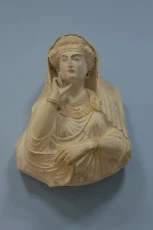
A sculpture of a woman, showing clothes and jewelry details

Drawings at the entrance Qasr al-Hayr ash-Sharqi
[Original: Malerei im Tor]

Lintel of the entrance of a hall in the roman religious complex, Mnin
[ Description by author: Detail aus dem Türsturz der kleinen Halle. ]

Great Mosque, view at courtyard in 2018
View of the inner courtyard during the restoration works and the rubble processing, especially the rubble of the destroyed minaret.

Courtyard of Khan Murad Basha (Museum of Maʿarrat an-Nuʿman)
shap_import_74305

Side facade of a byzantine church, al-Bara

Eine Reihe byzantinischer Säulen, Qasr al-Hayr al-Sharqi

Courtyard of Khan Murad Basha (Museum of Maʿarrat an-Nuʿman)
[Original: Khan Murad Pascha, osman. (heute Mosaiken-Museum)]

Bimaristan an-Nuri, Umrahmung der Haupteingangstür

The lower part of the lion of goddess Al-Lat, 1st c. AD
The lion was embedded in the outer wall of the Al-Lat temple. As a protector of an antelope it is a symbol of peacefullness. The stone statue was severely damaged by ISIS.

Bayt Junblat, northern iwan

Remains of a house, Qarqbiza

Coffehouse Aslan Dada (vanished)

Jamrin, Brücke über das Wadi az-Zaydi

At-Takiyya al-Mawlawiyya, the kitchen entrance

Burj as-Saʿa, mechanische Uhr

Straße bei einem Dorf im syrischen Küstengebirge

Tall al-Biʿa, view from afar
[Original: Blick auf Tall al-Biʿa]

Busra, Hammam Manjak, Nische im Heißbadetrakt

Jamiʿ at-Tawashi, eastern facade

Dayr Zakka (Kloster), Fußbodenmosaik im Sanktuarium, 595 AD
Raq19920015.tif

Vulkanisches Gestein hinter Khubra See, Jabal Says

Schäfer mit traditionellem Filzmantel und Überschuhen im Dorf Suwaydiyya Kabira

Qasr al-Hayr al-Sharqi, decorations at the top of tower gate
[Original: Turm links]
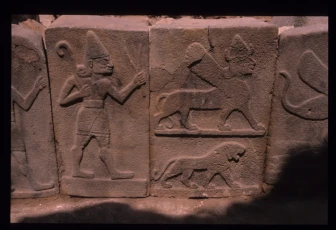
Citadel of Aleppo, Temple of the Storm God Hadad - Detail on platform wall
[Original: Ausgrabung Kai Kohlmeyer]

Al-Madrasa ash-Sharafiyya, entrance with half-dome and muqarnas

Qasr al-Hayr al-Sharqi, Ruinen eines aiyubidischen Bogens im Bereich der westlichen Einfriedung

Maʿlula, the procession to the Holy Cross celebration also passes through the narrow alleys of the old town.

Busra, Hammam Manjak, frigidarium or cold room (barrani)

ar-Raqqa, Qasr al-Banat, Nord-Iwan

View at al-Hariqa district showing the south-western tower of Damascus Citadel

50 piastres (silver), 24 mm, 1947

The apse of eastern cathedral, Afamiya

Al-Madrasa al-Hallawiyya, nördliche Fassade - Marmortafel mit Datumsinschrift 1315 AH und Tughra des Sultans ʿAbd al-Hamid Khan

Raqqa, Ruinen des Qasr al-Banat

Schutzüberdachung einer archäologischen Grabung in Mari (Tall al-Hariri)
[Original: Große Orientreise Nr.63 mit Rotel-Tours: Amman-Bagdad-Uruk-Babylon-Arbil-Mosul-Hatra-Samara-Mari-Dura Europos-Aleppo-Dayr Saman-Ugarit-Palmyra-Jarash]

Jamiʿ al-Mihmandar, lower part of the minaret
The minaret has a square base, octagonal drum, and cylindrical shaft ornamented with zig-zag friezes and blind arches. It dates to late 14th cent. AD (8th H) and was not constructed as part of the original mosque. The minaret was reconstruncted in 1946. (see also: archnet.org) The minaret had suffered severe damage during the conflict in Aleppo (2012-2016) and eventually collapsed.

Stage of the Roman Theater and the adjacent wall of the Islamic Citadel, Busra

Jamiʿ al-ʿAdiliyya, the prayer niche

Jabal ʿAruda, a view towards the Euphrates

Busra, Römisches Theater, umgeben von der islamischen Zitadelle

Jabal ʿAruda, Angeln im Euphrat

Remains of the western gate of the temple of Jupiter

Jamiʿ al-Utrush, western facade - decorated window
The upper part of the middle window of the exterior western facade.

Roman sarcophagus with decorations, Qanawat

Detail of a decorated wooden panel of the Damascus Room in the Dresden Museum for Ethnology

A side of architectural remains in Tall Mardikh (Ebla)
shap_import_48466
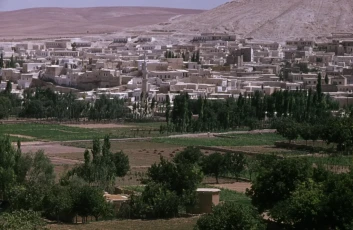
View of the city of Yabrud adjacent to agricultural fields
Town and irrigated fields

Dayr Zakka (monastery), floor mosaic of the narthex
Mosaic from monastery Dayr Zakka, upon Tall Bi'a; 86:22, Raq19900047.tif

Säulenstraße - Abschnitt A
[ Description by author: bis zum Monumentalbogen, linke Seite. Gesehen von ~ Südwesten. Alle Zuordnungen sind hypothetisch ! ]

Khan Dannun, Innenhof

Al-Madrasa az-Zahiriyya, capital of a column of a portico
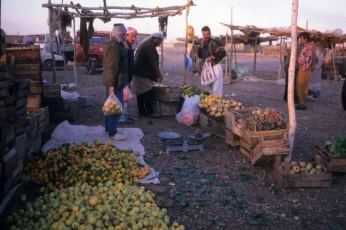
Weekly market in Maskana, where the farmers of the region sell their fruit and vegetables

Remains of fortifications in Halabiyya-Zalabiyya

Busra, Blick in die Kathedrale, 6. Jh.
[Original: Kathedrale (den Märtyrern Sergios und Bacchios und dem Leontios geweiht), Chor]

Al-Bab ash-Sharqi (Eastern citygate), the eastern entrance to Old City of Damascus
[ Description by author: [Original: Gesehen von ~ Südwesten. Es bildete das östliche Ende der Geraden Straße, deren ursprüngliche Struktur hier noch gut zu erkennen ist. Alles Drumherum ist modern.- Khâlid Ibn al-Walîd betrat Damaskus bei der Eroberung 634 durch dieses Tor. Vgl. Bild 0324 !] ]

Madrasat al-Firdaws, oktogonales Brunnenbecken mit gelapptem Rand - Detailansicht

Khan al-Wazir, interior facade of the khan's entrance

Ein teilzerstörtes historisches Gebäude im historischen Midan-Viertel

Hammam Bahram Basha, Hauptfassade, ausgerichtet nach Norden

A gathering of people around a rolled out woven Kilim tapestry
The rug consists of strips, that are sewed together

Habuba Kabira, water reservoir for field-irrigation, in the background motor pump of the well

Bimaristan an-Nuri, courtyard- entrances to single rooms

Jamiʿ al-Mihmandar, marble prayer niche

Inside the city wall, excavation work, Qatna
. [Original: Al-Mishrifa / Qatnâ']

Bayt Junblat, southern iwan -faience tiles

Jamiʿ al-Khayr, prayer hall

Qarqbiza, Portal der frühbyzantinischen Hauskirche
[Original: Tor eines Hauses]

View to Jabal ʿAruda on the right bank of the Euphrates
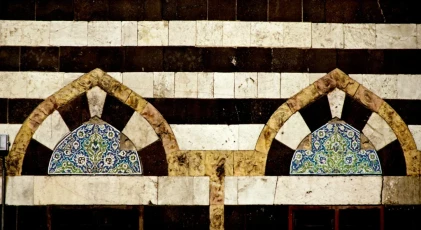
Damascene painted tiles over the windows, as-Sinaniyya Mosque
[ Description by author: Detail: Lünetten mit bemalten Kacheln über den Fenstern. ]

Qal‘at Shayzar (castle), The stairs leading to the entrance

A side of Salah ad-Din Castle

Fresco on the apse, Roman Orthodox St. Elian Church, Homs
[ Description by author: Fresken der Kalotte. Sie sollen aus dem 12. Jh. stammen. In der Mitte ein thronender Christus, flankiert links von Maria und Maria Magdalena, rechts von Johannes dem Täufer und dem Evangelisten Johannes . Darunter rechts und links in den Medaillons die vier Evangelisten. ]

Qasr al-Hayr al-Sharqi, Ruinen der Moschee im Bereich der wetslichen Einfriedung

Hinweistafel für die Afqa-Quelle
[Original: Straßenschild, Schwefelquelle]
![Arial view at Tall al-Bai'a from the north. [Kalla (1999) 131]: [Gßbor Kalla: Christentum am oberen Euphrat. Das byzantinische Kloster von Tall Bi'a. in: Antike Welt 30/2 (1999).]](https://syrian-heritage.org/wp-content/plugins/justified-image-grid/timthumb.php?src=https%3A%2F%2Fsyrian-heritage.org%2Fwp-content%2Fuploads%2F2020%2F04%2Fshap_import_44697-1024x697.png&h=230&q=90&f=.png)
Arial view at Tall al-Bai'a from the north. [Kalla (1999) 131]: [Gßbor Kalla: Christentum am oberen Euphrat. Das byzantinische Kloster von Tall Bi'a. in: Antike Welt 30/2 (1999).]
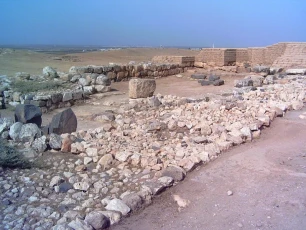
Tall Mardikh (Ebla), Blick über einen Teil des Ruinengelände
shap_import_48472

Khan Asʿad Basha al-ʿAzm, zentrale kreisförmige Dachöffnung (eingestürzte Mittelkuppel)

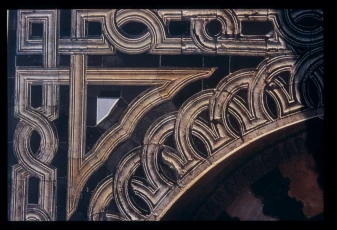
Al-Matbakh al-ʿAjami, detail of modern and re-used portal (spolia)

Great Mosque, Plan of the building parts
The Great Mosque of Aleppo has moderate damage, except for the complete destruction of the minaret in April 2013. The degree of damage is around 30%. The western wing shows two large circular holes in the roof. There are currently no photographs available which clarify the extent of the interior damage. Several fires have affected parts of the main prayer hall causing damage especially to the southern gate and the wooden doors of the northern facade. The northern arcade was burned and its main gate partially damaged. The eastern part of the courtyard floor is torn out.

General view of Baalshamin Temple, 2nd century AD
[ Description by author: und nördlicher Säulenhof, gesehen von ~ Ost-Nord-Ost. Die Anlage umfasste auch einen südlichen Säulenhof und erstreckte sich im Nordosten bis unter das heutige Hotel Zenobia. Der Tempel datiert aus der Mitte des 2. Jhs. n. Chr. ]

Eingang in den Khan al-Hallabat
[ Description by author: und Eingang, gesehen von der ~ Südmauer nach ~ Nordosten über den Innenhof. ]

Bayt Ghazala, the iwan
[Original: B86 /Film XV]

ar-Rusafa, general view of Basilica B, cisterns and city wall

Mausoleum of az-Zahir Baybars, colorful marble niche

Jamiʿ al-ʿAdiliyya, entrance of the prayer hall
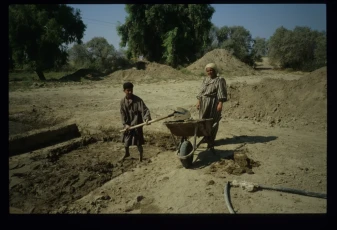
Preparation of mud for construction in one of Raqqa villages

Burg (Qalʿat) al-Qadmus, arabische Inschrift

General view of the fertile Zabadani plains

Eingang in die Burg (Qalʿat) Salah ad-Din

At-Takiyya al-Mawlawiyya, western facade, al-Midan

Jurn Kabir, Kalken der Fassade mit Kreidemilch

Ebla (Tall Mardikh), Steinsärge (?) im Südpalast
Wie Bild 1175, diesmal nach ~ Osten gesehen. Man beachte die "Becken" (Särge ?) zwischen den Orthostaten. [Original:Tall Mardîkh (Ebla)']

Destructions in Raqqa city center, 2018
The modern city was heavily destroyed by bomb attacks on the "capital" of the IS in 2017.

Afamiya Theater, remains of the scaenae frons

Production of a contemporary ‘Ajami decoration in a Syrian workshop
Mohammad Haj Qab decorates the arch of the Syrian embassy in Bonn in 1992

A row of Byzantine columns, Qasr al-Hayr al-Sharqi

General view of Jaʿbar castle on the left bank of the Euphrates

Jamiʿ at-Tawashi, Ostfassade - rahmende Ecksäule einer Fensternische

Madrasat al-Firdaws, Inschrift

Al-Madrasa al-Hallawiyya, Detail der hölzernen Gebetsnische (Mihrab)

Wohnbereich der halbnomadisch lebenden Familie aus der Maskana-Region

Al-Madrasa al-Hallawiyya, Eingang - verbaute Spolie an der Basis, ehemals Taufstein in der früheren Kathedrale

Western facade of the Seraya complex (Maʿbad Zeus), Qanawat
[Original: Zweigeschossige Fassade mit drei rechteckigen Portalen (prostyler Tempel aus der 2. Hälfte des 2. Jhs, im 5. Jh. christlich überarbeitet)]

Khan al-Jumruk, Innenhofansicht mit Moscheekuppel und innerer Eingangsfassade

Archaeological finds from Raqqa, exhibited in the Damascus National Museum
Pottery vessel from ar-Raqqa; National Museum Damascus; Mus.Nr.16067; R.6

Remains of two-storey building, Sirjilla

Jamiʿ al-Khayr, details from the main entrance

Madrasat al-Firdaws, Blick auf die südlichen Arkade mit Eingang zur Gebetshalle

An aerial view of a water canal in the village of Shaykh Hilal
This image shows clearly the path of an old waterway. The residents make holes to clean the canals and they are visible on the surface. Olive trees spread near the canal.

A Waterspout of the ablution fountain in the courtyard of al-Adilliyya Mosque

Al-Matbakh al-ʿAjami: Qaʿa, Plan und vier Ansichten des Raumes

Bayt Ajiqbash, traditional furniture in the guest room (qaʿa)
shap_import_63521

Bewässerungsfluren von ʿAyn at-Tina im Qalamoun (Gebirgsregion in Südwestsyrien)
[Das Dorf selbst liegt im Mittelgrund über dem Niveau der bewässerten Feldterrassen: Im Hintergrund die Eozänkalk-Schichtstufe des Jebel Maaloula mit bis zu 1913 m ü. M.]

The altar of Nabu Temple, Palmyra

Jamiʿ al-Maydani, Minarett

Restaurierungsarbeiten an der Zitadelle von Damaskus

Part of the mihrab decorations, Umayyad Mosque
[ Description by author: Mihrâb: Kapitellchen der kleinen Säulen im unteren Teil der Nische. ]

Raqqa - Glass discovered at the site "East Raqqa" - the northern complex
Northern Complex; glass jar (fragmented)

Muzayrib - Ruins of an historical bridge

Fest der Ausgrabung mit Musikern, die die lokale Musik mit Mizmar und großer Trommel spielen
Arwad, Ayyubid fort, entrance
[Original: al-Burj al-Ayyubi]

A view of people in traditional dress with a camel in Shahba

Waqf Ibshir Mustafa Pasha, Kaffeehaus, Innenraum
Das Kaffehaus besitzt einen rechteckigen Grundriss. Das quadratische Zentrum wird von einer Kuppel überspannt, die von vier Pfeilern und vier Säulen mit achteckigem Schaft und Muqarmaskapitellen getragen wird. Muqarnas-Pendentifs leiten vom quadratischen Mittelraum zum rund der Kuppel über. Die Kuppel selbst wird von einer Laterne bekrönt. Der zentrale Raum ist von Pfeilern umgeben. Der durchfensterte Eingangsbereich ist einschiffig, während die drei anderen Seiten zweischiffig gestaltet sind. Die Schiffe werden von Gewölben überdeckt.

Processes of the contemporary ‘Ajami handcraft: the application of metal foil
Mohammad Haj Qab in his workshop in Damascus

Burg (Qal'at) al-Marqab, Bauornamentik auf einen Segmentbogen

Al-Madrasa ar-Rukniyya al-Barraniyya - the dome from inside

ar-Rusafa, Blick auf die Basilika B, Zisternen und die Stadtmauer

Al-Madrasa ash-Sharafiyya, Inneres der Mihrab-Kuppel mit Muqarnas und Rippenkalotte

Khan Qurdbak, Iwan, Schnitt Ost-West

View of an orchard in the Eastern Ghouta

Monastery of St. Simeon Stylites, late 5th-early 6th c., Exterior of sanctuary of east basilica (apse from exterior)

Warp threads in a mill of the textile factory of the Mezannar family in Damascus

Al-Madrasa al-Hallawiyya, cathedral apse - columns with Corinthian capitals
[Original: Medrese Halawiya (gegenüber dem Westeingang der Großen Moschee): quadrat. Kuppelraum mit östlicher apsidialer Säulenstellung; vermutl. urspr. byz. Tetrakonchos Ostapsis mit korinthischen Kapitellen]

Ökologisch-botanischer Garten neben der Zitadelle von Damaskus

Jamiʿ Sharaf, Qastal

Khan Qurdbak, entrance - wooden door covered with iron

Ar-Rusafa, Zentralbau, Konche

Suq al-Hamidiyya
Seller of traditional refreshing drinks in the city's most famous bazaar. It was built at the end of the 19th century in the European style.

Agriculture south of the Monastery of Saint Simeon (geological term for a hollow form closed on all sides in karst areas)
[Original: Polje südl. a. Simeonsklosters]

A part of the city of Harim, located on the northwestern slope of a mountain

Fruit and vegetable growing in the Ghuta of Damascus

Frauen mit einer siebgedruckten Kopfbedeckung (Habari)

Qarqbiza, Inneres der Hauskirche
[Original: einschiffige Kirche, Innenansicht]

Damascus, Hammam al-Qaramani
A door - originally a high-lying window? Hammam al-Qaramani

Raqqa-Ost, Ostpalast, Ausgrabung
Raqqa V; Restoration of Eastern Palace

Khan al-Hallabat, Gesamtansicht von Südosten
[ Description by author: des Forts, gesehen von ~ Südosten. Es liegt an der späteren Strata Diocletiana zum Schutz der Verbindung Palmyra - Damaskus. ]

Qalb Lawza, Basilica of 5th c., Apse and south façade
[Original: Basilika, vor 469, SO-Seite]

Tal der Gräber (Westnekropole)
[Original: Palmyra u. Nekropole]

Busra - al-Jami‘ (mosque) al-ʿUmari from the south
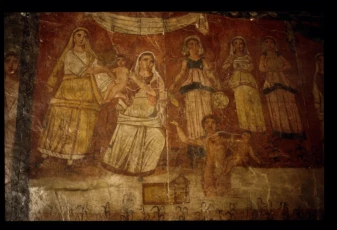
Fresco from Dura Europos, 3rd c. National Museum, Damascus

Eine Frau mit ihren Kindern und einer Spindel in ihrer linken Hand
Im Hintergrund liegt ein selbstgewebter Teppich

Tall Dahab, Guesthouse of a village with sculptural decoration of the facade

Madrasat al-Firdaws, Blick auf die südlichen Arkade mit Eingang zur Gebetshalle

Jamiʿ ar-Rumi, view of the courtyard and the western arcade

Bab as-Salam, the "door of peace" in the north of Old Damascus

Spring pasture of sheep grazing in Badiyyat ash-Sham at Sabʿ Biyar

Bimaristan an-Nuri, Inschrift über dem Eingang
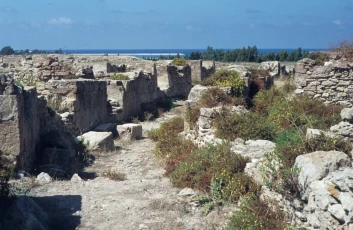
Ras Shamra, Remains of the Ugarit kingdom

Graves upon Jabal ʿAruda

Ausschnitt der Nordmauer der Zitadelle von Damaskus

Olive groves near Harim

Burj Alaʾ, southern facade from the inside with the arrow slit
shap_import_63424

Harran al-ʿAwamid, Hayat bin Qays al-Harani mosque

Theater, östliche Seite, 2. Jh. n. Chr.

View from the outer northwest edge of the ditch, Shumaymis Castle
Der innere Teil, gesehen nach ~ Südosten vom äußeren Nordwest-Rand des Grabens. . [Original: Qal'at ash-Shamîmîs']

Near Tall Tamir, In a tannur deepened in the ground the flat breads are baked
The Assyrian villages on the Khabur with their domed houses were built by the French Mandate Government for Christian refugees from Turkey and Iraq.

A side from Qalʿat al-Marqab (Castle)

Shaykh Shibli Schrein - al-Tar Gebirge, süd-östlich von al-Mayadeen , Grundriss

A side from the courtyard of Bayt Jubran Afandi Shamiyya, Bab Tuma
Hof mit Liwan und Seitenliwan

Jamiʿ al-Utrush, prayer hall

The North West Tower of Damascus Citadel

Kaffeehaus Aslan Dada (nicht erhalten)

Qalb Lawza Basilica, illustration of the assumed construction method
Drawing of a perspective section of the basilica showing an idea of its former construction.
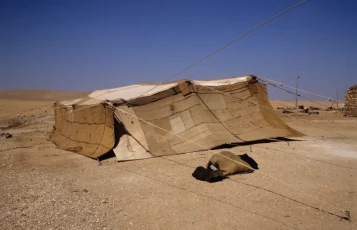
Tent made of jute sacks of a semi-nomadic family from the Maskana region

Remains of Zeus Temple (Seraya), Qanawat
[Original: Perystlilhof mit einfachen Säulen mit Plattenkapiteller auf hohen Basen]

Aleppo, Khan as-Sabun, view at eastern arcade in the first floor
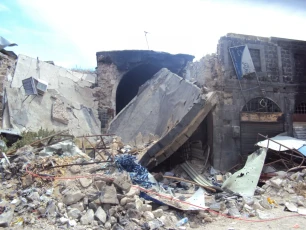
East part of suq al-Nuri (?)

Bootsfahrt auf dem Euphrat beim Jabal ʿAruda

Busra, Theater and Citadel - Aerial photograph
Citadel al-Qa'la, Aerial view Fl.305, Nr. 194, segment

Khan al-Wazir, innere Eingangsfassade
The Bavarian air force division 304b was based in Palestine from 25. October 1917 and was involved in the First World War until the division left the region, over Aleppo, in mid September 1918. During that period, over 3000 glas photographs, mostly aerial, have been made. Those early photographs were important for the archaeological research in the Middle East region.

Al-Muhammadiyya Wasserschöpfrad (Noria)

Excavation in the citadel of Damascus

Bayt Shaykh Qatana, Ansicht des Innenhofs vor dem Abriss
Blick ü.d. Hof auf den Liwan

Colored mosaic in the western arcade of the Umayyad Mosque
[ Description by author: Decke des mittleren Schiffs, gesehen nach ~ Südwesten. ]

al-Madrasa al-Hallawiyya, northern facade - marble plaque dated 1315 AH and sealed by the Sultan ʿAbd al-Hamid Khan (Tughra)

A part from the bath of Harim Castle

Ar-Raqqa - Islamic coins discovered in the site of al-Jamiʿ al-ʿAtiq
Numairidian Coin; approx. 450 h.; Ra91-GrMo-8145 (A)

An entrance, Qasr al-Hayr al-Gharbi

Al-Madrasa as-Sultaniyya, view from the courtyard to entrance and minaret

Manbij, Vegetable and fruit vendor in the centre

Jamiʿ al-Mihmandar, Gebetshalle - Rundnische der Hoffassade

Khan al-ʿArus before the restoration, view from south-west

Blick über die Flussaue des Euphrattals zu dem auf dem östlichen Steilufer gelegenen Dorf

Bimaristan an-Nuri, The main entrance decorated with muqarnas

Bayt Wakil, courtyard and fountain

Khan Ujkhan، main entrance

Raqqa, Qasr al-Banat, Säulenkapitell mit vegetabilen Motiven
Neg. Nr. 83/5-36A/37

Mediterranean Sea in Tartus

In the courtyrad of the Umayyad Mosque - view to al-ʿArus minaret and northern arcade

Nahiyat Tall Tamir, Sehr gut erhaltene Kuppelräume eines Gehöfts in einem assyrischen Dorf
Die assyrischen Dörfer am Khabur mit ihren Kuppelhäusern baute die französische Mandatsregierung für christliche Flüchtlinge aus der Türkei und dem Irak.

Noch leer stehende Neubauten für landwirtschaftliche Zwecke in der Ghab-Ebene

Khan Dannun - Courtyard

Takiyyat ash-Shaykh Abu Bakr, the inner entrance

Takiyyat ash-Shaykh Abu Bakr, al-Midan-Eingang

Jamiʿ al-Mihmandar, entrance

Busra - al-Jami‘ (mosque) al-ʿUmari - Islamic inscription

A view of the inner courtyard showing the Seljuk dome with muqarnas, al-Bimaristan an-Nuri

Al-Madrasa al-Hallawiyya, detail of Corinthian capital
[Original:'Al-Madrasa al-Halâwiya, Halab / Aleppo. Das "Windstoß"-Kapitell der Säule rechts der Tür.'].

Madinat al-Far, Grabung

Jurn Kabir, ein Igelkind

Aghabani table cloth with gold and silver threads

Bedouin movement in al-Hawl area with donkeys, camels and a litter

Raqqa, Exterior view of the Raqqa Museum

Bimaristan Arghun, passageway

Damascus, Khan Asʿad Basha al-ʿAzm, an arcade topped by a cross vault

Eine kurdische Frau mit einem aus Wolle gewebten kurdischen Gebetsteppich mit Stickereien

Al-Madrasa as-Sultaniyya, the main entrance

Citadel of Aleppo, prayer hall of the Great Mosque

Shuyukh Tahtani, a kurdish extended family after their dinner

Architectural Ummayad vestiges in Jabal Says

Bayt (Haus) Dada, Blick auf den Iwan
Liwan

View of Dahiyat as-Salihiyya at-Tarikhiyya from al-ʿAfif area

Töpfer in einer Werkstatt in der Khabur-Region, wahrscheinlich in al-Busayri

Maps of Aleppo: "Historical succession of buildings", 1982
Thematic map of Aleppo ancient city-center: Historical succession in current building stock. Scale 1:2000, ruler and legend. [Original in German: Historische Abfolge des Baubestands] Legend: Pre-Mamluk, Early-Mamluk, Late-Mamluk, Early-Ottoman, Late-Ottoman, Post-Ottoman until 1918

Raqqa-Ost, Tall Aswad, Ausgrabung im 1985
Tall Aswad

Habuba Kabira, Aussieben von Gerste als Saatgut durch die Großmutter

Interior view of the cathedral of Our Lady of Tortosa, Tartus museum today

Traditionelle Hanghäuser mit offenen Arkaden zur Talseite im Ma'lula der 1960er Jahre
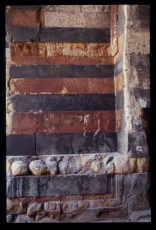
Khan Qurdbak, entrance - stone bench

Künstlicher Bewässerungskanal in der Oberen Euphratregion

Al-Madrasa al-Hallawiyya, courtyard and basin

A room cladded with ‘Ajami decoration in a Damascene house
shap_import_97592

Mosaic of Orpheus, Shahba Museum

Al-Matbakh al-ʿAjami, erneuertes bzw. restauriertes Portal - Detailansicht

Spools in the textile factory of the Mezannar family
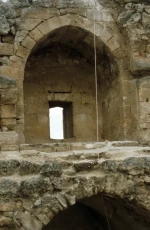
A small window in the middle of a niche- upper floor, Qal‘at Shayzar

Part of the ruins of Qalʿat Harim

Außenfassade der Burg von Arwad

Khan al-Jumruk, general view of the mosque in the center of the khan's courtyard

Shop in Suq al-Buzuriyya, currently selling candles for the Palm Sunday procession

Seitenanansicht der Burg al-Mudiq

Wedding party in a street in Mukhayyam al-Yarmuk in Damascus
Wedding party

Auftragen der Reliefmasse einer ‘Ajami Dekoration
Werkstatt von Abdelraouf und Ziad Baydon in Malaysia

Afamiya, Blick auf die nördlichen römischen Bäder

One of the towers of Qalʿat (castle) Shayzar

View to the Proscenium of Palmyra Theater, 2nd c. AD

Blick auf das Orontes-Tal in den 1960er Jahren

Traditional houses in Halbun
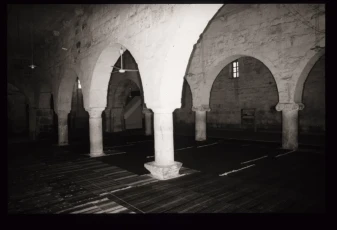
Dar'a, al-Jamiʿ (mosque) al-ʿUmari - The prayer hall

Roman sarcophagus with decorations, Qanawat
[Original: Rechteckige Grabkammer hinter der östlichen Exedra der Basilika: christlicher Sarkophag]

Jamiʿ al-Mihmandar, the prayer niche

Bayt Wakil, courtyard (restaurant)

Obstgärten nahe der Stadt Harim

Khusrawiyya Complex, damage mapping (Arabic)
The Khusrawiyya is severely destroyed. The northern arcade and parts of the western wing of the complex are damaged. There are parts which are still under rubble. The degree of damage is around 80%. The center of the explosion crater, produced in 2014, is located beneath the prayer room, i.e. in the domed hall of the Friday mosque, which doesn’t stand anymore. Most likely, the foundations are lost inside the inner area of the crater, while the rest of the area may contain remains of the building, perhaps sufficient for possible reconstruction. No action regarding the protection or management of the rubble has been done yet.

Ansicht der modernen Wohngebäude in Saydnaya

Hauptfassade der Moschee Jamiʿ at-Tawashi (zusammengesetztes Panorama)
Fotografie der Hauptfassade der Moschee im Südosten während der laufenden Renovierungsarbeiten und teilweise der Bergung. Mehrere Bilder sind zu einem Panorama zusammengesetzt worden.

Mushabbak, Byzantine basilica, nave looking west

Turbat Khaʾirbak (mausoleum), western facade - inscription band

Artificial field irrigation and drinking water supplies, al-Ghab Plain

ar-Raqqa - Qasr al-Banat, Lehmziegeldekoration

Takiyyat ash-Shaykh Abu Bakr, the iwan facade and the courtyard

Bayt Jubran Afandi Shamiyyim Viertel Bab Tuma, Innehof mit Iwan
Hof mit Liwan und Seitenliwan

Aerial photograph of Palmyra mountain ranges

The arcade wall of Great Mosque of Raqqa-Rafiqa, 8th/12th C.

General view of Maʿlula town
[Original: Malulla bei Damaskus, orientalischer Grundriss]

Mari (Tall Hariri), a side of the architectural remains

A view of Royal Palace G, Tall Mardikh (Ebla)
shap_import_48448

A view of an-Nuri Mosque and the Kilaniyya Norias (water wheels), Hama
A view from al-Kilaniyya Bridge towards an-Nuri Mosque and a group of three norias from the Kilaniyyat group (Kilaniyya, Tawafira and Jaʿbariyya).

Great Mosque, prayer hall, main entrance in 2006
Main entrance of the prayer hall with pointed arch and ribonwork from coloured stone marquetry and a restoration inscription above the door arch

Jamiʿ (Moschee) al-Hanabila, Innenhof mit Reinigungsbrunnen

Bayt Junblat, ground plan
Remarks in german. Size of plan 42 x 30, no scale.

Harim Castle, view into an entrance

Hammam Manjak, Nischen des Heißbads (Juwwani)

Hanging dyed silk to dry after washing it in cold water

Khan Qurdbak, Innenhof - südlicher und östlicher Arkadentrakt

Remains of a building from the extensions of Qasr al-Hayr al-Sharqi

Suq az-Zarb, Ansicht der Marktgasse
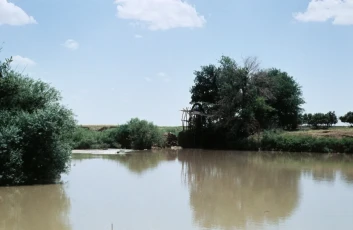
View of the Khabur River with a small noria

Qanawat, Severan doorway leading to second basilica — from north

Schafherde auf einer Straße in ar-Raqqa

Busra, Part of the citadel wall

Überbaute Gasse und traditionelle Häuser in Halbun

View of al-Marqab castle overlooking the Mediterranean Sea

Palmyra, Turmgräber

Afamiya, Blick in die große Kolonnade (Cardi Maximus)

Raqqa, Tall Aswad, Grabungsfunde

Hills around Palmyra (parts of Palmyra Chains)
[Original: Blick von der Burg auf die Wüstenlandschaft]

Jamrin, Brücke über das Wadi az-Zaydi

View from far to the Monastery of Mar Taqla, Maʿlula

A view in Wadi Barada
[Original:' Jarmuktal'].. The Bavarian air force division 304b was based in Palestine from 25. October 1917 and was involved in the First World War until the division left the region, over Aleppo, in mid September 1918. During that period, over 3000 glas photographs, mostly aerial, have been made. Those early photographs were important for the archaeological research in the Middle East region.

Hama, Gesamtsicht auf die Jisriyya (Brücken)-Noria (Wasserschöpfrad)
Hinweis: Dieses Foto wurde zwischen den Jahren 1924 - 1939 aufgenommen. Das gewählte Datum soll ein Durchschnittswert sein. (Fotograf unbekannt)

Jacquard-cartons with holelines for weaving design patterns

Karten Aleppos: Branchenkonzentration von Handel und Gewerbe, 1982
Thematische Karte von Aleppos historischer Altstadt: Branchenkonzentration von Handel und Gewerbe im Bereich Altstadt | Karte 4. Maßstab 1:2000, Maßstabsleiste und Legende.

Busra, Hammam Manjak, Ruheraum (Barrani)

One of the three minor mihrabs, Umayyad Mosque
[ Description by author: Einer der drei Neben-Mahârîb: jeder ist einer anderen Rechtsschule zugeteilt. Vgl. Bild 0225 ! ]

Al-Madrasa al-Ahmadiyya, courtyard and the southern portico

The towers of the outer wall of Qasr al-Hayr al-Sharqi
[Original: 1. Anlage]

Al-Madrasa as-Sultaniyya, general view from Saray

The village of al-Qirata on the northern slope of the Sajur valley, old lime-washed houses visible.

Inneres der seljukischen Wassermühle vom Bab as-Salam, Damaskus

Palmyra, Colonnaded axis and Qalʿat Ibn Mʿan in the back

Die Kirche in Qasr Ibn Wardan
[Original: Kirche (Kuppelbasilika mit Emporen), Westfassade (?)]

Flüsschen im syrischen Küstengebirge (al-Jibal as-Sahiliyya)

North-East Syria, the Upper Euphrates

Irrigation canal near Baniyas
[Original: Bewäserungkanal im Küstengebiet des Raumes Banias]
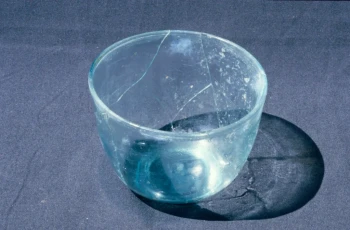
Raqqa - Glass discovered at the site "East Raqqa" - the northern complex
Raqqa VI East; Northern Complex; glass bowl, SW-Neg.87/801-802

The Great Colonnade in Palmyra, View to the south east

Noria (Wasserschöpfrad) in Hama
Auf diesem Bild sind die feinen Details des Wasserrschöpfrades klar erkennbar. Im Hintergrund des Bildes sind die Gewölbe eines Aquädukts zu sehen.

Jurn Kabir, a travelling horse-drawn cart dealer supplied the villages with vegetables and fruit

Bab Qinnasrin, general view of the gate's tower with its machicolations and parapets

Armanaz and its agricultural fields

Khusrawiyya-Komplex, Blick auf die Moschee im Jahr 2010

Burg (Qalʿat) al-Mudiq, von Afamiya aus gesehen

Bayt Junblat, section drawing of the southern iwan of the inner courtyard (juwwani)

The northern entrance of the historical city of Dura Europos (Qalʿat as-Salihiyya), end of 4th century BC

Kleines Wasserreservoir in der Burg von Harim

Details der Malereien des Aleppo-Zimmers in Berlin aus dem Bayt Wakil
Die farbenfrohen Malereien auf Holz gehörten in das Haus der Familie Wakil in Aleppo. Es werden Pflanzenornamente in verschiedenen Farben miteinander kombiniert.

Bel-Tempel, Blick von Westen (Jabal Muntar)
[ Description by author: Areal des Bel-Tempels, gesehen von ~ Westen. ]

Remains of arches, Qasr al-Hayr ash-Sharqi

Citadel of Aleppo, general view of the Theater

Qalʿat Ibn Maʿn, Gesamtsicht der Burg
[ Description by author: Die Burg des Fakhru d-Dîn al-Ma'ni, gesehen von ~ Süden. ]

Busra - (pool) Birkat al-Hajj

Yabrud: shops with residential houses on the first floor, houses probably from the beginning of the 20th century

Bab al-Hadid, general view of the gate's entrance from inside

Ein traditionelles Haus in Jabʿadin

Luxuriöse Sommerhäuser in Bludan

On the Genocide Memorial Day: at a stop on the pilgrimage, Armenian priests throw wreaths into the Euphrates to commemorate the victims of the genocide of 1915-17 who died in this very river

Grasende Schafe in den Ruinen von Halabiyya-Zalabiyya

Raqqa, Madinat ar-Rafiqa wall - Excavations

Bayt Ghazala, main entrance gate
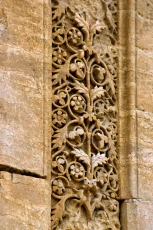
Decoration on the Arch of Triumph (Qaws Hadrian)
[ Description by author: - wo genau ? ]

Jamiʿ al-Khayr, the entrance from the inside

Shuyukh Tahtani, eine kurdische Großfamilie nach dem Abendessen

Burg (Qalʿat) von Shumaymis, Ruinen der Burgmauer

Qalʿat al-Qadmus (al-Qadmus Castle), Inscription

Bayt Junblat, western facade of the women hall (Haramlik)

The men's quarters (Salamlik), Qasr al-ʿAzm
(Offizieller Bereich): Innenhof. ['Original: Hamâ (Epiphania),']

Statue of a benefactor on a column along the Great Colonnade
[ Description by author: und Würdenträgers. Wie Bild 0658, aber frontal. ]

Bayt Wakil, reception hall - western wing

Krak des Chevaliers in West Syria, 12th C.

The western entrance of Maʿbad (temple) ad-Dumayr

Palmyra, Tal der Gräber (Westnekropole)

Tall Dahab, Mittelhallenhaus, Schlafpodium im Vordergrund

At-Tabqa, Jaʿbar Castle , one of the Castle's towers.

An arched entrance, Qasr al-Hayr al-Gharbi

Simeonskloster, korinthisches Kapitell

Palmyra / Tadmur - Umgebung NW, Jazil, Inneres des Höhlenklosters
[ Description by author: Bestimmung / Zwecke dieses Raumes ??? Vgl. Bild 0903 ! ]

General view to the lower parts of Jabal Haramun (Mount Hermon)

Theater, Blick auf Proszenium und Scaenae Frons

Palmyra / Tadmur - Umgebung NW, Jazil, drei Grabnischen im Fels
[ Description by author: Ganz "klassiche" Anlage mit Anordnung der drei "Särge" als Triclinium. Die sorgfältige Ausführung spricht für "bessere Leute": für den Abt (die Äbte) oder gar den Gründer des Klosters ? Vgl. Bild 0907 ! ]

As-Sinaniyya-Moschee, Inschriftentafel

Busra, Hammam Manjak, Restaurierungsarbeiten
Steinmetz bei Restaurierungsarbeiten

Hängebrücke über den Euphrat in Dayr ez-Zor

Burg (Qal'at) von Qadmus, Innenraum

Al-Matbakh al-ʿAjami, Südteil, Grundriss Erdgeschoss vor dem Teilabriss
Vor der Zerstörung des Südteils im Jahr 1950, Kopie. Plangröße 42 x 30. ohne Maßstab. [Original im Plan: الجبهة بحالتها الراهنة]

Dayr Zakka, Vorhalle (Narthex) der Klosterkirche mit Mosaikfußboden aus frühbyzantinischer Zeit
Datierung des Mosaiks: 509 n.Chr.. [Kalla (1999) 134]: [Gabor Kalla: Christentum am oberen Euphrat. Das byzantinische Kloster von Tall Bi'a. in: Antike Welt 30/2 (1999)].

Exterior view of al-Bab ash-Sharqi (Eastern citygate), the eastern entrance to Old City of Damascus
[ Description by author: [Original: Außenseite, gesehen von ~ Südosten. Vgl. Bild 0323 !] ]

Habuba Kabira, Kragkuppelkonstruktion im oberen Bereich

Jamiʿ Sharaf, mamlukisches Hohheitszeichen (Rank)

Armanaz, eine Siedlung umgeben von Landwirtschaft

al-Malikiyya - ʿAyn al-Khadra, Basalt Tombs

Ruinen des umaiyadischen Ortes Qasr al-Hayr al-Gharbi
[Original: "Heir al-Garbi"]

Chickpeas

Wakil house, courtyard with water basin
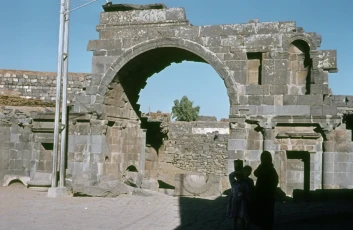
The main arch and the integrated columns of the Nabataean gate in Busra

A traditionally crafted tapestry weave of four panels, that are ornamented with embroidery

Western shore of Jabbul-Salt Lake, abondoned village with dome houses

Bayt (Haus) Dada, seitlicher Iwan
Seitenliwan
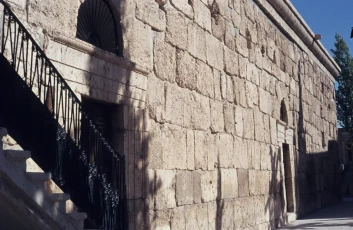
Yabrud: A stone facade of a historic building

Umaiyaden-Moschee, Teilansicht der Dekoration des Mihrabs
[ Description by author: Mihrâb: Kapitellchen der kleinen Säulen im unteren Teil der Nische. ]

View to the proscenium and scaenae frons, Palmyra Theater, 2nd c. AD

Busra, Theater und Zitadelle, Luftbild

Khan Qurdbak, Haupteingangsportal

Khan Qurdbak, portico, facade of the northern portal and east-west cross-section
Size of plan 34 x 32. with ruler (no scale).

Bayt Ghazala, ʿAjami-Holzdecke im nördlichen Sitzraum der Hauptempfangshalle (Qaʿa)

Traditional house with reed hut ("sibat", arab.) in Euphrates valley at the national road 4/junction to ar-Raqqa

Tartus, Wand in der Kapelle der Templer-Burg

Tartus, in the Chapel of the Templar fortress

Jebrud, bewässerter Gemüseanbau bei den Höhlen des Wadi Iskafta

As-Sinaniyya-Moschee, Bogenfelder mit Damaskus-Fliesen
[ Description by author: Detail: Lünetten mit bemalten Kacheln über den Fenstern. ]

Khan al-Jumruk, Torweg

Raqqa - "East of Raqqa" site - Tall Aswad - shard
Tall Aswad; Pottery Fragment; ROM 17

Qalʿat Ibn Maʿn, Teilsicht

Tall Dahab, Frau mit Feuerholz

Dorfgasse im Balik-Tal mit Ziegen und einem Kalb

The gate of the citadel seen from the east in the evening light

Rastan, Urban agglomorations on ridges

Busra - Birkat (Becken) al-Hajj

Baalshamin-Tempel - Cella, 2. Jh. n. Chr.
[ Description by author: Oberer Teil des Thalamos in der Cella, gesehen durch das Portal. ]

Burg (Qalʿat) al-Marqab, Hof und Kapelle

Remains of a Hexastyle Temple at Shahba
Note: these photos were taken between the year 1924 - 1939. The chosen date is to be average. (photographer unkown)

Jamiʿ as-Saffahiyya, minaret and entrance
shap_import_64338

Kitchen tent with fireplace of a semi-nomadic family from the Maskana region

Entrance and minaret of ad-Darwishiyya Mosque
[ Description by author: Erbaut 1574. Eingang und Minarett, gesehen vermutlich von ~ Osten. ]

Madrasat al-Firdaws, the marble prayer niche (mihrab) decorated with floral and geometric motifs
[Original:'Madrasa al-Firdaus, Halab / Aleppo. Mihrâb.].

Cows in a grove, the Ghouta of Damascus

Khan Qurdbak, decoration details above a window in the iwan

Umayyad mosque - Qaytbay minaret, rich in decorations

Bayt Junblat, southern iwan (the great iwan)

Eine Beduinenfrau webt mit einem horizontalen Webstuhl

A manufacturing facility for felt carpets in Al-Bab
Photographs of a manufacturing facility for felt carpets in Al Bab as part of the "Aleppo Stadtarchivprojekt" of GIZ (German Corporation for International Cooperation) in 2008

The facade of the church, Ibn Wardan Palace
[Original: Kirche (Kuppelbasilika mit Emporen, Innenraum)]

Qalb Lawza-Basilika, Darstellung der angenommenen Konstruktionsweise
Zeichnung eines Perspektivschnittes der Basilika, in der eine Vorstellung ihrer vormaligen Konstruktion dargestellt wird.

ar-Raqqa, Qasr al-Banat, the northern iwan

Traditional Aleppian house
This Aleppian house was occupied, before the war, by an architectural consultancy office. The courtyard in the picture is the perfect place for the employee’s break.

Waqf of Ibshir Mustafa Pasha, Coffeehouse, interior, dome and muqarnas squinches
The central area is covered by a high dome. Supported by four massive pillars, it rests on muqarnas pendentives – triangular-shaped with tiered rows of geometric cells –, and is topped by a round lantern with small columns plus pointed cupola.

Al-Madrasa al-Hallawiyya, Haupteingang

An artificial canal in Raʾs al-ʿAyn

Al-Madrasa as-Sultaniyya, Blick vom Innenhof auf Eingangsportal und Minarett

Überreste eines Minaretts in Khirbat as-Sarayij

Temporary title for Image 68390

General view of the city of Harim, Muhafazat Idlib

Bouquet of flowers and fruits in bowls on the wall cornice in the reception room (Qaʿa) of the Sadir house

A gathering of men in a reception room with wall textile cover

A wall painting from Zimri-Lim’s palace in Mari (Tall al-Hariri), which is known as "The Ordinator of the Sacrifice" (ca. 1780 BC) and hangs in the Louvre.
Section of a wall painting, where a large figure (here not visible) is the king, depicted presiding over a ritual sacrifice. [Original: Malerei aus Mari]
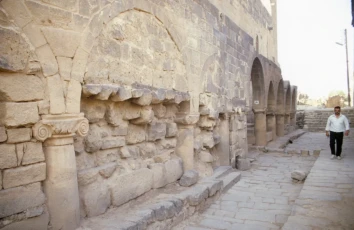
Busra, al-ʿUmari Mosque, eastern facade

Al-Matbakh al-ʿAjami, muqarnas squinches of the iwan dome

Jamiʿ al-Utrush, collapsed roof of prayer hall, eastern part
Hof mit Dikke [Original: Dscham'a el Utrusch]

Raqqa - finds discovered in the site "East of Raqqa", the Eastern Complex
Ra O-OK 221 Oil lamp, side-face. [original: 'Öllampe, seitenansicht']. [ 89/53/837] =[ photo's name as: year/ film no./ photo no,].

Ein Wasserbecken im umaiyadischen Palast "Qasr Says" in Jabal Says

Eine Gruppe von Säulen, die zu den südlichen römischen Bädern in Bosra gehört.
Blick auf einen Teil der südlichen römischen Bäder in Bosra aus dem 2. Jahrhundert n. Chr. mit zwei Reihen gut erhaltener Säulen mit ionischen Kapitellen. Die Kapitelle sind durch Spiralmotive gekennzeichnet, die auf die griechisch-römische Zeit verweisen.

Al-Khusrawiyya, Madrasa, Hofansicht 2007

Afamaiya, Blick über einen Teil des Ruinengeländes
shap_import_44111

Bayt Ajiqbash, Ground floor plan

View of a group of monumental buildings in Palmyra, Theater, Agora
[ Description by author: Hinten Mitte das Theater und die Rundstraße um die Cavea. Davor links die Agora mit ganz links dem Bankettsaal. Rechts der Agora der Annex. Blick nach ~ Nordosten. ]

Bayt Junblat, Süd-Iwan, Aufriss des inneren Hofes (juwwani)

A view of the remains of Harim Castle

A mechanical loom in the textile factory of the Mezannar family in Damascus

Jamiʿ al-Qayqan, southern facade with spolia stones and hieroglyphic writing

Raqqa-Ost, Tall Aswad, Ausgrabung im 1985
[1985/72/983] = [photo's name as: year/ film no./ photo no.]

Damaskus, Glasbläserei nahe Bab Sharqi
Glaswerkstätten, in denen alte Techniken angewandt werden, sind bis heute in der Altstadt zu finden. Seit Mitte des 20. Jahrhunderts wurden sie zunehmend durch industrielle Fertigung verdrängt.

Afamiya, Ruinen der Kolonnadenstraße (Cardo Maximus)
shap_import_70670
Al-Madrasa al-Muqaddamiyya, the entrance
shap_import_65981

Tall Brak, general view of the main mound
shap_import_44764

Große Moschee von Aleppo, Minarett mit Gründungsinschrift an der Basis
Das Minarett der Großen Moschee wurde vom Richter (Kadi) von Aleppo während der Herrschaft der Seldschuken-Dynastie in Syrien in Auftrag gegeben. Der Baubeginn ist in der Inschrift an der Basis angegeben und das Fertigstellungsdatum befindet sich oben: 483 - 489 AH / 1090 - 1096 AD. Sie bestand bis 2013. Das Minarett hat eine quadratische Form, sein Schaft ist ca. 45 m hoch und besteht aus Kalkstein. An seinem oberen Rand befindet sich ein Gesims, das aus zwei Reihen flacher, gewölbter Nischen besteht, die reichlich mit Blumenelementen verziert sind. Hinzu kommen eine offene Holzgalerie für den Muezzin (Gebetsrufer) und ein kurzer Turm mit Kuppel. Zwischen der Basis und der Spitze ist das Minarett in vier Zonen unterschiedlicher Höhe unterteilt. Diese sind, mit Ausnahme des zweiten, mit Blindbögen verziert, die aus profilierten Gesimsen gebildet sind, die jeweils ununterbrochen um den Schaft des Minaretts verlaufen. Jede Zone ist durch Friese mit kalligraphischen, künstlerisch geschriebenen, arabischen Inschriften getrennt. Diese exquisit geschnitzten Inschriften sind in der florierten Kufi - einem Schriftstil, der sich durchfloral verzierte Buchstaben auszeichnet - und in der Naskhi-Schrift geschrieben. An der Basis des Minaretts befindet sich die Unterschrift des Architekten Hasan ibn Mufrih al-Sarmani, die in einer Kartusche geschrieben steht. Die Inschrift aus der Basis des Minaretts zeigt, dass der örtliche Aleppiner Richter und der seldschukische Gouverneur die Macht in der Stadt teilten, da ihre Namen gemeinsam erwähnt werden: "Die Moscheen Gottes dürfen nur von denen erhalten werden, die an Gott und den Jüngsten Tag glauben, das Gebet verrichten und Zakat geben [Quran 9:18]. Es wurde begonnen, vom Hohen Richter Ibn al-Khashshab Mohammed ibn Mohammed al-Khashshab gebaut zu werden, möge Gott ihm gnädig sein. In den Tagen von al-Amin al-ʿAjal al-Muzaffar Qasim al-Dawla wa-Nasir al-Mila Abi Saʿid Aqsunqur Bak, der Sklave des Kommandanten der Gläubigen, möge Gott seine Anhänger vermehren". Die oberen Inschriften zeigen die Namen der damals herrschenden Seldschuken-Sultane Malikschah I. und Tutusch sowie von Barakat ibn Faris, Kommandant der städtischen Miliz.

One of the Basilica aisles, is separated from the central courtyard by a row of arches based on columns, Basilica A, ar-Rusafa
[Original: 1945 Geschenk Prof. Friedrich Sarre]

Maronite Cathedral, one of the cathedral pointed towers
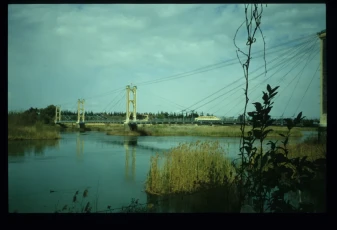
The suspension bridge over the Euphrates River, Dayr az-Zawr

A horizontal loom
Drawings by Estibaliz Sienra Iracheta to illustrate processes of traditional textile manufacturing
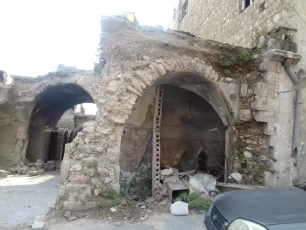
Suq az-Zarb, view of the former (destroyed) entrance arch to the west
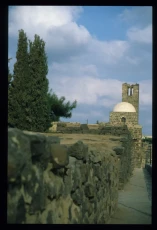
Busra, Madrasat Abu al-Fidaʾ, known as "Jami ad-Dabbagha'

Raqqa, Baghdad-Tor, Geometrische dekorierte Nische aus gebrannten ziegeln

Al-Madrasa al-Hallawiyya, Eingang - verbaute Spolie an der Basis, ehemals Taufstein in der früheren Kathedrale

Busra Theater, one of the main destinations for tourists

Bayt Ghazala, eastern facade - plant ornament above the main entrance from the inside

Der Barada nahe der Viktoria-Brücke, fast komplett ausgetrocknet

Euphrattal bei Jurn Kabir, Leihhirte mit Schafen aus seinem Dorf

Dar'a, al-Jamiʿ (mosque) al-ʿUmari, arcade

Bab Antakiya, Inschrift über dem Torportal

Aleppozimmer in Berlin (Bayt Wakil), mittlerer Teil
Ein Blick auf das Aleppo-Zimmer aus dem Haus der Familie Wakil. Die prächtigen Holzarbeiten aus Aleppo wurden aus Aleppo übernommen, um sie im Museum für Islamische Kunst in Berlin auszustellen. Die bemalten Holzpaneele dieses Raumes sind die ältesten bekannten aus einem syrischen Haus der osmanischen Zeit. Sie zeigen verschiedene Themen, darunter spezifische Elemente der islamischen Kunst, wie verschiedene Pflanzen- und geometrische Darstellungen, christliche Themen wie Bilder der Jungfrau Maria mit ihrem Kind sowie höfische Szenen wie die Darstellung eines Herrschers auf seinem Thron und Jagdszenen.

Storage vessel made of mud-clay slurry in the niche of a transversal arch house

Tall Bdiri, Aufgelassenes Haus mit Tür- und Wandverstärkungen

Blick auf die Altstadt von Maʿlula mit seinen traditionellerweise hellblau getünchten Fassaden

Qasr al-ʿAzm, Obergeschoss - Hof, Portikus der Qaʿa mit Kuppel

Simeonskloster - Pilgerkirche des hl. Simeon Stylites, Blick nach Osten aus der Westbasilika

Kaffeehaus und wartendes Servicetaxi im Zentrum der kleinen Grenzstadt

Tall Shaykh Hamad (Dur Katlimmu) - Excavations

Bayt Junblat, Nord-Iwan, Aufriss

Archaeological finds from Raqqa, exhibited in the Damascus National Museum
Glazed pottery vessel; Palace B, ar-Raqqa; now in National Museum Damascus; Mus.Nr.16476

Traditional houses in a village, near the Sajur river

Husn Sulayman, Cella eines Tempels

General view of the remains of ʿAyn Dara Temple
shap_import_73075

Monastery of St. Simeon Stylites, late 5th-early 6th c., Exterior of sanctuary of east basilica (apse from exterior)
[Original: Apsiden der Ostbasilika von außen]

St. Sergius-Kloster am Rand der Hochebene oberhalb von Maʿlula

Grazing sheep on the Euphrates

Ruine des byzantinischen Prätoriums von Barbalissos/Balis

Blick in ein Zelt einer Beduinenfamilie des Tayy-Stammes

Jamiʿ at-Tawashi, Minarett
[Original:'Jâmi' at-Tawâshi, Halab / Aleppo. Oberer Teil des Minaretts.'].

Column capital on the terrace of the northern riwaq.

Jamiʿ at-Tawashi, entrance - decoration details

Kafr Halab village, clay dome houses

Southwest side of the Byzantine Basilica, Qalʿat Burqush
[ Description by author: der byzantinischen Basilika. Sie dienten zur Erweiterung der Terrasse des römischen Tempels nach Südwesten. Hier zu sehen die Südwest-Seite. Sie ist eingestürzt, so dass man die gegenüberliegende Wand der ersten Halle mit den Ansätzen der Gewölbe-Gurte sieht. Gesehen von ~ Südwesten.- Für alle Burqush-Bilder gilt: die GPS-Tags sind nur approximativ, aber sicher sehr nahe am Punkt. ]

Al-Matbakh al-ʿAjami, eastern Qaʿa, section north-south, view to east
"Small" qaa, view to east, double window partly reconstructed in drawing. Size of plan 70 x 50, with ruler (no scale).

A mechanical loom in the textile factory of the Mezannar family

Aufsicht auf eine Gruppe von traditionellen Häusern in Saydnaya

Busra, Bühne des Römischen Theaters mit anliegender Wand der islamischen Zitadelle

Qalʿat al-Mudiq seen from the ruins of Afamiya

Palmyra, Monumentalbogen der Säulenstraße und Reitkamele

Khan Qurdbak, Iwan, Grundriss Obergeschoss

Inscription on the Damascus wall

Dada House, a view of courtyard seen from the Iwan
Hof vom Liwan aus gesehen

Al-Madrasa al-Hallawiyya, entrance - Zengid inscription in Naskhi script

Al-Imam Ismaʿil Mosque, muqarnas on the dome from the inside
Zwickel an der Kuppel. Irgendwo habe ich gelesen, dass diese kleinen Nischen die erste Stufe der Entwicklung der Muqarnas darstellen und dass darin die künstlerische Bedeutung der Moschee bestehe.- S. Beschreibung Bild 1052 gegen Ende ! [Original: 'Salamiya (Salamias)']

General view of the Tetrapylon
[Original: Große Orientreise Nr.63 mit Rotel-Tours: Amman-Bagdad-Uruk-Babylon-Arbil-Mosul-Hatra-Samara-Mari-Dura Europos-Aleppo-Dayr Saman-Ugarit-Palmyra-Jarash]

Qalʿat Ibn Maʿn, Gesamtsicht der Burg
[Original: mittelalterliche arabische Burg]

Hammam ʿAbd al-Basit, view from al-Jisr al-Abyad square

Luftbild von Raqqa mit der Stadtmauer und der Großen Moschee (Originalfoto: Mohamad Al-Roumi)

Interior view of the church, Qarqbiza
[Original: einschiffige Kirche, Innenansicht]

Theater von Qanawat

The northern entrance of the historical city of Dura Europos (Qalʿat as-Salihiyya), end of 4th century BC
Außenseite, frontal von ~ Südwesten. Vgl. Bild 1614 !

Northern towers from inside the North Gate, Halabiyya-Zalabiyya

Small vaulted passageway, Qalʿat Harim

Al-Madrasa as-Sultaniyya, view of eastern window of al-Malik az-Zahir Ghazi tomb

Qalʿat Ibn Maʿn, Gebäudereste und Innenhof

Plastik- und Metallmüll in at-Tabqa
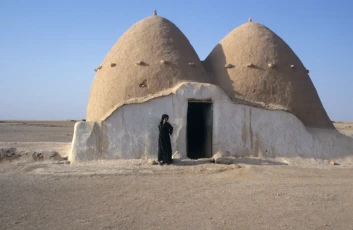
At-Turn, Double-dome house on the edge of the steppe close to Maskana

Khan al-Wazir, innere Eingangsfassade

Al-Madrasa al-Muqaddamiyya, a groin vault in the entrance
shap_import_65982

Bab al-Hadid, inscription beside the door from outside

Sirjilla, Gesamtansicht der Gebäudereste

Raqqa, Qasr al-Banat, clay decoration

Turmgrab des Elahbel, Deckenfresken
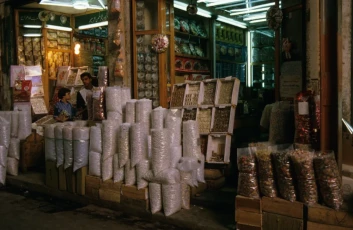
Suq al-Buzuriyya: shops with candied fruit, sugar-coated nuts and other sweets
Shop

Jurn Kabir, Well on the shore terrace, overlooking the wide flood plain of the Euphrates, which was flooded in the Tishrin reservoir

Inside the city wall, excavation work, Qatna
. [Original: Al-Mishrifa / Qatnâ']

Mosaik der Meeresgöttin Thetys, Ausschnitt
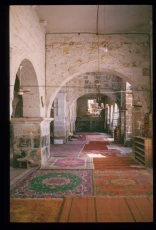
Dar'a, al-Jamiʿ (mosque) al-ʿUmari - the prayer hall

Great Mosque, Plan of the building parts
The Great Mosque of Aleppo has moderate damage, except for the complete destruction of the minaret in April 2013. The degree of damage is around 30%. The western wing shows two large circular holes in the roof. There are currently no photographs available which clarify the extent of the interior damage. Several fires have affected parts of the main prayer hall causing damage especially to the southern gate and the wooden doors of the northern facade. The northern arcade was burned and its main gate partially damaged. The eastern part of the courtyard floor is torn out.

Jurn Kabir, construction of a room from quarry stones with clay mortar

Al-Madrasa as-Sultaniyya, Innenhofansicht mit Südfassade - Eingang und Minarett

Izraʿ, Kanisat (Kirche) Mar Jirjis, Grundriss
Kirche St. Georg

Bayt Ajiqbash, Grundriss Erdgeschoss

Busra - Southern Roman Bath (al-Hammam ar-Rumani al-Janubi)
Exterior view to east

Khan Qurdbak, Inneres der West-Arkade

Das Kilaniyya-Viertel in Hama
Diese Ansicht zeigt die historische an-Nuri-Moschee und das Ensemble der Kilaniyya-Norias am linken Ufer des Orontes-Flusses.

25 piastres (Commemorative coins: 25th anniversary of al-Baath Party), 20,3 mm, 1972

The handles of the main door of al-Madrasa az-Zahiriyya

Propylon, Diokletians-Thermen
[ Description by author: der Anlage. Seine Säulen aus rosa Asuan-Granit überragen das Niveau der Kolonnade (s. rechte Halbsäule / Pfeiler !) und stehen in die Straße vor (hier rechts unten und Bild 0688 !). Den Randsäulen des Propylon entsprechen in der Kolonnade zwei ebenso hohe Pilaster, die wiederum mit je einem Bogen - nur noch die Ansätze erhalten - mit dem restlichen Gebäude verbunden sind. Die Thermen stammen bereits aus severischer Zeit (ca. 200 n. Chr.) und wurden ca. 300 n. Chr. erneuert. Gesehen von ~ Südosten aus dem 2. Abschnitt der Säulenstraße. ]

Raqqa-Ost - Tall az-Zujaj - Grabungsareal
Raqqa X; Glass-Tall

Am Westufer des Jabbul-Salzsees, verlassenes Kuppelhaus-Dorf

A Bedouin woman twisting a hand spun thread spool
The patchwork-cover in the background is separating the living area from the sleeping area

Jamiʿ Aslan Dada, Halle - Überleitung zum Kuppeltambour mit Trompen und Bögen

Waqf Ibshir Mustafa Pasha, Kaffeehaus, Innenraum, Kuppel und Muqarnas-Pendentifs
Der zentrale Bereich wird von einer Kuppel überdeckt, die von vier Pfeilern und vier Säulen getragen wird und auf Muqarnas-Pendentifs ruht. Die Kuppel wird von einer Laterne mit schlanken Säulchen bekrönt.

Part of the remains of Najm Castle (Qalʿat Najm)

Citadel of Aleppo, entrance gateways and bridge
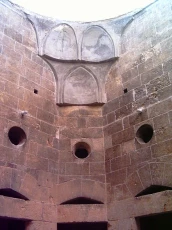
Bimaristan Arghun, Achteckhof - Muqarnas-Zwickel der Kuppel
shap_import_60896

At-Takiyya al-Mawlawiyya, Westfassade - al-Midan

View into an arcade with ablaq masonry, Khan Asʿad Basha al-ʿAzm

Fruitful trees and corn in the Ghouta of Damascus

Eine volkstümliche Ladenstraße in Raqqa

Blick auf den Euphrat von Dura Europos (Qalʿat as-Salihiyya)

Theater von Afamiya, Ruinen der Zuschauertribüne (cavea)
shap_import_70740

Raqqa - "East of Raqqa" site - Western Palace
[1985/50/750] = [photo's name as: year/ film no./ photo no.]

Ausgrabungsarbeiten in der Daydariyya-Höhle

Qalʿat Burqush, Byzantinische Kathedrale
[ Description by author: Die Substrukturen von oben. Man steht am Rand des letzten erhaltenen Gewölbes, Blick nach ~ Südosten. Links sind vier Ansätze der Gewölbe-Gurte zu erkennen. Die Kathedrale liegt links außerhalb des Bildes. ]

The space is 02 in general, according to the ground plan. Here secondary spaces 09-13 are seen.

View from south to the church of Kharab Shams
[Original: Säulenbasilika, 4. Jh. von weitem, von W]

General view of Bel Temple with the palm trees
[ Description by author: Areal des Bel-Tempels, gesehen von ~ Westen. ]

A woman with a screen-printed headscarf called Habari

Tall Abyad, mit Bildern und Segenssprüchen auf der Hausfassade werden Mekka-Pilger bei ihrer Rückkehr begrüßt

Monastery of St Simeon Stylites, view to the west across the courtyard

The gate of south-western side, Dura Europos (Qalʿat as-Salihiyya)
Gate of south-western side [Original: "Salihiyyah, Tor der Südwestseite"]

Romam Gate (Peribolos) at the Straight Street, Old City of Damascus
[ Description by author: von Bild 0321, gesehen von ~ Osten. Der alte Fahrdamm ist heute ein "Park". ]

The cold (barrani) section of as-Salamiyya historical bath
In this cold section, called the barrani”, the picture shows three iwans with vaulted ceilings, enclosing a small courtyard of which in the middle is a water fountain. The appearing iwans contain small niches and seating platforms (sing. mastaba) that also feature many niches at the bottom.

Popular restaurants on both banks of the Barada River

Säulenarkade, westliches Propylon des Jupiter-Tempels von Damaskus mit Durchblick auf das Qaytbay-Minarett der Umayyaden-Moschee

Khan Qurdbak, southern and eastern porticos

Naʿurat al-Muhammadiyya (waterwheel), the biggest noria in Hama

Ebla (Tall Mardikh), Königspalast G
Mittlerer und oberer Teil. Gesehen nach ~ Südwesten [Original:Tall Mardîkh (Ebla)']

Jamiʿ al-Qayqan, southern facade with spolia stones
[Original: Moschee um Bab Antakiya}, on the photo was mentioned: creation date between 1985-86]

Theater, view to proscenium and scenae frons

Abu al-Fidaʾ-Moschee, Gesamtsicht auf die Moschee über dem Orontes
Jami' al-Haiyaya, [Original: 'Jâmi' al-Haiya']. Gesehen von Südosten über den 'Âsi. Unter der rechten, kleineren Kuppel ist der Politiker, Historiker und Geograph Abû l-Fidâ' begraben. ['Original: Hamâ (Epiphania),']

Remains of arches of the Najm Castle (Qalʿat Najm)

Jamiʿ al-ʿAdiliyya, general view of central dome
View from the minaret to the lead-covered dome, which was placed on a short cylindrical wall (tambour). The eight short buttresses at the corners of the roof above the prayer room, which are supposed to compensate for the transverse forces of the dome, are clearly visible.

Grabrelief - Büste einer Frau in reicher Gewandung

Near Tall Abyad, view of ʿAyn al-ʿArus lake

Agriculture in ar-Ruj plain

Cathedral of Busra from the inside
[Original: HQ-k.9 Interior view, Arch]

Al-Matbakh al-ʿAjami, Kuppel des großen Iwans

Nahiyat Tall Tamir, Baking flat breads on the tannur wall (tannur deepened in the ground)
The Assyrian villages on the Khabur with their domed houses were built by the French Mandate Government for Christian refugees from Turkey and Iraq.

Propyläen des Jupiter-Tempels in Damaskus

Der bronzene Telegraphenmast auf dem Marja-Platz

The facade of prayer hall overlooking the courtyard, Umayyad Mosque
[Original:'Damaskus, Omajjaden-Moschee, vom Friedhof aus gesehen']. The Bavarian air force division 304b was based in Palestine from 25. October 1917 and was involved in the First World War until the division left the region, over Aleppo, in mid September 1918. During that period, over 3000 glas photographs, mostly aerial, have been made. Those early photographs were important for the archaeological research in the Middle East.

Al-Faranthiyya Mausoleum, Blick in die Kuppel
at destrict Damaskus-as-Salihiyya, Ceiling of dome

Hammam Bahram Basha, the main northern facade

Qasr al-Hayr al-Sharqi, Ruinen der Moschee in der westlichen Einfriedung
[Original: Pavillon]

Busra, Hammam Manjak, north wing with hot water reservoir during the restoration
North wing with hot water reservoir

Remains of walls in Halabiyya-Zalabiyya

Remains of Afamiya Theater

Application of the relief paste of a ‘Ajami decoration
Ziad Baydoun in his workshop in Malaysia

Waqf of Ibshir Mustafa Pasha, siteplan of the building parts (English)
The waqf (endowment) complex of Ibshir Mustafa Pasha has suffered serious damage in several areas. This includes the khan on the north side and the eastern and western qaysariyya. Without removing the rubble, no final statement can be made about the extent of damage. Most likely, there was a total loss in the areas affected by the April 2015 tunnel bomb explosion. The western portion of the waqf complex, including its front facade, is still standing but is noticeably damaged. Two of the most important buildings of the waqf complex of Ibshir Mustafa Pasha survived: the mosque and the coffeehouse at the south. The uniquely decorated facade of the hall of the coffeehouse, as well as its first row of vaults, were destroyed. The core of the hall was only partially damaged, while the section of the central dome with its high lantern was, for the most part, destroyed.

Remains City Wall and Ibn Maʿn Castle in the back
[ Description by author: Blick nach ~ Nordwesten: Burg und Prätorium / Fahnenheiligtum des Diokletians-Lagers. Zwischen Burg und Lager erkennt man die nördliche Stadtmauer - die Stadtmauer läuft westlich des Lager den Berg dahinter (Jabal al-Husainiya) hoch zu einer kleinen Festung und dann auf der Nordseite wieder hinunter. Dies ist eine beliebte Befestigungsform, besonders schön erhalten in Halabiya (Zenobia) am Euphrat. ]

Haus in Bahsita, , abgeschrägte Wandecke mit einer Muqarnas-Konsole

Eingangstürme auf der Westseite der Burg von Harim

Maronite Cathedral, general view from the outside

Blick vom archäologischen Tall Abyad in die Ebene des Balikh

Decorated wooden door of the Damascus Room in the Dresden Museum for Ethnology

Die Häuser von Bludan, oberhalb der Ebene von Zabadani


Al-Madrasa as-Sultaniyya, marble prayer niche
The mihrab is another fine example of marble marquetry, with recessed panels bordered by a relief molding in the central half-cylinder, horizontal coursing in the niche head, and a well developed interlace occupying the spandrels. Columns, capitals, and bases are again contemporary. (Allen, Terry. "Madrasah al-Sultaniyah". In Ayyubid Architecture. Occidental, CA: Solipsist Press, 2003. http://www.sonic.net/~tallen/palmtree/ayyarch/ch8.htm#alep.msul)

Archäologische Ausgrabungen in Tall Brak

Houses overlooking the Barada River in Old Damascus

Habuba Kabira, construction of a dome house (foreground: room, that will have a flat roof)

Jamiʿ al-Khayr, details from the main entrance

Barada River in a state of drought, near Victoria Bridge

Jamiʿ Aslan Dada, Kuppel der Halle - Ecktrompe als Überleitung zum achteckigen Tambour

Im Hof des Klosters Mar Musa al-Habaschi
[ Description by author: Innenhof, rechts die Kirche.- Das Kloster geht auf Mönchsgrotten in der Umgebung aus dem 6. Jh. zurück, die ältesten Gebäudeteile stammen aus dem 10. Jh., die Fresken (vgl. Bild 0480 - 0490 !) - in drei Lagen übereinander ! - aus der Zeit bis zum 15. Jh.. Gegen Ende des 17. Jh. wurde das Kloster verlassen. Sein Patron soll der Sohn eines äthiopischen Königs sein und das Kloster gegründet haben. ]

Qalʿat al-Marqab, Decoration on the entrance arch

Jurn Kabir, inside a traditional living room, equipped with wooden door and window, water basin and felt carpet (lubbad)

Raqqa, Qasr al-Banat, clay decoration

Citadel of Aleppo, entrance of the Throne Hall
shap_import_62017

Jurn Kabir, die traditionelle Form des Doppelraumhauses, das innen durch eine Querwand unterteilt ist
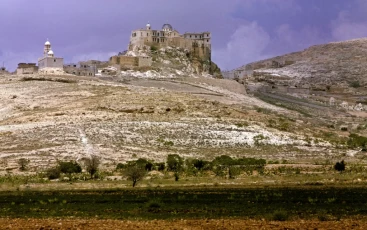
General view of Notre Dame de Saydnaya
[ Description by author: von ~ Südosten. In dem Felssockel rechts befindet sich das Grab mit den Figuren von Bild 0420.- Trotz obiger Zuordnung (nach den wichtigsten Ausbau-Stufen): die Ursprünge der Anlage gehen in byzantinische Zeit zurück und sollen in Zusammenhang mit einem Erlebnis des Kaisers Justinian stehen: eine von ihm verfolgte Gazelle verwandelte sich in ein Marienbild (des Lukas ...), das die Erbauung einer Kirche an dieser Stelle verlangte und seither Wunder tat. ]

Umayyaden-Moschee, Innenhof, Nord-Arkade und Minarett der Braut (al-ʿArus)

Qasr Asʿad Basha al-ʿAzm, Innenhof mit Brunnen im Familienwohnbereich (haramlik oder juwwani genannt)

The north western corner of the peribolos wall, Temple of Bel
[ Description by author: Aber welche ? Die Form des Mauerwerks und des Porikus sprechen für die Nordwest-Ecke und nachmittags / abends wäre eine derartige Beleuchtung möglich.- Wenn diese Überlegung stimmt, gesehen von ~ Nordwesten. ]

Blick auf den Euphrat von der Jaʿbar Burg

General view of Krak des Chevaliers in an-Nasara valley area

Bayt Ghazala, Blick in das Bad (Hammam) des Hauses

View from the portico towards the entrance of dome hall, al-ʿAzm Palace

Löwe der Göttin Al-Lat, 1. Jh. n. Chr.
[ Description by author: Detail, vom Eingang des Temenos der Allât. Sie symbolisiert den beschützenden Aspekt - siehe die "glückliche" Antilope - der Herrin der Tiere. Die Statue soll um die Zeitenwende entstanden sein. Eine Kopie - oder doch das Original ? - steht im Garten des Nationalmuseums in Damaskus. Vgl. Bild 0752 und 0754 ! ]

Gesamtansicht der Burg von Masyaf

Burj Alaʾ, general view of the tower's facade

Traditional production of animal glue

Zayzun tributary to Yarmuk river: Women washing wool as preparation for matresses as dowry

Euphrattal südlich von Qalʿat Najm, wie es vor der Flutung des Tishrin-Stausees aussah

Euphrates valley south of Qalʿat Najm as it looked before the flooding of lake Tishrin

The minaret of the Mosque of Shaykh ʿAqil al-ʿUmari al-Manbiji

Hama, Gesamtansicht der Burg al-Madiq von Süden

Afamiya, Northern Roman baths

Bayt Ghazala, interior view - dome of the main hall (qaʿa)

Al-Madrasa as-Sultaniyya, interior view of az-Zahir Ghazi tomb

Qubbat as-Sayyar (Qasyun-Gebirge)

Tempel von ad-Dumayr (Thelsae), Portalfassade von Westen gesehen
[ Description by author: ~ Westseite. Sehr schön ist der in islamischer Zeit zugemauerte und mit einer Schießscharte versehene Eingang zu erkennen. Vgl. Bild 0380 ! ]

Loopholes in the fortifications of Halabiyya

Damascus, Khan Asʿad Basha al-ʿAzm, upper view of the inner courtyard and its fountain in the center

Blick auf ʿAyn al-ʿArus

Raqqa - "East of Raqqa" site - Tall Aswad, excavation in 1985
[1985/72/983] = [photo's name as: year/ film no./ photo no.]

Maʿlula, traditional hillside houses with galleries opening to the valley during the 1960s

Damaskus, Ruinen des Jupiter-Tempels, 1. Jh.
Das Westtor des Jupiter-Tempels liegt inmitten der historischen Altstadt. Heute markiert es den Übergang zwischen Basarbereich und Umaiyaden-Moschee.

View towards Notre-Dame de Saydnaya

Propylon of Diocletian Baths
[ Description by author: der Anlage, diesmal gesehen von ~ Nordosten längs der Säulenstraße Richtung Monumentalbogen. Gut zu erkennen, dass das Propylon höher ist als die Kolonnade (Halbsäule - Pfeiler) und dass es in die Straße vorspringt (Halbsäule / Pfeiler - Säulen). ]

Bayt Wakil, top view of the ʿataba of the reception hall (qaʿa)

Columns with Corinthian capitals in one of Sirjilla's buildings

Maʿlula, St.Tekla Convent during the Holy Cross feast on september 14th

Raqqa, enclosure wall and arcade of al-Jamiʿ al-ʿAtiq (Great Mosque)

Al-Matbakh al-ʿAjami, renoviertes bzw. restauriertes Portal

Ugarit, Entrance gate to the city

Umayyad Mosque, the Mamluk Minaret of Qaytbay on the northwestern corner

Ruins of Qalʿat ash-Shugr wa-Bakas on the edge of a mountain slope
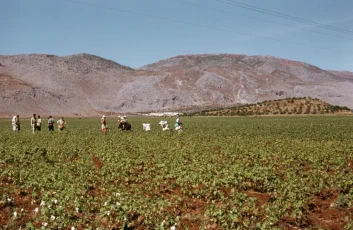
Baumwollernte in der ar-Ruj-Ebene

General view of the Orontes valley in the 1960s

Imam Ismaʿil Moschee, Minarett und Mausoleums-Kuppel
Gesehen vermutlich vom Dach des Hauses der Ghâli (Hishâm und Amjad) nach ~ Westen, vgl. Bild 1049 ! - Salamiya ist der (syrische) Hauptort der Ismailiten (Zweig der Shî'a) unter ihrem (derzeitigen) Oberhaupt Karîm Aga Khân. [Original: 'Salamiya (Salamias)']

Jamiʿ al-Khayr, westliche Fassade

Preparation of the design of a felt carpet
Photographs of a manufacturing facility for felt carpets in Al Bab as part of the "Aleppo Stadtarchivprojekt" of GIZ (German Corporation for International Cooperation) in 2008

Al-Madrasa as-Sultaniyya, view from the courtyard to entrance and minaret

Painting on the wall of the iwan, al-ʿAzm Palace
Malerei auf der Rückseite des Iwans. ['Original: Hamâ (Epiphania),']

Frühlingslandschaft, Raʾs al-ʿAyn

Im Zelt einer Beduinenfamilie mit dem Wohnbereich im Vordergrund und hinter der Abtrennung der Aufbewahrungsbereich aller Besitztümer

Raqqa - Jar discovered at the site "East Raqqa" - the northern complex
Ra-O-NK. 146, Ceramic. [original: 'Keramik']. [original:' s. unten Nr. 18'].[ 89/54/863] =[ photo's name as: year/ film no./ photo no,].

Jamiʿ al-Khayr, arcade along the prayer hall

Qasr al-ʿAzm, Nische in der Qaʿa mit Kuppel

Palmyra, Tempelgrab Nr. 86

Tempel von ad-Dumayr (Thelsae), Innere Westwand
[ Description by author: Detail aus Bild 0390: der Durchgang und die beiden "Kammern". ]

Qalb Lawza, Basilica of 5th c., decorative door of reliquary room in southern facade (east)
The relics of Symeon were located in the southern apse side room. This martyrion can be recognized from the outside by the third door in the south wall and by a tiny window next to the door through which the pilgrims could be supplied with holy oil. A direct door into the sanctuary suggests that the Symeon relic was also used during the service. The windows are bordered by a particularly elaborately designed cornice band. The façade also has oblique grooves and square depressions, probably from the base of a sloping roof and its purlins.

Aleppine Soap
The picture shows a section of the cubed laurel soap bar after drying. It is green on the inside.

As-Sabuniyya Mosque, the upper part of the entrance, muqarnas and rich ornaments
[ Description by author: Dekor des oberen Teiles, wohl von ~ Osten gesehen. ]

Khan al-Hibal, the southern facade from inside

Jamiʿ al-Mihmandar, Innenhof - Inschrift an der nördlichen Fassade

Approximate

Baalshamin-Tempel, 2. Jh. n. Chr.
[Original: Tempel des Baal Schamin (beim Hotel Zenobia)]

Große Moschee von Aleppo, Ansicht des Innenhofes in Richtung Nordwesten
Blick auf den Innenhof (Sahn) mit seinen zweifarbigen Pflasterungen und den beiden Reinigungsbrunnen. In der Nordwestecke befindet sich das berühmte Minarett, vor seiner Zerstörung im Jahr 2013!

Maʿlula, traditionelle Hanghäuser mit Arkaden im Ma'lula der 1960er Jahre

Al-Khusrawiyya, Freitagsmoschee, 1547

Cows in a field in the Ghouta of Damascus
The Ghouta of Damascus was characterized by the raising of cattle (known as the Damascene cows) of pure race, which is unique compared with the rest of the Levant. The rich pastures of the Ghouta provided good feed, and hence the cows provided the best milk.

Jamiʿ ash-Shuʿaybiyya, Building ornaments at the entrance

Busra - Südliches Römisches Bad (al-Hammam ar-Rumani al-Janubi)
Südtherme, von der Kolonnade aus gesehen

Theater, Blick auf Proszenium und Scaenae Frons
[Original: Theater, 2. Jh. n.Chr.]

Aghabani table cloth

Reconstruction of Assyrian town Dur Katlimmu
Reconstruction of Assyrian town Dur Katlimmu in the modern village Tall Shaykh Hamad. Taken on: Exhibition stand "Umwelt und Technik vor 3500 Jahren" on Hannover Messe 1983

Qasr Asʿad Basha al-ʿAzm, Nordarkade im Innenhof des Familienwohnbereichs (juwwani)

at-Takiyya ar-Rifaʿiyya (az-Zawiyaal-Ikhlasiyya ),Inschrift über dem Haupteingang
Inschrift_Separaiting Sheet. 82/II
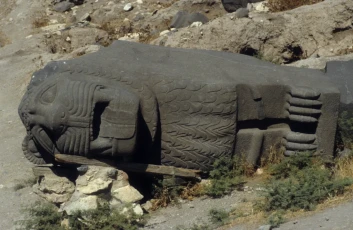
ʿAyn Dara Temple, Colossal basalt lion

Qasr al-Hayr al-Sharqi, Remains of the mosque of the western enclosure

Details der Zeltkonstruktion, Befestigung der seitlichen Seile des Beduinenzeltes
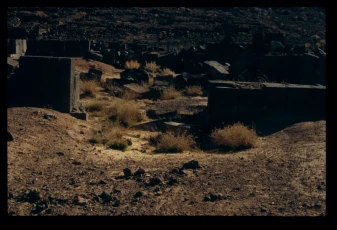
Remains of the Ummayad Palace in Jabal Says

Bimaristan Arghun, southern facade of main courtyard
shap_import_60905

Raqqa, The decorated outer facade of Baghdad Gate

Khan al-Wazir, Haupteingangsportal

Habuba Kabira, construction of the base of a mud brick house

Zwei Werkstätten zur Herstellung und dem Verkauf von Werkzeug aus Eisen in Raqqa

Grundriss der Qubbat as-Sayyar (Qasyun-Gebirge)
Kataster no. 1790 II/6.2 No.96-B

Paintings in Hananiya church in Bab Tuma quarter
Paintings on the walls of a room in the church, that tell the story of Paul's missionary journeys between 46 and 62 AD.

Eingangstürme auf der Westseite der Burg von Harim

Bab Qinnasrin, äußere Torfassade

Yabrud: Herstellung von Burghul, im Hintergrund Gartenmauer aus spezieller Pisé-Technik

Tartus, Blick auf das Mittelmeer

Eine Beduinenfrau webt mit einem horizontalen Webstuhl

Maʿlula, Inneres eines Felsgrabs
[ Description by author: auf dem Kloster-Plateau: Rückwand und Teil der rechten Seitenwand. Vgl. Bild 0460 ! ]
![Painting of Euphrates river at Tibne. Dated 15.02.1899 [Original: Euphrat bei Tibne]](https://syrian-heritage.org/wp-content/plugins/justified-image-grid/timthumb.php?src=https%3A%2F%2Fsyrian-heritage.org%2Fwp-content%2Fuploads%2F2020%2F04%2Fshap_import_6692-1024x649.png&h=230&q=90&f=.png)
Painting of Euphrates river at Tibne. Dated 15.02.1899 [Original: Euphrat bei Tibne]

Al-Matbakh al-ʿAjami, Muqarnas-Zwickel der Iwan-Kuppel
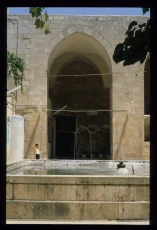
Jamiʿ ar-Rumi, view from the courtyard on the eastern arcade

Ruinen der Burg von Harim

Überreste der Stadtmauer, Blick auf Qalʿat Ibn Maʿn
[ Description by author: Blick nach ~ Nordwesten: Burg und Prätorium / Fahnenheiligtum des Diokletians-Lagers. Zwischen Burg und Lager erkennt man die nördliche Stadtmauer - die Stadtmauer läuft westlich des Lager den Berg dahinter (Jabal al-Husainiya) hoch zu einer kleinen Festung und dann auf der Nordseite wieder hinunter. Dies ist eine beliebte Befestigungsform, besonders schön erhalten in Halabiya (Zenobia) am Euphrat. ]

Raqqa - "East of Raqqa" site - Tall Aswad, excavation in 1985
Tall Aswad

A staircase and an entrance leading to two halls within the Roman religious complex, Mnin
[ Description by author: Detail aus Bild 0397: Freitreppe zur großen Halle und Eingang der kleinen Halle. ]

Busra, Überreste der Kathedrale

The monastery of Mar Taqla

Burj as-Saʿa, General view

Street side of the homestead: a terrace in front of a house of Kurdish family in the Malkiyya-Region

Izraʿ, al-Jamiʿ (Moschee) al-ʿUmari, Inschrift auf einem Basaltsturz

al-Malikiyya - ʿAyn al-Khadra, Basaltgrab mit arabischer Inschrift

Al-Madrasa az-Zahiriyya, interior view of eastern facade - Iwan

Al-Madrasa al-Hallawiyya, Gebetsnische aus Holz im Iwan
shap_import_62569

Qasr al-ʿAzm, view of the ground floor courtyard

Dayr az-Zawr, Hängebrücke über den Euphrat

Eine traditionell hergestellte Decke (Kelim)

Kameltour für Touristen
[Original: Palmyra. Touristenkamele]

Ausgrabungen in Tall Afis

View from Qalat al-Mudhiq to the lower village and the Ottoman Khan in the Orontes plain

Salkhad, historisches Wasserreservoir (Birket)

Qasr al-Hayr al-Sharqi, Decoration

A niche in an exterior wall of Harim Castle

At-Takiyya al-Mawlawiyya, Rahmenöffnung mit Durchbruchornament an der Außenfassade

Khan as-Sabun, inner northern facade after widening the street

Raqqa, Tall Aswad, small finds

General view of Shumaymis castle (Qalʿat Shumaymis)

Jamiʿ (mosque) ash-Shaykh Muhyi ad-Din Ibn ʿArabi, seen from Friday's suq
Photos near al-Jami' as-Salimi, Nr.50

Reste historischer Bausteine im Jabal Haramun (Hermon-Gebirge)

Gang in der Burg Najm (Qalʿat Najm)

Jamiʿ Sharaf, Minarett

Jamiʿ Aslan Dada, Innenhof mit rechteckigem Wasserbecken
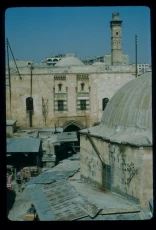
Khan al-Jumruk, general view showing the mosque's dome and the internal facade of the Khan's entrance

Aleppo, Ajiqbash House, courtyard and iwan damages in 2018
The former courtyard house of a merchant family served as Aleppo’s Museum of Folk Traditions. The house is severely damaged, especially the open living space facing the courtyard (Iwan).

The Great Colonnade
[ Description by author: 3. Abschnitt mit dem Tempelgrab als Abschluss. Rechts die Burg des Fakhru d-Dîn al-Ma'ni. Gesehen von ~ Südosten. ]
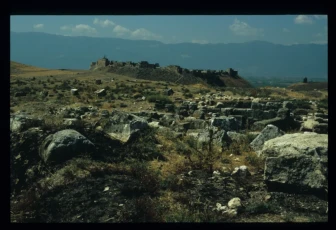
View of al-Mudiq castle overlooking the plain of al-Ghab

Dayr az-Zawr, Hängebrücke über den Euphrat

View of Najm Castle (Qalʿat Najm) from the inside

Jamiʿ al-Khayr, Inneres der Gebetshalle - Minbar
![[Institut Français du Proche Orient]](https://syrian-heritage.org/wp-content/plugins/justified-image-grid/timthumb.php?src=https%3A%2F%2Fsyrian-heritage.org%2Fwp-content%2Fuploads%2F2020%2F04%2Fshap_import_74685-1024x699.png&h=230&q=90&f=.png)
[Institut Français du Proche Orient]

Qanawat, Ruine des Zeus-Tempels (Saraya)

Making falafel sandwiches

Inscription on the wall, Jamiʿ as-Sinaniyya

Hammam Bahram Basha, äußerer Bereich (barrani)

Jamrin, Brücke über das Wadi az-Zaydi

Qalʿat ash-Shugr wa-Bakas, the connection bridge between the two castles
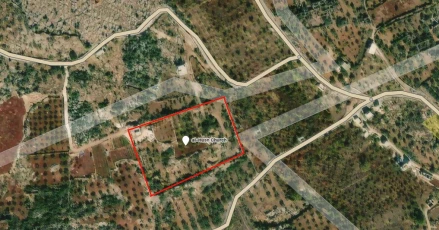
صورة أقمار صناعية تظهر موقع كنيسة الحصن في البارة، 2021

Künstliche Bewässerungsanlage in der Ghab-Ebene

Beduinenfamilie im Euphrat-Tal

Al-Madrasa al-Kamiliyya, Gebetshalle - Muqarnas in der Kuppel

Burj al-Ghanam, partial view of the tower's south eastern facade
shap_import_63420

Bayt Ghazala, ʿajami panels decorating the southern wing ceiling in the main hall (qaʿa)

Jamiʿ Aslan Dada, Halle - oktogonaler Tambour der Kuppel

Tartus, Museum in der ehemaligen Kathedrale, Blick auf die Westfassade

Der Barada in Damaskus, nahe der Viktoria-Brücke
shap_import_51655

Jabla, Sultan-Ibrahim-Moschee, Hofarkaden

Burg (Qalʿat) Salah al-Din, die massive Burgmauer mit Turm auf der senkrechten Felskante

A group of domed houses in the village of Shaykh Hilal
In this scene, the workers coat the domes with mud as part of the restoration and maintenance work. These three domes seem to belong to one house.

Ghab Ebene: strohgedeckte Lehmhäuser, 1963

Eine Frau aus ländlicher Gegend mit traditioneller Kleidung

Waqf Ibshir Mustafa Pasha, Kaffeehaus, Außenfassade
Die Straßenfassade des Kaffeehauses mit ihren vielen verschiedenenen Fenstern und der reichen Bauornamentik ist in Aleppo einzigartig.

Minaret of an-Nuri Mosque
1172 erging der Erlass zum Bau dieser Moschee.- Gesehen von ~ West-Nord-West. ['Original: Hamâ (Epiphania),']

Große Moschee von Aleppo, Innenhof, vertikale Sonnenuhr

Courtyard with dome houses in Shaykh Hilal
This picture shows one of the daily-life activities of hanging laundry in the courtyard of a domed house.

Diokletians-Thermen, Inneres
[ Description by author: mit dem Becken (Stufen !) und seinem Peristyl. Ganz links die Nordwest-Ecke des Peribolos des Bel-Tempels, weiter rechts der Monumentalbogen von innen, im Bogen die arabische Bastion. Ganz rechts das Propylon der Thermen. Gesehen von ~ Nord-Nord-West. ]

Jamiʿ al-ʿAdiliyya, one of the flying buttresses supporting the prayer hall dome

Suq az-Zarb, view towards west of the suq after the destruction

Gasse in einem Dorf in der Ghuta von Damaskus

Yabrud: residential houses with central hall disposition and three-arcade-motif
Street view with Mittelhallenhaus. This building along the street shows a local variation (of the Qalamun Mountains) of the house form known from Lebanon since the middle of the 19th century: shaded entrance hall with an entrance arcade of three arches on round columns on the ground floor, above it on the upper floor the repetition as open seating area with balcony in front. A symmetrical stone façade made of cleanly carved limestone and slender arched windows. These houses will probably be built in the first quarter of the twentieth century.

Bayt Mustafa al-Jabiri (Bayt cad. VII 2056) before belonging to waqf al-Jabiri
Size of plan 55 x 45. with ruler (no scale)

Modern painted panels with ‘Ajami decoration in Ziad Baydoun´s workshop in Malaysia

Jamiʿ Aslan Dada, Innenansicht der Gebetshalle (qibliyya)

Palmyra, Blick auf das Tetrapylon

Summerrestaurant in Bludan

al-Matbakh al-ʿAjami, nordwestliche Ecke der großen Halle

Muzayrib - Ruins of an historical bridge
Pilgerstraße, Brücke

Obstgärten an den Hängen des Anti-Libanon

Feldweg entlang einer Wasserleitung in der Ghab-Ebene

Chest of drawers in traditional inlay technique with mother of pearl in an old house in Maʿlula

Jisr ash-Shughur, Qalʿat ash-Shugr wa-Bakas, Kreuzritterburgen, Höhle

Khan Qurdbak, Haupteingangsportal - Steinbank

Jamiʿ Aslan Dada, Inneres der Gebetshalle (qibliyya) mit Kuppel

25 pounds (Commemorative coins: twenty-fifth anniversary of Corrective Movement), 25 mm, 1995

Afamiya, Ruinen der Kolonnadenstraße

Qalʿat Ibn Maʿn, Gesamtsicht von Süden

Busra, Hammam Manjak, Brunnen im Ruhebereich (Barrani)

Maps of Aleppo: functional zoning in the ancient city, 1982
Thematic map of Aleppo ancient city-center: Functional zoning. Scale 1:2000, ruler and legend: - Retail I (higher level, western style), - Retail II (more simple/ traditional), - Retail III (basic level), - Retail IV (for rural customers), - Quarter suq I (rich assortment), - Quarter suq II (simple & handycrafts), - Wholesale I (offices & delivery/higher standard), - Wholesale II (warehouse/ lower standard), - Wholesale III (warehouse for purchase/ agricultural materials), - Warehouse (basic for retail, wholesale and crafts), - Basic usage I (storage, garbage, cattle), - Basic usage II (housing in non-housing buildings), - Crafts I (modern western), - Crafts II (traditional+technolgy), - Crafts III (traditional, basic), - Religious building, - Hammam, Schooll, - Traditional Coffeehouse, - Public authority-health-military use. [Original in German: Aleppo: Funktionale Gliederung | Karte 3] Inventory no. stamp: Museum für Islamische Kunst Isl 85/31 2 Berlin-Dahlem. Part of TAVO Reihe B Nr. 58

Salah ad-Din Castle, massive castle walls above the vertical rock face

Raqqa, Northeast Complex, coin found during the excavation
Tahir; Coin; approx. 199 h.; Ra-83-NO-06

Hammam Bahram Basha, the entrance façade

Raqqa - "East of Raqqa" site - Tall Aswad – sherds
Raqqa IV; Tall Aswad; Pottery garden probl. near excavation house in Tall Bi'a

Mosaics covering the tympanum of az-Zahir Baybars Mausoleum
[Original: Zahiriya, Mausoleum des az-Zahir Baibars, 1277, Glasmosaiken im Tympanon]

al-Burayj, General view of the Monastery of Saint Daniel, 6th c. AD
[Description/Comment by the author:] Gesehen von ~ Südosten. Links Reste eines Turmes, der von manchen für der einer Kirche (die Steine links davon) gehalten wird. Das Gebäude rechts daneben enthält u.a. eine Kapelle, zum Türsturz vgl.Bild 2685 ! Dahinter die Pfeiler der dreistöckigen Galerie der Pilgerherberge. Das rechte Gebäude besteht aus zwei Teilen: links ein Turm, vermutlich der eines Einsiedlers, um den sich das Kloster entwickelte (der "Erker" wäre dann die Toilette), rechts ein angefügtes Gebäude, in dem sich Arcosol-Gräber befinden. Die Anlage stammt aus dem späten 6. Jh.. Vgl. Bild 2706 !

Al-Matbakh al-ʿAjami: Qaʿa, section east-west, view to north
Qaʿa of Matbakh al-ʿAjami, size of plan 55 x 45, ruler.

Al-Madrasa ar-Rukniyya al-Barraniyya - view from the south

The top floor of a house in Old Damascus

Burj as-Saʿa, Qastal - Ausgussöffnung

Bab al-Maqam, gate's arch

Khan al-Wazir, the mosque

Ad-Dumayr, view of the temple from the inside
[ Description by author: Blick von der Höhe der inneren ~ Ostwand nach ~ Westen. Unten die beiden "Kammern" und die Hofseite des Durchgangs, oben interessant die Verbindung des Giebels mit den beiden Ecktürmen. Vgl. Bild 0391 ! ]

Jamiʿ al-ʿAdiliyya, prayer hall - minbar's entrance

At-Takiyya as-Sulaymaniyya, domed arcade and behind it larger domes covering a range of rooms

ʿAyn al-ʿArus, ausgegrabene Säulenkapitelle als Gartendekoration
Spolia in courtyard

Exterior view of Krak des chevaliers (Qalʿat al-Husn)

Aleppo in the 1930s, aerial view in northwest direction with the citadel and the old town in the background
On the left side of this picture you can see the areas of the bazaar with the big mosque. On the gate of the citadel you can still see the remains of the domes of the throne hall. On the back of the photos: [1988/144]. On the back of the photos: ['1988/203']. [Objekt: Reproduktion SW-Fotos, 24.Juni 1988, Peter Grunwald, Film 1 (2), Ende Film 2]

at-Takiyya ar-Rifaʿiyya (az-Zawiyaal-Ikhlasiyya ), inscription above the main entrance
Inscription_Separaiting Sheet. 82/II

Masbanat az-Zanabili, view of the courtyard and the northern courtyard facade

Zayzun-Nebenfluss, der in den Yarmuk mündet: Frauen waschen Wolle für Matratzen

Aerial photograph of the Bel Temple and old village houses in front of the temple

General view of the castle and the village, Qalʿat Najm

Al-Madrasa az-Zahiriyya, angle niches below the dome in the mausoleum
shap_import_66076

Watermill on ʿAyn al-ʿArus lake

Luftbild des Jabal Haramun (Hermon-Gebirge)

Aleppo, Khan as-Sabun, Blick auf die östliche Arkade im ersten Stock.

Türsturz des Haupteingangs der Kirche, Qasr Ibn Wardan
[Original: Kirche (Kuppelbasilika mit Emporen), Tympanon der südlichen Tür]

Al-Matbakh al-ʿAjami, modern and re-used portal (spolia)
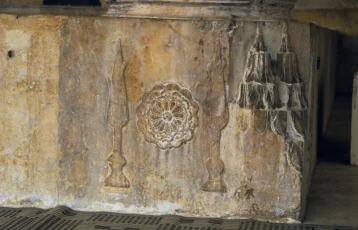
Jamiʿ al-ʿAdiliyya, decoration details in the double arcade

Habuba Kabira, construction of cantilever domes

Bayt Wakil, courtyard and fountain

Burg und Dorf Qalʿat Najm

In the tent of a Bedouin family with the living area in the foreground and behind the partition the storage area of all goods

Bayt Junblat, the northern iwan decorated with marble and ceramic tiles
[Original:'Qasr Jumblât, Halab / Aleppo. Inneres des Nord-Iwâns.].

General view to the lower parts of Jabal Haramun (Mount Hermon)

Dorfbewohner beim Bau eines traditionellen Wohngebäudes im Gouvernement ar-Raqqa

Teil der Brücke bei ʿAyn Diwar

Al-Madrasa al-Hallawiyya, the main entrance

A side from the courtyard of Bayt Jubran Afandi Shamiyya, Bab Tuma
Hof gegen Tarma

Hof eines Kuppelhauses im Dorf Shaykh Hilal
In einem der Dorfhäuser konnten früher Touristen übernachten. In der Mitte des Innenhofes befindet sich ein Brunnen, der ebenfalls aus Lehmziegeln gebaut wurde. Die beiden Kuppeln auf dem Bild sind mit einer Kalkputz überzogen, die sie verschönert und schützt.
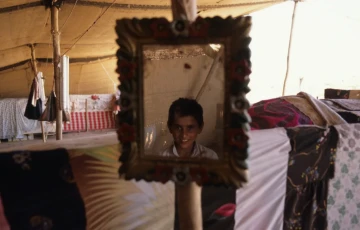
In the sleeping compartment of the tent of a semi-nomadic family from Maskana-region

Al-Matbakh al-ʿAjami, modern and re-used portal (spolia)

Damaskus, Werkstattladen für "Tauschierung" (Kupfereinlegearbeiten) in der Geraden Straße

Qasr al-Hayr al-Sharqi, Upper part of the gate tower,

Bimaristan Arghun, westward view of main doorway

Temporary title for Image 68390